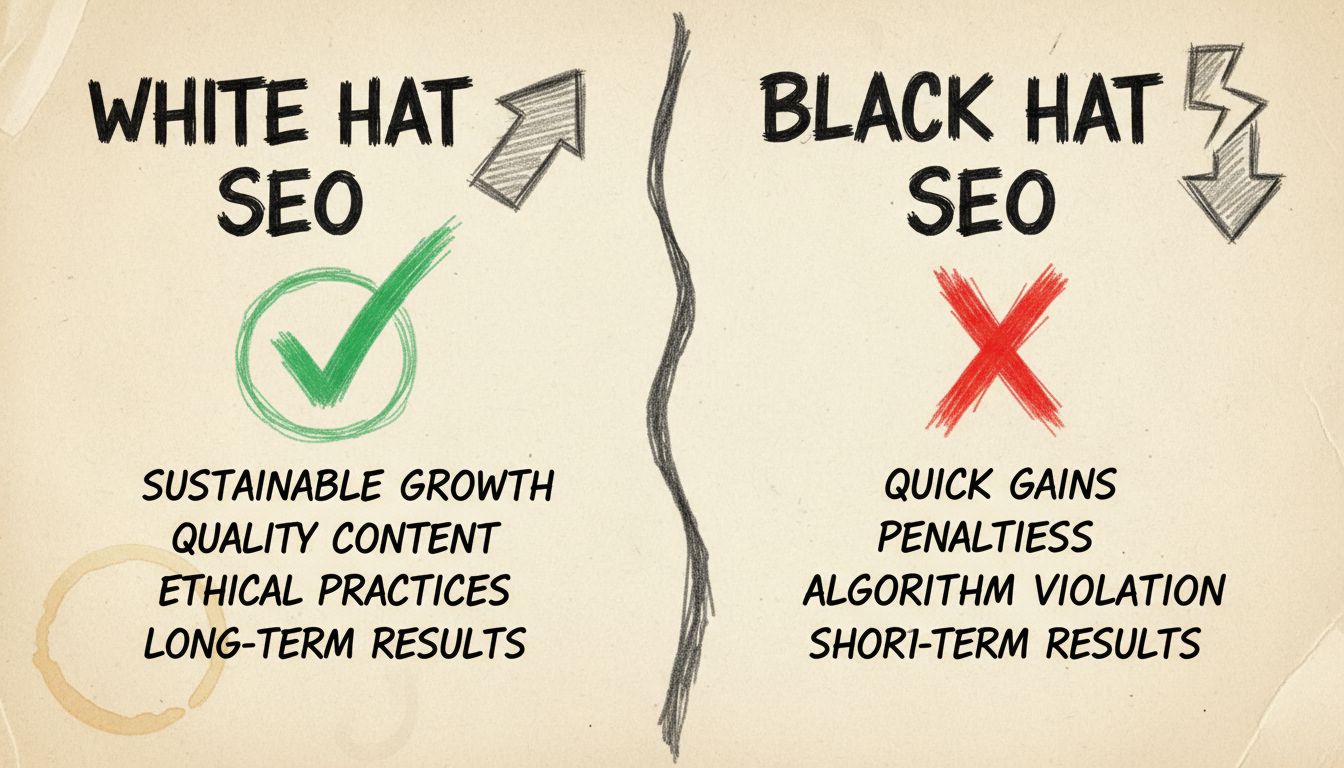
What Is White Hat SEO?
Origin of the Term
White hat SEO uses practices consistent with search-engine guidance to make useful content accessible, understandable and relevant. For an affiliate site, it includes original comparisons, clear navigation and accurate product information rather than hidden text, link schemes or mass-produced pages intended primarily to manipulate rankings.
Google Search Essentials as the Governing Framework
- Helpful, people-first content — pages should exist to serve users, not to rank.
- E-E-A-T signals — Experience, Expertise, Authoritativeness, and Trustworthiness.
- Technical accessibility — pages must be crawlable, indexable, and renderable.
- No deceptive practices — cloaking, sneaky redirects, and hidden text are explicitly forbidden.
White hat SEO aligns with all four. Black hat violates them.
Launch your affiliate program today
Set up advanced tracking in minutes. No credit card required.
White Hat vs. Black Hat vs. Grey Hat SEO
What Is Black Hat SEO?
Black hat SEO uses tactics designed to manipulate search rankings, regardless of whether users benefit. Common black hat techniques include:
- Keyword stuffing — cramming target terms into content, meta tags, or alt text at unnatural densities.
- Cloaking — serving different content to search engine crawlers than to human visitors.
- Link farms and PBNs — building networks of low-quality sites solely to generate backlinks.
- Doorway pages — thin pages created only to funnel traffic toward a different destination.
- AI-generated spam — mass-producing unedited, low-value content through generative AI tools.
What Is Grey Hat SEO?
Grey hat SEO occupies the ambiguous middle. It describes techniques not explicitly banned by search engine guidelines but that push against their spirit. Examples include:
- Buying expired domains with existing backlink profiles and redirecting them.
- Exchanging links at scale without clear disclosure (beyond natural editorial linking).
- Using AI to rewrite competitor content with minimal human editing — technically “original” but substantively thin.
Grey hat tactics are risky because the line moves. A practice that Google tolerates today may trigger a penalty after the next core update. What feels “grey” in January can become unambiguously black by December.
Comparison Table
| Aspect | White Hat SEO | Grey Hat SEO | Black Hat SEO |
|---|
| Intent | Serve users; follow rules | Gain an edge without explicit rule-breaking | Manipulate algorithms; ignore user value |
| Content approach | Original, researched, people-first | Repurposed or lightly edited; borderline original | Spun, scraped, AI-spammed, or duplicated |
| Link building | Earned through quality and outreach | Reciprocal at scale; expired-domain redirects | Purchased links, PBNs, link farms |
| Risk of penalty | Near zero | Moderate; rises after algorithm updates | High; manual actions and SpamBrain triggers likely |
| Timeline to results | 3–12 months | 1–6 months | Days to weeks |
| Outcome durability | Compounding, long-term growth | Unstable; requires constant adjustment | Collapses after penalties; often unrecoverable |
Core White Hat SEO Techniques
Keyword Research and Intent Matching
Effective white hat SEO starts with understanding what users actually want. Keyword research tools — Google Keyword Planner, Ahrefs, Semrush, Mangools — reveal search volume, competition, and related queries. But the white hat approach goes beyond volume: it classifies each term by search intent.
Mapping content to intent ensures pages satisfy the reason behind the query, not just the keywords in it.
On-Page Optimization
On-page white hat SEO covers every element the user and search engine see on the page:
- Title tags — unique, descriptive, 50–65 characters, with the primary keyword near the front.
- Meta descriptions — 120–160 characters summarizing the page’s value; not a direct ranking factor but influences click-through rate.
- Heading hierarchy — one H1, descriptive H2s for major sections, H3s for subtopics. Question-phrased headings (e.g., “How Does White Hat SEO Work?”) perform well for informational queries.
- Alt text — every image gets a concise, accurate description. Not a place for keyword stuffing.
- Internal links — connect related pages with descriptive anchor text to distribute authority and help users navigate.
Ethical Link Building
White hat link building earns backlinks rather than buying or manufacturing them. Proven methods include:
- Creating linkable assets — original research, data studies, comprehensive guides, and free tools that other sites naturally reference.
- Guest posting — writing genuinely useful articles for reputable sites in your niche, with a single relevant link back to your content.
- Digital PR — earning coverage from news outlets and industry publications through newsworthy data or expert commentary.
- Broken link replacement — finding dead links on relevant sites and offering your content as a replacement.
Join our newsletter
Be the first to know about new features and product updates.
White Hat SEO for Affiliate Marketing
Why Affiliate Marketers Need White Hat SEO
For affiliate program managers, the stakes extend beyond one site. If your affiliates use black hat tactics, their sites get penalized — and your program loses distribution channels. Vetting partners for ethical SEO practices is a risk-management function as much as a marketing one.
Practical Workflows for Publishers
Affiliate publishers — bloggers, reviewers, comparison-site operators — should:
- Build topical authority in a defined niche — a site covering “home gym equipment” with 80 in-depth, interconnected articles will outrank a generic review site with 500 thin posts.
- Write honest product reviews based on hands-on testing — first-hand experience is an E-E-A-T signal. Mention specific use cases, limitations, and who the product is not for.
- Avoid thin affiliate pages — a page that copies the manufacturer’s product description, adds an affiliate link, and calls it a “review” is a prime target for Google’s thin-content classifier.
- Diversify traffic sources — email lists, social media, and direct traffic reduce dependence on any single search engine update.
Practical Workflows for Affiliate Program Managers
- Monitor affiliate sites for black hat red flags — sudden ranking drops, spammy link profiles, or templated content across multiple domains.
- Set SEO standards in affiliate terms of service — explicitly prohibit black hat tactics and reserve the right to suspend partners who incur Google penalties.
- Use tracking software to attribute conversions accurately — clean, first-party tracking preserves data integrity even as third-party cookies phase out. This supports the technical SEO health of your entire program ecosystem.
- Educate affiliates with white hat resources — share keyword research, content briefs, and compliance checklists. Partners who rank sustainably generate commissions sustainably.
Obsolete Practices to Avoid
Some tactics once considered acceptable are now firmly black hat or simply ineffective:
- Exact-match domains as a ranking shortcut — Google devalued these years ago. A domain like
best-running-shoes.com no longer gets an automatic boost. - Article spinning — using software to rewrite existing content produces unreadable, low-value pages that SpamBrain detects.
- Comment spam for backlinks — nofollow attributes make these links worthless for ranking, and they signal spam behavior.
- Keyword density targets — there is no magic percentage. Write naturally; use keywords where they fit; stop counting.
Origin of the Term
The “white hat” label traces back to early 20th-century Western films, where costume designers dressed heroes in white hats and villains in black hats so audiences could instantly tell them apart. The security industry adopted the distinction decades later — white hat hackers find vulnerabilities ethically; black hat hackers exploit them. SEO borrowed the same framing, and it stuck.
Core Definition
White hat SEO means optimizing a website for search engines without deception. Every tactic — on-page, off-page, and technical — must follow the rules published by the search engine itself. The document covers three areas: technical requirements (what a page must do to be indexed), spam policies (what will get a site penalized), and key best practices (what helps a page perform well).
Google Search Essentials as the Governing Framework
Its guidelines are the de facto rulebook for ethical SEO. The Search Essentials emphasize:
- Helpful, people-first content — pages should exist to serve users, not to rank.
- E-E-A-T signals — Experience, Expertise, Authoritativeness, and Trustworthiness.
- Technical accessibility — pages must be crawlable, indexable, and renderable.
- No deceptive practices — cloaking, sneaky redirects, and hidden text are explicitly forbidden.
White hat SEO aligns with all four. Black hat violates them.
What Is Black Hat SEO?
Black hat SEO uses tactics designed to manipulate search rankings, regardless of whether users benefit. Common black hat techniques include:
- Keyword stuffing — cramming target terms into content, meta tags, or alt text at unnatural densities.
- Cloaking — serving different content to search engine crawlers than to human visitors.
- Link farms and PBNs — building networks of low-quality sites solely to generate backlinks.
- Doorway pages — thin pages created only to funnel traffic toward a different destination.
- AI-generated spam — mass-producing unedited, low-value content through generative AI tools.
These tactics can produce fast ranking gains. Manual actions — human-reviewed penalties — can remove a site from search results entirely. Recovery often takes months; in severe cases, it never happens.
What Is Grey Hat SEO?
Grey hat SEO occupies the ambiguous middle. It describes techniques not explicitly banned by search engine guidelines but that push against their spirit. Examples include:
- Buying expired domains with existing backlink profiles and redirecting them.
- Exchanging links at scale without clear disclosure (beyond natural editorial linking).
- Using AI to rewrite competitor content with minimal human editing — technically “original” but substantively thin.
Grey hat tactics are risky because the line moves. A practice that Google tolerates today may trigger a penalty after the next core update. What feels “grey” in January can become unambiguously black by December.
Comparison Table
| Aspect | White Hat SEO | Grey Hat SEO | Black Hat SEO |
|---|
| Intent | Serve users; follow rules | Gain an edge without explicit rule-breaking | Manipulate algorithms; ignore user value |
| Content approach | Original, researched, people-first | Repurposed or lightly edited; borderline original | Spun, scraped, AI-spammed, or duplicated |
| Link building | Earned through quality and outreach | Reciprocal at scale; expired-domain redirects | Purchased links, PBNs, link farms |
| Risk of penalty | Near zero | Moderate; rises after algorithm updates | High; manual actions and SpamBrain triggers likely |
| Timeline to results | 3–12 months | 1–6 months | Days to weeks |
| Outcome durability | Compounding, long-term growth | Unstable; requires constant adjustment | Collapses after penalties; often unrecoverable |
Why White Hat SEO Matters
AI and the Evolution of Search
Google’s integration of generative AI into search — through AI Overviews (formerly SGE), multisearch, and zero-click answers — has reshaped what ranking means. When Google answers a query directly in the results page, the traditional blue link gets fewer clicks. White hat SEO adapts by structuring content so it is the source Google cites in those AI-generated answers.
The pages that do earn traffic overwhelmingly follow white hat principles: they target real search intent, demonstrate expertise, and avoid manipulative shortcuts that SpamBrain flags.
Long-Term Sustainability vs. Short-Term Risk
White hat SEO behaves like compound interest. A page optimized ethically in January may rank modestly at first. By June, it has accumulated backlinks, user-engagement signals, and topical authority. By the following year, it anchors an entire content cluster.
Black hat SEO is the opposite: a spike, then a wipeout.
Is SEO Dead with AI?
No — but it has fundamentally changed. AI does not replace the need to rank; it changes what ranking rewards. White hat SEO is the only approach that aligns with this shift. AI overviews pull from sources that demonstrate E-E-A-T; black hat sites are systematically excluded from those citations.
Keyword Research and Intent Matching
Effective white hat SEO starts with understanding what users actually want. Keyword research tools — Google Keyword Planner, Ahrefs, Semrush, Mangools — reveal search volume, competition, and related queries. But the white hat approach goes beyond volume: it classifies each term by search intent.
- Informational intent — the user wants to learn something (“what is white hat SEO”).
Mapping content to intent ensures pages satisfy the reason behind the query, not just the keywords in it.
People-First Content Creation
Google’s guidance is explicit: create content for people, not search engines. In practice, this means:
- Answer the query completely — cover the topic in enough depth that a reader does not need to bounce back to search results.
- Demonstrate first-hand experience — cite data you collected, tests you ran, or workflows you use. Competitor pages that report first-hand use rank more often.
- Keep content current — date facts with the current year.
- Structure for readability — use descriptive headings, short paragraphs, and bulleted lists where they add clarity.
On-Page Optimization
On-page white hat SEO covers every element the user and search engine see on the page:
- Title tags — unique, descriptive, 50–65 characters, with the primary keyword near the front.
- Meta descriptions — 120–160 characters summarizing the page’s value; not a direct ranking factor but influences click-through rate.
- Heading hierarchy — one H1, descriptive H2s for major sections, H3s for subtopics. Question-phrased headings (e.g., “How Does White Hat SEO Work?”) perform well for informational queries.
- Alt text — every image gets a concise, accurate description. Not a place for keyword stuffing.
- Internal links — connect related pages with descriptive anchor text to distribute authority and help users navigate.
Technical SEO
A site that search engines cannot crawl or render will not rank, regardless of content quality. Core technical white hat practices include:
- Site speed — pages should load in under 2.5 seconds on mobile. Compress images, minimize render-blocking JavaScript, and use a CDN.
- Mobile-friendliness — responsive design is non-negotiable.
- HTTPS — secure connections are a confirmed ranking signal and a user-trust baseline.
- Clean URL structure — descriptive, hyphenated slugs (e.g.,
/what-is-white-hat-seo) rather than parameter-laden strings. - XML sitemaps and robots.txt — help crawlers discover and prioritize content without accidentally blocking important pages.
Ethical Link Building
White hat link building earns backlinks rather than buying or manufacturing them. Proven methods include:
- Creating linkable assets — original research, data studies, comprehensive guides, and free tools that other sites naturally reference.
- Guest posting — writing genuinely useful articles for reputable sites in your niche, with a single relevant link back to your content.
- Digital PR — earning coverage from news outlets and industry publications through newsworthy data or expert commentary.
- Broken link replacement — finding dead links on relevant sites and offering your content as a replacement.
Why Affiliate Marketers Need White Hat SEO
Affiliate revenue depends on organic traffic. White hat SEO protects that income by building rankings that survive algorithm changes.
For affiliate program managers, the stakes extend beyond one site. If your affiliates use black hat tactics, their sites get penalized — and your program loses distribution channels. Vetting partners for ethical SEO practices is a risk-management function as much as a marketing one.
Practical Workflows for Advertisers
Advertisers running affiliate programs should:
- Audit landing pages for thin content — every page in your funnel should satisfy a specific search intent with original, substantive content.
- This is a white hat baseline.
- Recruit affiliates with established, penalty-free sites — check a prospective affiliate’s organic traffic trend in tools like Ahrefs or Semrush. A sharp drop often signals a recent penalty.
- Provide affiliates with original product data and assets — unique images, spec sheets, and usage data help affiliates create content that search engines recognize as original and valuable.
Practical Workflows for Publishers
Affiliate publishers — bloggers, reviewers, comparison-site operators — should:
- Build topical authority in a defined niche — a site covering “home gym equipment” with 80 in-depth, interconnected articles will outrank a generic review site with 500 thin posts.
- Write honest product reviews based on hands-on testing — first-hand experience is an E-E-A-T signal. Mention specific use cases, limitations, and who the product is not for.
- Avoid thin affiliate pages — a page that copies the manufacturer’s product description, adds an affiliate link, and calls it a “review” is a prime target for Google’s thin-content classifier.
- Diversify traffic sources — email lists, social media, and direct traffic reduce dependence on any single search engine update.
Practical Workflows for Affiliate Program Managers
- Monitor affiliate sites for black hat red flags — sudden ranking drops, spammy link profiles, or templated content across multiple domains.
- Set SEO standards in affiliate terms of service — explicitly prohibit black hat tactics and reserve the right to suspend partners who incur Google penalties.
- Use tracking software to attribute conversions accurately — clean, first-party tracking preserves data integrity even as third-party cookies phase out. This supports the technical SEO health of your entire program ecosystem.
- Educate affiliates with white hat resources — share keyword research, content briefs, and compliance checklists. Partners who rank sustainably generate commissions sustainably.
How to Implement White Hat SEO
Step-by-Step Checklist
- Audit your current site — run a crawl with a tool like Screaming Frog or Sitebulb to identify technical issues, thin pages, and broken links.
- Research keywords by intent — map every target term to informational, commercial, transactional, or navigational intent.
- Create or improve content — for each keyword cluster, publish a comprehensive pillar page supported by cluster content.
- Optimize on-page elements — unique title tags, meta descriptions, heading structure, alt text, and internal links for every page.
- Fix technical issues — improve page speed, ensure mobile responsiveness, implement HTTPS, and submit an updated XML sitemap.
- Build links ethically — create linkable assets, pursue guest posts on reputable sites, and monitor your backlink profile for toxic links.
- Track and iterate — monitor rankings, organic traffic, and conversions in Google Search Console and your analytics platform. White hat SEO is a continuous process, not a one-time fix.
Obsolete Practices to Avoid
Some tactics once considered acceptable are now firmly black hat or simply ineffective:
- Exact-match domains as a ranking shortcut — Google devalued these years ago. A domain like
best-running-shoes.com no longer gets an automatic boost. - Article spinning — using software to rewrite existing content produces unreadable, low-value pages that SpamBrain detects.
- Comment spam for backlinks — nofollow attributes make these links worthless for ranking, and they signal spam behavior.
- Keyword density targets — there is no magic percentage. Write naturally; use keywords where they fit; stop counting.