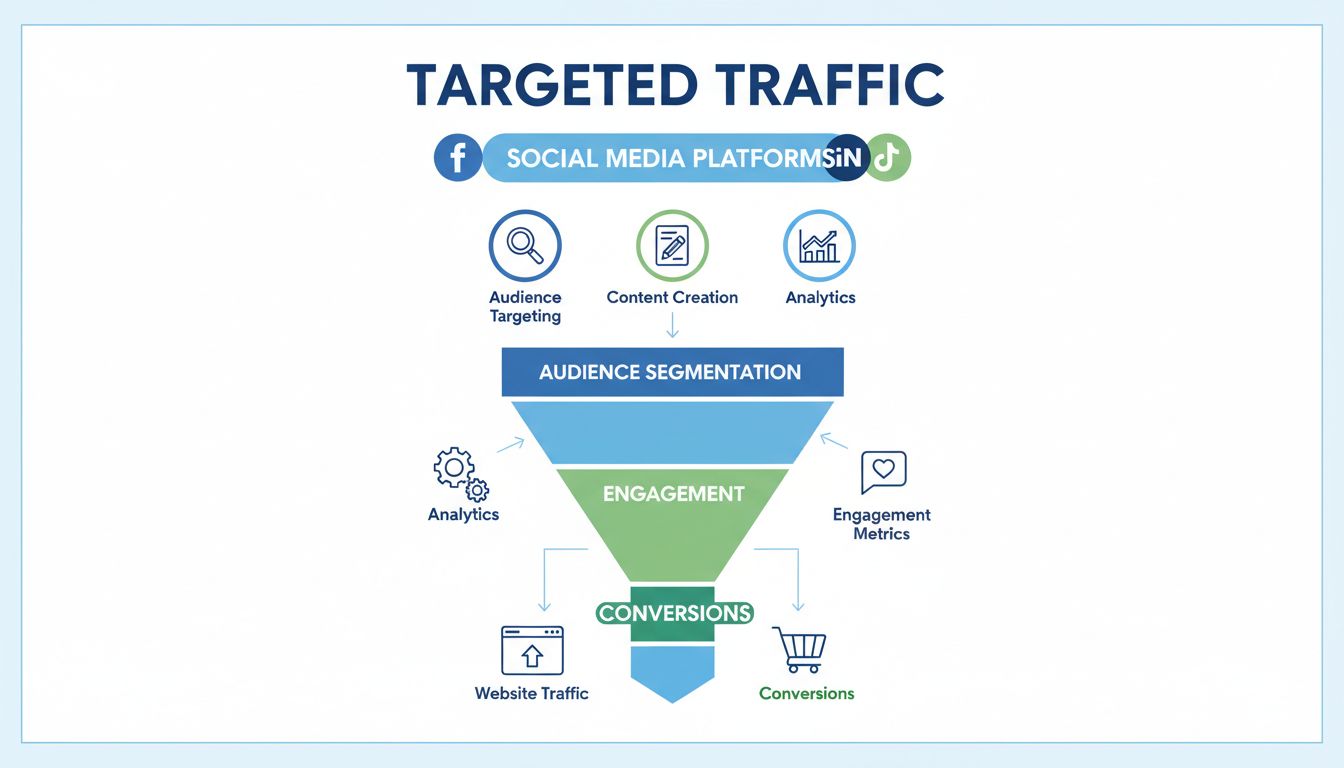
Targeted traffic is website visitors who arrive with a pre-existing interest, specific search intent, or demographic profile that matches what your business offers — making them significantly more likely to convert than random visitors. In affiliate marketing terms, a targeted visitor is already qualified before the click: they searched for what you sell, fit the audience profile of past buyers, or encountered your link in a context that signals genuine interest.
What Is Targeted Traffic?
Targeted traffic refers to the share of visitors who match the offer they land on. The match comes from one of three signals:
- Search intent — the visitor typed a query that directly relates to your product, service, or content.
- Audience signal — the visitor belongs to a demographic, interest, or behavioral segment that overlaps with your buyer profile.
- Contextual placement — the visitor encountered your link in an environment where the surrounding content primes them for your offer (a niche newsletter, an industry forum, a relevant blog).
A visitor who landed on your homepage because a cheap display ad auto-redirected them from a unrelated site is not. The intent travels with the visitor onto the page — and it shows up in every metric that matters.
How Targeting Works in Practice
Targeting layers can be combined. A Facebook ad campaign might target women aged 25–44 in California who have expressed interest in “online business” and visited your pricing page in the last 30 days. A Google Ads campaign might target the exact phrase “affiliate program software” with a bid adjustment for users searching from the United States during business hours. Each layer narrows the pool and raises the average intent level of the visitor who clicks through.
Launch your affiliate program today
Set up advanced tracking in minutes. No credit card required.
Targeted vs. Untargeted Traffic
The two look identical in a raw session count. They behave nothing alike at the revenue line. Here is how they compare across the dimensions that determine whether a visit becomes a conversion:
| Dimension | Targeted Traffic | Untargeted Traffic |
|---|
| Source | Paid search, audience-targeted social, niche referrals, email | Generic display, bot networks, traffic exchanges, broad social |
| Intent signal | Search query, audience match, contextual relevance | None or weak |
| Average engagement time | 60 to 240 seconds | 0 to 15 seconds |
| Pages per visit | 2 to 5 | 1.0 to 1.2 |
| SEO impact | Positive engagement signals | Negative or neutral; possible spam flags |
The cost-per-visit column tells the real story. Untargeted traffic looks cheaper on a CPM or CPC basis, but measured on a cost-per-conversion basis it is almost always more expensive — sometimes infinitely so, when the conversion count stays at zero.
Why Targeted Traffic Matters
For Conversion Rates and Revenue
Targeted visitors convert at 3× to 10× the rate of generic visitors. The same dollar spent on intent-matched channels produces roughly ten times the buyers.
Google’s ranking systems measure how users interact with your listing in search results. Click-through rate, dwell time, and pogo-sticking (returning to search results quickly after clicking) all feed into systems like NavBoost that adjust rankings. Targeted traffic from real search queries generates positive engagement signals. Bot traffic or accidental visits generate none — or worse, patterns that look like spam.
Join our newsletter
Be the first to know about new features and product updates.
Targeted Traffic for Affiliate Marketers
For Affiliate Program Managers
When you evaluate a publisher’s application to join your affiliate program, their traffic source is one of the strongest predictors of their future performance. A publisher who drives targeted search traffic from a niche blog will almost always outperform one who promises “massive traffic” from an undisclosed source. We recommend asking publishers to share their top three traffic sources and the average conversion rate per source before approving them.
Every dollar spent on untargeted inventory is a dollar you cannot spend on audiences that convert. Tightening targeting parameters — adding geographic, device, time-of-day, and audience exclusions — often reduces total spend while increasing total conversions.
For Publishers and Content Creators
Publishers who build audiences around specific topics attract higher-paying affiliate offers and direct ad deals. An email list of 5,000 subscribers who opted in from a blog about email marketing software is worth far more to an ESP affiliate program than 50,000 subscribers from a general “make money online” list. Targeted traffic compounds: engaged visitors share content, link to it, and return — building the kind of referral traffic that converts without ongoing ad spend.
How to Buy Targeted Traffic
Types of Website Traffic You Can Buy
Not all paid traffic is created equal. Here are the main categories, ranked from most to least likely to deliver genuine targeting:
- Paid search ads (Google Ads, Microsoft Advertising). You bid on keywords. Visitors arrive through search results. This is the gold standard for intent-based paid traffic.
- Paid social ads (Facebook, Instagram, LinkedIn, TikTok). You target by demographic, interest, and behavior. Intent is weaker than search but targeting granularity is high.
- Niche display and native ads (Taboola, Outbrain, industry-site placements). Contextual targeting places your ad alongside relevant content. Quality varies sharply by network.
- Search-based click services (SerpClix and similar). Real humans search your keyword and click your listing. Generates engagement signals. Not a direct sales channel — used primarily for SEO signal generation.
- Targeted visitor networks. Services that sell “targeted traffic” packages with geographic, device, or interest filters. Quality ranges from legitimate (real visitors from ad arbitrage) to fraudulent (bots with spoofed referrers). Vet carefully.
- Traffic exchanges and “bulk traffic” sellers. You pay for visits and receive sessions of unknown origin. Almost never genuinely targeted. High bounce rates, zero conversions. Avoid for any campaign where ROI matters.
Pricing Ranges
| Channel | Typical CPC Range | Typical CPM Range | Notes |
|---|
| Google Ads (Search) | — | — | Varies sharply by vertical |
| Facebook Ads | — | — | Lower CPC, weaker intent |
| LinkedIn Ads | — | — | Premium B2B audience |
| Native ads (Taboola/Outbrain) | — | — | Content-driven, variable quality |
| Targeted visitor networks | — | — | Price often reflects quality |
| Bulk/traffic exchanges | — | — | Almost never worth buying |
Payment Options
Most paid traffic platforms offer several payment models:
- Cost per click (CPC): You pay when someone clicks your ad. Best for direct-response campaigns where you can calculate a target CPA.
- Cost per thousand impressions (CPM): You pay per 1,000 ad views. Best for brand awareness or when you have strong creative and a clear retargeting funnel.
- Cost per action / cost per lead (CPA/CPL): You pay only when a specified action occurs. Available on some networks; harder to scale because the platform bears the conversion risk.
- Flat-rate sponsorships: You pay a fixed fee for a newsletter sponsorship, podcast ad, or site takeover. Pricing is negotiated directly.
For affiliate marketers buying traffic to promote offers, CPC is usually the right starting point — it ties cost directly to the traffic you receive and makes ROI calculation straightforward.
Is Buying Targeted Traffic Safe?
The short answer: buying traffic is safe when you buy from platforms where the traffic mechanism is transparent and the visitors are real. It is unsafe — for your budget, your analytics, and potentially your standing with ad networks — when you buy from services that obfuscate their sources.
Legitimate Paid Traffic
- Google Ads, Microsoft Advertising, Meta Ads, LinkedIn Ads — these platforms have fraud detection, real audiences, and transparent reporting. Your analytics will show verifiable sessions from real browsers.
- Reputable niche networks (Carbon Ads, BuySellAds, niche newsletter sponsorships) — smaller scale but high relevance.
- Search-based click services that use real human panels — transparent about what they do (generate engagement signals) and what they do not do (guarantee sales).
Red Flags When Buying Traffic
- The seller cannot or will not name the traffic source. “We have our own network” without specifics usually means arbitraged or bot traffic.
- No geographic, device, or interest targeting controls. If you cannot filter, the traffic is commodity inventory.
- Payment only via cryptocurrency or non-refundable methods. Legitimate ad platforms offer standard payment methods and dispute resolution.
What “Safe” Does Not Mean
Buying legitimate targeted traffic does not guarantee sales. What happens after the click — whether they convert, bounce, or bookmark — depends on your landing page, offer, pricing, and trust signals. Treat paid traffic as a distribution mechanism, not a substitute for conversion optimization.
How to Measure Targeted Traffic Quality
Core Quality Metrics
| Metric | What It Tells You | Healthy Range (Targeted) | Red Flag |
|---|
| Bounce rate | % of visitors who leave after one page | — | — |
| Average session duration | How long visitors stay | 60–240 seconds | <15 seconds |
| Pages per visit | Depth of engagement | 2–5 | <1.2 |
| Conversion rate | % of visitors who complete a goal | — | — |
| New vs. returning visitors | Audience loyalty | — | — |
| Referral source diversity | Natural link profile | Multiple domains | Single-source domination |
Traffic Source Analysis Workflow
- Segment by source in Google Analytics (Acquisition → All Traffic → Source/Medium).
- Sort by conversion rate, not by session count. A source with 200 visits and a 5% conversion rate is worth more than one with 5,000 visits and a 0.1% rate.
- Check geographic distribution. If you target the US and 80% of sessions come from data centers in a single country you did not target, the traffic is likely fraudulent.
- Review landing page reports by source. High bounce rates on specific landing pages from specific sources often reveal a targeting mismatch.
- Track assisted conversions. Some traffic sources initiate the customer journey without closing the sale. Multi-channel funnel reports show which sources play assist roles.
For Affiliate Program Managers: Evaluating Publisher Traffic
When a publisher applies to your program or starts sending traffic, look at:
- The referral URL — is the traffic coming from a real content site, or a redirect chain?
- Conversion rate relative to program average — publishers sending targeted traffic convert at or above average; those sending generic traffic convert well below.
- Chargeback and refund rates on their orders — high rates often signal low-quality or misleading traffic.
- Geographic match — does the publisher’s traffic geography align with your target markets?
For Affiliate Program Managers
Your job is to recruit publishers who can deliver targeted traffic, not just any traffic. Here is a practical workflow:
- Screen publisher applications for traffic source transparency. Require applicants to list their top three traffic sources and approximate monthly volume per source.
- Set minimum conversion-rate thresholds for publishers to remain active.
- Provide publishers with keyword and audience data. Share the search terms that convert best on your own site, the demographic profile of your highest-value customers, and the content topics that drive the most affiliate sales. Publishers who use this data attract more targeted visitors.
- Monitor for traffic source changes. A publisher who suddenly sends 10× their normal volume from a new, unnamed source warrants investigation — the spike often comes from a bulk traffic purchase.
For Publishers and Content Creators
Targeted traffic is the foundation of sustainable affiliate revenue. The publishers earning consistent five-figure monthly commissions are not the ones chasing trending topics with low-value listicles. They are the ones who:
- Build topic authority. A site that covers one niche deeply — say, email marketing software comparisons — attracts visitors who are close to a purchase decision. Each article targets a specific search query with commercial intent.
- Use email capture to build a retargeting-free owned audience. A 5,000-subscriber niche email list often outperforms 50,000 monthly organic visitors in affiliate revenue because the subscribers have self-identified as interested.
The strongest publishers combine SEO, email, YouTube, and niche social communities.
For Advertisers Running Affiliate Programs
- Tier your commission rates by traffic quality. Offer higher commissions to publishers who demonstrate above-average conversion rates, low bounce rates, and low refund rates — metrics that correlate with targeted traffic.
- Create publisher-specific landing pages optimized for the traffic source. A page designed for search traffic (keyword-rich, answer-focused) looks different from one designed for email traffic (relationship-driven, offer-focused).
- Share conversion data back to publishers. When publishers see which of their content pieces drive sales, they produce more of that content — a feedback loop that increases targeted traffic to your program.
Common Mistakes and Obsolete Practices
Some traffic-generation tactics were never effective. Others stopped working as platforms tightened their fraud detection and ranking systems.
Obsolete or Ineffective Practices
- Traffic exchanges. You “earn” visits by viewing other members’ sites. The visitors have zero intent, bounce instantly, and generate no conversions. Search engines ignore the traffic. This practice has been worthless for over a decade.
- Bulk “targeted traffic” packages with no targeting controls. If the seller cannot filter by geography, device, or interest, the traffic is commodity inventory — usually a mix of pop-under redirects, domain parking traffic, and bot scripts.
- Automated social media posting without engagement. Blasting links to dozens of Facebook groups or X accounts via automation tools generates referral spam, not targeted visitors. Most platforms now algorithmically suppress this behavior.
- Comment spam and forum link drops. Dropping links in unrelated blog comments or forum threads was never a scalable source of targeted traffic and is now actively penalized by most platforms.
Practices to Distinguish: Retargeting vs. Prospecting
Retargeting — showing ads to people who already visited your site — is not the same as generating new targeted traffic. Retargeting re-engages existing interest; it does not create it. Campaigns that skew too heavily toward retargeting eventually exhaust the pool and see diminishing returns.
What Changed: Bot Traffic Detection
Traffic that would have appeared in your reports as “direct” or “referral” five years ago is now more likely to be filtered before it reaches your dashboard. This is good news — your data is cleaner — but it means that cheap bulk traffic services are less likely than ever to produce sessions that even register in your analytics.