


How Does Mobile Affiliate Marketing Work?
Learn how mobile affiliate marketing works in 2025. Discover commission models, tracking methods, and best practices for driving app installs and revenue throug...
11 min read
Mobile affiliate marketing is a form of performance-based advertising where an affiliate promotes a product, service, or mobile app to smartphone and tablet users and earns a commission when the user completes a specified action — an install, a registration, a subscription, or a purchase.
Mobile affiliate marketing is a form of performance-based advertising where an affiliate promotes a product, service, or mobile app to smartphone and tablet users and earns a commission when the user completes a specified action — an install, a registration, a subscription, or a purchase. Unlike traditional web affiliate marketing, which relies on browser cookies, mobile campaigns depend on device-level attribution: SDKs, deep links, install referrers, and mobile measurement partners that connect a click on one device to a conversion that may happen inside a native app hours or days later.
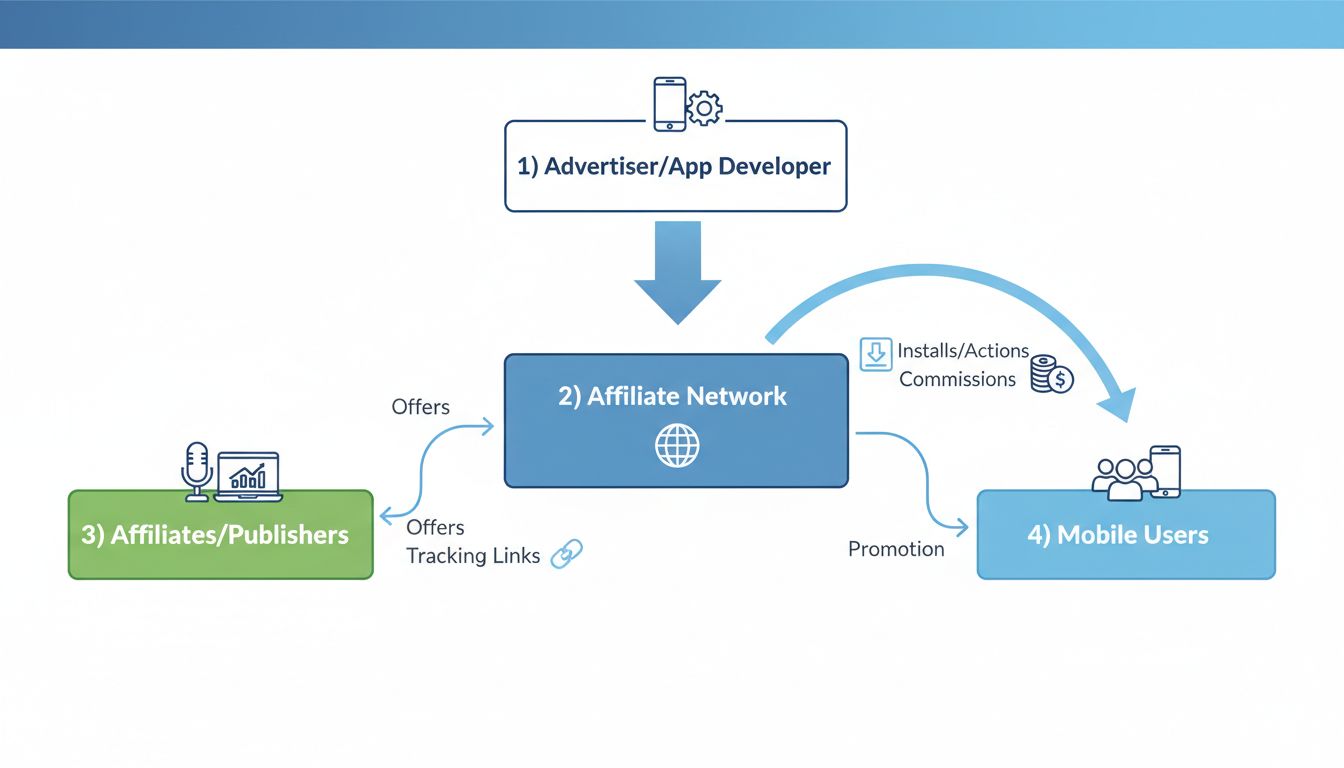
The core transaction is straightforward: an advertiser provides a unique tracking link; the affiliate distributes it through social media, a website, email, paid ads, or an in-app offerwall; a user clicks, installs, or buys; the affiliate gets paid. The mechanics underneath — attribution, fraud detection, payout logic — are what make mobile affiliate marketing a distinct discipline within performance marketing.
On this page
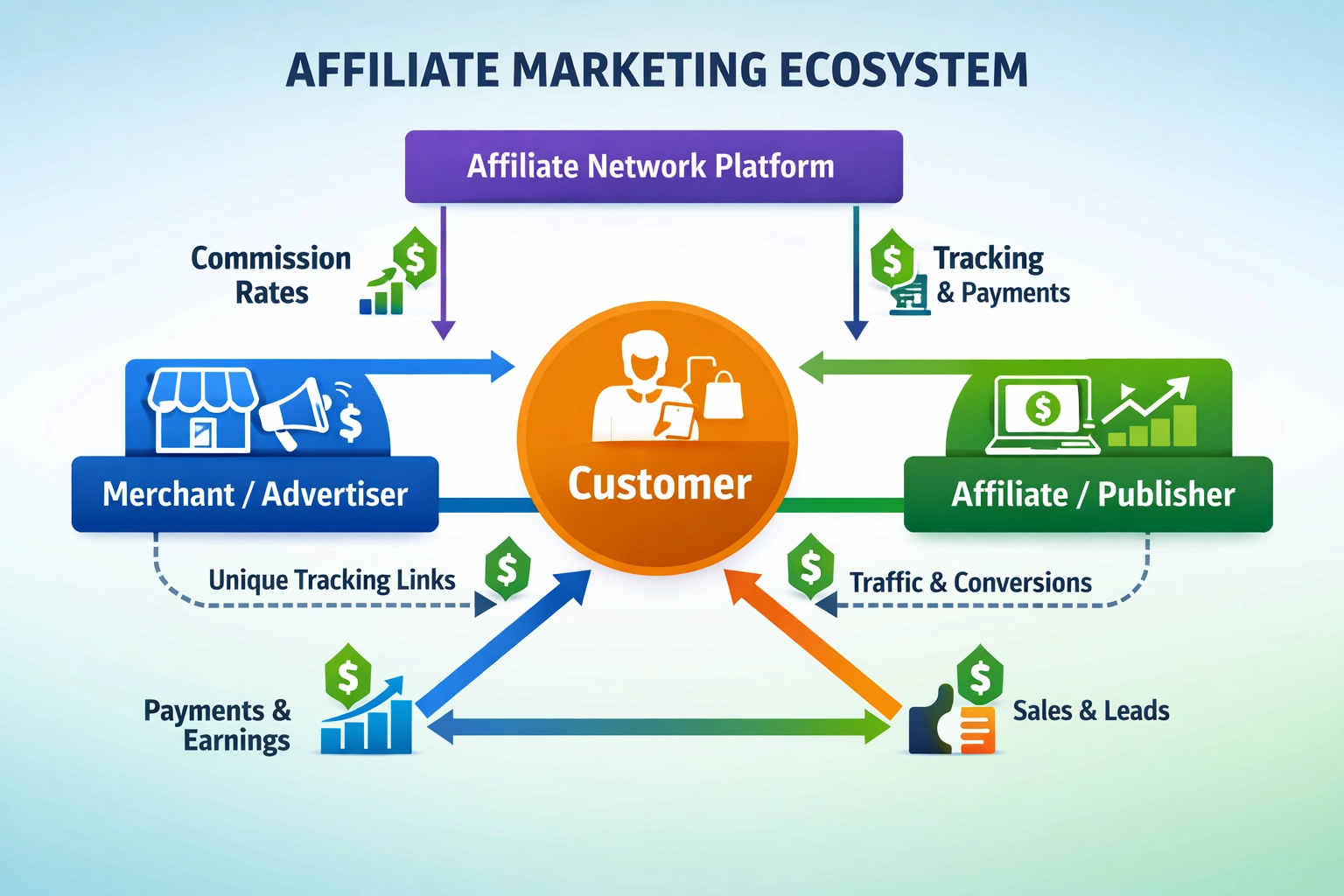
Mobile affiliate marketing involves three primary participants: the advertiser (the brand or app developer who owns the offer), the affiliate (also called a publisher — the person or entity driving traffic), and the affiliate network or tracking platform that connects them and records conversions.
The typical mobile conversion path crosses multiple environments, which is what makes tracking harder than on the web:
Desktop affiliate marketing places a cookie in the user’s browser. That cookie persists, and when the user checks out days later, the affiliate still gets credit. Mobile breaks that model in two ways:
For iOS, Apple’s privacy restrictions add further complexity. SKAdNetwork provides aggregate campaign measurement but no user-level data and no individual affiliate identification. Apps running iOS affiliate programs need their own attribution pipeline alongside SKAdNetwork.

Set up advanced tracking in minutes. No credit card required.
Mobile campaigns use standardized payout models. The right model depends on the advertiser’s goal and the user action that delivers value.
| Model | Full Name | The affiliate gets paid when… | Typical use |
|---|---|---|---|
| CPI | Cost Per Install | A user installs the app | Game launches, utility apps, any app seeking install volume |
| CPA | Cost Per Action | A user completes a defined action (registration, trial start, first deposit) | Fintech, subscription apps, e-commerce |
| CPL | Cost Per Lead | — | Insurance, education, lead-generation offers |
| CPE | Cost Per Engagement | A user reaches a specific in-app milestone (level 5, first transaction) | Mobile games, habit-forming apps |
| Revenue Share | RevShare | The referred user generates revenue, and the affiliate earns a percentage — often for the user’s lifetime | Subscription apps, in-app purchase-heavy games |
CPA campaigns pay more per conversion but require the user to take a higher-intent action.
The differences go beyond tracking technology and affect how affiliates source traffic, what they promote, and how they optimize.
| Dimension | Traditional (Web) Affiliate | Mobile Affiliate |
|---|---|---|
| Tracking method | Browser cookies, UTM parameters | Device fingerprints, SDKs, install referrers, deep links |
| Conversion event | Online purchase, form submission | App install, in-app purchase, registration, subscription |
| Cookie/attribution window | 30–90 days | 24–48 hours typically |
| Primary traffic sources | SEO blogs, review sites, email, coupon sites | Social media (TikTok, Instagram), in-app offerwalls, push notifications, SMS |
| Content format | Long-form reviews, comparison tables, blog posts | Short video, Stories, playable ads, interstitial offers |
| Payout models | Revenue share, CPA (sale) | CPI, CPA, CPE, RevShare |
| Privacy constraints | Third-party cookie deprecation (ongoing) | iOS ATT, SKAdNetwork, limited device fingerprinting |
| Fraud vectors | Cookie stuffing, trademark bidding | Click injection, install hijacking, bot farms, emulator farms |
The practical implication: a blog-based affiliate who earns through SEO and 90-day cookies will find mobile campaigns operate on a shorter clock with different creative requirements. A TikTok creator driving CPI installs needs vertical video, a clear hook in the first two seconds, and an offer that converts on impulse — not a 2,000-word comparison article.
Be the first to know about new features and product updates.
Advertisers run the affiliate program and pay commissions. They are typically mobile-first companies — gaming studios, fintech apps, subscription services, e-commerce marketplaces — that want to acquire users at a predictable cost. Instead of paying for impressions or clicks, they pay only when a defined action occurs, which makes affiliate marketing one of the most capital-efficient user-acquisition channels.
For an app developer, the economics are straightforward: if the average revenue per user (ARPU) exceeds the CPI or CPA payout, the campaign is profitable.
Affiliates are the distribution layer. They range from individual creators with a TikTok following to large media-buying teams running paid ad campaigns across multiple networks. A mobile affiliate’s job is to find audiences that will install or buy, at a cost below the commission.
Successful mobile affiliates typically specialize by traffic source: some run Facebook and TikTok ads against CPI offers; others build organic audiences on YouTube or Instagram; still others operate offerwalls inside their own apps, where users complete advertiser actions to earn virtual currency. Each approach requires different skills, budgets, and risk profiles.
Networks sit between advertisers and affiliates, providing offer aggregation, tracking infrastructure, payment processing, and — critically — fraud prevention. Examples include Mobidea, RichAds, Perkox, and Awin. Some networks specialize in mobile CPI/CPA offers; others span web and mobile.
They generate unique affiliate links, record clicks, match installs to clicks using device fingerprinting or install referrers, and calculate commissions. For program managers, the platform is the system of record: it determines who gets paid and how much.
Step 1: Choose a traffic source you can execute on. Most beginners start with organic social media — TikTok, Instagram Reels, or YouTube Shorts — because it requires no ad budget. Paid traffic (Facebook Ads, Google UAC, programmatic) scales faster but demands capital and media-buying expertise. Pick one channel and master it before expanding.
Step 2: Join a mobile affiliate network. Networks like Mobidea, RichAds, and Perkox maintain offer marketplaces with hundreds of CPI and CPA campaigns. Browse offers by vertical, payout, conversion flow, and geographic targeting. Start with offers that have clear conversion criteria and a payout you can make the unit economics work against.
Step 3: Get your tracking link. Once approved for an offer, the network provides a unique tracking URL. This link is your revenue pipeline — every qualified conversion that flows through it earns you a commission.
Step 4: Create content that drives installs. Mobile audiences scroll fast. Your content needs to grab attention immediately. For CPI offers, short-form video works best: demonstrate the app, show the result, and include a clear call to action. For CPA and revenue-share offers, review-style content that explains the product’s value tends to convert better.
Step 5: Track, test, optimize. Monitor click-through rate, conversion rate, and effective cost per action. If one creative underperforms, swap it. Mobile affiliate marketing rewards rapid iteration.
Step 1: Define your conversion event and payout. What action is worth paying for? An install? A subscription? A first deposit? Set a payout that leaves margin after accounting for your customer lifetime value.
Step 2: Choose a tracking platform. The platform handles link generation, click tracking, attribution matching, commission calculation, and affiliate payments. Affise and TUNE offer mobile-first infrastructure with deep linking and real-time analytics.
Step 3: Set up attribution. Configure deep links (iOS Universal Links, Android App Links) so that users who already have your app installed skip the store and open directly. Implement deferred attribution for new installs: record a device fingerprint on click, match it on first launch. On Android, integrate the Google Play Install Referrer API for deterministic attribution.
Step 4: Recruit affiliates. List your program on affiliate networks and marketplaces. Reach out to creators and publishers whose audience matches your target users. Provide affiliates with creative assets — banners, video clips, copy suggestions — and clear terms: what actions qualify, what the attribution window is, and when they get paid.
Step 5: Monitor and prevent fraud. Mobile affiliate fraud is real and sophisticated. Common tactics include click injection (fraudsters inserting their affiliate click just before an organic install), install farms (emulators generating fake installs), and SDK spoofing. Use a platform with built-in fraud detection, set reasonable attribution windows, and audit affiliate traffic patterns regularly.
Privacy-first attribution is now the norm. Apple’s App Tracking Transparency framework and Google’s Privacy Sandbox for Android have reduced the fidelity of device-level tracking. Affiliates and networks have adapted by combining probabilistic matching with first-party data and SKAdNetwork aggregate reporting. The days of unlimited device fingerprinting are over; compliance is a competitive advantage.
Offerwalls are a major distribution channel. In-app offerwalls — where users in one app complete actions in another app to earn rewards — have become a primary mobile affiliate format, especially in gaming. A player in a casual game completes a CPI offer, installs a mid-core game, and earns virtual currency. The original game’s developer earns a commission. This ecosystem now drives billions of installs annually.
Short-form video dominates affiliate creative. TikTok, Instagram Reels, and YouTube Shorts are the top-of-funnel engines for mobile affiliate campaigns. Successful affiliates produce native-looking content — not polished ads — that demonstrates the app and drives impulse installs. The format rewards authenticity and speed over production value.
AI-assisted optimization is reducing the guesswork. Networks and platforms increasingly use machine learning to predict conversion rates, recommend bid adjustments, and flag fraudulent traffic patterns. Affiliates who leverage these tools can optimize campaigns faster than those relying on manual split-testing.
Mobile affiliate marketing is not a passive income stream. Affiliates who treat it as one — posting a link and waiting — earn nothing. It requires consistent content production, audience building, and performance analysis.
Attribution is imperfect. Affiliates should expect some discrepancy between their own tracking and the network’s reported numbers.
Fraud cuts both ways. Affiliates risk promoting offers from advertisers who shave conversions or delay payments. Advertisers risk paying for fake installs. Working through reputable networks with transparent reporting reduces both risks but does not eliminate them.
The regulatory landscape is tightening. Affiliates and program managers operating across borders need to understand the compliance requirements in each market.
Explore cutting-edge strategies, networks, and tools to boost your success in mobile affiliate marketing. Start earning commissions by leveraging the power of mobile traffic today.
Learn how mobile affiliate marketing works in 2025. Discover commission models, tracking methods, and best practices for driving app installs and revenue throug...
Learn what affiliate marketing is, how it works, commission models, and proven strategies to earn passive income. why 84% of brands use affiliate programs.
A practical look at what actually changes when your entire affiliate business runs from a phone instead of a laptop, and what mobile does and doesn't make easie...
Join our community of happy clients and provide excellent customer support with Post Affiliate Pro.




Cookie Consent
We use cookies to enhance your browsing experience and analyze our traffic. See our privacy policy.