



What is a Niche in Affiliate Marketing?
Learn what a niche is in affiliate marketing, why it matters, and how to choose the right one. Discover profitable niches and strategies for success.
8 min read
Niche marketing is a highly targeted advertising strategy that concentrates resources on a small, well-defined segment of consumers whose specific needs, preferences, or problems are not adequately met by the broader market.
Niche marketing is a highly targeted advertising strategy that concentrates resources on a small, well-defined segment of consumers whose specific needs, preferences, or problems are not adequately met by the broader market. Rather than competing for everyone’s attention, niche marketers identify and serve a focused group — building deeper relevance, stronger loyalty, and higher margins in the process.
A niche is a specialized, clearly defined subset of a larger market. Within the marketing environment — the full set of internal and external forces that shape how a business reaches customers — niche marketing operates at the intersection of a narrow audience and a tailored message.
This approach contrasts with mass marketing, which broadcasts a single message to the widest possible audience. Mass marketing competes on price and volume. Niche marketing competes on expertise, specificity, and the depth of the customer relationship.
These terms are related but not interchangeable:
| Concept | Definition | Example |
|---|---|---|
| Niche market | A small, specific segment of a broader market defined by shared needs or traits. | Owners of senior dogs who need grain-free, organic food. |
| Target audience | The specific group of consumers a business aims to reach with a given campaign. | Women aged 45–65 in urban US zip codes who follow veterinary influencers on Instagram. |
A niche market is what you serve. A target audience is who you reach with a specific message. You can have multiple target audiences within the same niche.
Every niche exists within a marketing environment — the combination of competitive forces, economic conditions, consumer trends, regulatory factors, and technological shifts that affect demand. A niche that is profitable today (for example, keto snack subscriptions) may shrink if consumer preferences shift or if the broader market absorbs the demand. Understanding the marketing environment helps niche businesses anticipate threats and pivot before a segment collapses.

Set up advanced tracking in minutes. No credit card required.
| Factor | Mass Market | Niche Market |
|---|---|---|
| Audience size | Large, general | Small, specific |
| Product design | Standardized, one-size-fits-all | Specialized, tailored to a segment |
| Competition | High, dominated by established brands | Lower, fewer direct competitors |
| Pricing strategy | Price-driven, thin margins | Value-driven, premium pricing possible |
| Marketing message | Broad appeal | Highly specific, speaks to exact pain points |
| Customer loyalty | Transactional, price-sensitive | Relationship-based, higher retention |
| Growth ceiling | High volume potential | Limited by segment size |
Be the first to know about new features and product updates.
List your own skills, industry experience, and interests. A niche you understand firsthand is easier to research, market, and defend. Affiliate publishers who work from genuine knowledge produce more convincing content than those parachuting into an unfamiliar segment.
Use keyword research tools (Ahrefs, Semrush, Google Keyword Planner) to verify that people search for the niche topic. Look for:
Study competitors. Read their customer reviews — especially negative ones. What complaints recur? What features do buyers wish existed? These gaps are your opportunities. Broad-market competitors often overlook small but vocal customer segments because the segment is too small to move their revenue needle.
A niche with zero competition is often a warning sign, not an opportunity — it may mean there is no demand. Healthy niches have some competitors but not so many that the segment is saturated. Evaluate whether you can differentiate on:
Before investing heavily, test the niche. Methods include:
Articulate exactly what makes your offering different.
Build a detailed picture of your ideal customer. Go beyond demographics (age, income, location) to include:
Niche audiences cluster in specific places. A B2B niche for property managers might live on LinkedIn and industry newsletters. A consumer niche for minimalist travelers might congregate on YouTube and niche blogs. Identify where your segment already spends time and meet them there rather than trying to pull them elsewhere.
Generic content does not convert niche audiences. Produce content that demonstrates deep understanding:
Track metrics that matter for niche businesses: customer acquisition cost (CAC), lifetime value (LTV), churn rate, and net promoter score (NPS). Because niche audiences are smaller, losing even a few customers signals a problem worth investigating immediately.
| Broad Market | Niche Example | Why It Works |
|---|---|---|
| Fitness | Online coaching for postpartum core rehabilitation | Addresses a medically specific need general trainers ignore |
| Pet supplies | Biodegradable chew toys rated for giant-breed dogs | Solves a durability problem standard toys cannot handle |
| Skincare | Vegan, fragrance-free skincare for chemotherapy patients | Serves a sensitive medical demographic with precise formulation |
| Software/SaaS | Project management tools built for remote architecture firms | Tailors workflow features to a profession’s exact regulatory needs |
| Food & beverage | Shelf-stable, high-protein meals for long-haul truck drivers | Fills a gap in portable nutrition for a mobile workforce |
| Education | Online courses teaching SQL specifically for healthcare analysts | Narrows a broad skill into an industry-specific, job-ready credential |
For affiliate program managers, niche marketing informs partner recruitment. Instead of onboarding thousands of generic affiliates, programs that recruit publishers within a specific segment — such as tech reviewers for home automation products — see higher conversion rates because the audience is pre-qualified. A niche affiliate with 5,000 engaged subscribers often outperforms a general-interest affiliate with 50,000.
For advertisers and brands, niche thinking shapes campaign structure. Running multiple small campaigns targeting distinct segments (pet owners, new parents, remote workers) with tailored creative yields better ROAS than a single broad campaign. Platforms like Facebook Ads and Google Performance Max enable granular audience segmentation that makes this practical at scale.
For publishers and affiliate marketers, niche selection is the single most consequential early decision. Search engines reward this depth with higher rankings, and audiences reward it with trust — both of which compound over time.
Affiliate management platforms enable niche-focused programs by providing:
Acknowledging the downsides helps businesses plan realistically:
Leverage the power of niche marketing to target specific audiences, reduce competition, and increase your ROI in affiliate marketing.
Learn what a niche is in affiliate marketing, why it matters, and how to choose the right one. Discover profitable niches and strategies for success.
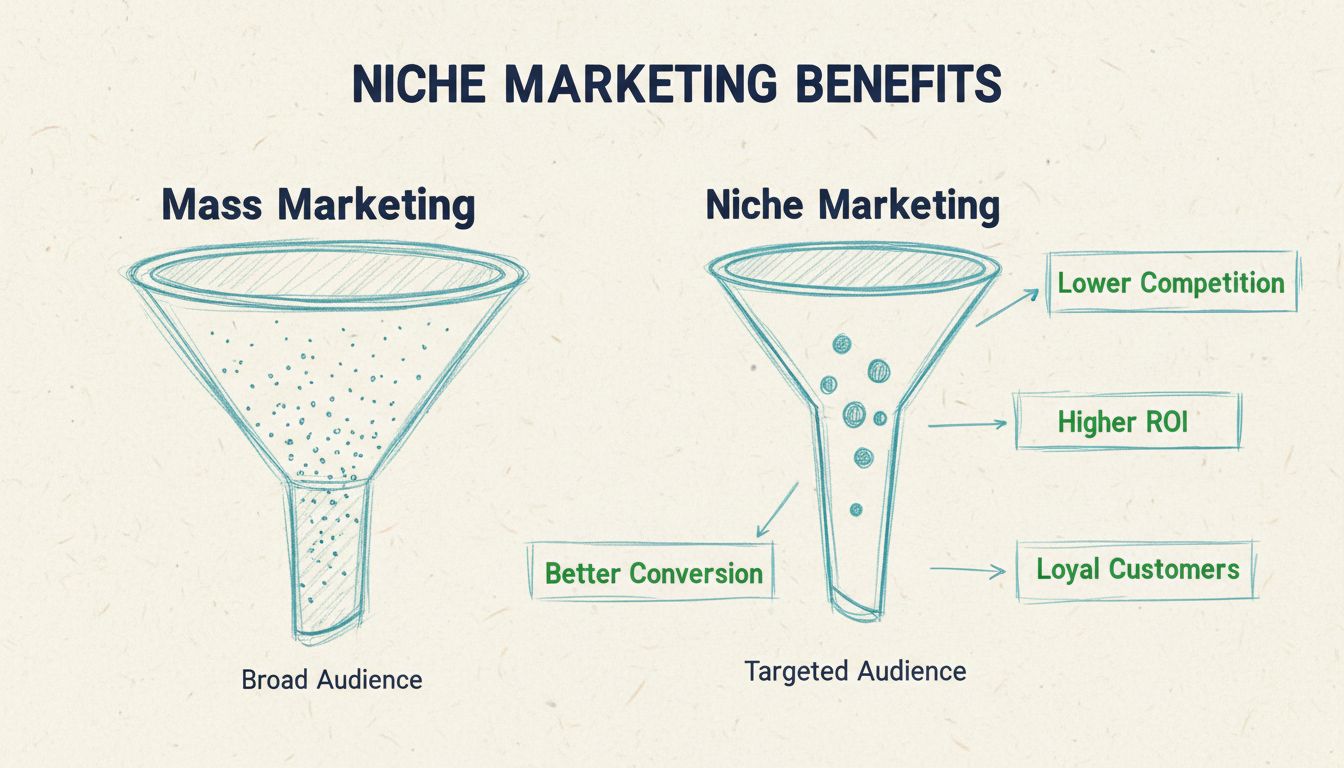
Discover the key benefits of niche marketing including reduced competition, higher ROI, improved customer loyalty, and premium pricing. Learn how PostAffiliateP...

why selecting a specific niche in affiliate marketing is crucial. how niche focus drives higher conversions, reduces competition
Join our community of happy clients and provide excellent customer support with Post Affiliate Pro.




Cookie Consent
We use cookies to enhance your browsing experience and analyze our traffic. See our privacy policy.