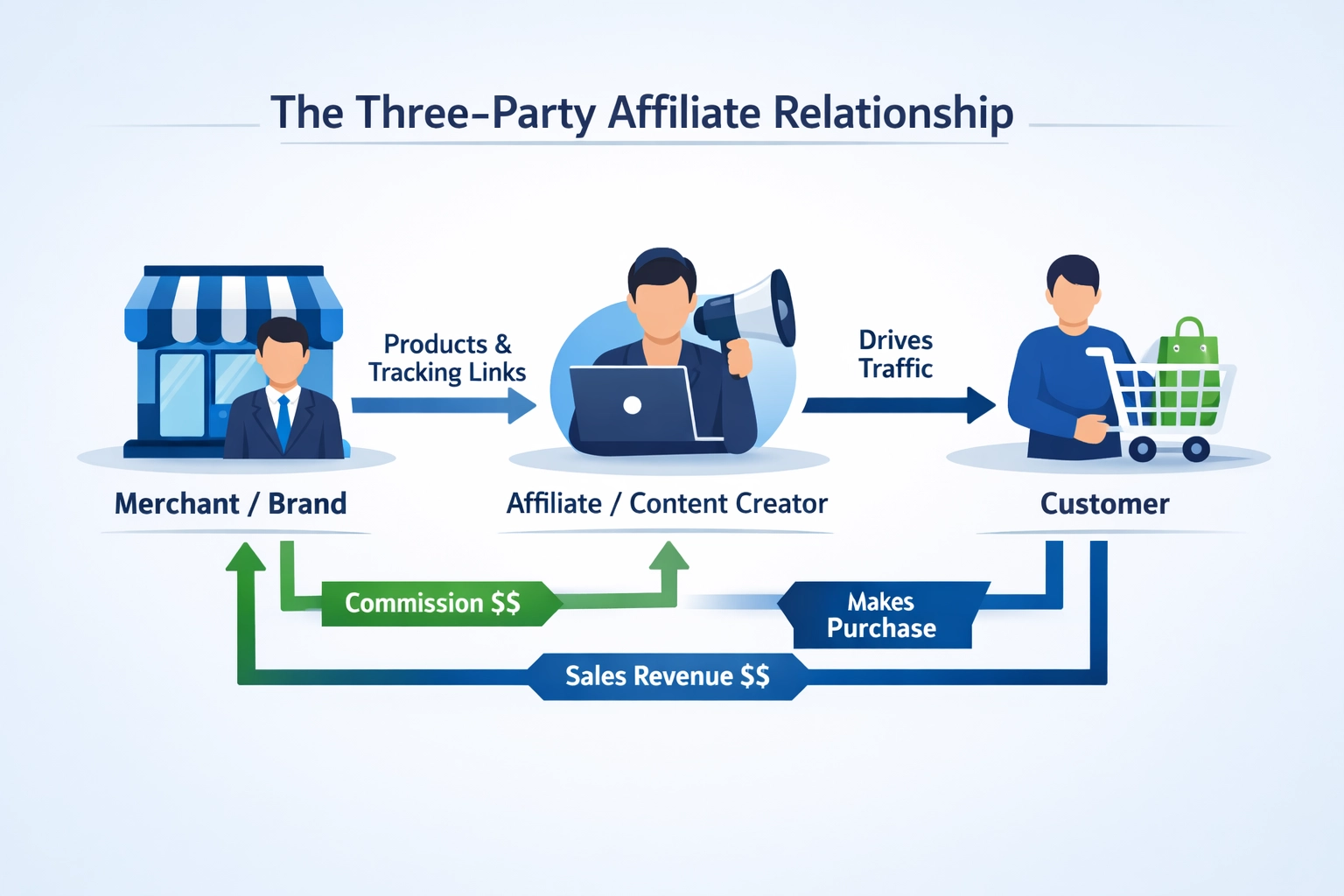
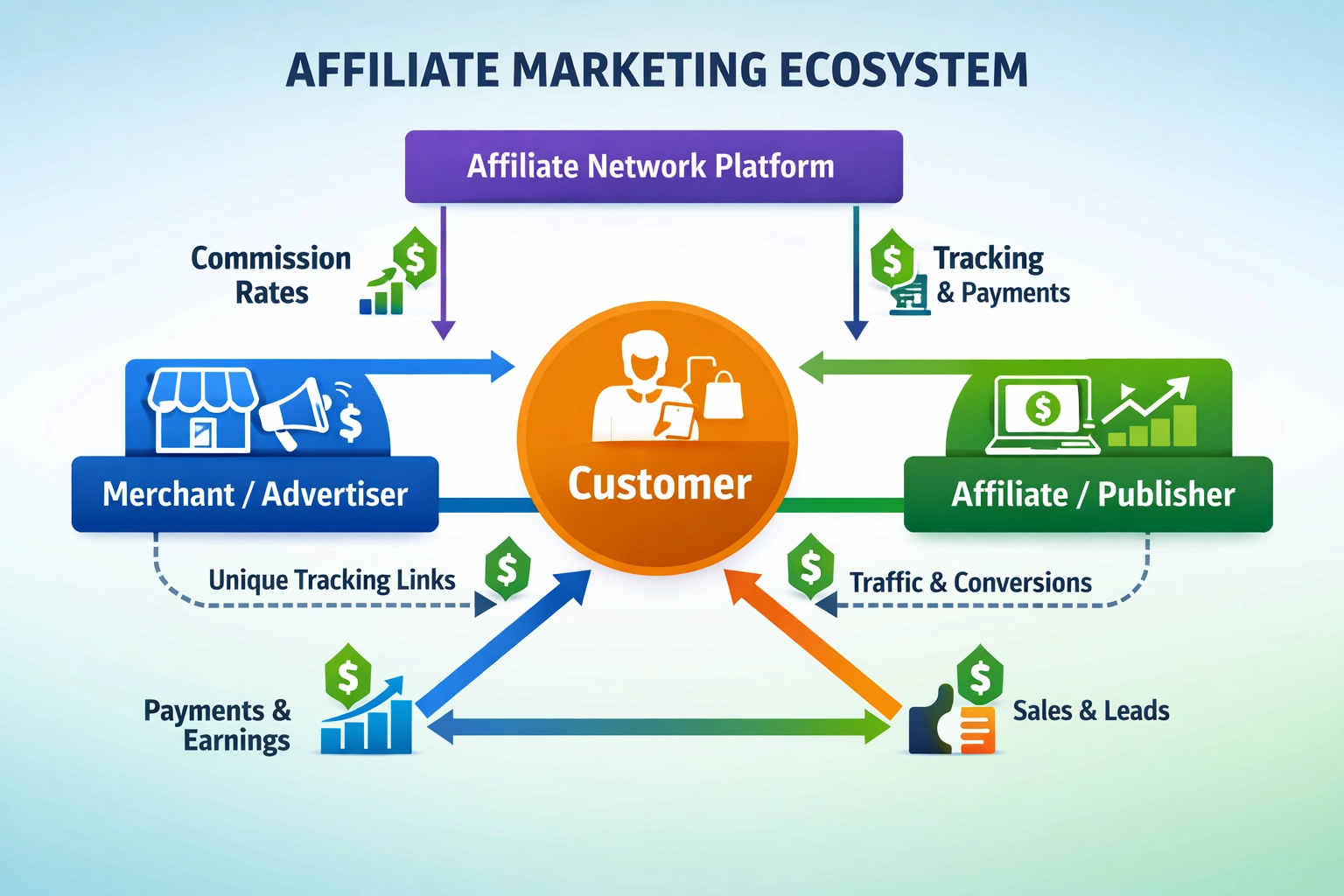
A commission in affiliate marketing is a performance-based payment that a business (the advertiser or merchant) makes to an external partner (the affiliate or publisher) when that partner generates a specific, measurable result — most commonly a sale, but also a lead, signup, click, or other pre-agreed action. The commission is the core incentive that powers the entire affiliate marketing model: the affiliate gets paid only when their promotional efforts produce a verified outcome.
This performance-based structure is what separates affiliate marketing from other digital marketing channels. Unlike paid search or display advertising — where you pay for impressions or clicks regardless of whether anything is purchased — affiliate commissions tie every dollar of marketing spend directly to a result. The affiliate takes on the promotional risk; the brand pays only for performance.
How Affiliate Commissions Work
The Commission Flow: Step by Step
The mechanics of an affiliate commission follow a predictable workflow that has remained consistent even as the technology around it has evolved:
- A brand creates an affiliate program and sets its commission structure — defining what actions qualify for payment, how much each action pays, and any rules around attribution.
- An affiliate joins the program and receives a unique tracking link containing an identifier (typically a partner ID embedded in a URL parameter or subdomain).
- The affiliate promotes the brand’s products through their channels — a blog post, YouTube video, social media content, email newsletter, or paid advertising.
- A consumer clicks the affiliate’s tracking link. A cookie (or server-side tracking token) is stored on the consumer’s device, recording which affiliate referred them and when the click occurred.
- The consumer completes a qualifying action — usually a purchase — within the program’s cookie window. The affiliate platform records the conversion and attributes it to the correct partner.
- The commission is calculated and queued for payout. The affiliate platform applies the appropriate rate, checks for any bonuses or tier adjustments, and adds the amount to the affiliate’s balance.
The Role of Tracking Technology
Accurate commission attribution depends on reliable tracking. Most programs use a combination of:
- First-party cookies: Set via the affiliate’s tracking link, these record the referring partner and click timestamp.
- Server-side (cookieless) tracking: As browser privacy restrictions have tightened, many affiliate platforms now offer server-to-server tracking that doesn’t rely on third-party cookies. This uses unique transaction IDs passed through the checkout flow.
- Coupon codes: Many programs assign unique discount codes to affiliates, providing an alternative attribution method when cookies are blocked or expired.
- Last-click attribution: The industry standard model — the most recent affiliate click before conversion gets the commission. Some programs now use multi-touch or first-click models for specific partner types.
Launch your affiliate program today
Set up advanced tracking in minutes. No credit card required.
Common Affiliate Commission Structures
The way you structure commissions directly affects which partners join your program and how they behave once they’re in it.
| Structure | How It Works | Best For | Typical Example |
|---|
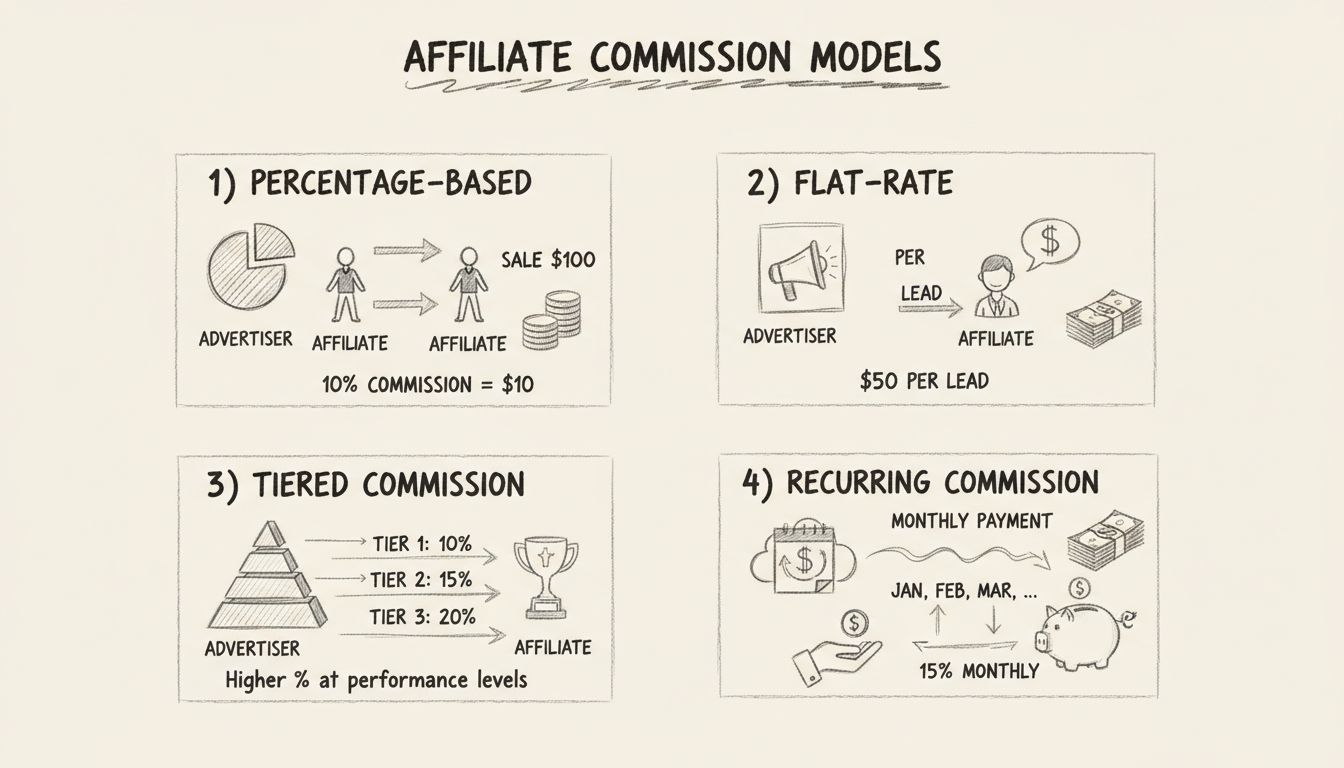
| Percentage of Sale (CPS) | Affiliate earns a set percentage of the sale price | E-commerce, retail, physical goods | 10% of a $100 order = $10 |
| Flat Rate (CPA) | Affiliate earns a fixed dollar amount per conversion | Lead generation, high-ticket items, services | — |
| Recurring Commission | Affiliate earns ongoing payments for subscription customers | SaaS, membership sites, subscription boxes | — |
| Tiered Commission | Rate increases as affiliate hits volume milestones | Scaling performance, rewarding top partners | — |
| Hybrid Commission | Combines two or more of the above models | Complex businesses with multiple product lines | — |
Percentage of Sale (Cost Per Sale / CPS)
The most common model. The affiliate receives a percentage of the total transaction value. This aligns incentives well — the more valuable the sale, the more the affiliate earns.
Flat Rate (Cost Per Action / CPA)
The affiliate receives a fixed dollar amount regardless of transaction size. It also simplifies forecasting for both the brand and the affiliate.
Recurring Commission
Common in SaaS and subscription businesses. The affiliate earns a percentage of the customer’s ongoing payments, often for the lifetime of that customer.
Tiered Commission
Tiered structures reward volume. This motivates top performers to prioritize your program and rewards the partners who deliver the most value.
Hybrid Models
Many mature programs layer multiple structures. For example, a program might pay a flat $10 for every free trial signup plus a 15% commission if that trial converts to paid — rewarding both lead generation and revenue outcomes.
What Is a Good Affiliate Commission Rate?
There is no single “good” rate. What works depends on your profit margins, customer lifetime value (LTV), industry norms, and competitive landscape.
| Product Category | Typical Commission Range | Notes |
|---|
| Fashion & apparel | — | Higher margins allow more generous splits |
| Health & wellness supplements | — | High-margin consumables; recurring-purchase potential |
| Digital courses & e-learning | — | Near-zero marginal cost; creators can afford high splits |
| SaaS & software | — | Lifetime value justifies ongoing commissions |
| Financial products (credit cards, loans) | — | Regulated industry; flat-fee model dominates |
| Web hosting | — | Competitive niche; affiliates often prefer flat bounties |
| Luxury goods | — | High price points make even small percentages substantial |
How to Set Your Rate
The most reliable method is to calculate your absolute commission ceiling — the maximum you can pay while remaining profitable:
- Determine your average customer lifetime value (LTV).
- Subtract your cost of goods sold (COGS) and all non-commission operating expenses.
- The remainder is your maximum affordable commission per customer.
For example, if your LTV is $500 with $200 in costs, your maximum commission budget is $300 per customer. A 20% commission on a $100 order ($20) would let you acquire roughly 15 customers before hitting your ceiling — a comfortable margin. This math-driven approach is more reliable than simply matching a competitor’s advertised rate, since you cannot see their actual margins.
Join our newsletter
Be the first to know about new features and product updates.
This is one of the most common questions about affiliate commissions, and it comes down to the cookie window (also called a cookie duration or attribution window).
When a consumer clicks an affiliate link, a cookie is placed on their device. If they come back to purchase later — on their own, without clicking another affiliate link — that original affiliate still receives credit, as long as the purchase happens within the cookie window.
- 7 days: Common for lower-priced impulse purchases
- 30 days: The industry standard across most programs
- 60–90 days: Common for high-consideration purchases (B2B software, luxury goods, travel)
- Session-only: Rare; used mainly for time-sensitive offers
If the consumer clicks a different affiliate’s link during the cookie window, last-click attribution typically applies — the most recent affiliate gets the commission, overwriting the earlier cookie.
If the consumer clears their cookies or switches devices between clicking and purchasing, the affiliate will not receive credit unless the program uses server-side tracking or coupon-code attribution as a backup.
How Do Affiliate Marketers Get Paid?
Payment Schedules
- Monthly: Most common.
- Biweekly: Less common; used by some high-volume programs.
Payment Methods
- Direct deposit / ACH: Most common in the US; low fees, reliable.
- PayPal: Widely used internationally; fees apply.
- Wire transfer: For large international payments; higher fees.
- Store credit / gift cards: Occasionally offered in addition to cash.
- Check: Increasingly rare; slowest option.
Commission Validation Period
The affiliate is paid only for commissions that survive this validation period.
How to Get Started With Affiliate Marketing as a Beginner
Here is the modern workflow:
- Choose a niche you understand. The most successful affiliates have genuine expertise or interest in their topic area. Audiences detect shallow content quickly.
- Pick a platform. You need at least one owned distribution channel. Options include a blog or content website, a YouTube channel, a social media account (TikTok, Instagram, Pinterest), an email newsletter, or a podcast. A website gives you the most control, but social-first strategies work well for visual and lifestyle niches.
- Build an audience first, monetize second. New affiliates who rush into promotion before building trust typically see low conversion rates. Spend at least 3–6 months creating genuinely useful content before layering in affiliate links.
- Join affiliate programs in your niche. Start with one or two programs where you use and trust the products. Individual merchant programs often pay more than broad networks like Amazon Associates, though networks offer convenience.
- Create content that naturally incorporates affiliate links. Product reviews, comparison posts, tutorials, and “best of” roundups are formats that perform well.
- Track and optimize. Pay attention to which content generates clicks and conversions. Double down on what works and improve or remove what doesn’t.
What Are the Most Popular Niches for Affiliate Marketing?
Some niches consistently attract affiliate activity because they offer strong commission rates, high search volume, and products people research before buying:
- Technology & software: SaaS tools, web hosting, VPNs, and productivity apps.
- Health & wellness: Supplements, fitness equipment, meal delivery services, mental health apps.
- Personal finance & investing: Credit cards, banking products, investment platforms, tax software.
- Fashion & beauty: Clothing, skincare, cosmetics, accessories.
- Online education: Courses, learning platforms, certification programs.
- Travel: Booking platforms, luggage, travel insurance, tours.
- Home & garden: Furniture, home improvement tools, smart home devices.
How Do I Choose a Niche for Affiliate Marketing?
Selecting the right niche determines whether you’re building a sustainable affiliate business or chasing short-term affiliate income. Ask these questions:
- Do I have genuine interest or expertise here? You’ll produce better content, persist longer, and build more authentic trust if you care about the topic.
- Are there products with affiliate programs? Research available programs before committing. A passion for a topic with no monetizable products won’t generate commissions.
- What are the commission rates and average order values? A niche with 5% commissions on $500 items ($25/sale) may outperform one with 50% commissions on $20 items ($10/sale).
- How competitive is the niche? Use keyword research tools to evaluate whether you can realistically rank for relevant terms. Highly competitive niches require stronger content or a unique angle.
- Is the audience growing or shrinking? Look for categories with upward search trends rather than declining interest.
Which Type of Affiliate Marketing Should I Choose?
Affiliate marketing is commonly categorized into three types based on the affiliate’s relationship to the product:
| Type | Description | Examples |
|---|
| Unattached | The affiliate has no personal connection to the product and no authority in the niche. | Running paid ads to affiliate offers without a brand presence. |
| Related | The affiliate has an audience in a related niche but doesn’t personally use the product. | A fitness blogger promoting supplements they haven’t personally tried. |
| Involved | The affiliate has personally used the product and can speak from experience. | A software developer reviewing a coding tool they use daily. |
Involved affiliate marketing consistently produces the highest conversion rates and longest audience loyalty. Building a business on the involved model takes more effort upfront but compounds over time, while unattached models tend to produce diminishing returns as platforms tighten their policies.
What Are the Benefits of Affiliate Marketing?
For Advertisers (Brands)
- Performance-based cost: Pay only for measurable results — sales, leads, or other defined conversions — making ROI tracking straightforward.
- Scalable distribution: Affiliates expand your reach without the fixed costs of hiring a sales team or buying media upfront.
- Diverse traffic sources: A well-built affiliate program brings customers from blogs, YouTube, social media, newsletters, and comparison sites — channels a brand might not otherwise reach.
- Brand advocacy: Affiliates who genuinely use and recommend products create earned credibility that paid advertising struggles to match.
For Publishers (Affiliates)
- Low startup costs: No inventory, no customer support, no fulfillment. A domain, hosting, and time are the primary investments.
- Location independence and flexibility: Affiliate marketing can be done from anywhere with an internet connection and on a self-determined schedule.
- Passive income potential: Content created once can generate commissions for years if it continues to rank and attract traffic.
- No customer risk: Affiliates don’t handle refunds, complaints, or product issues — those remain the merchant’s responsibility.
For Affiliate Program Managers
- Measurable channel contribution: With proper tracking software, program managers can report exact revenue attribution, partner-level performance, and channel ROI.
- Partner diversification: A portfolio of content affiliates, coupon sites, influencers, and B2B partners protects against over-reliance on any single partner type.
- Programmatic optimization: Commission structures, bonuses, and partner tiers can be adjusted dynamically based on performance data.
What Are the Risks and Limitations?
For Advertisers
- Commission fraud: Fake referrals, cookie stuffing, and unauthorized paid-search bidding on brand terms are persistent risks. Robust tracking software with fraud detection is essential.
- Attribution disputes: Partners may disagree about who should receive credit for a conversion, particularly in programs using last-click attribution.
- Brand representation risk: Affiliates operating outside brand guidelines — making false claims or using misleading tactics — can damage reputation.
- Cannibalization: Paying commission on sales that would have happened organically eats into margins. Setting appropriate cookie windows and excluding branded search terms from commission eligibility helps mitigate this.
For Affiliates
- Income volatility: Commission income can fluctuate significantly month to month based on traffic changes, algorithm updates, seasonality, or program changes.
- Platform dependency: Relying on a single traffic source (Google, YouTube, a social platform) creates vulnerability to algorithm changes or policy shifts.
- Program changes beyond control: A merchant can reduce commission rates, shorten cookie windows, or shut down their program with limited notice.
- Delayed payments: With validation periods and net-30 schedules, there can be a 60-day gap between driving a sale and receiving the commission.
Affiliate Commission Tracking and Software
Core Capabilities
- Tracking and attribution: Captures clicks, sets cookies or server-side tokens, and matches conversions to the correct partner across devices and channels.
- Commission calculation: Applies the correct rate structure — percentage, flat, recurring, or tiered — to each conversion automatically.
- Fraud detection: Identifies suspicious patterns (abnormal click-to-conversion ratios, duplicate transactions, known bad-actor IPs) and flags them for review.
- Payout management: Aggregates approved commissions, generates partner statements, and integrates with payment processors for batch payouts.
- Partner portal: Gives affiliates a dashboard to view their performance, get creatives, and track earnings in real time.
Why Software Matters for Commission Accuracy
Without purpose-built tracking, a program inevitably undercounts or overcounts conversions. Common failure points include:
- Cross-device attribution loss: A customer clicks on mobile and buys on desktop — without cross-device tracking, the affiliate loses credit.
- Ad-blocker interference: Some ad blockers strip tracking parameters. Server-side tracking mitigates this.
- Return-window complications: If a customer returns a product after the commission is paid, the reversal must be processed accurately.
For program managers evaluating software, the key requirement is that the platform supports the commission structures your business uses — not every tool handles recurring commissions or complex tiered models equally well.