Ask five creators what they charge for a single post and you will get five answers, and none of them will match the average you found online. That is not because creators are being difficult. Influencer rates are not a price list. They are the result of a negotiation between what a creator’s attention is worth to them and what it is worth to you.
This guide gives you the tools for that negotiation. It covers what published sources say about how much influencers charge per post, what a rate card is and how to read one, how flat fee, commission and hybrid deals compare, a worked break-even example, and what to write into the agreement. It is organised by deal type, not by creator size, because the deal you choose changes the price more than the follower count does.
In short
- There is no standard rate. Published averages vary by year, platform and method, so use them as anchors, not as a price list.
- Ask for a rate card from every creator, and compare them on the same deliverable.
- A flat fee is a fixed cost for guaranteed content. Commission ties cost to sales. A hybrid pays a smaller fee plus commission.
- Do the break-even sum before you agree: how many orders does a commission have to produce to cost the same as the flat fee?
- Write down the base, the hold period and the refund rule. Vague terms are where disputes start.
How much do influencers charge per post?
Influencers charge very different amounts per post, and no published average covers every platform, niche and year. The price depends on audience size, engagement, niche, content format, usage rights, exclusivity and how long the content must stay live. Treat any average as a starting point and get quotes.
Two sources show how uneven the picture is. In 2021, Social Media Today reported a survey by the influencer platform Intellifluence in which creators with up to 1,000 followers charged around $193 per Instagram post on average, while creators with more than 80,000 followers would generally charge more than $1,000 (Social Media Today ). The same report cautioned that audience size should not be the only deciding factor and that there is no fixed pricing structure for creators.
Digiday’s older piece, from 2017, shows the same lack of agreement from the agency side. One agency quoted roughly $1,000 per 100,000 Instagram followers, adjusted for engagement, campaign length and budget, and another said it started at $250 per post for accounts under 50,000 followers and added about $1,000 per 100,000 followers. The article also quoted prices for dedicated YouTube videos that differed from one source to the next by several times over (Digiday ).
| Source | Year | Platform | What it reported |
|---|---|---|---|
| Intellifluence survey, via Social Media Today | 2021 | About $193 per post up to 1,000 followers; generally over $1,000 above 80,000 followers | |
| Digiday, quoting agencies | 2017 | About $1,000 per 100,000 followers, or from $250 per post under 50,000 followers plus about $1,000 per 100,000 |
These figures are old, they come from different methods and they cover only one platform, which is exactly the point. Use them to understand how prices are built, not to set yours. A current quote from the creator you actually want will always beat an average.

Launch your affiliate program today
Set up advanced tracking in minutes. No credit card required.
What is an influencer rate card?
An influencer rate card is a creator’s price list. It sets out what they charge for each type of deliverable, such as a feed post, a short video, a story set or a bundle, and often adds the price of extras like usage rights, exclusivity or a longer posting window.
Ask for one before you talk numbers. It lets you compare creators on equal terms, and it shows how they think about their own work. A few things to look for:
- What is included in each price, such as the number of revisions, the posting window and whether the creator edits the content.
- What costs extra, especially usage rights (using the content in your own ads) and exclusivity (not working with competitors).
- Whether packages are discounted, since three posts often cost less than three single posts.
- Whether they will quote a commission-based option, which tells you how much of the risk they are willing to share.
A rate card is a starting point, not a final price. The terms can be discussed, especially if you are offering a longer relationship or a mix of fee and commission.
What are the ways to pay an influencer?
You can pay an influencer a flat fee, a commission on sales, a mix of the two, or in product only. Each shifts the risk differently. A flat fee puts the risk on you, commission puts it on the creator, and a hybrid splits it.
| Deal type | How it works | Who carries the risk | Works best when | Watch out for |
|---|---|---|---|---|
| Flat fee | A fixed price per deliverable | The brand | You need guaranteed content or awareness | Paying for reach that does not convert |
| Commission | A percentage or fixed amount per attributed sale | The creator | The creator already knows and likes the product | Weak interest if the offer is too thin |
| Hybrid | A smaller fee plus commission, sometimes a bonus | Shared | You want effort and results to both count | A messy agreement if the terms are vague |
| Product only | Free product, no obligation | The brand, in time and stock | You are testing creators | No guaranteed output, see product seeding |
Join our newsletter
Be the first to know about new features and product updates.
Flat fee vs commission: which should you offer?
Offer a flat fee when you need guaranteed content or awareness, and commission when you trust the creator to sell. A flat fee gives them certainty and you a fixed cost. Commission ties your cost to results but asks the creator to work without a guarantee.
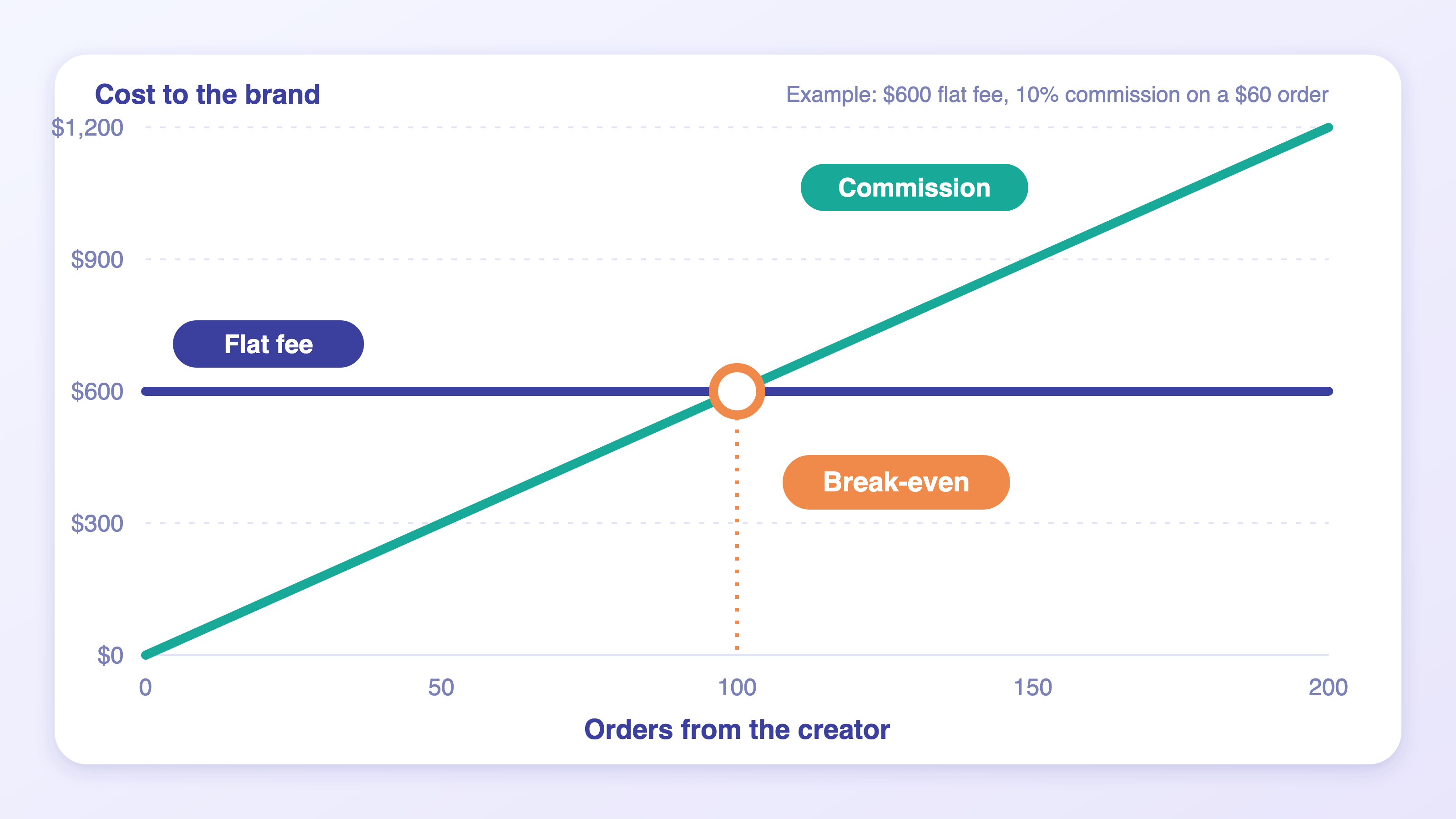
The honest way to decide is to run the numbers. The break-even point is the number of orders at which a commission costs the same as the flat fee: divide the flat fee by the commission earned on one order.
Here is a worked example. The numbers are illustrative, not market rates. Assume a flat fee of $600, an average order of $60 and a commission of 10 percent, which is $6 an order. The break-even is 600 divided by 6, or 100 orders.
| Orders from the creator | Flat fee ($600) | Commission only (10%) | Hybrid ($200 plus 5%) |
|---|---|---|---|
| 0 | $600 | $0 | $200 |
| 50 | $600 | $300 | $350 |
| 100 | $600 | $600 | $500 |
| 200 | $600 | $1,200 | $800 |
Read it from both sides. If you expect fewer than 100 orders, commission costs you less. If the creator is likely to drive more than 100 orders, the flat fee is the cheaper deal for you, and a creator who believes in their own numbers will probably ask for commission instead. The hybrid sits in between: it pays the creator something for their time even if sales are slow, and it still rewards them when sales are strong.
One adjustment matters in real life. Those numbers ignore the discount you are giving the customer, and returns. Subtract both before you decide what a sale is worth to you. If you are using codes, our guide to influencer discount codes covers how to track and pay on them.
How do hybrid influencer deals work?
A hybrid influencer deal pays a base fee for the content plus commission on the sales the creator drives, sometimes with a bonus for hitting a target. The base covers the creator’s time and the commission rewards results, so both sides have a reason to care about the outcome.
Three decisions shape a hybrid:
- The size of the base. Low enough that you are not paying full price for reach, high enough that the creator takes the work seriously.
- The commission rate and base. The rate, and whether it applies to the price paid or the price before the discount.
- The bonus rule, if you use one. A clear target, such as a number of orders in a month, works better than a vague promise of a bonus.
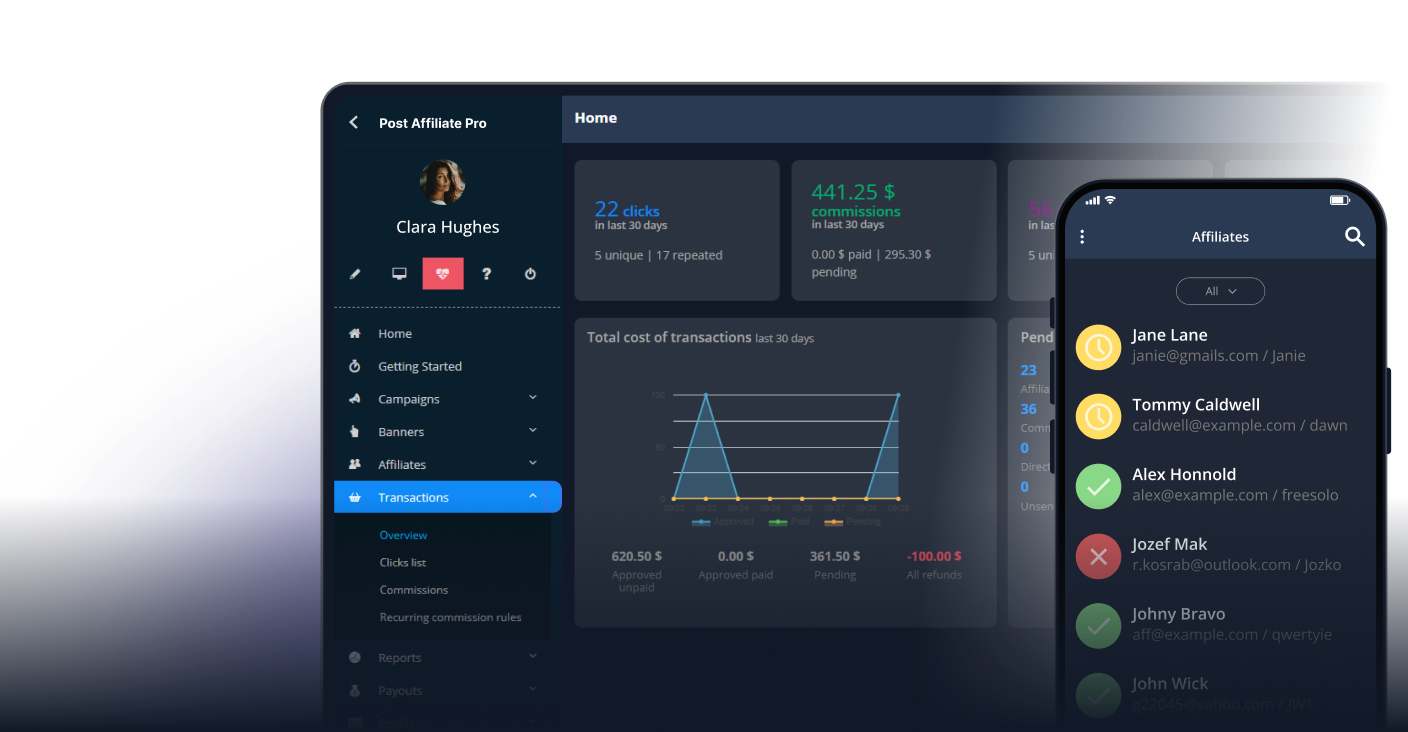
The commission half is where affiliate software earns its keep. In Post Affiliate Pro a sale commission can be a percentage or a fixed amount, and there are click and action commissions as well (see types of commissions ). You can give different affiliates different rates in the same campaign with commission groups , and add bonus commissions with performance rules that reward affiliates who reach a target. Each commission type has its own approval setting, automatic or manual, so you can hold a payout until you are happy with the sale. The flat fee is a contract matter you settle with the creator directly.
A note on terms: in this guide a flat fee is a fixed price for the content. If you are choosing between a fixed bounty per sale and recurring payouts for your whole program, our guide to recurring vs flat-rate affiliate commissions covers that choice.
Do influencer rates change with audience size?
Audience size is the most common starting point for rates, but it is not the whole story. Engagement, niche, platform, content format and the rights you want all move the price. A smaller niche audience can sell better than a larger general one, which is why a cheaper creator is not always the lower-risk choice.
The Social Media Today report makes the same point: audience size should not be the only deciding factor, and smaller niche audiences can drive better direct response and sales. For definitions of micro and macro creators and how they differ, see our guide to micro vs macro influencers . This guide stays on the deal itself.
What should be in an influencer agreement?
An influencer agreement should state the deliverables, the fee or commission, the commission base, the hold period, the refund rule, usage rights, exclusivity, approval steps, disclosure requirements and how either side can end the deal. Writing it down prevents most disputes.
A checklist for the agreement:
- Deliverables: what is posted, on which platform, when and for how long.
- Payment: the flat fee, the commission rate or both, and when each is paid.
- Commission base: price paid or price before discount.
- Hold period: how long you wait before commission is payable, so returns can come through.
- Refunds and chargebacks: commission is reversed on a refunded or charged-back order.
- Usage rights: whether you can reuse the content, where and for how long.
- Exclusivity: whether the creator can work with competitors during the deal.
- Approval: who signs off on the content before it goes live.
- Disclosure: wording and placement of the paid or affiliate relationship.
On disclosure, the FTC says advertisers need reasonable programs to train and monitor the people they pay, and suggests requiring that paid posts are not published until you have approved them in advance (FTC ). A clause that makes approval a condition of posting is an easy way to meet that. This is US guidance and not legal advice, so check the rules in the markets you work in.
How do you negotiate influencer rates?
Negotiate influencer rates by asking for the rate card, defining the deliverable exactly, comparing cost per outcome instead of cost per post, and offering performance upside in exchange for a lower base. Start with a small trial, then renew on results.
- Ask for the rate card and audience details before you propose a number.
- Define the deliverable. The same price buys very different things depending on revisions, rights and posting windows.
- Compare cost per outcome. A pricey post that converts can be cheaper than a cheap one that does not.
- Offer commission upside for a lower base, and show the break-even so both sides see the logic.
- Run a trial first. One post or one month tells you more than an average ever will.
- Renew on your own data. After the first campaign you know what a sale from this creator costs you, which is worth more than any benchmark.
Common mistakes when setting influencer rates
- Using an online average as a price list - Averages hide year, platform and method.
- Comparing quotes for different deliverables - Check what is included before you compare numbers.
- Forgetting usage rights and exclusivity - They can cost more than the post itself.
- Paying commission on the wrong base - Agree whether it is price paid or price before discount.
- Paying before the return window closes - Hold payment until sales are safe.
- Leaving refund rules unwritten - Without them, every reversal becomes an argument.
- Judging a creator on one post - One result is noise, a pattern is information.
Match the deal to the creator
The right rate is the one both sides can defend. A flat fee buys certainty, commission buys alignment and a hybrid buys a bit of both. Run the break-even, write the terms down and use your own results to adjust the next deal.
If you want to pay creators on performance without chasing spreadsheets, try Post Affiliate Pro free and set up commissions, rates and approval rules for your first partners.