


Choose the Right Affiliate Program: Selection Criteria
Learn key factors for selecting the best affiliate program: commission structures, payout frequency, security, and company reputation.
9 min read
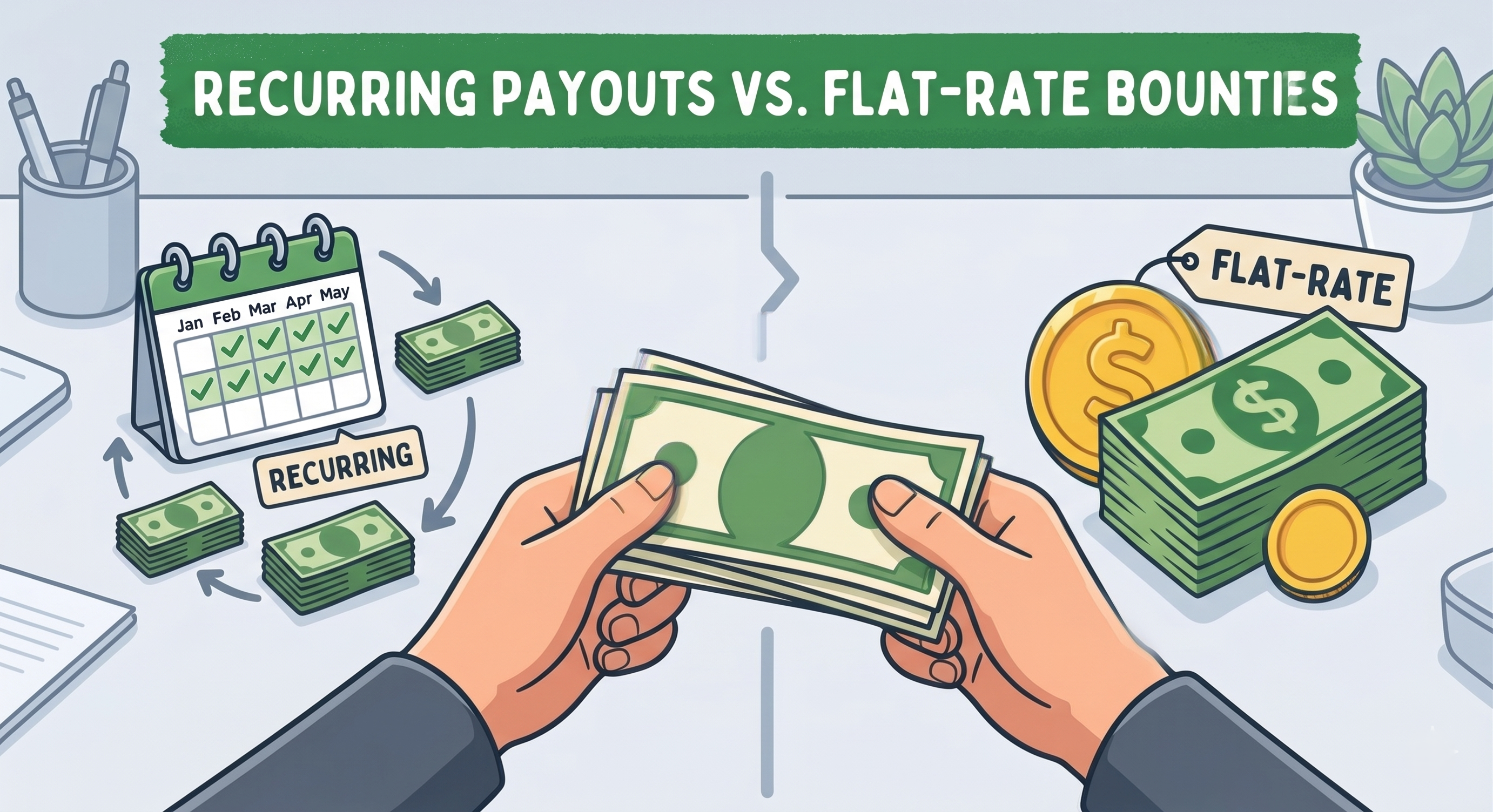
Compare recurring commissions vs. flat-rate bounties to find the right affiliate payout model for your niche, cash flow, and partner expectations.
Here is a scenario that plays out more often than most program managers admit.
Your new affiliate campaign looks like a success. Conversions are coming in, and your numbers are up. But 45 days later, you check your churn report and realize that nearly half of those referred users canceled before their second billing cycle.
What went wrong? You offered a large one-time payment to attract popular influencers. They promoted your product, collected their payout, and moved on. You paid for sign-ups, not loyal customers, and the math didn’t work out.
Your commission structure is not a minor detail. It determines which affiliates you attract, how they promote your product, and whether the program is profitable long term. This guide walks you through the two main models, recurring commissions and flat-rate bounties, so you can choose the one that fits your business.
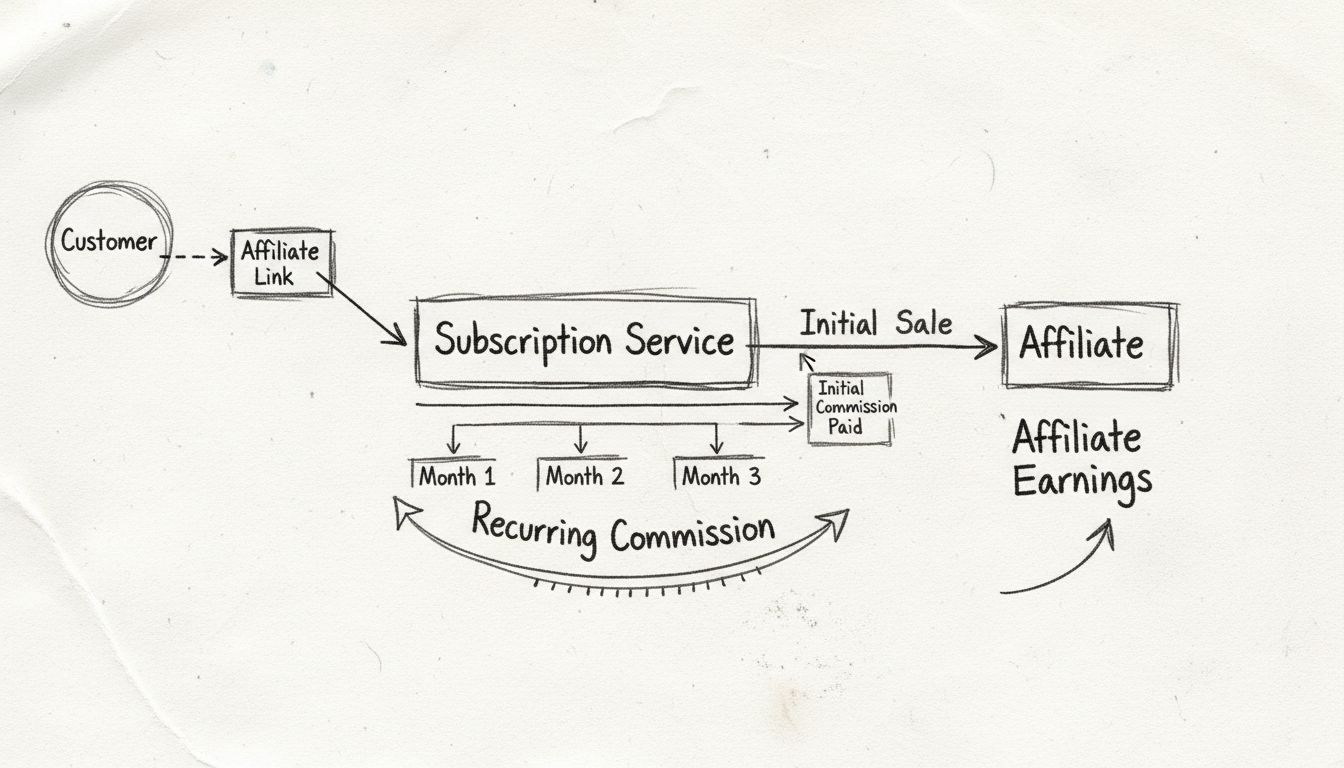
With a recurring commission model, you pay your affiliate a percentage of each payment a referred customer makes — not just the first one. As long as that customer keeps paying their subscription, the affiliate keeps earning.
Example: An affiliate refers a customer to your $100/month SaaS plan. You offer a 30% recurring commission. The affiliate earns $30 in month one, $30 in month two, and so on for as long as that customer stays subscribed.
This works well for merchants because your commission costs grow in line with actual revenue. If a customer cancels early, your costs stop too. You are not paying out money you haven’t earned yet.
For affiliates, recurring commissions are attractive because they build up over time. A blogger or content creator who recommends your product today can still be earning from that recommendation a year from now. That kind of predictable income encourages affiliates to write thorough, honest reviews and genuinely care whether their referred users stick around.
The key number to keep in mind is your Customer Lifetime Value (LTV) — roughly how much revenue you expect from a customer before they cancel. A simple way to estimate it: divide your average monthly revenue per customer by the percentage of customers who cancel each month. For example, if customers pay $100/month and 5% cancel each month, your LTV is $2,000.
Your recurring commission rate should stay well below that number so the program remains profitable.
A flat-rate bounty, sometimes called a Cost-Per-Acquisition (CPA) payment, is a fixed amount you pay an affiliate once, immediately after a new customer completes a qualifying action (such as signing up, making a first purchase, or funding an account).
Example: You sell a $300 home security system and offer affiliates a flat $45 bounty per sale. Every time an affiliate drives a confirmed purchase, they receive $45, regardless of whether that customer ever buys from you again.
This model is simple to manage. You set a fixed amount, pay it once, and the transaction is complete. There are no ongoing tracking obligations tied to that customer.
Flat-rate bounties tend to attract affiliates who run paid advertising campaigns — people who spend money on Google or Facebook ads to drive traffic and need to recover that spend quickly. A recurring commission that pays out over 12 months does not help them cover ad costs today. A flat bounty paid within 30 days does.
The trade-off for merchants is upfront risk. You pay the bounty before you know whether that customer will stay. If your product has a high early cancellation rate, you can end up paying commissions on customers who generate very little revenue.
| Recurring Commission | Flat-Rate Bounty | |
|---|---|---|
| When you pay | Every billing cycle, as long as the customer stays | Once, after the qualifying conversion |
| Upfront cost | Low — costs grow with revenue | Higher — you pay before knowing customer value |
| Your risk if customer cancels early | Low — commission stops when revenue stops | High — you already paid the full bounty |
| Best affiliate type | Bloggers, reviewers, content creators | Paid advertisers, coupon sites, deal aggregators |
| Tracking required | Ongoing, tied to billing cycles | Single conversion event |
| Fraud risk | Lower — no incentive to send fake sign-ups | Higher — fake or low-quality sign-ups can trigger payouts |

Set up advanced tracking in minutes. No credit card required.
The right model depends heavily on what you sell and who buys it.
Software subscriptions and online learning platforms have low delivery costs — there is no inventory to ship, and adding a new customer costs very little. Revenue comes in monthly or annually, which makes recurring commissions a natural fit.
Affiliates in these spaces — independent reviewers, tutorial creators, software comparison sites — invest significant time creating content. A 20% to 40% recurring commission gives them a reason to keep promoting your product long after they publish their first review, and to genuinely care whether their audience finds it useful.
When someone buys a sofa, a garden tool, or a camera, they are almost certainly buying it once. There is no subscription to continue, so a recurring model does not apply.
For these niches, a flat-rate bounty of 10% to 15% of the sale value, or a fixed amount per transaction, is the standard approach. It rewards the affiliate for driving the sale and keeps your accounting straightforward.
Financial apps, investment platforms, and digital banking products occupy a middle ground. These companies want long-term customers, but they also compete in a crowded market where popular personal finance creators can be selective about which programs they join.
Many FinTech brands attract affiliates by offering flat bounties of $50 to $300 per verified sign-up. The high payout gets attention, but it also means the program needs careful monitoring, fake or low-quality sign-ups are a real risk when individual payouts are this large.
Choosing the right commission model starts with understanding which niches actually deliver sustainable returns. For a data-backed breakdown of commission rates, audience intent, and program complexity across the top verticals — SaaS, finance, health, fashion, and more — see our guide to the most profitable affiliate marketing niches for 2026 .
Once your program grows beyond a handful of affiliates, tracking commissions manually stops working. Subscriptions upgrade, downgrade, and cancel. Payments come in different currencies. Referral histories go back months or years.
Errors in commission tracking — paying too much, too little, or too late — damage trust with your affiliates faster than almost anything else.
A proper affiliate tracking platform connects directly to your payment processor and handles the calculations automatically:
[Customer Billed] ──► [Payment Gateway Webhook] ──► [Post Affiliate Pro] ──► [Affiliate Commission Updated]
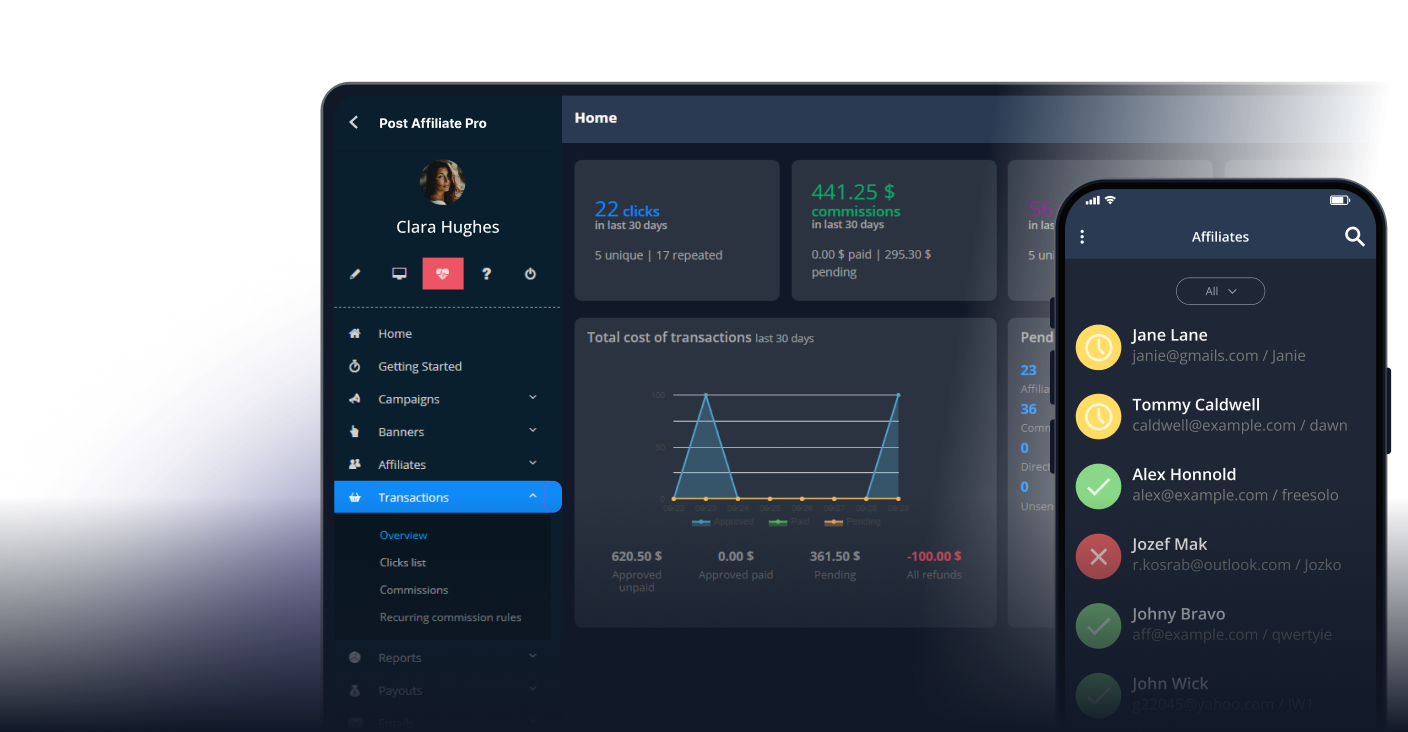
Post Affiliate Pro integrates with payment processors like Stripe and PayPal Braintree through direct API connections. Here is what happens each time a subscriber renews:
No manual work required on your end.
Subscribers do not always stay on the same plan. Some upgrade to a higher tier, some downgrade, and some cancel partway through a billing period.
If your tracking is not connected to live billing data, you risk paying commissions on revenue you did not actually receive, or underpaying affiliates when customers upgrade. Post Affiliate Pro reads the actual invoice value from each transaction, so the commission always reflects what was genuinely charged, keeping your records accurate and your affiliate relationships intact.
Be the first to know about new features and product updates.
Three questions will point you in the right direction:
Post Affiliate Pro gives you the tools to run any of these structures, recurring, flat-rate, or hybrid, with automated tracking and clear reporting at every step. Start your free trial today and set up a commission structure that works for your program from day one.
Tamara is a copywriter at Post Affiliate Pro. She's passionate about helping businesses and marketers understand how affiliate programs can drive growth, one blog post at a time.

Post Affiliate Pro gives you the automated webhooks, granular reporting, and flexible commission structures you need to run recurring or flat-rate programs at scale.
Learn key factors for selecting the best affiliate program: commission structures, payout frequency, security, and company reputation.
Learn how recurring commissions work in affiliate marketing. Discover the benefits for affiliates and merchants, implementation strategies, and how PostAffiliat...

Learn how to customize recurring commissions manually in affiliate software. Discover flexible commission management strategies and best practices.
Join our community of happy clients and provide excellent customer support with Post Affiliate Pro.



Cookie Consent
We use cookies to enhance your browsing experience and analyze our traffic. See our privacy policy.