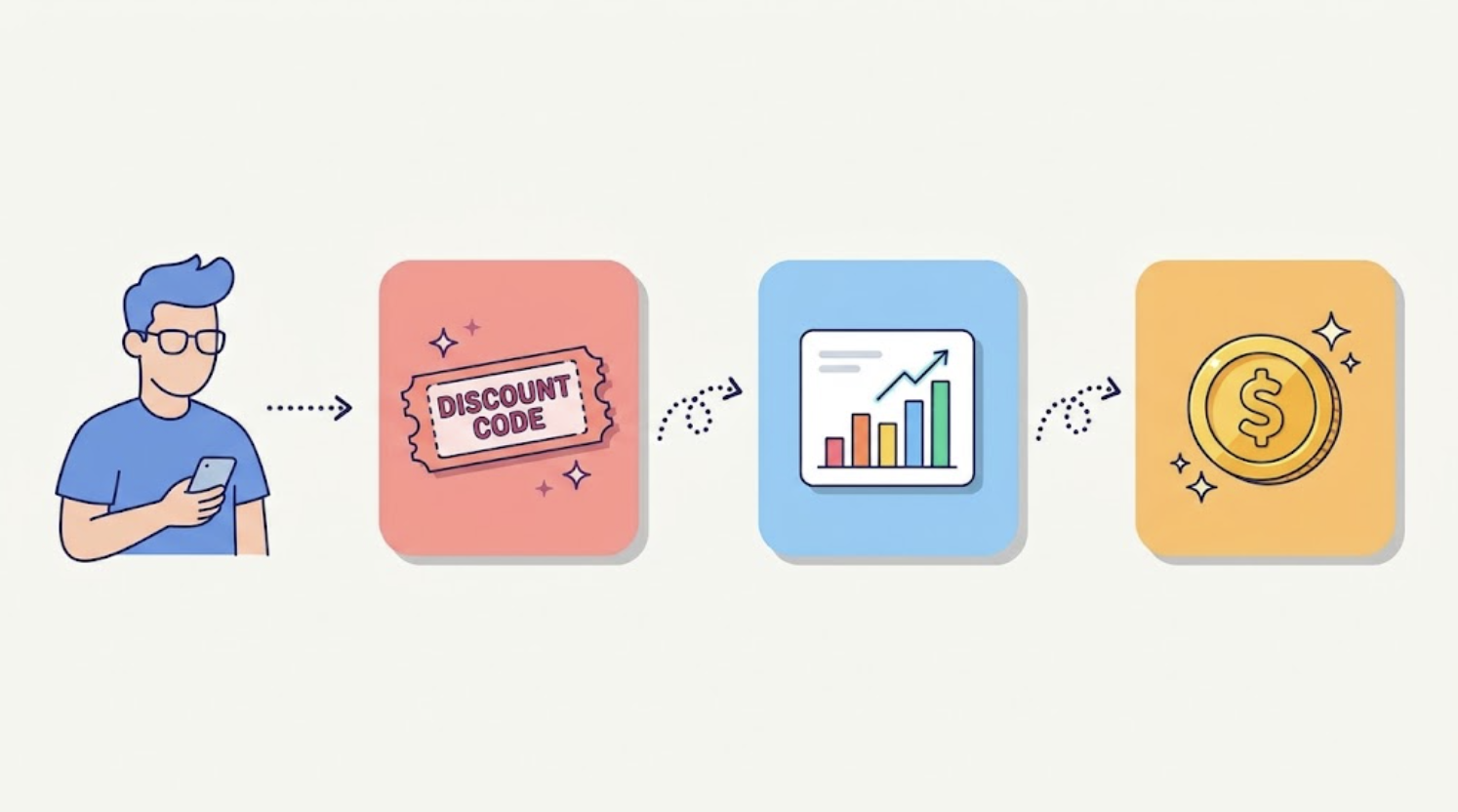
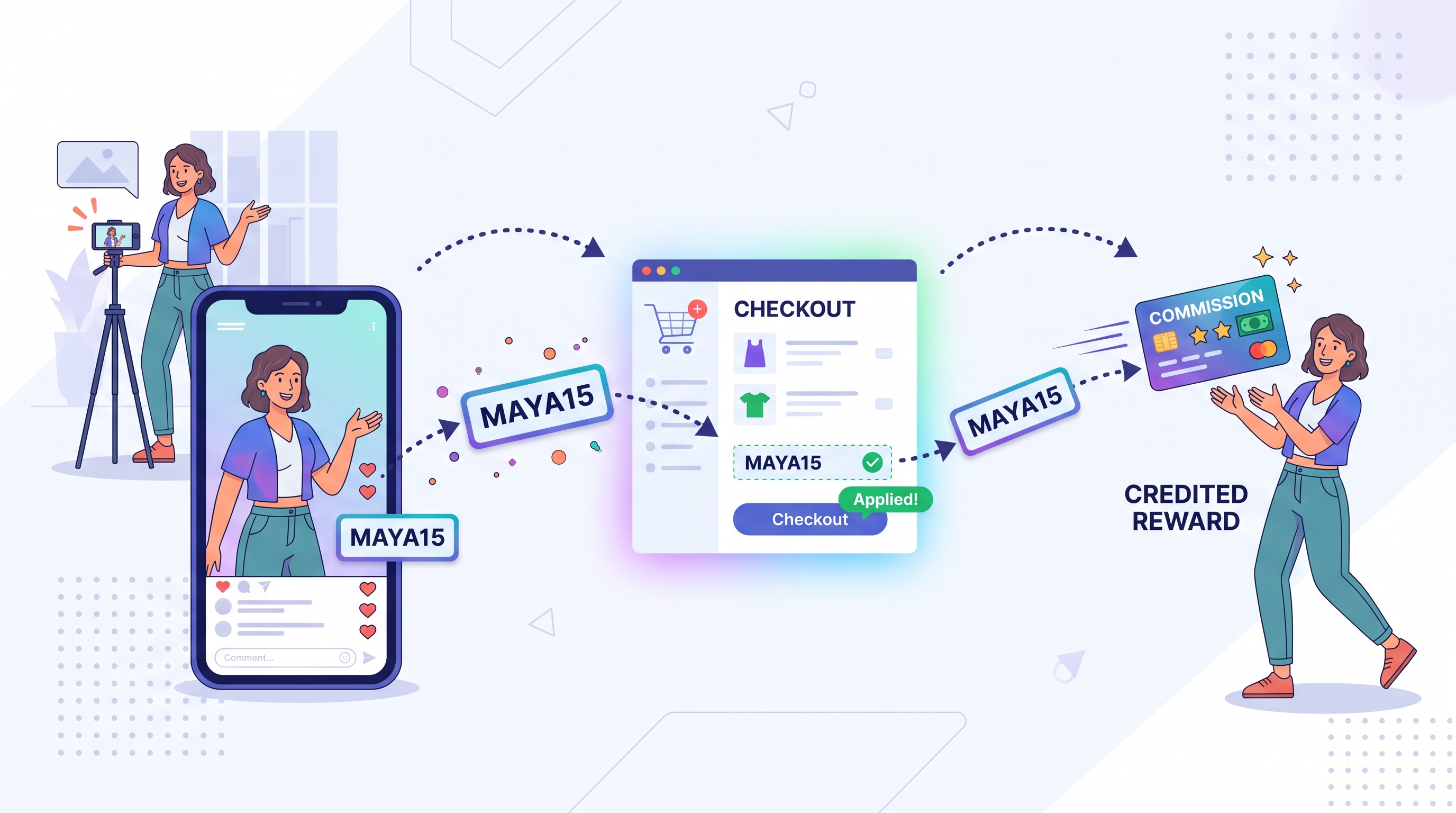
An influencer discount code is a short, memorable code, like MAYA15, that a creator shares with their audience. The customer types it at checkout, gets money off, and the sale is credited to the creator who shared it. That one line of text does three jobs at once. It gives the buyer a reason to act now, it tells you which creator earned the sale, and it gives you a clean basis for paying them.
That is why brands keep reaching for influencer codes, and why so many of them wince at the results of the first campaign. A code is easy to hand out and surprisingly easy to get wrong. The same code turns up on a coupon site. Nobody agreed whether commission is paid on the price before or after the discount. A refund lands three weeks later, after the creator has already been paid.
This guide follows a code through its whole life: how to create it, how to track it, how to pay for what it sells, what the FTC expects from you, and how to stop it leaking. Where Post Affiliate Pro does something specific, we say exactly what it does.
In short
- An influencer discount code (also called an influencer promo code) is a unique code that gives the customer a discount and credits the sale to one creator.
- Codes beat links when people cannot click: podcasts, video, stories, group chats and shop counters. Links beat codes when the customer clicks and buys in one go. Many programs run both.
- Give every creator their own code, with an expiry date and a use limit, so you can attribute sales and shut down a leaked code without touching anyone else’s.
- Decide how you pay before you launch: the commission base, the hold period and what happens on a refund or chargeback.
- Disclosure is your job as well as the creator’s. The FTC expects brands to train and monitor the people who promote them.
What is an influencer discount code?
An influencer discount code is a code, usually named after the creator or their audience, that a customer enters at checkout to get a discount. The code links the sale to that creator, so the brand can see what each partnership produces and pay commission on it.
You will also see it called an influencer promo code, an influencer coupon or simply an influencer code. They are the same tool. What changes the value is how the code is set up:
- A unique code per creator (SOFIA10, ALEX-GLOW) lets you attribute every sale and measure each partnership.
- A shared code for everyone (WELCOME10) is a marketing offer. It tells you nothing about who sent the customer.
- A vanity code is a unique code built from the creator’s name. It is easier to remember and says out loud, “this one is mine”, which is part of why audiences trust it.
Vanity formats, tiering and the exact setup inside Post Affiliate Pro are covered step by step in our personalized coupons guide, linked in step 4 below. This guide covers the program around the code.

Launch your affiliate program today
Set up advanced tracking in minutes. No credit card required.
Why do brands use influencer discount codes?
Brands use influencer discount codes because a code travels where a link cannot. A creator can say a code out loud in a podcast, flash it on screen in a video, drop it in a group chat or print it on a card. The customer can remember it and use it days later on a different device, and it still points back to the creator.
There is a second reason that gets less airtime. A discount is a nudge. Someone who already likes a creator and is nearly ready to buy often needs just a small push, and a code gives them that push with a little social proof attached.
The honest counterweight: a discount costs margin on every redemption, and some of those redemptions would have happened anyway. That is why the sections below on limits, leakage and commission matter more than the code itself.
Influencer discount code or affiliate link: which attributes sales better?
Neither wins everywhere. A link attributes best when the customer clicks it and buys in the same session. A code attributes best when the audience cannot or will not click. Many programs do best with both, and a clear rule for which one decides the credit when both appear on the same sale.
| Situation | Affiliate link | Discount code |
|---|---|---|
| Customer clicks from a post and buys straight away | Works well | Works, if they also type the code |
| Audience hears about you in a podcast or video | Hard to use | Works, because it can be spoken |
| Customer returns days later on another device | The referral can be lost | Works if they remember the code |
| Platform hides or buries the link | Weak | Works, since nothing needs clicking |
| Customer hunts for a deal at checkout | Another source can overwrite the referral | The code owner is credited |
| In-person or offline sale | Not applicable | Works with a code at the till |
The two are not rivals. A link tells you where the click came from. A code tells you who persuaded the customer. Running both gives you two signals instead of one.
What matters is the tiebreaker. In Post Affiliate Pro, when a sale carries a valid coupon, the affiliate who owns the coupon is credited ahead of any link or cookie referral on that sale, and the transaction is recorded with the coupon as its tracking method. If you want the background on how credit is decided in general, the glossary entry on attribution tracking explains the models.
Join our newsletter
Be the first to know about new features and product updates.
How do brands create influencer discount codes?
Brands create influencer discount codes in two places that have to match: the store, where the discount actually applies, and the tracking software, where the code is tied to a creator. Choose the offer, choose the code format, set limits, then create the codes in both systems.
Step 1: decide the offer
Pick the discount before you pick the code. A percentage off, a fixed amount, free shipping and a minimum order value each change your margin differently. Work out your break-even before a creator posts anything, because the discount comes out of the same pot as the commission.
Step 2: choose a code format
Short and speakable beats clever. Audiences often have to type a code from memory after hearing it once, so avoid characters that get confused (the letter O and the number 0) and keep the code to something a creator can say in one breath. A name plus a number (MAYA15) is the classic for a reason.
Step 3: set the limits
Every code should have guardrails. Your store platform probably offers some of them. Shopify, for example, lets you cap the total number of times a code can be used and limit it to one use per customer, and it allows a cumulative maximum of 20,000,000 unique discount codes per store (Shopify Help Center ). Add an expiry date to each code as well. A code with no end date is a code that will still be circulating next year.
Step 4: create the codes in your tracking software
Create each code in your affiliate software too, assign it to its creator and give it the same limits you set in the store. In Post Affiliate Pro, coupons are a feature called Coupons and Offline Sales. It is included in the Pro, Ultimate and Network plans but not in Starter, and you switch it on under Configuration, Features. You can generate codes in bulk from a format, paste a list or import a CSV that names each affiliate, and a plugin can create a code for every new affiliate.
The coupon record holds the code, status, dates, use limit and owner. The discount itself lives in your store, so the two codes must match exactly. Our personalized coupons guide walks through every setting, and the Post Affiliate Pro discount coupons page gives the feature overview.
How do you track influencer discount codes?
You track influencer discount codes by giving each creator a unique code, passing that code to your tracking software when the order is placed, and reviewing sales by code. The code on the order is what ties the sale to the creator, with or without a click.
Here is the flow in plain terms:
- The customer enters the code at checkout and the store applies the discount.
- Your checkout reports the order to the tracking software and includes the code.
- The software checks that the code is valid: approved, inside its dates and under its use limit.
- If it passes, the creator who owns the code is credited and a commission is recorded.
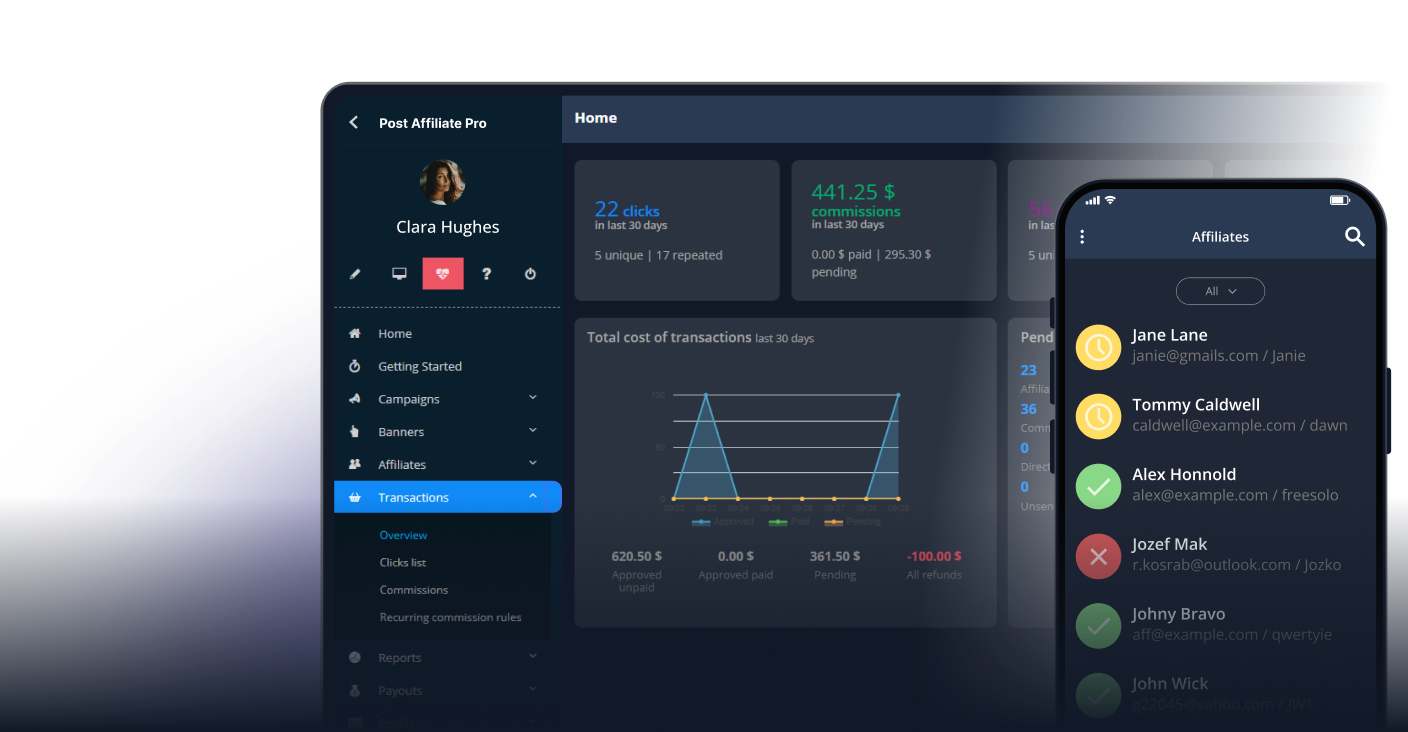
After that you can review sales by code. Post Affiliate Pro adds a Coupon Code column and filter to the transactions list for exactly that.
Tracking offline and spoken codes
A podcast read or a video shout-out produces sales with no click anywhere. If the order carries the code, it tracks like any other. Sales that never touch your online checkout need a different route, and our guide to tracking offline affiliate sales covers that case.
What to measure per creator
Redemptions alone flatter every campaign. These numbers tell you whether a creator is actually worth keeping:
| Metric | What it tells you |
|---|---|
| Orders per code | The raw reach of the partnership |
| Share of orders from the code vs the link | Whether this audience clicks or types |
| New vs returning customers on the code | Whether you are buying customers or giving existing ones a discount |
| Refund and chargeback rate per creator | Whether the sales stick |
| Discount cost plus commission per order | What a sale really costs you |
How do you pay influencers on discount codes?
You pay influencers on discount codes by fixing three things in writing before launch: what commission is calculated on, when it becomes payable, and what happens if the order is refunded. The structure itself can be a percentage of sales, a flat fee, or a mix of the two.
Commission base. Decide whether commission is calculated on the price the customer actually paid or the price before the discount. The only wrong answer is leaving it vague, because the creator and your finance team will each assume a different one.
Hold period. Do not pay on the day of the sale. Hold payment until your return window has closed. In Post Affiliate Pro, commissions can be set to need manual approval, so you can approve them once the return window has passed.
Refunds and chargebacks. Plan for reversals before they happen. Post Affiliate Pro records a refund as a negative transaction that reverses the commission, records chargebacks as their own transaction type, and has a setting that controls how refund requests are processed. Details are on the refunds and chargebacks feature page, and the glossary entry on a chargeback explains how a reversal reaches the creator’s earnings.
Structure. Some brands pay commission only, some pay a flat fee for the post and add commission on top. Which one fits depends on the creator’s size and your margin. Our guide to influencer rates compares flat fee, commission and hybrid deals, so this guide stays on how the code itself is handled.
What does the FTC say about influencer discount codes?
The FTC says a personalized discount code may not be enough on its own to tell people that a creator is paid. If a significant minority of the audience may not understand that the creator earns money when the code is used, the creator should add a clearer disclosure (FTC ).
That guidance sits inside a bigger point for brands. The FTC says advertisers need reasonable programs in place to train and monitor the people in their network, and that sending training material alone is important but not enough. The Endorsement Guides themselves say that an advertiser may be liable for a deceptive endorsement even when the endorser is not (16 CFR 255.1 ). And material connections, which include payment or free or discounted products, must be disclosed clearly and conspicuously when the audience would not expect them (16 CFR 255.5 ).
In practice, that means four habits:
- Put disclosure wording in the brief and the contract, not just in your good intentions.
- Show creators examples of acceptable and unacceptable disclosures.
- Check posts from time to time, especially in the first weeks of a partnership.
- Act when something is wrong: ask for a fix, and escalate if it keeps happening.
This is US guidance and not legal advice. If you sell into other countries, check the advertising rules there too.
How do you stop influencer discount codes from leaking?
You stop influencer discount codes from leaking by making each code unique to one creator, limiting how long and how often it works, and checking where it appears. You cannot make a code impossible to share, so the goal is to keep a leak cheap and easy to shut down.
Codes tend to travel. A good code gets screenshotted, reposted and eventually listed on a coupon site, and from then on it is available to people who never saw the creator. Every one of those redemptions costs you the discount, and the creator is credited for it, so you pay commission on sales they did not drive.
Practical defences:
- Unique code per creator, so a leak points at one source and can be switched off alone.
- Expiry dates and use limits on every code. In Post Affiliate Pro each coupon can have a validity window and a limit on how many sales can use it, and you can decline a coupon by changing its status.
- One use per customer where your store platform supports it.
- Search your own code names now and then. It takes a minute and often finds the leak first.
- Refresh codes between campaigns instead of recycling the old ones.
There is a second option, and it is a business decision: if coupon sites are going to list your codes anyway, bring the relevant ones in on your terms. A coupon affiliate with their own tracked code is easier to measure than an unknown source, and you decide the commission. The question to ask is the same one behind brand bidding : is this partner bringing you customers, or only collecting commission on customers you already had?
How do influencer discount codes work with product seeding?
Influencer discount codes work well with product seeding because the code gives the creator something to offer the audience along with the free product. Put a unique code in every seeding kit, and you can later see which creators turned a free product into paying customers.
The two have different jobs. Seeding builds awareness and content; the code turns attention into a trackable sale. Our guide to product seeding covers the seeding side.
Common mistakes with influencer discount codes
- One shared code for every creator. You get sales and no insight.
- No expiry date. The code outlives the campaign and the creator.
- Commission on the wrong base. Nobody agreed whether it is before or after the discount.
- Paying immediately. The refund comes after the money has gone.
- A code in the software and a different code in the store. The text has to match exactly, or the sale is untracked.
- Treating the code as the whole program. Codes need a brief, disclosure guidance and a review habit around them.
- A discount that quietly eats the margin. Do the arithmetic before launch, not after.
A launch checklist
- Set the offer and calculate your break-even.
- Create one unique code per creator, with an expiry date and a use limit.
- Create the matching code in your store and in your tracking software.
- Confirm the checkout passes the code to the tracking software.
- Run a test order with each code before anything goes live.
- Write down the commission base, hold period and refund rule.
- Send creators a brief with disclosure wording and examples.
- Review redemptions, refunds and discount cost by creator after the first two weeks.
Make every code count
A discount code is a small thing that carries a lot of weight. It persuades the customer, identifies the creator and sets the terms of the payout. Get the setup right and you learn which partnerships are worth growing. Get it wrong and you are paying for discounts and commission on sales nobody can explain.
If you want codes that are tied to creators, tracked on every sale and reversed when an order is refunded, try Post Affiliate Pro free and set up your first creator code.