



How much can beginners make in affiliate marketing in 2026
How much can beginners make in affiliate marketing in 2026? A realistic, source-checked breakdown of beginner affiliate marketing income, timelines, and what ac...
13 min read
What affiliate marketers actually earn at every experience level, which niches pay the most, and what separates a $600 month from a $10,000 one.
Ask ten different affiliate marketers what they make and you’ll get ten different answers, and all of them can be true at once. Someone six months in might be counting their first $80 commission like it’s a milestone, while someone five years into the same niche is running it like a real business with a team behind them. Both are “affiliate marketers.” The gap between them is almost entirely explained by time, strategy, and a handful of decisions made early on.
The industry itself has plenty of room for both. The global affiliate marketing market is on track to pass $20 billion in 2026 and reach $27.78 billion by 2027 (Source ), so the opportunity isn’t shrinking. What matters more for any individual affiliate is understanding realistically where they sit in that range, and what it actually takes to move up a tier.
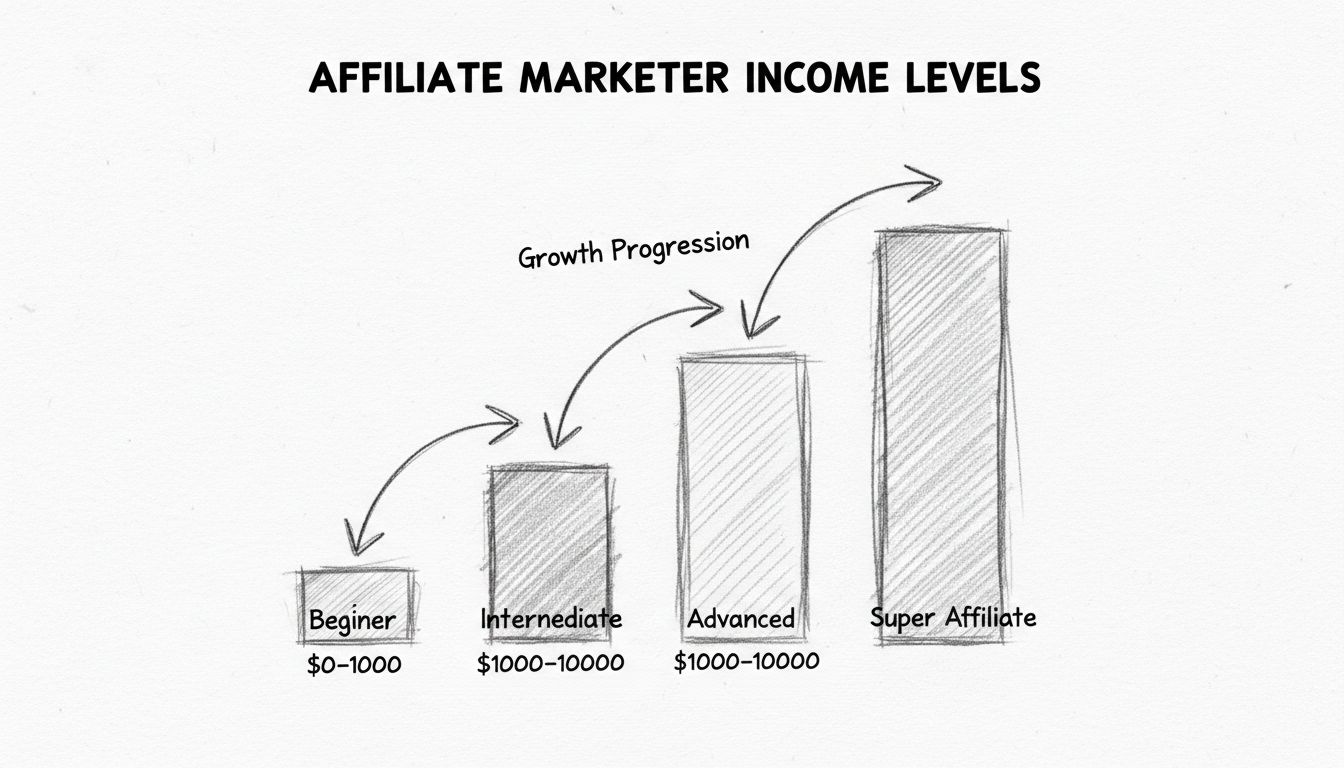
Experience is the single biggest factor in how much an affiliate marketer earns, and the progression tends to follow a fairly consistent pattern. Beginners, typically in their first year, earn between $0 and $1,000 a month while they’re still learning the basics, building a platform, and figuring out their audience. Most earn little to nothing for the first six to twelve months, which is a normal part of the process rather than a sign something’s wrong. Our dedicated guide on beginner affiliate marketers walks through that first year in much more detail.
Intermediate affiliates, generally one to three years in, earn between $1,000 and $10,000 a month. This tier represents a real jump from beginner earnings, and it usually reflects a marketer who has found a working traffic source, refined their content, and started to understand which products their audience actually responds to. According to a survey of more than 2,000 affiliate marketers by Authority Hacker, affiliates with one to two years of experience average $4,196 a month, nearly seven times the beginner figure (Source ).
Advanced affiliates, usually three to five years in, earn between $10,000 and $100,000 a month, averaging $10,789. At this stage, most have built real authority in their niche, developed relationships with better-paying programs, and often run more sophisticated campaigns across multiple channels rather than relying on one.
Super affiliates, typically with a decade or more of experience, average over $44,000 a month, with plenty earning well into six figures monthly. Most have diversified beyond straight commissions too, adding their own products, sponsorships, or consulting alongside their affiliate income.

Set up advanced tracking in minutes. No credit card required.
Averages can be misleading in a field this skewed, so it helps to look at the full distribution. About 80% of affiliate marketers earn under $80,000 a year, 15% earn between $80,000 and $1 million, and roughly 1% clear $1 million annually (Source ). The often-quoted $8,038-a-month average sits well above what most affiliates actually take home in a given month, precisely because that small top tier pulls the number upward. A more honest way to read it: reaching a genuinely high income is possible, but it’s the outcome of years of compounding work rather than something most people hit in their first year or two.
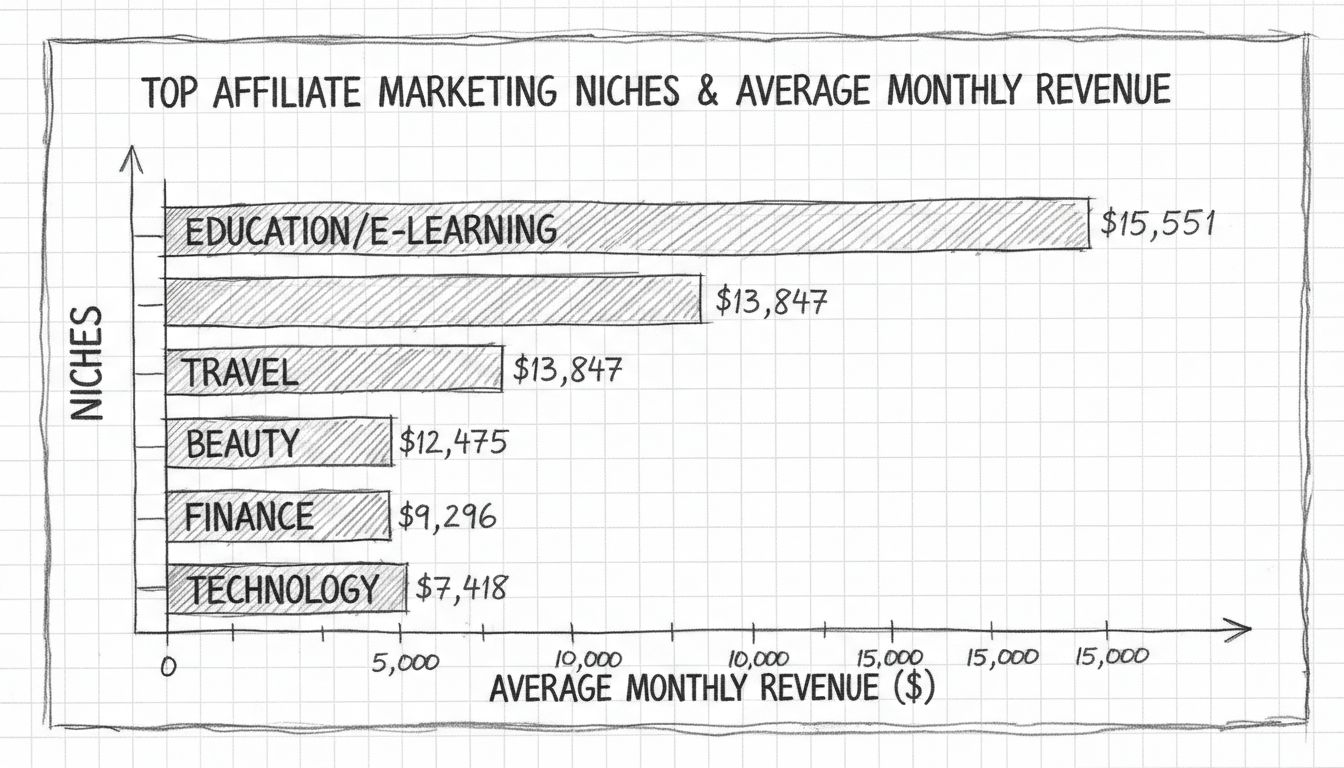
Niche choice sets both your commission ceiling and how much competition you’ll face, so it’s worth understanding where the money actually concentrates. These figures come from the same Authority Hacker survey referenced above (Source ):
| Niche | Average monthly income | Typical commission range | What drives it |
|---|---|---|---|
| Education and eLearning | $15,551 | 15% to 30% | High-ticket courses, often recurring |
| Travel | $13,847 | 10% to 15% | Expensive bookings, seasonal demand |
| Beauty and skincare | $12,475 | 10% to 30% | Repeat purchases, strong influencer fit |
| Finance and investment | $9,296 | 20% to 40% | High customer lifetime value |
| Digital marketing | $7,217 | 10% to 50% | Growing B2B demand |
| Technology | $7,418 | 5% to 20% | High traffic volume, heavy competition |
| Health and wellness | $7,194 | 10% to 50% | Evergreen demand across many sub-niches |
| E-commerce and software | $5,967 | 20% to 70% | Often recurring, SaaS-driven |
| Home and garden | $5,095 | 2% to 10% | Seasonal, lower commissions |
Education and eLearning leads the pack largely because course platforms charge more per sale and frequently pay recurring commissions on subscriptions. Finance pays well too, but it demands real credibility since you’re influencing decisions about someone’s money, which makes it a harder niche to break into quickly than the commission rate alone would suggest. Software and SaaS programs sit lower on average revenue here but carry the widest commission range of the group, up to 70% on some plans, plus the kind of recurring payouts that keep arriving as long as the referred customer stays subscribed.
Be the first to know about new features and product updates.
The channel an affiliate relies on shapes both how fast they can expect results and how sustainable those results are. SEO is by far the dominant strategy, used by close to 4 in 5 affiliate marketers, because once a page ranks, it keeps generating traffic and commissions with very little ongoing effort (Source ). The tradeoff is time. SEO-driven traffic typically takes six to twelve months to become consistent, which is exactly why so many beginners give up before it kicks in.
Social media and blogging both play a strong supporting role, with roughly two-thirds of affiliate marketers using each. Social platforms can generate sales much faster, sometimes within weeks, but they carry more platform risk since an algorithm change can cut traffic overnight.
Email marketing tends to punch above its weight for the affiliates who build a list early, since subscribers who opted in to hear from you convert at a noticeably higher rate than cold traffic, and email remains one of the highest-return channels in marketing generally, with returns commonly cited around $36 to $40 for every dollar spent.
Paid advertising can accelerate results for affiliates who already know their numbers, but it requires real ad spend and a working conversion funnel before it becomes profitable rather than just fast. Most affiliates who reach the higher income tiers aren’t relying on a single channel. They’re combining two or three, so an algorithm shift on any one of them doesn’t wipe out their income.
A handful of variables account for most of the difference between a mediocre month and a great one.
Commission structure sets your ceiling per sale. Cost-per-sale programs typically pay 5% to 75% depending on the product, cost-per-lead programs commonly pay $5 to $100 per qualified lead, and cost-per-click programs pay a small amount, often $0.10 to $5, for every click regardless of whether it converts. Recurring commissions from SaaS products tend to build the most stable long-term income of the three, since a single referral keeps paying out every month the customer stays subscribed. Our guide on how affiliate marketers get paid goes deeper into how each of these models actually reaches your bank account.
Niche selection determines your market size and how much competition you’re up against, and the niches with the biggest customer lifetime value usually attract the most experienced affiliates chasing the same audience.
Traffic quality matters more than traffic volume. A smaller audience that’s genuinely interested in your niche will consistently outconvert a much bigger but less targeted one, and mobile now accounts for around half of all affiliate traffic, which makes a mobile-friendly site less optional than it used to be.
Conversion rate optimization can move the needle without adding a single new visitor. Testing your link placement, your calls to action, and how directly your content addresses a reader’s hesitations can meaningfully change how many visitors actually click through and buy.
Experience compounds all of the above. The longer you’ve been doing this, the faster you can spot what’s working, avoid costly mistakes, and scale the campaigns that are already paying off.
Affiliate marketing keeps expanding at a pace most digital channels would envy. The global market is projected to grow at roughly a 15.44% compound annual rate, from just over $20 billion in 2026 to $38.35 billion by 2030 (Source ). In the US specifically, spending reached $12.42 billion in 2025 and climbed to $13.81 billion in 2026, an 11.3% year-over-year increase (eMarketer ). Brand adoption is a big part of what’s fueling that growth: 84% of brands now run an affiliate program, up from 81% not long ago (Source ). More brands running programs means more options for affiliates to find one that actually fits their niche, rather than settling for whatever’s available.
Two other shifts are worth watching. Roughly 79% of affiliate marketers are already using AI tools somewhere in their workflow, from content drafting to campaign optimization (Hostinger ), and mobile devices now account for around half of all affiliate traffic, with over 70% of conversions happening on a phone (WeCanTrack ).
Neither trend changes the fundamentals of what earns money, good content and real audience trust, but both are quietly raising the bar for what “competitive” content looks like. For the fuller picture of where this industry is headed, see our breakdown of the affiliate marketing industry’s size and growth .
A few habits separate affiliates who steadily climb the income tiers from those who plateau.
If you’re on the other side of these programs, deciding how to pay affiliates rather than earning from one, the same commission choices affiliates weigh here directly shape how long they stick around. Our guides on recurring versus flat-rate commissions , affiliate onboarding , and affiliate churn and inactive affiliates cover that side of the equation, and our walkthrough on tracking affiliate earnings and commissions in Post Affiliate Pro shows you exactly where to find these numbers for your own program.
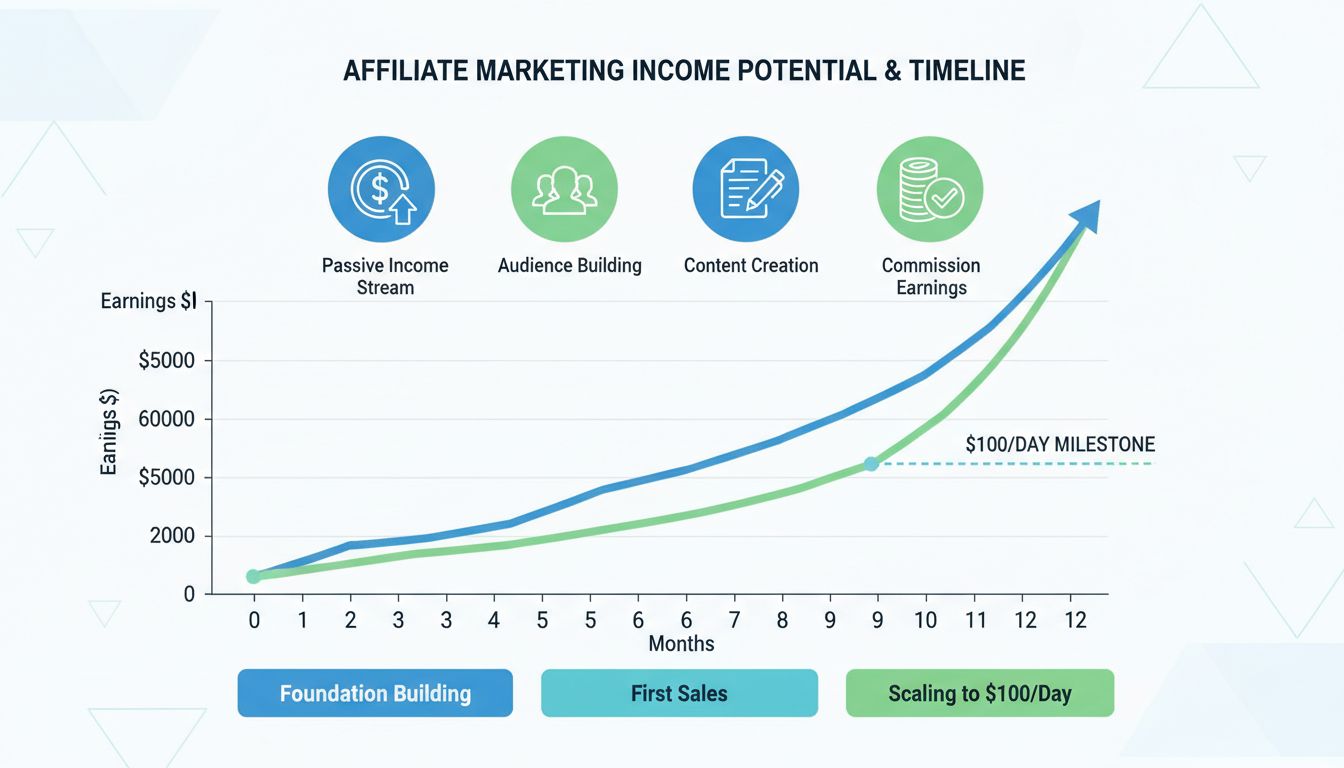
Most affiliates who go on to earn a real income follow a fairly similar arc. The first three months are almost entirely setup, building a website or channel, creating early content, and joining programs, with little to no income to show for it yet. Months four through six usually bring the first sales as early content starts to rank or gain traction, though earnings are still modest. By months seven through twelve, if the effort has been consistent, monthly income commonly settles into the $100 to $500 range. Year two is typically where the real acceleration shows up, often reaching $1,000 to $2,000 a month as the content library and audience trust compound. From year three onward, affiliates who’ve kept refining their approach frequently cross into the $10,000-plus range, backed by real authority and access to better-paying partnerships.
That first quiet stretch is also exactly when most people quit, well before any of the above has a chance to play out. If that’s where you are right now, our guide on not giving up on affiliate marketing is worth reading before you decide anything.
Affiliate marketing income spans an enormous range, from $0 for someone just starting out to well over $100,000 a month for the small group of super affiliates at the top. Niche selection, traffic strategy, and commission structure all shape where you land in that range, but experience is what ties them together, since it’s what lets you get better at all three at once.
There’s no shortcut around the first year or two of modest earnings. What the data does show is that affiliates who stick with it, diversify their traffic, and keep refining their approach tend to see real, compounding income growth well beyond what their first year looked like. If you’re weighing whether that trade-off is worth making at all, is being an affiliate worth it covers that decision on its own terms.
PostAffiliatePro provides the most advanced affiliate management platform to help you track, optimize, and maximize your affiliate marketing earnings. Manage unlimited affiliates, real-time commission tracking, and powerful analytics to grow your revenue faster.
How much can beginners make in affiliate marketing in 2026? A realistic, source-checked breakdown of beginner affiliate marketing income, timelines, and what ac...
Discover if affiliate marketing is worth your time and effort. Learn realistic income expectations, timeline to profitability, and proven strategies to build pa...

proven strategies to earn $10,000 monthly with affiliate marketing. niche selection, traffic generation, and conversion optimization techniques used by
Join our community of happy clients and provide excellent customer support with Post Affiliate Pro.




Cookie Consent
We use cookies to enhance your browsing experience and analyze our traffic. See our privacy policy.