


What is Customer Churn Rate? Definition, Calculation & Strategies to Reduce It
Learn what customer churn rate is, how to calculate it, and discover proven strategies to reduce churn and improve customer retention in 2025.
8 min read

Affiliate churn explained with real benchmark data, the early warning signs an affiliate is about to go inactive, and what actually works to keep your best partners engaged.
Every affiliate program manager has seen this pattern. You approve a new affiliate, they seem genuinely excited, and then three weeks later their dashboard shows zero clicks and zero logins. They never officially quit. They just quietly stopped.
That quiet stopping is affiliate churn, and it is a far bigger part of running a program than most people budget time for. Understanding how much of it is normal, why it happens, and how to catch it early is worth more to most programs than another round of affiliate recruitment.
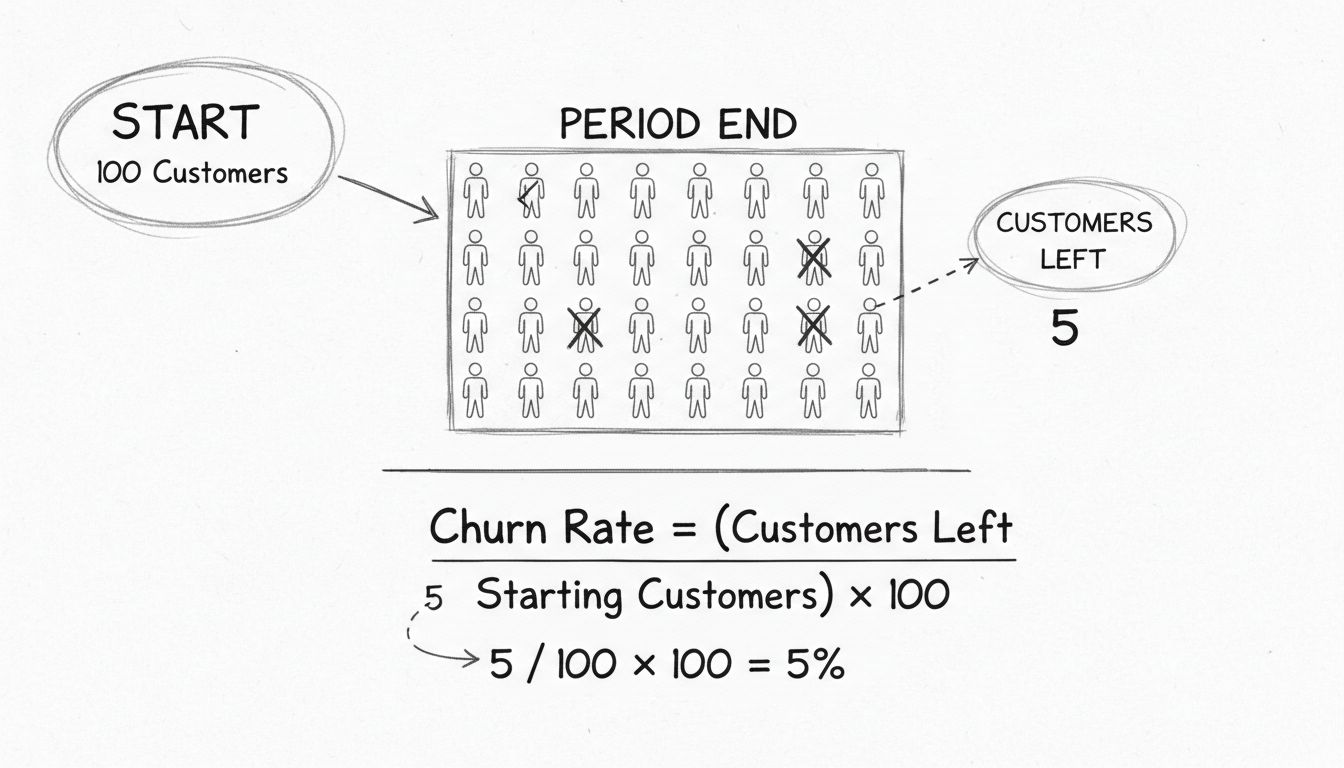
Before comparing your program to any benchmark, it helps to know your own number, and the formula is simple.
Affiliate churn rate equals affiliates lost during a period, divided by the number of active affiliates at the start of that period, multiplied by 100.
Say you started the quarter with 200 active affiliates and 24 of them went fully inactive by the end of it. That is 24 divided by 200, multiplied by 100, which comes out to a 12% quarterly churn rate. Run that same math monthly, quarterly, or annually depending on how often you want to check in (just make sure you are not folding newly recruited affiliates into your starting count, since that understates the real number).
If you would rather skip the arithmetic, Post Affiliate Pro’s churn rate calculator runs the same formula for you and is worth bookmarking for a quick monthly check.
According to benchmarking from GrowSurf, the average affiliate program experiences around 30% annual churn (GrowSurf ). In practice, that means if you do nothing else all year, roughly a third of your currently active affiliates will stop producing by the time the year is out.
That is not a sign your program is failing. It is closer to a baseline fact of how affiliate relationships work, similar to how any sales team expects some level of attrition. The takeaway is not to panic over the number, it is to plan around it, since ongoing recruitment has to be a permanent part of running a program rather than a one-time setup task.

Set up advanced tracking in minutes. No credit card required.
Here is the number that tends to surprise new program managers the most. Top-performing affiliate programs typically see just 5% to 10% of their affiliates generating 80% to 90% of total program revenue (GrowSurf ).
This is the Pareto principle showing up almost exactly as it does everywhere else in business. A small core of genuinely engaged affiliates carries the overwhelming majority of your results, while a much larger group signs up, tries briefly or not at all, and never becomes a meaningful contributor.
This matters for how you spend your time. If 90% of your affiliates are contributing close to nothing, chasing every single inactive account with equal urgency is not a good use of your attention. The better approach is triage: protect and grow your top 5% to 10% aggressively, run a light-touch, mostly automated re-engagement process for the long tail, and accept that a meaningful share of any affiliate base was never going to be active regardless of what you did.
Affiliate disengagement rarely comes from one dramatic event. It is almost always a slow fade, and the reasons tend to repeat across programs.
Some affiliates join with real enthusiasm and simply underestimate the effort involved. Producing content, building an audience, or driving consistent traffic takes longer than a quick signup suggests, and momentum fades once the first week of effort does not produce an immediate payout.
Others get discouraged by friction in the program itself. A confusing commission structure, a slow first payout, or a dashboard that makes it hard to see how they are actually performing all quietly push a borderline affiliate toward disengagement.
A smaller group churns for reasons entirely outside your control: they moved on to a different niche, shut down their site, or simply lost interest in affiliate marketing as an income source. These are not fixable, and treating your churn rate as if every lost affiliate represents a retention failure will misdirect your effort.
Be the first to know about new features and product updates.
Affiliate churn rarely happens without warning. The signals just tend to be easy to miss if nobody is actively watching for them.
A drop in dashboard logins is usually the earliest sign. An affiliate who checked their stats weekly and suddenly stops looking at all is disengaging, even if their existing links are technically still live.
A decline in click volume that is not explained by anything on your end is another strong signal, especially when it happens gradually rather than all at once. Gradual decline usually means an affiliate is slowly deprioritizing your program in favor of something else, rather than experiencing a technical issue.
Timing matters too. Disengagement that follows shortly after a slow payout, a confusing commission change, or an unanswered support question is rarely a coincidence. These moments are exactly when a borderline affiliate decides whether continuing is worth the effort.
None of these signals alone is definitive. But two or three together, especially clustered around a specific friction point, are worth treating as an active retention opportunity rather than a stat you notice in a monthly report.
Lumping every affiliate into one churn number hides a lot of what is actually going on, since different types of partners tend to show disengagement in different ways, even without hard data yet on which segment churns fastest overall.
Coupon and deal site affiliates are a genuinely large part of the industry. Discount and coupon publishers account for roughly 42% of US affiliate revenue, the single biggest publisher category (eMarketer ). It would not be surprising if some of these partnerships are tied closely to a specific seasonal promotion or keyword ranking, where a slipping rank or an ended promotion weakens the relationship faster than it would for an affiliate whose value comes from an ongoing audience. Worth watching for in your own data rather than assuming it holds true across the board.
Content affiliates, the bloggers and review site owners, tend to show disengagement more gradually, and there is real evidence behind that pattern. Search Engine Land documents “content decay” as a well-established phenomenon, where aging posts lose relevance as competitors publish fresher pages and search intent shifts, causing organic traffic to fade even without the affiliate doing anything differently. The effect can be severe: one affiliate site, HouseFresh, reportedly lost 91% of its organic traffic after a single Google core update in March 2024 (Search Engine Land ). A content affiliate rarely disappears overnight, but their published content going unmaintained can still quietly turn into a churn problem by the time it shows up in your click reporting.
Influencer partnerships are harder to generalize about. In practice, a creator moving into a different niche or simply posting less often tends to show up in your data as declining referrals well before any formal disengagement, so that pattern is worth watching for in your own numbers rather than assuming one universal timeline.
The practical takeaway is not a fixed ranking of which affiliate type churns fastest. It is that segmenting your own churn analysis by affiliate type, rather than looking at one blended number, will very likely reveal a different early warning sign and a different fix for each group in your specific program.
The programs that retain affiliates well tend to share a few specific habits, rather than one single trick.
Fast, reliable payouts build trust quickly, and trust is most of what keeps a borderline affiliate engaged past their first few months. Transparent, self-serve reporting matters almost as much, since affiliates who can see their own performance clearly are far less likely to disengage out of confusion or uncertainty.
Timing is the biggest lever most programs underuse. Reaching out to an affiliate the week their activity starts dropping works far better than reaching out after three months of silence. By that point, re-engagement is a much harder sell than simple retention would have been.
If you are looking for concrete tactics rather than just principles, our guides on keeping affiliates from dropping out and motivating inactive affiliates with targeted outreach go deeper into specific email sequences and incentive structures that work. Our piece on dashboard features that support engagement and retention covers the reporting and visibility side in more detail.
Affiliate churn is really just the other half of affiliate lifetime value . Every additional month an affiliate stays active before churning out adds directly to how much they are worth to your program overall.
That connection is worth keeping in mind whenever churn feels like an abstract metric rather than a real cost. A 30% annual churn rate is not just a retention statistic. It is 30% of your affiliate lifetime value walking out the door every year, which makes catching disengagement early one of the highest-leverage things a program manager can spend time on.
For the wider data behind why retention matters this much across the affiliate industry, see the full affiliate marketing statistics roundup for 2026 .
Tamara is a copywriter at Post Affiliate Pro. She's passionate about helping businesses and marketers understand how affiliate programs can drive growth, one blog post at a time.

Post Affiliate Pro tracks affiliate activity automatically and flags accounts that are going quiet, so you can re-engage a partner before they churn out completely.
Learn what customer churn rate is, how to calculate it, and discover proven strategies to reduce churn and improve customer retention in 2025.

No new dashboard needed. Here are 7 everyday signs your affiliate program has quietly stopped growing, and what to do the moment you notice them.

Learn proven strategies for selecting high-quality affiliates. Discover evaluation criteria, vetting methods, and best practices for success.
Join our community of happy clients and provide excellent customer support with Post Affiliate Pro.



Cookie Consent
We use cookies to enhance your browsing experience and analyze our traffic. See our privacy policy.