


Affiliate marketer earnings: a complete income guide
What affiliate marketers actually earn at every experience level, which niches pay the most, and what separates a $600 month from a $10,000 one.
10 min read

How much can beginners make in affiliate marketing in 2026? A realistic, source-checked breakdown of beginner affiliate marketing income, timelines, and what actually moves the needle.
Most people who start affiliate marketing spend their first few months publishing content into what feels like silence. No sales, no comments, barely any traffic. It is not a sign that the model is broken. It is just what month one looks like for almost everyone who eventually makes money at this.
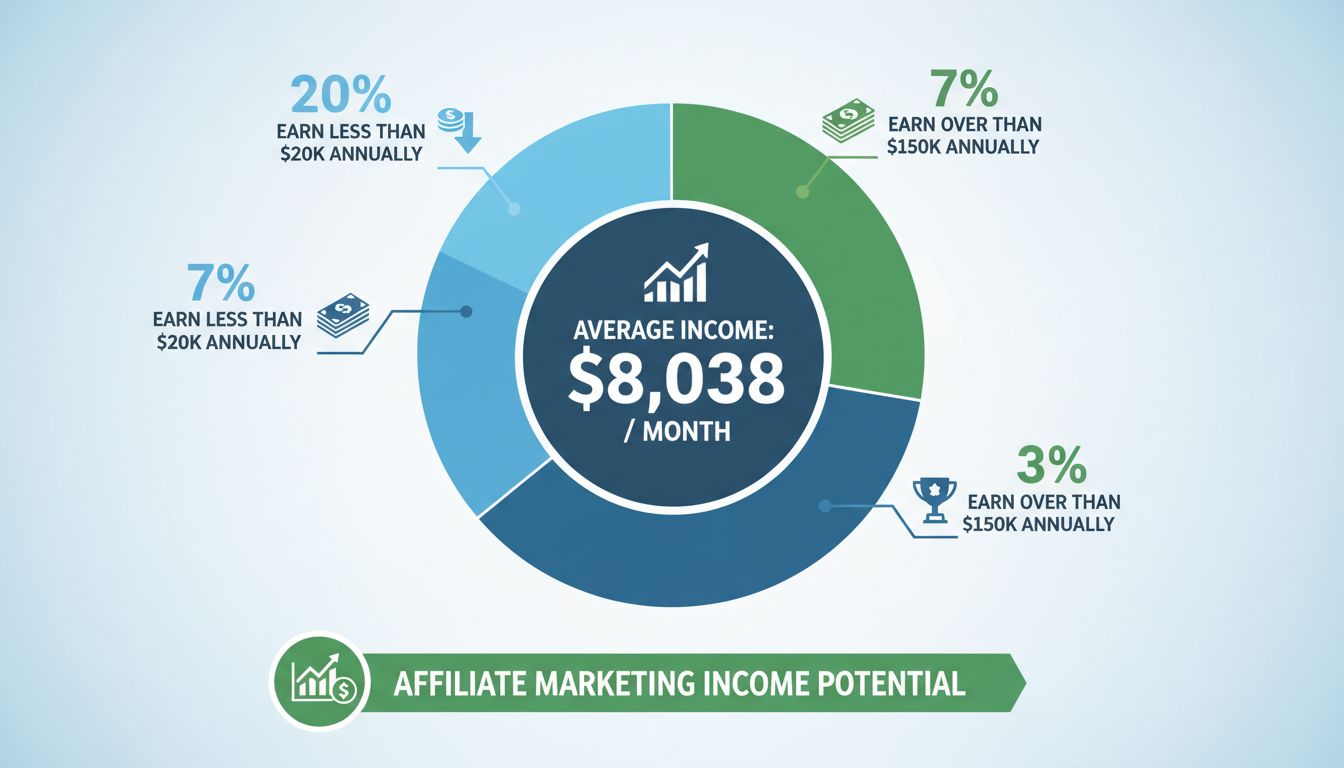
So how much can beginners make in affiliate marketing? Realistically, somewhere between $0 and $1,000 a month during year one, with most people settling closer to $300 to $500 a month by month twelve. That range lines up with a survey of more than 2,000 affiliate marketers run by Authority Hacker, one of the more frequently cited data sets in the industry (Source ). Zoom out to include every experience level, not just beginners, and the average affiliate marketer earns around $8,038 a month, though that figure is stretched upward by a small number of high earners the same way average income statistics usually are. A more grounded way to read it: roughly 4 in 10 affiliate marketers make under $1,000 a month at any given time, while those with one to two years of consistent effort average $4,196 a month, nearly seven times the typical beginner figure (Source ).
None of this is a promise. What you actually earn depends on the products you promote, the commission rates those merchants pay (commonly somewhere between 5% and 30%, though some digital products pay far more), and how many people you can put in front of a genuinely relevant offer. For a closer look at exactly how those payouts reach you, percentage of sale, flat fee, or recurring, see our breakdown of how affiliate marketers get paid . What tends to separate people who eventually earn a real income from people who quit is not talent. It is whether they treat the first six months as an investment period rather than a paycheck.
If you’re still deciding whether any of this is worth attempting in the first place, our guide on is being an affiliate worth it walks through that decision directly, weighing the realistic timeline against what it actually costs you in time and effort.

Affiliate income tends to move in stages rather than a smooth upward line, and knowing roughly where you sit helps you set expectations that won’t burn you out.
| Experience level | Monthly income range | Typical timeline | What’s actually happening |
|---|---|---|---|
| Beginner | $0 to $1,000 | Year one | Learning the basics, publishing content, building the first audience |
| Intermediate | $1,000 to $10,000 | Years one to three | Traffic compounding, content library growing, first optimizations paying off |
| Advanced | $10,000 to $100,000 | Years three to five | Established authority, multiple programs, real audience trust |
| Super affiliate | $100,000+ | Five years and beyond | Diversified income, negotiated rates, often a small team |
Most beginners spend that first year learning far more than they earn: how to write for an audience, how affiliate links actually convert, what their readers respond to. By year two or three, the content built during that quieter stretch starts compounding, which is usually the point where income crosses into the intermediate range. Getting from intermediate to advanced is less about writing more and more about building real authority, tightening conversion rates, and often adding paid traffic to the mix.
For a full breakdown across every stage, including how six to ten years of experience compares with ten-plus, see our complete guide to affiliate marketer earnings , which digs deeper into the intermediate-to-advanced transition than this beginner-focused guide does.
The long-term ceiling is real, if rare. NerdWallet, a site that runs almost entirely on affiliate and performance-marketing partnerships with banks and insurers, made a total of $75 in its first year in business back in 2009 and reported $687.6 million in revenue for full-year 2024 (Source ). Nobody starts there. But it is a useful reminder that the ceiling on this model has very little to do with where you start.

Set up advanced tracking in minutes. No credit card required.
A handful of factors do most of the work in determining what a beginner actually takes home, and the good news is that most of them are things you can influence directly rather than just wait out.
Commission structure: A higher percentage per sale obviously helps, but recurring commissions, common with SaaS products, tend to matter more over time than a bigger one-time payout, since they keep paying you for as long as the customer stays subscribed.
Niche selection: Some niches simply pay better per sale or per lead than others. Personal finance and eLearning routinely outearn lower-ticket categories, though they also tend to be more competitive to break into.
Audience relevance over audience size: A smaller audience that genuinely cares about your niche will usually outconvert a much larger, less targeted one. Traffic that arrives already interested in the problem you’re solving is worth more than traffic that just happened to click.
Content quality: Detailed, honest reviews and guides build the kind of trust that gets someone to actually click your link instead of Googling the product name directly. Thin, generic posts rarely convert, no matter how many of them you publish.
Conversion rate: Where you place a link, how you frame the recommendation, and whether you address the reader’s real hesitations can double your results without any additional traffic at all.
Traffic diversity: Relying on a single channel, whether that’s Google or one social platform, leaves your income exposed to a single algorithm update. Beginners who spread across SEO, email, and at least one social channel tend to have steadier months.
Timing and demand: A great product pitched at the wrong moment still underperforms. Promoting winter gear in July will disappoint you regardless of how good the content is.
Your own skill development: Copywriting, basic SEO, and a working sense of what your specific audience responds to compound over time. Beginners who deliberately study these skills tend to move through the early stages faster than those who rely purely on trial and error.

Knowing the shape of a typical first year makes the quiet early months easier to sit through, because you can see roughly where you are in the process instead of wondering if something’s wrong.
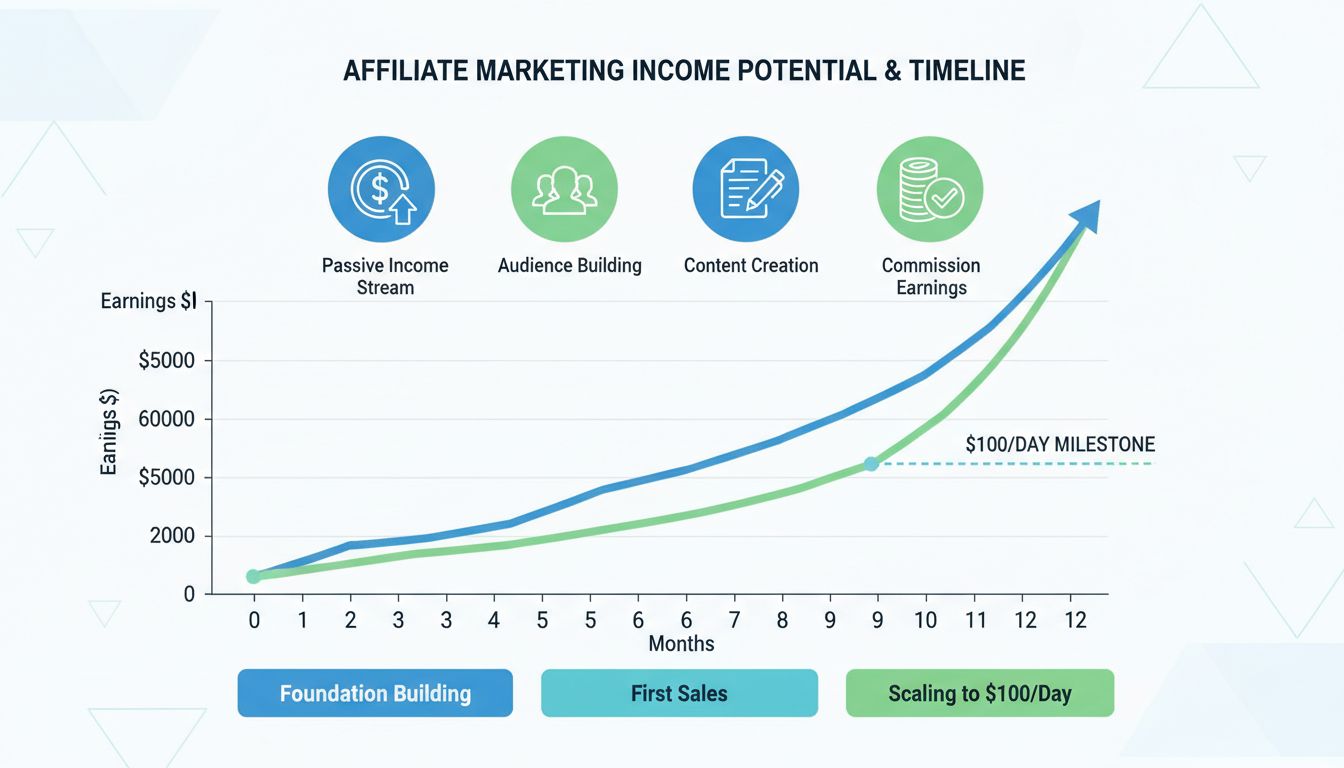
Months 0 to 3 are almost entirely setup. You’re picking a niche, publishing your first pieces of content, and joining your first affiliate programs. Earnings during this stretch are usually $0, and that’s expected rather than a warning sign, since you’re building an asset, not clocking hours for pay.
Months 3 to 6 are when most people make their first sale. Search engines start indexing your early content, and if you’re active on social media, a first trickle of clicks tends to show up here too. Income in this window is typically $50 to $200 for the month, sometimes less.
Months 6 to 12 is where the compounding becomes visible. Your content library has grown, a portion of it is starting to rank, and sales stop feeling like isolated events. Monthly earnings commonly settle into the $100 to $500 range, though competitive niches like personal finance can take longer to reach this point, sometimes 12 to 18 months rather than 6 to 9.
Months 12 to 24, assuming you kept publishing and started paying attention to what converts, is often when income climbs to $500 to $2,000 or more a month. This is also usually the point where beginners start reinvesting some of their earnings into tools or paid traffic to accelerate further.
The single biggest reason people never see this curve play out is that they quit between months three and six, right when earnings are still near zero and the payoff feels furthest away. That is also, unfortunately, exactly the point where the compounding is about to start.
Be the first to know about new features and product updates.
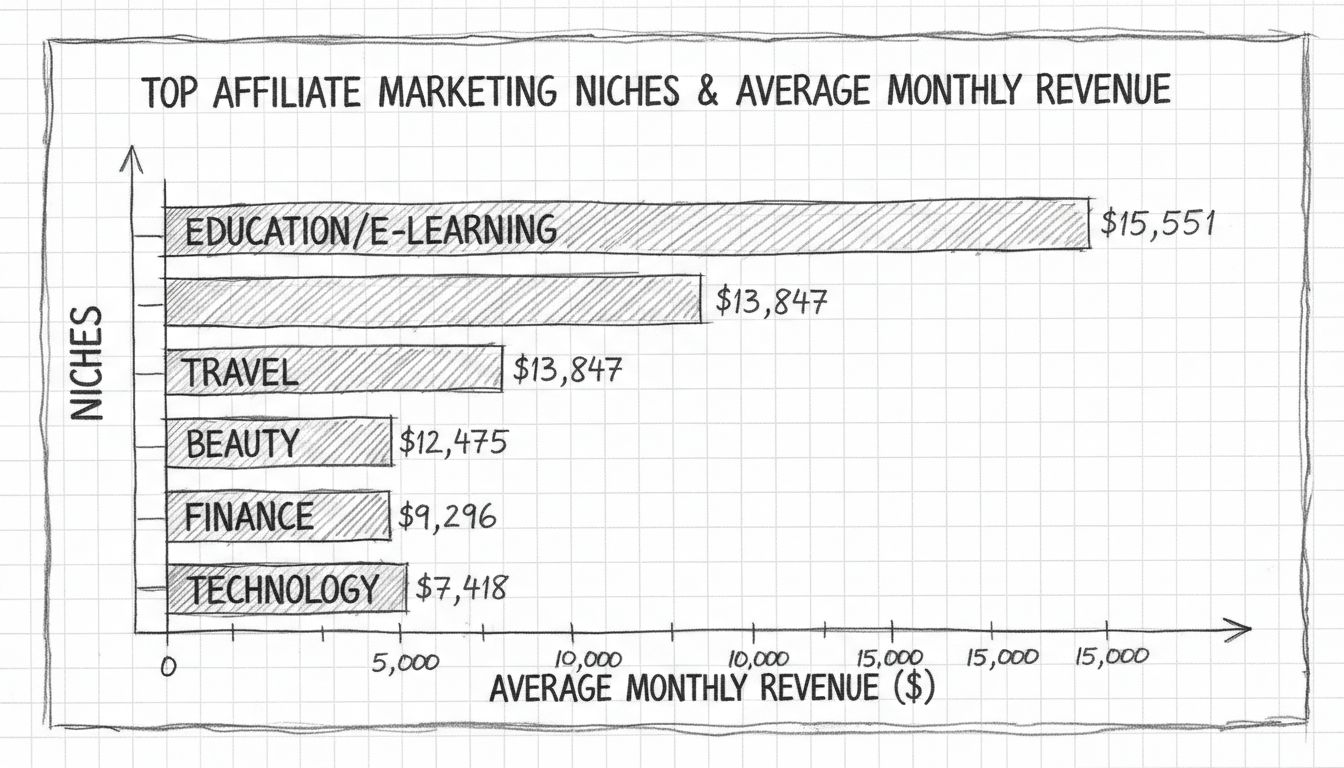
Niche choice matters more than almost any other early decision, since it sets both your commission ceiling and how hard you’ll have to work to earn trust in that space. The following figures come from the same Authority Hacker survey referenced earlier, and they line up closely with the fuller niche table in our affiliate marketer earnings guide (Source ):
| Niche | Typical commission range | Average monthly revenue among surveyed affiliates |
|---|---|---|
| Education and eLearning | 15% to 30% | $15,551 |
| Travel | 10% to 15% | $13,847 |
| Beauty and skincare | 10% to 30% | $12,475 |
| Finance and investment | 20% to 40% | $9,296 |
| Technology | 5% to 20% | $7,418 |
| Health and wellness | 10% to 50% | $7,194 |
| E-commerce and software | 20% to 70% | $5,967 |
| Home and garden | 2% to 10% | $5,095 |
Education and eLearning tops the list largely because course platforms charge more per sale and often pay recurring commissions on subscriptions. Finance products pay well too, but the niche demands real credibility since readers are trusting you with decisions about their money, which makes it a harder one for a true beginner to break into quickly.
Software and SaaS programs sit lower on average revenue but often carry the widest commission range, up to 70% on some plans, and recurring payouts that keep arriving as long as the customer stays subscribed. When you’re picking a niche, weigh the commission structure against something just as important: whether you actually know or care about the topic, since that shows up in your writing whether you intend it to or not.
A few habits, done consistently from the start, do more for beginner income than any single traffic hack. Lead with content that genuinely helps before you ever mention a product. Trust built this way converts far better later than a page that opens with a sales pitch. Start building an email list early, since subscribers who opted in to hear from you convert noticeably better than social media followers, and email remains one of the highest-return channels in marketing, with returns commonly cited around $36 to $40 for every dollar spent.
Choose affiliate programs that actually fit what your audience came to you for. Recommending something off-topic just because the commission is attractive tends to cost you more in trust than it earns in commission.
Invest time in basic SEO early, since it’s slow to pay off but keeps paying long after you stop actively promoting a piece. Segment your audience where you can, since a budget-conscious reader and a reader looking for a premium option respond to different pitches for the same problem. And track your numbers. Knowing which pages, products, and channels actually generate revenue is the only reliable way to know what to do more of.
A handful of avoidable mistakes account for most of the beginners who never get past month three or four.
Promoting too many products at once dilutes your credibility and confuses readers about what you actually stand for. Most people who eventually earn a real income focus on three to five core products they genuinely believe in. Choosing a niche purely for its commission rate, with no real interest or knowledge behind it, tends to show up in flat, uninspired content, and readers notice.
So does prioritizing volume over quality: one thorough, honest guide will usually outperform ten rushed posts. Being vague or evasive about affiliate relationships erodes trust the moment a reader figures it out, and readers usually do.
Quitting around month three, right before the compounding effects of consistent publishing start to show, is probably the single most common reason people conclude affiliate marketing “doesn’t work,” and it’s a big part of why an estimated 95% of beginners end up failing or quitting altogether (Source ). And ignoring your own data, meaning which content and products actually convert, means you’re optimizing blind instead of doubling down on what’s already working. If you’re in that stretch right now and wondering whether to keep going, our guide on not giving up on affiliate marketing is written for exactly this point.
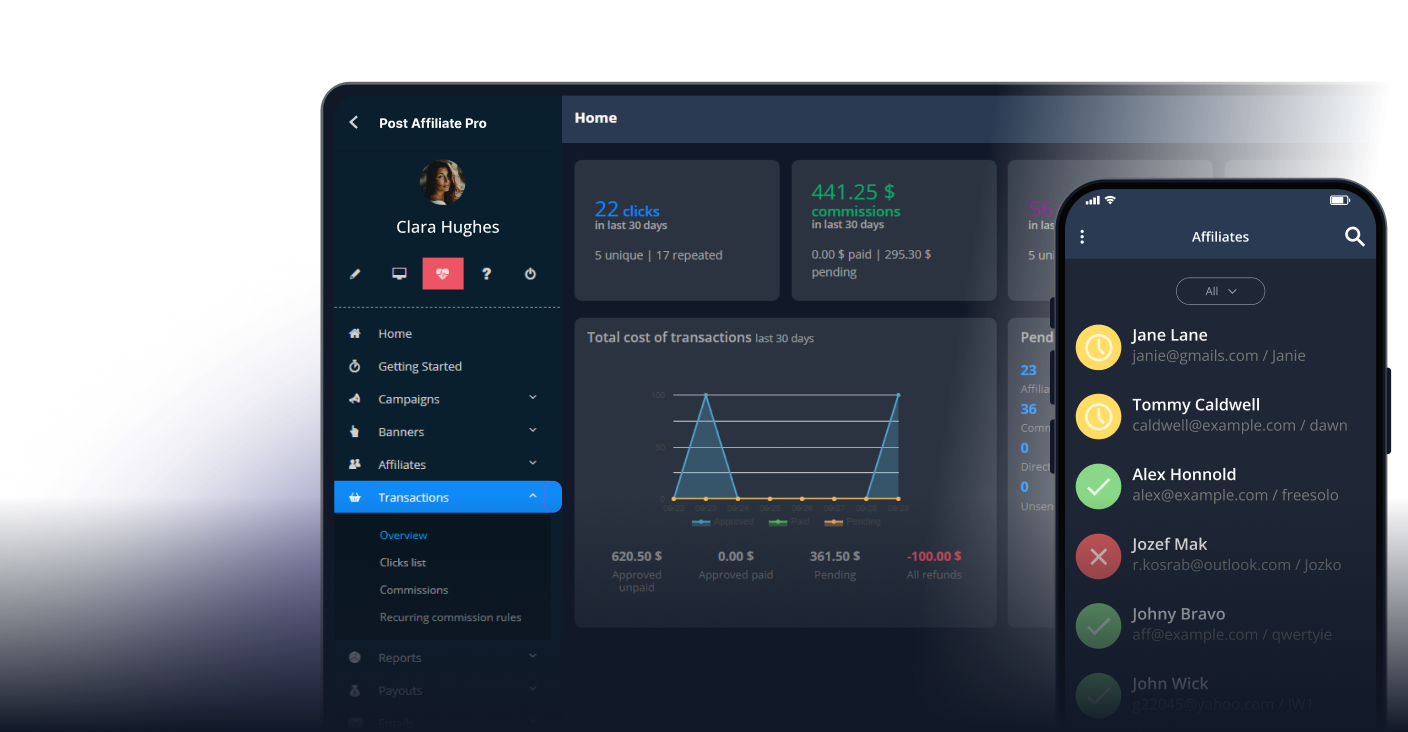
If you’re reading this from the other side of the relationship, running the affiliate program rather than promoting for one, that same drop-off shows up in your own dashboard too. Our guide to affiliate churn and inactive affiliates covers the warning signs before an affiliate goes quiet, getting the commission model and onboarding process right early on does a lot to keep new affiliates past that critical first few months, and our walkthrough on tracking affiliate earnings and commissions in Post Affiliate Pro shows you exactly where to see this happening in your own reports.
The right tools won’t replace good content, but they do remove a lot of friction while you’re still learning.
Amazon Associates remains one of the easiest starting points for beginners thanks to its enormous catalog, though it’s worth knowing the ground has shifted recently: commission rates across the program currently run from about 0% to 20% depending on category, and Amazon quietly cut rates in a number of categories by as much as 50% during 2026, according to reporting from eMarketer (Source ).
It’s a good place to start, but it’s also a reminder not to build your entire income around a single program you don’t control. Awin, which absorbed the affiliate network ShareASale in 2025, and ClickBank both give you access to a much wider range of programs, with ClickBank in particular known for commissions as high as 75% on many digital products (Source ).
If you’re running your own affiliate program rather than joining someone else’s, Post Affiliate Pro is built for exactly that, handling commission tracking, payouts, and performance reporting so you can focus on growing the partnerships rather than the spreadsheet behind them. Beyond the networks themselves, Google Analytics is worth learning early so you actually know where your traffic and conversions come from, an email platform like ConvertKit or Mailchimp helps you start building an owned audience from day one, and a basic SEO tool makes keyword research far less of a guessing game.
None of this needs to cost much starting out. Even a modest $50 to $100 a month budget for tools tends to pay for itself once you factor in the time it saves.

Crossing from beginner into intermediate territory usually means doing a handful of things you were probably avoiding while you were still learning the basics. Reinvesting a portion of your early earnings, many affiliates put back 30% to 50%, into tools, paid traffic, or outsourced help accelerates growth in a way that waiting and hoping never does.
Expanding into paid advertising once you understand your numbers can turn a $1,000 month into something considerably larger within a few months, though it does require genuinely knowing your conversion rates first. Publishing more comprehensive content, covering your niche in real depth rather than a handful of scattered posts, compounds your organic reach.
Growing your email list matters even more here, since a list in the tens of thousands can realistically generate several thousand dollars a month from promotions alone. Joining more programs, rather than relying on two or three, reduces how exposed you are if one changes its terms, as Amazon Associates affiliates learned the hard way in 2026.
And building relationships, through guest content, podcast appearances, or simple outreach, tends to open doors to better commission rates than the standard published ones. None of this happens overnight. Most people who make this jump take twelve to twenty-four months of steady, deliberate effort to get there, but it happens far faster for people who treat it as a plan rather than a hope.
PostAffiliatePro is the leading affiliate software solution trusted by top brands to manage, track, and optimize their affiliate programs. Start managing your affiliate network with powerful tools designed for growth.
What affiliate marketers actually earn at every experience level, which niches pay the most, and what separates a $600 month from a $10,000 one.
Discover if affiliate marketing is worth your time and effort. Learn realistic income expectations, timeline to profitability, and proven strategies to build pa...
Discover the realistic truth about affiliate marketing income potential. Learn what percentage of marketers earn six figures, success factors, and how PostAffil...
Join our community of happy clients and provide excellent customer support with Post Affiliate Pro.



Cookie Consent
We use cookies to enhance your browsing experience and analyze our traffic. See our privacy policy.