


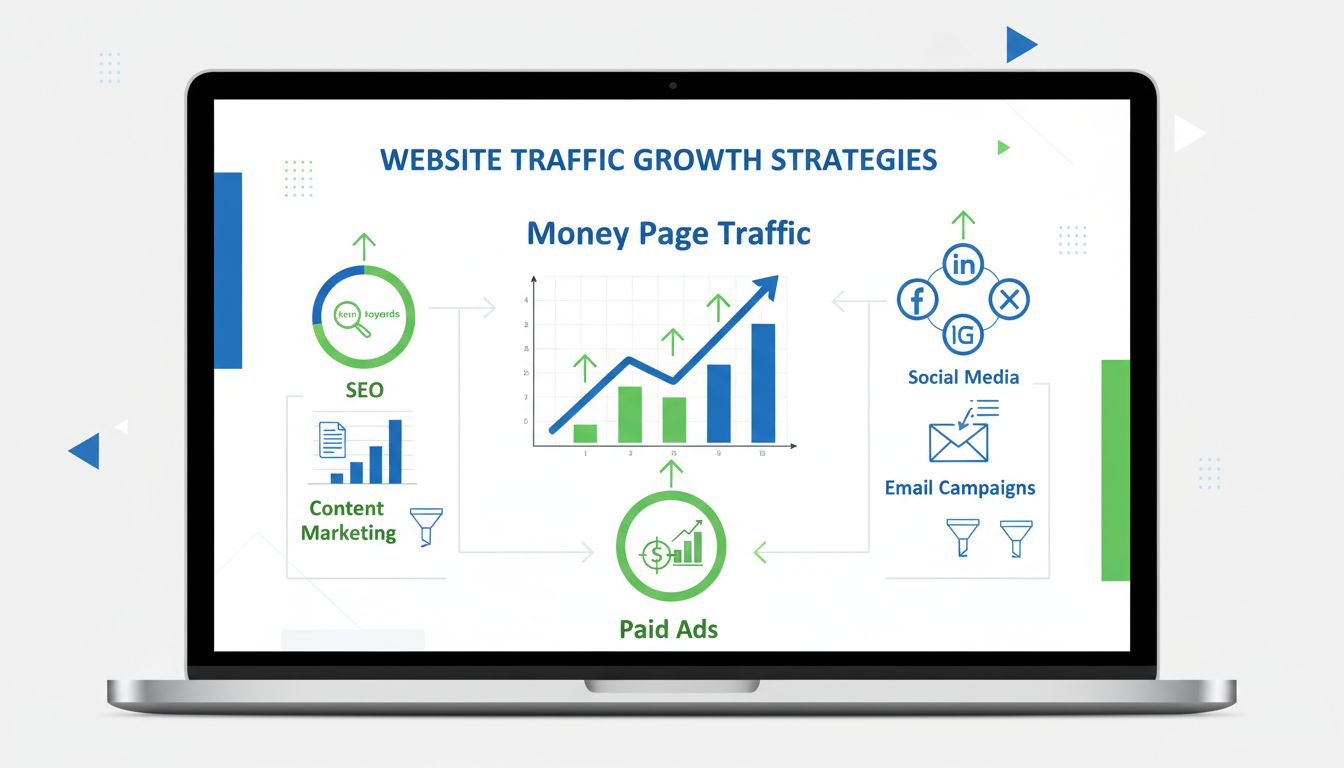
How Can I Get More Visitors to My Money Page? Complete 2025 Guide
Discover proven strategies to increase traffic to your money pages in 2025. Learn SEO, content marketing, paid ads, and social media tactics to drive qualified ...
12 min read
This structure works because it respects user intent.
On this page
For example, a website about home coffee equipment might publish an informational guide titled “How to Dial In Espresso Grind Size.” That article attracts readers who are learning, not necessarily buying.
This structure works because it respects user intent. The informational article serves someone who wants to learn; the money page serves someone ready to act.

Set up advanced tracking in minutes. No credit card required.
The difference between a money page and an informational page is search intent, not format. A page can contain affiliate links without being a true money page. What matters is the primary job the page does for the reader.
| Feature | Money Page | Informational Page |
|---|---|---|
| Primary goal | Generate revenue (commissions, sales, leads) | Educate, answer a question, or entertain |
| Target keyword intent | Commercial or transactional (“best X,” “X vs. Y,” “X review”) | Informational (“how does X work,” “what is X”) |
| Affiliate link density | High — links are central to the page’s purpose | Low or none — links are supplementary |
| Call to action | “Check Price,” “Buy Now,” “Get the Deal” | “Learn more,” “Read next,” newsletter signup |
| Reader’s mindset | Comparison shopping, close to purchase | Researching, curious, early in the buyer’s journey |
| Typical formats | Product reviews, roundups, comparison posts, buying guides, discount pages, tool/resource lists | How-to guides, tutorials, definitions, news, opinion pieces |
A page can blur the line — a detailed tutorial that includes a single affiliate link is still primarily informational. A “best-of” list with ten product cards and buy buttons is unambiguously a money page. The distinction matters for SEO strategy, internal linking, and conversion-rate optimization.
Affiliate marketers use several proven money page formats. Each targets a different stage of commercial intent.
A single-product deep-dive that evaluates features, performance, pricing, and real-world usability. Example: “Breville Barista Express Impress Review: 6 Months of Daily Use.”
Head-to-head comparisons between two or more competing products. These pages capture readers who have narrowed their choices and are deciding between specific options. They convert well because the reader is at the bottom of the funnel. Example: “Breville Barista Express vs. DeLonghi La Specialista: Which Wins?”
Curated lists of top products in a category, often segmented by use case, budget, or skill level. Roundups capture broad commercial queries with high search volume. Example: “The 7 Best Espresso Machines Under $500 for Home Baristas.”
Educational-commercial hybrids that explain what to look for when purchasing a product category, then recommend specific models. Buying guides convert by building trust before presenting options. Example: “How to Choose Your First Espresso Machine: A Complete Buying Guide.”
Curated lists of software, gear, or services the affiliate personally uses and recommends. Common in B2B, SaaS, and creator-economy niches. These pages often earn recurring commissions from subscription products. Example: “The 15 Tools I Use to Run My Six-Figure Blog.”
Pages dedicated to active discounts, promo codes, or seasonal sales. These convert quickly because the reader’s intent is transactional and urgent.
Be the first to know about new features and product updates.
If you already run a website with affiliate content, identifying which pages are — or should be — your money pages is a critical optimization step.
Use Google Analytics 4 (GA4): Navigate to Reports → Engagement → Pages and screens. Sort by conversions or ecommerce revenue if those events are configured. Pages with high affiliate-link click-through rates but lower overall traffic may still be your highest earners.
Use Google Search Console: Filter by queries containing commercial modifiers — “best,” “review,” “vs,” “price,” “buy,” “discount,” “alternatives.” Pages ranking for these terms are your money pages, even if you haven’t been treating them as such.
Cross-reference high-converting URLs with your content inventory.
Identify these high-efficiency pages and protect them in every site update.
A money page only works if it converts. Here are the elements that separate pages that earn from pages that merely list products.
Readers can detect a sales pitch in the first three seconds. Open with genuine expertise — why you tested these products, how long you used them, what criteria you applied. Pages that cite first-hand experience consistently outperform those that summarize manufacturer specs. If you tested five espresso machines over three months, say so. Include photos of the products in your kitchen, not stock images.
Most visitors to money pages scan before they read. Use clear H2 and H3 headings, product comparison tables, and bulleted pros-and-cons lists. Each product in a roundup should follow a consistent structure so readers can compare quickly.
A structured table at the top or middle of the page helps readers compare key features — price, rating, commission, best-for use case — at a glance. Tables also improve the page’s chance of appearing in featured snippets.
| Product | Price | Best For | Commission | Rating |
|---|---|---|---|---|
| Breville Barista Express | — | Beginners | — | 4.6/5 |
| DeLonghi La Specialista | — | Ease of use | — | 4.4/5 |
| Rancilio Silvia | — | Enthusiasts | — | 4.7/5 |
Every product section should include a clear but non-aggressive call to action: a “Check Price” button, a “Read Full Review” link, or a “See Current Deal” link. Avoid clustering multiple CTAs in a single paragraph — it dilutes click-through. One primary CTA per product section is the standard.
Outdated pricing, discontinued products, or broken affiliate links destroy trust and conversion rates. Review each money page at least quarterly. Add a “Last updated: [Month Year]” dateline.
Every how-to article and glossary post on your site should link to at least one relevant money page using descriptive anchor text. This funnels search authority from high-traffic informational pages to your revenue-generating content — a strategy called “authority sculpting” in affiliate SEO circles.
The SEO playbook for money pages has evolved significantly.
Understanding money pages is not just for affiliates. Advertisers and program managers who know how money pages work can make smarter recruitment, tracking, and optimization decisions.
When evaluating potential affiliate partners, review their existing money pages. Ask: Does their content format (reviews, comparisons, roundups) suit your product? Do they demonstrate genuine category knowledge? A YouTuber with detailed comparison videos will drive different — and often higher-quality — conversions than a coupon site with thin deal pages.
Affiliates perform better when you supply them with conversion-optimized materials: high-quality product images, comparison data sheets, sample pros-and-cons lists, and exclusive discount codes. The easier you make it for an affiliate to build a compelling money page, the more revenue both parties generate.
Using affiliate tracking software, tag conversions by the specific money page URL that drove the click. This reveals which affiliates’ content formats convert best for your product — data you can use to guide future recruitment and commission-tier decisions.
Some affiliates bid on your branded keywords in paid search and direct traffic to their money pages instead of your site. Decide whether this aligns with your program rules. Many advertisers prohibit trademark bidding in their affiliate terms to prevent affiliates from intercepting high-intent traffic.
Identify a commercial-intent keyword. Use tools like Ahrefs, Semrush, or Google Keyword Planner to find queries with modifiers like “best,” “review,” “vs,” or “under [price].” Prioritize keywords where the top-ranking pages are not major media brands — those are easier to compete against.
Research the products thoroughly. Buy, borrow, or extensively test the products you plan to feature. Document your experience with notes, photos, and data points. If physical testing is impossible, aggregate and synthesize user reviews, expert opinions, and spec comparisons — but disclose your methodology.
Outline the page structure. Plan H2 sections for each product (in roundups), or for each evaluation criterion (in single-product reviews). Include a comparison table, a “how we tested” section, and an FAQ block.
Add affiliate links and CTAs strategically. Place a primary CTA after each product section. Use “Check Price on Amazon” or “See Current Deal” as button text — it sets accurate expectations and avoids over-promising.
Publish supporting informational content. Write 3–5 informational articles that relate to the money page topic and link internally to it. This builds topic authority and drives relevant traffic.
Monitor and iterate. After 90 days, review performance in Search Console and your affiliate dashboard. Update pricing, add new products, remove discontinued ones, and refresh outdated sections.
Money pages are powerful but fragile when treated as the sole monetization strategy.
Algorithm dependency: A Google core update can shift rankings overnight. Affiliates whose entire income depends on three money pages are one algorithm change away from losing most of their revenue. Diversify traffic sources — build an email list, grow a YouTube channel, or develop direct brand partnerships.
Diversify across multiple affiliate programs and networks.
Rising competition from media brands: Major publishers like Forbes, Wirecutter, and U.S. News now compete for the same commercial keywords that independent affiliates once dominated. To compete, independent sites must lean into niche expertise and first-hand testing that large editorial teams cannot replicate at scale.
Cookie window limitations: Most affiliate programs use 24-hour to 30-day cookie windows. If a reader clicks your link but purchases after the cookie expires, you earn nothing. This makes conversion-rate optimization and clear CTAs especially important on money pages.
Learn how to create high-converting money pages and maximize your affiliate marketing revenue with expert tips and tools.
Discover proven strategies to increase traffic to your money pages in 2025. Learn SEO, content marketing, paid ads, and social media tactics to drive qualified ...
Money site is a website owned by a merchant, specifically designed to generate revenue. Learn about money sites, their characteristics, monetization strategies,...
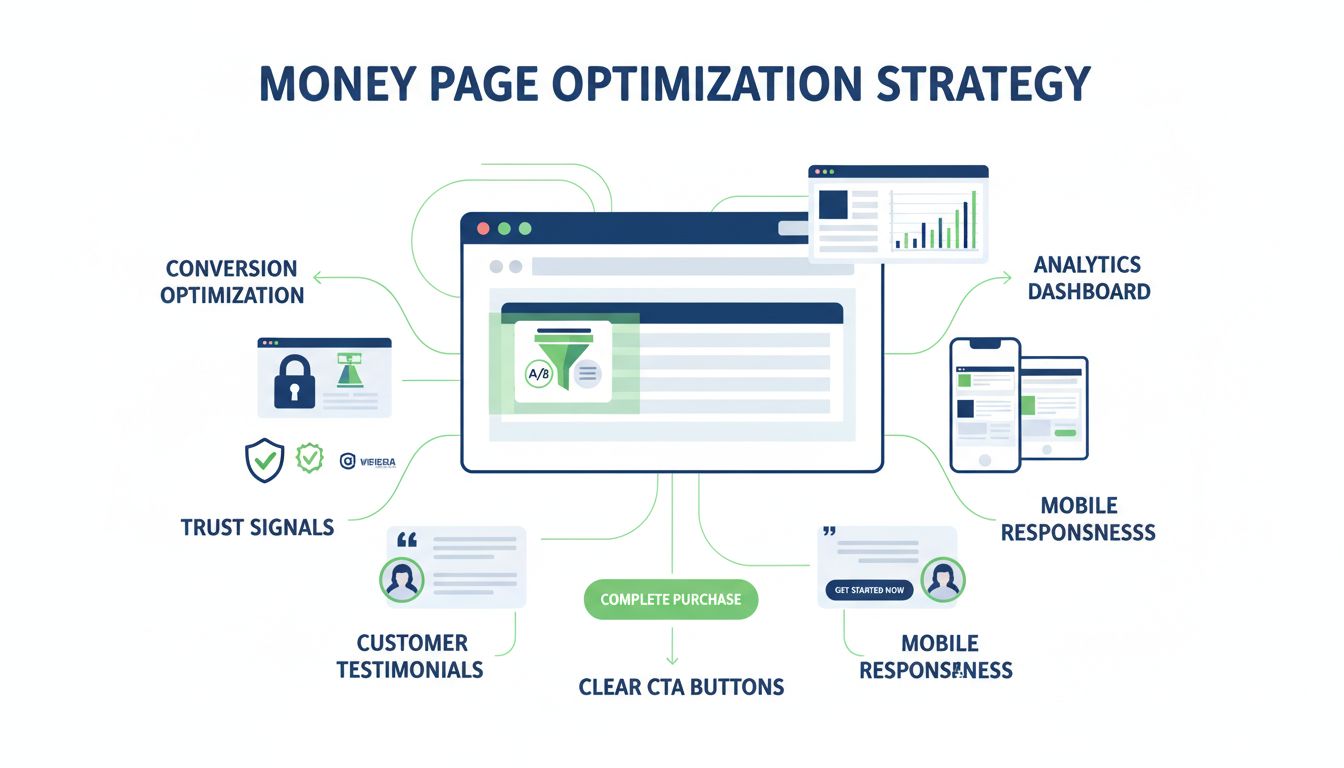
Learn proven strategies to optimize money pages for higher conversions. Discover best practices for CTAs, trust signals, mobile optimization, and conversion rat...
Join our community of happy clients and provide excellent customer support with Post Affiliate Pro.


Cookie Consent
We use cookies to enhance your browsing experience and analyze our traffic. See our privacy policy.