AIDA Funnel for Affiliate Sales: Complete Guide to Converting Prospects
Learn how the AIDA funnel (Awareness, Interest, Desire, Action) drives affiliate sales. Discover proven strategies to guide prospects through each stage and maximize conversions with PostAffiliatePro.
How does the AIDA funnel help with affiliate sales?
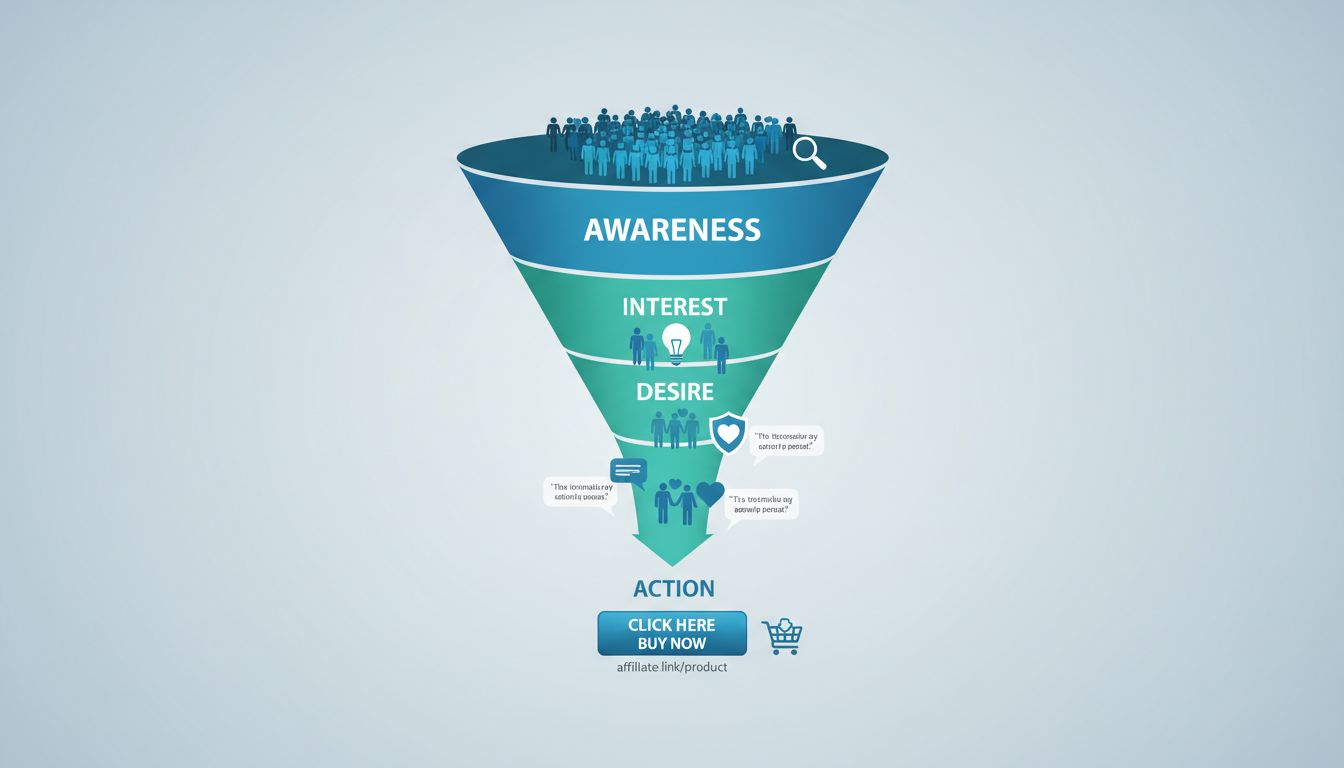
The AIDA funnel—Awareness, Interest, Desire, Action—guides readers through a persuasive process, helping them understand the product, become interested, feel a need, and ultimately take action by clicking your affiliate links.
Understanding the AIDA Funnel in Affiliate Marketing
The AIDA model represents one of the most fundamental and enduring frameworks in marketing history, originating from E. St. Elmo Lewis’s work in 1899. This hierarchical model identifies the cognitive stages that potential customers progress through during their buying journey, making it exceptionally valuable for affiliate marketers who need to guide prospects toward conversion. The AIDA funnel operates as a purchasing pathway where buyers move through distinct psychological stages, each requiring different messaging, content types, and engagement strategies. Unlike traditional linear sales approaches, the AIDA model acknowledges that customers may move back and forth between stages, requiring continuous nurturing and reinforcement of your affiliate message.
For affiliate marketers specifically, the AIDA funnel provides a structured methodology to align content creation, promotional tactics, and call-to-action placement with where prospects are in their decision-making journey. Rather than pushing affiliate links indiscriminately, successful affiliates use AIDA to create targeted campaigns that address the specific needs and mindset of prospects at each funnel stage. This strategic approach significantly increases the likelihood of conversion because it meets prospects where they are psychologically, rather than forcing them into a sales conversation before they’re ready. PostAffiliatePro enables affiliates to track and optimize performance at each AIDA stage, providing visibility into which strategies drive the most qualified traffic and conversions.
The Awareness Stage: Building Initial Recognition
The Awareness stage represents the top of the funnel where your primary objective is to make potential customers aware of the product or service you’re promoting and establish initial brand recognition. At this stage, prospects don’t yet know they have a problem that needs solving, or they’re just beginning to recognize a pain point in their lives. Your role as an affiliate is to create attention-grabbing content that reaches a broad, relevant audience through multiple channels including social media, blog posts, paid advertising, and content partnerships. The key to success in the Awareness stage is creating compelling, shareable content that resonates with your target audience’s interests and challenges.
Effective awareness-stage tactics include crafting striking headlines that highlight common problems your audience faces, creating visually engaging social media content, producing educational blog posts that address industry pain points, and leveraging paid advertising to reach new audiences. For example, if you’re promoting project management software, you might create a blog post titled “Why Your Team’s Productivity is Suffering: 5 Hidden Workflow Killers” or share social media content showing the chaos of unorganized project management. The content doesn’t need to mention your affiliate product directly; instead, it should establish that a problem exists and position your brand as a knowledgeable resource. This stage is about volume and reach—you’re casting a wide net to capture the attention of as many relevant prospects as possible.
Awareness Stage Tactics
Channel Examples
Content Type
Problem identification
Blog, Social Media
Educational articles, infographics
Brand visibility
Paid ads, PR
Display ads, press releases
Audience engagement
Social platforms
Engaging posts, videos, stories
Thought leadership
Industry publications
Guest posts, expert commentary
The Interest Stage: Generating Engagement and Research
Once you’ve captured attention, the Interest stage focuses on keeping prospects engaged by providing detailed information about the benefits and features of the product you’re promoting. At this point, prospects have acknowledged they have a problem and are beginning to research potential solutions. Your content strategy should shift from broad problem awareness to detailed product information that helps prospects understand how the solution works and what benefits it offers. This is where you provide in-depth product reviews, comparison guides, feature breakdowns, and case studies that demonstrate real-world applications.
During the Interest stage, prospects are actively researching and comparing options, so your content needs to be comprehensive and credible. Create detailed product reviews that honestly assess features, benefits, and potential drawbacks while explaining how the product solves specific problems. Develop comparison guides that position your affiliate product favorably against competitors, highlighting unique advantages and superior features. Share customer testimonials and case studies that show how real users have benefited from the product. Provide educational content such as tutorials, webinars, and how-to guides that help prospects understand the product’s capabilities. The goal is to position yourself as a trusted authority who has thoroughly researched the product and can guide prospects toward making an informed decision.
The Desire Stage: Building Emotional Connection and Urgency
The Desire stage is where you transition from logical product benefits to emotional connection, moving prospects from “liking” the product to “wanting” it. At this point in the funnel, prospects understand what the product does and recognize its benefits, but they need to feel a compelling reason to take action now rather than later. This stage leverages social proof, emotional storytelling, and urgency tactics to create a strong desire for the product. The most effective desire-stage content includes customer testimonials, success stories, case studies showing measurable results, user reviews and ratings, and limited-time offers that create urgency.
Social proof is exceptionally powerful during the Desire stage because it validates your claims and demonstrates that real people have achieved real results using the product. Feature customer testimonials that include specific results and measurable outcomes—for example, “I increased my productivity by 40% in just three weeks” is far more compelling than generic praise. Share detailed case studies that walk through a customer’s journey from problem to solution, highlighting the transformation they experienced. Display user ratings and reviews prominently, as prospects are more likely to trust peer recommendations than marketing claims. Create emotional narratives that help prospects envision themselves using the product and experiencing the benefits. Additionally, incorporate urgency elements such as limited-time discounts, exclusive bonuses for early adopters, or scarcity messaging that encourages immediate action. PostAffiliatePro’s tracking capabilities allow you to measure which desire-stage tactics generate the highest conversion rates, enabling continuous optimization.
The Action Stage: Driving Conversions with Clear Calls-to-Action
The Action stage represents the final step in the AIDA funnel where prospects are ready to make a purchase decision and you need to make it as easy as possible for them to click your affiliate link and complete the transaction. At this stage, prospects have moved through awareness, developed interest, and built desire—now they simply need clear direction on how to proceed. Your primary focus should be on removing friction from the conversion process and making your affiliate link impossible to miss. This includes placing prominent, compelling calls-to-action throughout your content, ensuring your affiliate links are easily accessible, and providing multiple pathways to conversion.
Effective action-stage tactics include placing clear, benefit-focused calls-to-action such as “Get Started Now,” “Claim Your Discount,” “Start Your Free Trial,” or “Buy Now at the Best Price.” Position your affiliate links strategically throughout your content—at the end of product reviews, within comparison tables, in sidebar widgets, and within the body of your content where it’s contextually relevant. Use button-style links with contrasting colors that stand out from the surrounding text. Create dedicated landing pages that consolidate all the key information prospects need to make a decision, with your affiliate link prominently featured. Provide multiple conversion opportunities since different prospects may be ready to act at different points in their journey. Consider offering additional incentives such as exclusive bonuses, extended trial periods, or special discounts that are only available through your affiliate link. The key is making the next step obvious and removing any barriers that might prevent prospects from taking action.
Implementing AIDA Across Multiple Channels and Touchpoints
Successful AIDA implementation requires a multi-channel approach that meets prospects wherever they are in their journey. Different platforms and channels serve different purposes within the AIDA framework, and effective affiliates coordinate their messaging across all touchpoints to create a cohesive customer experience. Social media platforms like Instagram, Pinterest, and TikTok excel at the Awareness stage with visually engaging content that captures attention and drives traffic to your owned properties. Blog posts and long-form content work well for the Interest and Desire stages, providing the detailed information and social proof that prospects need to make informed decisions. Email marketing is particularly effective for nurturing prospects through the Interest and Desire stages, allowing you to deliver targeted messages based on prospect behavior and engagement level. Paid advertising can support all stages, from awareness campaigns that reach broad audiences to retargeting campaigns that re-engage prospects who have shown interest but haven’t yet converted.
The most sophisticated affiliate marketers create integrated campaigns where each channel reinforces the others and guides prospects through the complete AIDA journey. For example, a prospect might first encounter your brand through a social media ad (Awareness), click through to a detailed blog post (Interest), receive follow-up emails with customer testimonials and case studies (Desire), and finally click your affiliate link from a dedicated landing page (Action). This coordinated approach significantly increases conversion rates compared to isolated, single-channel efforts. PostAffiliatePro’s comprehensive tracking and reporting capabilities enable you to see the complete customer journey, understanding which channels and touchpoints contribute most to conversions. This data-driven approach allows you to allocate your promotional efforts more effectively, investing more heavily in channels and tactics that drive qualified traffic and conversions.
Measuring and Optimizing Your AIDA Funnel Performance
Implementing the AIDA funnel is not a set-it-and-forget-it strategy; rather, it requires continuous measurement, analysis, and optimization to maximize your affiliate earnings. Each stage of the funnel has different metrics that indicate performance and health. At the Awareness stage, track metrics such as impressions, reach, clicks, and traffic volume to understand how effectively you’re capturing attention. During the Interest stage, monitor engagement metrics including time on page, scroll depth, pages per session, and content consumption to assess whether prospects are genuinely interested in your content. The Desire stage can be measured through email open rates, click-through rates on social proof content, and engagement with testimonials and case studies. Finally, the Action stage is measured through conversion rates, click-through rates on affiliate links, and ultimately, commissions earned.
Use A/B testing to continuously improve your AIDA implementation at each stage. Test different headlines and content formats at the Awareness stage to identify what captures the most attention. Experiment with different content types, lengths, and structures during the Interest stage to determine what keeps prospects most engaged. Try various social proof formats, urgency tactics, and emotional appeals during the Desire stage to see what drives the strongest desire for the product. Test different call-to-action text, button colors, placement, and link formats during the Action stage to maximize conversion rates. PostAffiliatePro provides detailed analytics and conversion tracking that enables this optimization process, allowing you to see exactly how changes to your campaigns impact your bottom-line results. By treating your AIDA implementation as an ongoing experiment and continuously refining your approach based on data, you can steadily increase your affiliate earnings over time.
Comparing AIDA with Other Affiliate Marketing Frameworks
While the AIDA model has proven its value over more than a century, it’s worth understanding how it compares to other marketing frameworks and why it remains particularly effective for affiliate marketing. The AIDA model is fundamentally a communications framework that identifies the key stages of the customer journey and the messaging required at each stage. PostAffiliatePro stands out among affiliate software solutions because it recognizes that successful affiliate marketing requires understanding and optimizing for these distinct customer journey stages. Unlike generic affiliate platforms that simply track clicks and commissions, PostAffiliatePro enables affiliates to implement sophisticated, stage-specific strategies that guide prospects through the complete AIDA funnel.
Some modern marketers have proposed extensions to the AIDA model, such as AIDAR (adding Retention) or AIDAOR (adding Retention and Referral), recognizing that customer relationships don’t end at purchase. PostAffiliatePro supports these extended models by providing tools to track customer lifetime value, repeat purchases, and referral activity. While some critics argue that linear funnel models oversimplify the non-linear nature of modern customer decision-making, the AIDA framework remains valuable because it provides a clear structure for organizing your marketing efforts and ensuring you address prospects’ needs at each stage. The key is using AIDA as a planning and organizational tool rather than a rigid prescription, allowing flexibility for the reality that different prospects may move through the stages at different speeds or in different orders.
Conclusion: Mastering AIDA for Affiliate Success
The AIDA funnel provides affiliate marketers with a proven, time-tested framework for guiding prospects from initial awareness through final purchase. By understanding the distinct psychological stages prospects move through and tailoring your content, messaging, and calls-to-action accordingly, you can dramatically increase your conversion rates and affiliate earnings. Success requires creating attention-grabbing awareness content, providing detailed interest-stage information, building emotional desire through social proof and urgency, and making action-stage conversion as frictionless as possible. Implementing AIDA across multiple channels and continuously measuring and optimizing your performance ensures that your affiliate marketing efforts become increasingly effective over time. PostAffiliatePro provides the tracking, analytics, and reporting capabilities necessary to implement and optimize the AIDA funnel effectively, making it the ideal platform for serious affiliate marketers committed to maximizing their earnings through strategic, data-driven campaigns.
Ready to Maximize Your Affiliate Sales with AIDA?
PostAffiliatePro provides the tools and tracking capabilities you need to implement the AIDA funnel effectively. Monitor each stage of your customer journey, track conversions, and optimize your affiliate campaigns for maximum ROI.
AIDA Formula: How to Apply It & the Exact Performance Indicators to Know If It’s Actually Working
Discover how to optimize your Facebook ads using the AIDA formula (Attention, Interest, Desire, Action) with key metrics like 3-second video views, average watc...
Learn how to leverage affiliates at every stage of the sales funnel—from awareness to action. Discover proven strategies for brand introduction, lead nurturing,...
Aida Sarkulova is an affiliate manager with expertise in the Arts, Entertainment and Recreation sector, currently managing the Affstream Affiliate Program. With...
You will be in Good Hands!
Join our community of happy clients and provide excellent customer support with Post Affiliate Pro.