


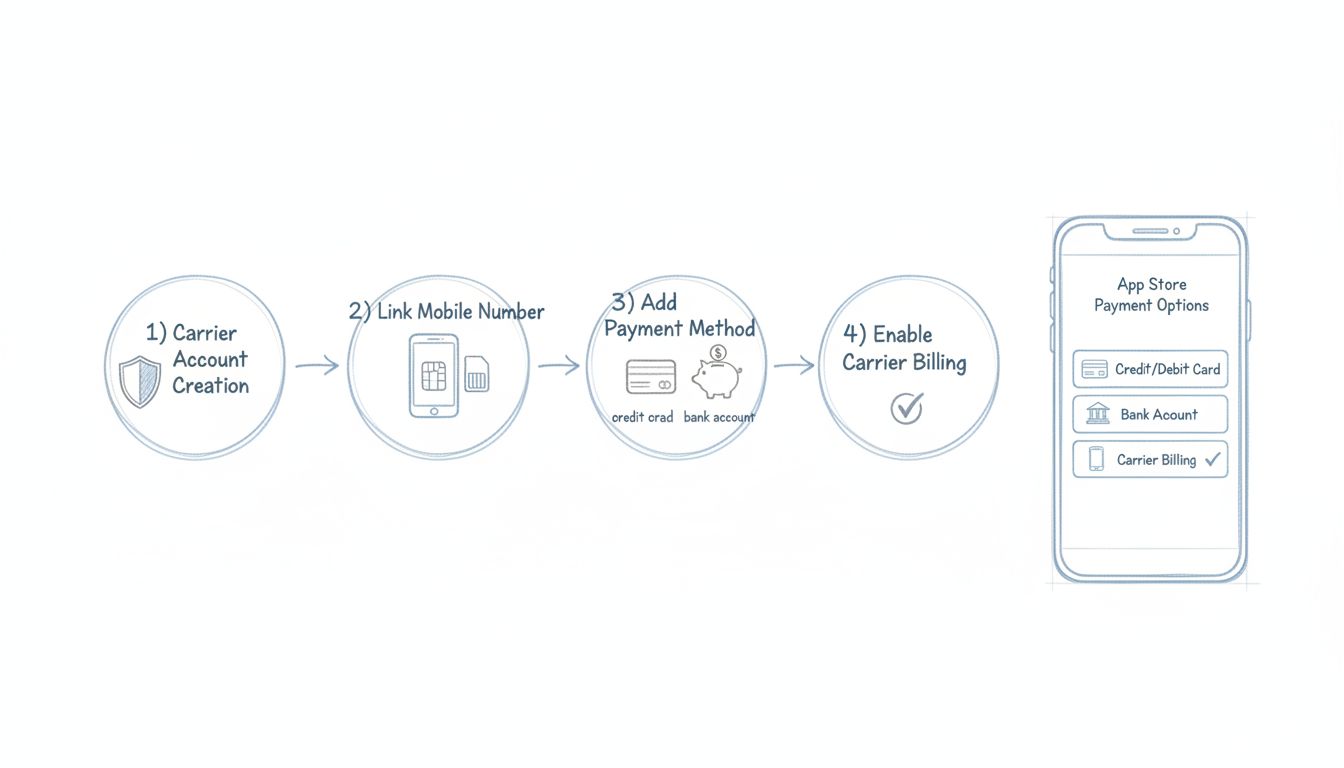
How to Enable Mobile Billing: Complete Setup Guide
Learn how to enable mobile billing with your carrier. Step-by-step guide to set up carrier billing for app purchases, in-app transactions, and digital services ...
8 min read
You tap “buy” on a game.
You tap “buy” on a game. No credit card. No bank login. The charge lands on your next phone bill. That is mobile billing — a payment method that turns your mobile carrier into the middleman between you and a merchant.
It is also called direct carrier billing (DCB) or carrier billing. The concept is simple: instead of pulling money from a bank account or card, the purchase amount gets added to your monthly postpaid statement or deducted from your prepaid balance. Your carrier collects the payment, takes a cut, and passes the rest to the merchant.
For digital businesses and affiliate marketers, mobile billing opens a door to audiences that credit cards never reach. For consumers, it removes the friction of typing 16-digit card numbers on a small screen. But the method also comes with real costs, limits, and risks that every advertiser, publisher, and program manager should understand before relying on it.
Mobile billing is a payment method that lets a consumer charge a purchase directly to their mobile phone bill or prepaid balance, without using a credit card, debit card, or bank account. The mobile network operator (the carrier) acts as the billing intermediary: it authenticates the user, approves the transaction, and settles funds with the merchant.
The technical term is direct carrier billing (DCB). Industry insiders also use “operator billing” and “charge to phone bill” interchangeably. All describe the same mechanism: the carrier owns the customer relationship and the payment rail, and the merchant plugs into it through an aggregator or direct carrier connection.
These two terms are often confused, but they describe fundamentally different things:

Set up advanced tracking in minutes. No credit card required.
DCB compresses checkout into two or three steps. The exact flow depends on the carrier’s network capability and local regulations.
This is the most common DCB method worldwide, used for subscription content, mobile games, and digital services across Europe and Asia-Pacific.
The PIN creates a verifiable consent record. Regulators in the EU and several APAC markets explicitly require this step for subscription sign-ups.
On networks where the carrier injects the subscriber’s identity at the network layer — using a header called the MSISDN forwarder — no PIN is needed. The user taps once and the charge processes automatically.
Click-to-buy is the dominant flow for app store top-ups handled by aggregators like Bango and Boku. It converts at three to five times the rate of PIN-based flows because there is no interruption. It also draws the most regulatory attention, since a user can be charged before fully understanding what they bought.
For higher-value purchases or regulated markets, carriers add a second factor. An OTP (one-time password) confirmation SMS arrives with the product name and price. The user replies “YES” to confirm. This double opt-in is common in Italy, Spain, and Gulf Cooperation Council countries where consumer-protection rules mandate explicit consent for each transaction.
Not all mobile billing works the same way. Four distinct models exist, each with different technical requirements, use cases, and regional adoption patterns.
| Type | How It Works | Typical Use | Key Markets |
|---|---|---|---|
| Direct Carrier Billing (DCB) | Charge added to phone bill; PIN or click-to-buy authentication | App stores, games, streaming, digital subscriptions | Global; strongest in Europe, APAC, Middle East |
| Premium SMS Billing | User sends or receives a chargeable SMS; cost added to bill | Voting, charity donations, ringtones, wallpapers | Declining globally; still active in parts of Africa and South Asia |
| WAP Billing | Device MSISDN auto-detected via mobile browser; one-click charge | Mobile content portals, news subscriptions | Legacy; largely replaced by DCB |
| Mobile Airtime Transfer | Prepaid credit transferred between users as payment | Peer-to-peer payments in unbanked regions | Sub-Saharan Africa, South Asia |
DCB is the dominant model today.
Premium SMS comes in two forms: Mobile Originated (MO), where the user sends a text to a short code and gets charged, and Mobile Terminated (MT), where the user receives a chargeable message. Once the backbone of mobile content monetization, premium SMS has declined sharply as DCB and app-store billing took over. It remains relevant in markets where smartphone penetration is low and SMS is still a primary communication channel.
WAP (Wireless Application Protocol) billing detects the user’s MSISDN automatically when they browse a mobile-optimized site. No phone number entry is needed. The purchase completes with a single click. WAP billing was popular in the pre-smartphone era for ringtone and wallpaper downloads. Most WAP billing implementations have been absorbed into modern DCB flows.
Be the first to know about new features and product updates.
Mobile billing dominates in three commercial categories and a specific set of geographies where card penetration lags behind mobile phone ownership.
Apple, Google, Microsoft, and Sony all support mobile billing as a payment method in select countries. On Google Play, users can charge app purchases, in-app items, and subscriptions to their phone bill where their carrier supports it. Sony’s PlayStation Store uses SMS-based OTP verification to link a mobile number for purchases. Apple supports mobile phone billing for App Store and iTunes purchases in a limited set of regions.
Streaming platforms, dating apps, fitness subscriptions, and news paywalls use DCB to capture subscribers who lack cards. The recurring billing mechanism works natively: the carrier handles renewal charges on the same schedule as the phone bill cycle. For merchants, this means lower involuntary churn compared to card-on-file billing, where expired or canceled cards break the payment chain.
Nearly everyone owns a phone with a SIM. In Indonesia, Nigeria, India, and Egypt, DCB fills the gap. Carriers in these markets have invested heavily in DCB infrastructure because they already own the billing relationship with hundreds of millions of subscribers. For digital merchants, mobile billing is not a nice-to-have in these regions — it is the only payment rail that reaches the majority of potential customers.
Mobile billing is not cheap. The carrier takes a significant share of every transaction, and aggregators layer additional fees on top.
The premium reflects the carrier’s role: they provide not just payment processing but also customer authentication, billing infrastructure, collections, and — in postpaid scenarios — credit risk.
Most merchants do not connect directly to carriers. They work through aggregators — companies like Boku, Bango, DIMOCO, and Fortumo (now part of Boku) — that maintain technical integrations with dozens or hundreds of carriers worldwide. Aggregators charge their own fees, either as a flat percentage on top of the carrier’s cut or as a blended rate that bundles both costs.
The aggregator handles settlement, currency conversion, compliance, and technical maintenance across carrier connections.
| Cost Factor | Mobile Billing (DCB) | Credit Card Processing |
|---|---|---|
| Chargeback risk | Low (carrier absorbs most disputes) | Moderate to high |
| Settlement time | 30–90 days typical | 2–7 days |
| Integration complexity | High (carrier-by-carrier, regional) | Low (unified gateway) |
| Customer reach in emerging markets | High | Low |
The takeaway: mobile billing trades higher per-transaction costs for access to audiences that cards cannot reach and a checkout flow that converts better on mobile devices.
Affiliate marketers, publishers, and program managers encounter mobile billing in specific, high-value contexts. Understanding how the payment rail interacts with affiliate tracking is essential for anyone running or promoting mobile-billed offers.
Mobile billing is the default payment method for a large category of affiliate offers: value-added services (VAS), mobile content subscriptions, gaming top-ups, and digital service trials. An affiliate might promote a mobile antivirus subscription, a weekly horoscope service, or a cloud storage plan — all billed through DCB.
The typical flow: a user clicks an affiliate link, lands on a mobile-optimized offer page, enters their phone number, confirms via PIN, and the subscription begins. The affiliate earns a commission — usually a fixed CPA (cost per acquisition) or a revenue share on the first billing cycle.
Tracking mobile-billed conversions requires carrier-level data that standard web tracking cannot capture. The key piece of infrastructure is MSISDN forwarding: the carrier passes the user’s phone number (or a hashed version of it) to the merchant’s payment page. The affiliate network or tracking platform matches this identifier against the click record to attribute the conversion.
When a carrier confirms a successful charge, the aggregator fires a postback URL with the transaction details. The affiliate software records the conversion and credits the referring publisher.
Mobile billing has a fundamentally different dispute model than card payments. When a consumer disputes a card charge, the card network initiates a chargeback — the merchant loses the funds and pays a penalty fee. In mobile billing, the carrier is the merchant of record for the phone bill. The consumer complains to the carrier, not to the card issuer.
In practice, carriers handle most billing disputes internally. They may refund the consumer and deduct the amount from the merchant’s next settlement — but the formal chargeback process with its associated fees is rare. For merchants, this means fewer chargebacks than with card payments. However, it also means less control: the carrier decides the outcome of a dispute, and the merchant has limited recourse.
Mobile cramming is the practice of placing unauthorized third-party charges on a consumer’s phone bill. It was a significant problem in the early 2010s, when premium SMS subscriptions were sometimes activated without clear consent. The U.S.
The PIN flow, OTP confirmation, and double opt-in mechanisms described earlier are direct results of these regulatory interventions. Merchants operating in mobile billing must maintain auditable consent records.
Mobile billing is not a universal payment solution. Its drawbacks are significant and should factor into any decision to adopt it.
For low-margin digital products, this can make DCB economically unviable.
These caps exist to limit carrier credit risk and comply with consumer-protection regulations. Mobile billing works for microtransactions and mid-tier subscriptions. It does not work for high-ticket digital goods or physical products.
There is no global DCB standard. Each carrier operates its own billing platform with different APIs, authentication flows, settlement cycles, and fee structures. Aggregators abstract some of this complexity, but the underlying fragmentation remains.
Mobile billing is designed for digital goods and services — apps, games, subscriptions, streaming content, and virtual currency. Carriers generally prohibit using DCB for physical products because of the higher risk of delivery disputes, returns, and chargebacks. If your business sells physical goods, mobile billing is unlikely to be an option.
Learn how integrating mobile billing can boost your affiliate marketing conversions and reach new audiences.
Learn how to enable mobile billing with your carrier. Step-by-step guide to set up carrier billing for app purchases, in-app transactions, and digital services ...
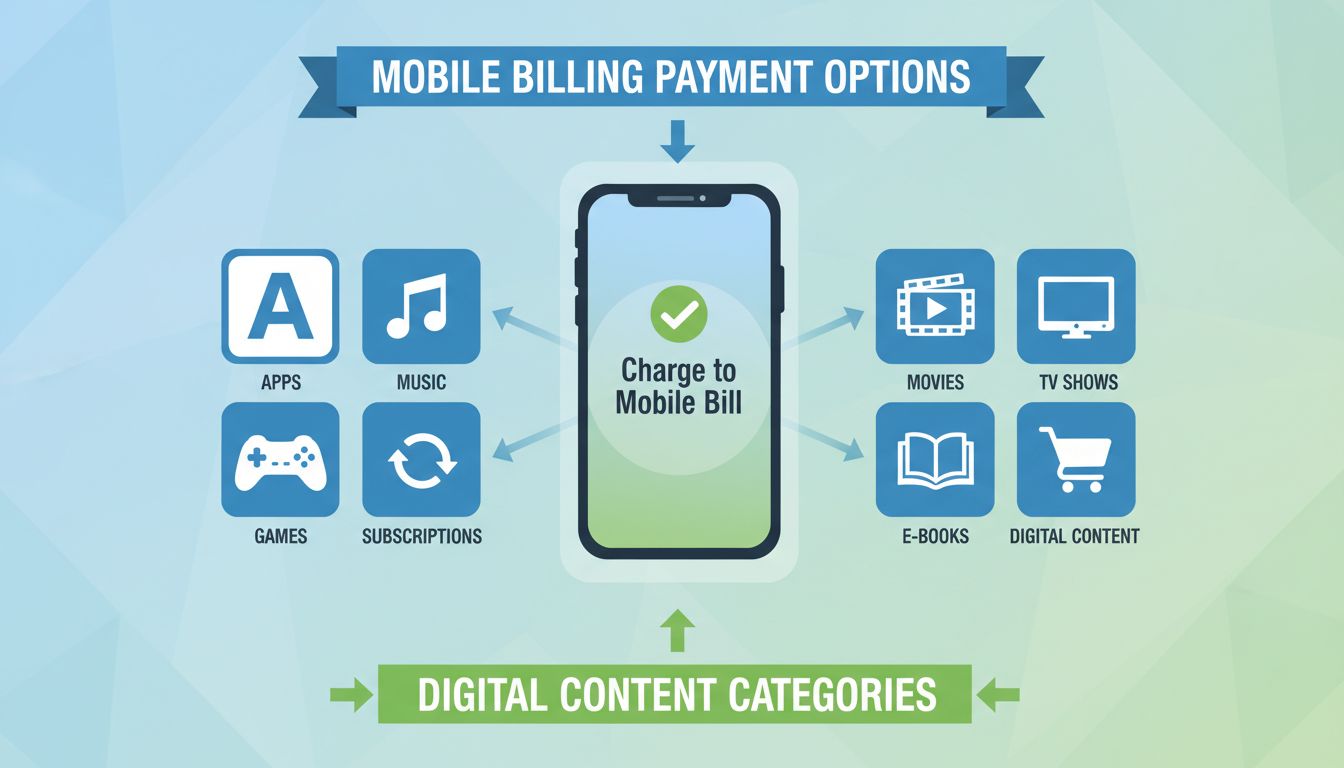
Discover what you can purchase with mobile billing in 2025. Learn about apps, subscriptions, digital content, and how mobile carrier billing works for seamless ...
A direct billing flow charges insurers, employers, or carriers directly—no customer payment upfront.
Join our community of happy clients and provide excellent customer support with Post Affiliate Pro.




Cookie Consent
We use cookies to enhance your browsing experience and analyze our traffic. See our privacy policy.