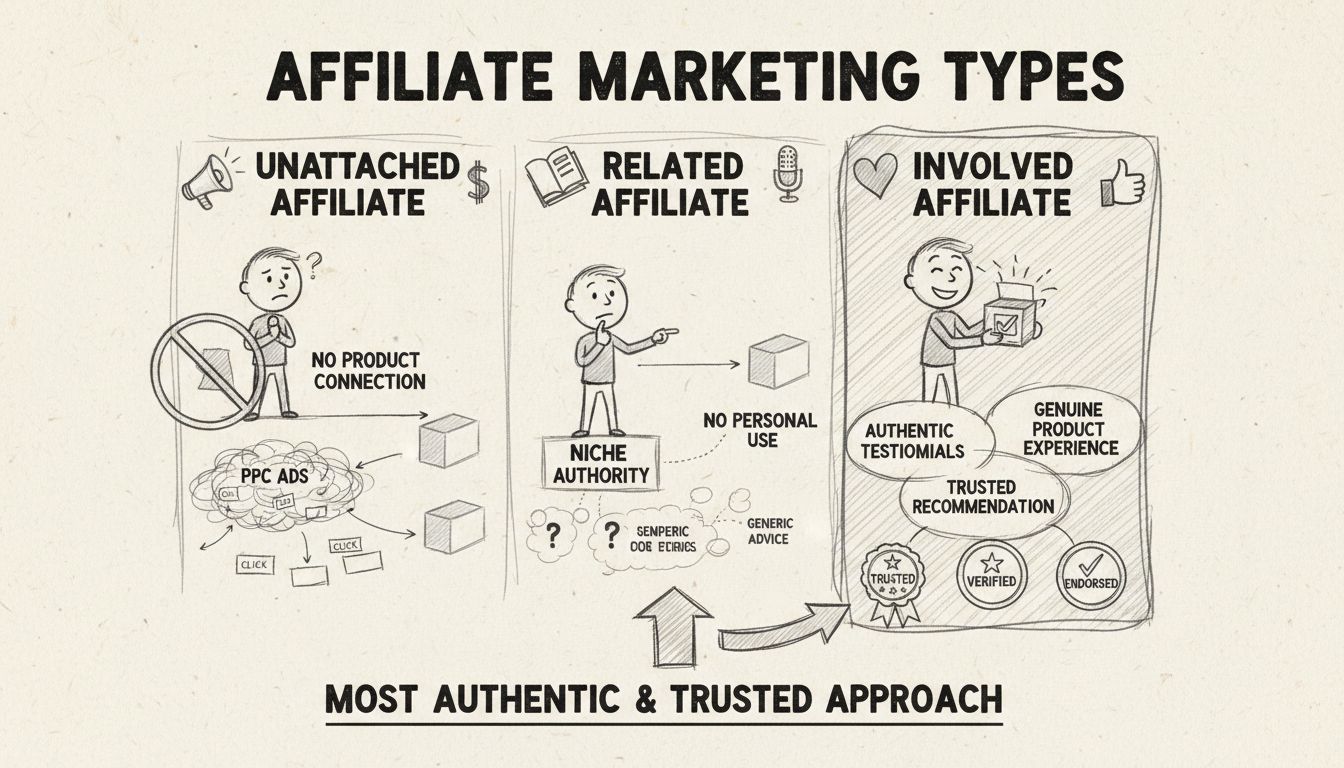
An involved affiliate is an affiliate marketer who personally uses — or has used — the product or service they promote, and whose endorsement is grounded in firsthand experience. Rather than placing ads for products they have never touched, involved affiliates create reviews, tutorials, walkthroughs, and testimonials drawn from actual usage. This direct product experience builds audience trust, increases conversion rates, and distinguishes the involved affiliate from unattached and related affiliate types.
What Is an Involved Affiliate?
Core Definition
An involved affiliate promotes a merchant’s product or service based on personal experience. They have used the item themselves — sometimes for months or years — and they speak about it from a position of genuine knowledge. Their content typically takes the form of detailed reviews, comparison posts, video demonstrations, or social media testimonials that reference specific features, benefits, and drawbacks they encountered firsthand.
This definition matters because it sets a clear bar: the involved affiliate is not guessing. When they say a SaaS platform’s reporting dashboard loads slowly on mobile, they know because they tested it. When they recommend a specific running shoe for overpronation, they have logged miles in it. That credibility translates into higher engagement and conversion rates than impersonal advertising can achieve.
Where the Term Comes From
The “unattached / related / involved” taxonomy was popularized by Pat Flynn of Smart Passive Income in 2009, when he categorized affiliate marketing into three tiers based on the affiliate’s relationship to the product:
- Unattached: No connection to the product; the affiliate runs paid ads and hopes for clicks.
- Related: The affiliate operates in the product’s niche and has audience authority, but may not have used the specific item.
- Involved: The affiliate has used the product and speaks from direct experience.
This framework has since been adopted across the industry — appearing in Investopedia’s affiliate marketing guide, BigCommerce’s merchant resources, Coursera’s educational content, and glossary pages like this one. It remains the standard taxonomy for classifying affiliate types by their level of product engagement.
When Each Type Makes Sense
Unattached affiliate marketing works for advertisers who need volume fast and have the margins to absorb lower conversion rates. It is a paid-acquisition play, not a trust play.
Related affiliate marketing suits publishers who have built an audience around a topic and want to monetize with products that fit naturally — even if they have not used every single one.
Involved affiliate marketing is the strongest model for sustainable, trust-based income. It takes longer to build because testing products requires time and sometimes money, but it produces content with a longer shelf life and higher per-visitor value. For brands, recruiting involved affiliates means accepting slower partner onboarding in exchange for higher-quality, more credible promotion.
Launch your affiliate program today
Set up advanced tracking in minutes. No credit card required.
Real-World Examples of Involved Affiliates
Tech and SaaS Reviewer
A software developer runs a YouTube channel reviewing productivity tools. They use a specific project-management SaaS daily to run their own business. Their review video shows the actual dashboard, explains their workflow, and highlights three features they rely on — plus two limitations they wish the vendor would fix. They include an affiliate link in the description. Viewers trust the review because the details are too specific to be fabricated.
Fitness and Wellness Creator
A certified personal trainer posts Instagram and blog content about home gym equipment. They purchase a set of adjustable dumbbells, use them for eight weeks of training, and publish a detailed review with progress photos, weight-tracking data, and comparisons to three other brands they have owned. Their affiliate link to the manufacturer earns a commission on each sale.
Ecommerce Product Reviewer
A parent runs a blog reviewing baby gear. They test a stroller across six months of daily use — city sidewalks, public transit, car trunks, and travel. Their review includes photos of wear and tear, a comparison table against two competitors, and an honest assessment of which use cases the stroller suits best. Affiliate links point to the manufacturer’s direct site and to Amazon.
- Blog posts: Place a disclosure at the top of the post, before the first affiliate link. Example: “Disclosure: I purchased this product myself. If you buy through links in this post, I may earn a commission at no extra cost to you.”
- YouTube videos: Include a verbal disclosure in the first 30 seconds and a written disclosure in the description above the fold (before “Show More”).
- Instagram/TikTok: Place “#ad” or “Affiliate link” at the beginning of the caption, not buried in a hashtag cluster at the end.
- Email newsletters: Disclose in the body text near the first affiliate link — not only in a footer.
How Affiliate Software Supports Involved Affiliates
Tracking and Attribution
For involved affiliates who publish evergreen review content that ranks in search engines, this means a single piece of content can generate commissions for years. The software tracks every click and conversion, providing both the affiliate and the advertiser with transparent performance data.
Affiliate software helps program managers identify which involved affiliates drive genuine value vs. those who might be inflating numbers. Key metrics include:
- Conversion rate by affiliate
- Average order value of referred customers
- Refund and chargeback rates per affiliate
- Click-to-conversion time
- Geographic and device distribution of traffic
Unusual patterns — such as a sudden spike in clicks from a single IP range or an abnormally high refund rate — trigger fraud alerts, protecting the advertiser’s budget.
Join our newsletter
Be the first to know about new features and product updates.
Limitations and Common Pitfalls
Scalability Constraints
An involved affiliate can only test so many products. Each review requires purchase or procurement, usage time, content creation, and ongoing updates. Unlike an unattached affiliate who scales by increasing ad spend, the involved affiliate’s output is bounded by time. This makes the model higher-quality but lower-volume — a trade-off that suits some business goals better than others.
Audience Fatigue and Trust Erosion
If an involved affiliate promotes too many products too frequently, or if they endorse a product that turns out to be low-quality, audience trust erodes quickly. The involved model depends on the perception — and reality — of honest, selective endorsement. One undisclosed paid promotion or one glowing review of a bad product can undo years of credibility.
Product Dependency Risk
An involved affiliate whose income is concentrated in one product or brand faces significant risk. If the merchant changes commission terms, discontinues the product, or shuts down the affiliate program, the affiliate’s revenue can collapse. Diversifying across multiple merchants and product categories mitigates this risk.
Core Definition
An involved affiliate promotes a merchant’s product or service based on personal experience. They have used the item themselves — sometimes for months or years — and they speak about it from a position of genuine knowledge. Their content typically takes the form of detailed reviews, comparison posts, video demonstrations, or social media testimonials that reference specific features, benefits, and drawbacks they encountered firsthand.
This definition matters because it sets a clear bar: the involved affiliate is not guessing. When they say a SaaS platform’s reporting dashboard loads slowly on mobile, they know because they tested it. When they recommend a specific running shoe for overpronation, they have logged miles in it. That credibility translates into higher engagement and conversion rates than impersonal advertising can achieve.
Where the Term Comes From
- Unattached: No connection to the product; the affiliate runs paid ads and hopes for clicks.
- Related: The affiliate operates in the product’s niche and has audience authority, but may not have used the specific item.
- Involved: The affiliate has used the product and speaks from direct experience.
This framework has since been adopted across the industry — appearing in Investopedia’s affiliate marketing guide, BigCommerce’s merchant resources, Coursera’s educational content, and glossary pages like this one. It remains the standard taxonomy for classifying affiliate types by their level of product engagement.
Key Characteristics of an Involved Affiliate
| Characteristic | Description |
|---|
| Firsthand product use | Has purchased, tested, or extensively used the product before promoting it |
| Authentic endorsement | Recommendation is based on genuine satisfaction, not just commission potential |
| Detailed content | Produces reviews, tutorials, walkthroughs, or case studies with specific details |
| Audience trust | Followers recognize the affiliate’s track record of honest, experience-backed opinions |
| Higher conversion rates | Personal testimony converts better than generic ad copy — often 2× to 5× the rate of unattached campaigns |
| Long-term orientation | Builds sustainable income through reputation, not short-term ad arbitrage |
Side-by-Side Comparison
| Unattached Affiliate | Related Affiliate | Involved Affiliate |
|---|
| Product connection | None — never used the product | Niche-aligned but may not have used this specific product | Has personally used the product |
| Primary strategy | Paid advertising (PPC, display, social ads) | Content marketing within a niche | Reviews, tutorials, and personal testimonials |
| Trust level | Low — audience has no reason to trust the recommendation | Moderate — audience trusts the affiliate’s niche expertise | High — audience trusts firsthand experience |
| Scalability | High — limited only by ad budget | Moderate — limited by content output | Lower — limited by time to test each product |
| — | High — disclosure often overlooked in paid ads | Moderate | Lower — authentic use is inherently more transparent |
| Example | A Google Ads campaign sending traffic to a weight-loss supplement landing page | A tech blogger promoting a VPN service they have researched but not used long-term | A photographer reviewing a camera body they purchased and shot with for six months |
When Each Type Makes Sense
Unattached affiliate marketing works for advertisers who need volume fast and have the margins to absorb lower conversion rates. It is a paid-acquisition play, not a trust play.
Related affiliate marketing suits publishers who have built an audience around a topic and want to monetize with products that fit naturally — even if they have not used every single one.
Involved affiliate marketing is the strongest model for sustainable, trust-based income. It takes longer to build because testing products requires time and sometimes money, but it produces content with a longer shelf life and higher per-visitor value. For brands, recruiting involved affiliates means accepting slower partner onboarding in exchange for higher-quality, more credible promotion.
How the Involved Affiliate Model Works
The Affiliate’s Workflow
- Acquire and use the product. The affiliate buys, receives a review unit, or gains access through a brand partnership. They use it in real scenarios — not a cursory unboxing.
- Document the experience. They note specific features, performance data, pros, cons, and comparisons to alternatives they have also used.
- Create content. The affiliate produces a review, video walkthrough, comparison post, tutorial, or social media thread grounded in their actual usage.
- Integrate affiliate links. Unique tracking links are placed naturally within the content. On a blog, this might be inline text links and a summary call-to-action. On YouTube, it is the description link and a verbal mention.
- Earn commission. When a reader or viewer clicks through and completes a purchase (or specified action), the affiliate earns a commission tracked by the merchant’s affiliate software.
The Advertiser’s Workflow
- Define the affiliate program. Set commission rates, cookie duration, attribution rules, and payment terms within affiliate tracking software.
- Recruit involved affiliates. Identify content creators who already use — or would genuinely use — the product. Outreach emphasizes the fit between their audience and the product’s value.
- Provide access. Supply review units, trial accounts, or demo licenses so affiliates can gain the firsthand experience that defines the involved model.
- Track performance. Affiliate software records clicks, conversions, and commissions per partner. Advertisers monitor which involved affiliates drive the highest-quality traffic.
- Optimize and reward. Top-performing involved affiliates may receive higher commission tiers, exclusive promo codes, or early access to new products.
The Program Manager’s Role
Affiliate program managers sit between affiliates and advertisers. For involved affiliate relationships, their responsibilities include:
- Vetting applicants: Confirming that a prospective involved affiliate actually uses the product category and has an audience that matches the target customer profile.
- Performance analysis: Comparing conversion rates, average order value, and customer lifetime value across involved vs. other affiliate types to justify higher commission tiers.
- Relationship management: Involved affiliates are partners, not just traffic sources. Regular communication, product updates, and early access to new releases keep the relationship productive.
Tech and SaaS Reviewer
A software developer runs a YouTube channel reviewing productivity tools. They use a specific project-management SaaS daily to run their own business. Their review video shows the actual dashboard, explains their workflow, and highlights three features they rely on — plus two limitations they wish the vendor would fix. They include an affiliate link in the description. Viewers trust the review because the details are too specific to be fabricated.
Fitness and Wellness Creator
A certified personal trainer posts Instagram and blog content about home gym equipment. They purchase a set of adjustable dumbbells, use them for eight weeks of training, and publish a detailed review with progress photos, weight-tracking data, and comparisons to three other brands they have owned. Their affiliate link to the manufacturer earns a commission on each sale.
Ecommerce Product Reviewer
A parent runs a blog reviewing baby gear. They test a stroller across six months of daily use — city sidewalks, public transit, car trunks, and travel. Their review includes photos of wear and tear, a comparison table against two competitors, and an honest assessment of which use cases the stroller suits best. Affiliate links point to the manufacturer’s direct site and to Amazon.
FTC Compliance and Disclosure for Involved Affiliates
What the FTC Endorsement Guides Require
For involved affiliates, this means:
- If you receive a free review unit, you must disclose it.
- If you earn a commission on sales through your links, you must disclose it.
- The disclosure must appear before the affiliate link — not buried at the bottom of a post or hidden in a terms page.
Involved affiliates who fail to disclose risk fines and loss of audience trust — the very asset their model depends on.
How to Disclose Correctly
- Blog posts: Place a disclosure at the top of the post, before the first affiliate link. Example: “Disclosure: I purchased this product myself. If you buy through links in this post, I may earn a commission at no extra cost to you.”
- YouTube videos: Include a verbal disclosure in the first 30 seconds and a written disclosure in the description above the fold (before “Show More”).
- Instagram/TikTok: Place “#ad” or “Affiliate link” at the beginning of the caption, not buried in a hashtag cluster at the end.
- Email newsletters: Disclose in the body text near the first affiliate link — not only in a footer.
Tracking and Attribution
When a visitor clicks that link, a cookie is stored on their device. If they complete a purchase within the cookie window (commonly 30–90 days), the software attributes the sale to that affiliate and calculates the commission.
For involved affiliates who publish evergreen review content that ranks in search engines, this means a single piece of content can generate commissions for years. The software tracks every click and conversion, providing both the affiliate and the advertiser with transparent performance data.
Modern affiliate platforms support commission models beyond the flat percentage:
- Tiered commissions: Affiliates who drive more sales unlock higher rates.
- Recurring commissions: Common in SaaS — the affiliate earns a percentage each month the referred customer stays subscribed. This rewards involved affiliates whose thorough reviews attract high-retention customers.
- Performance bonuses: One-time bonuses for hitting volume thresholds, running successful seasonal campaigns, or producing especially high-quality content.
- First-click vs. last-click attribution: Software lets advertisers choose which touchpoint gets credit. Involved affiliates who produce top-of-funnel review content benefit from first-click attribution models.
Affiliate software helps program managers identify which involved affiliates drive genuine value vs. those who might be inflating numbers. Key metrics include:
- Conversion rate by affiliate
- Average order value of referred customers
- Refund and chargeback rates per affiliate
- Click-to-conversion time
- Geographic and device distribution of traffic
Unusual patterns — such as a sudden spike in clicks from a single IP range or an abnormally high refund rate — trigger fraud alerts, protecting the advertiser’s budget.
Typical Commission Ranges by Industry
| Industry | Typical Commission Range | Common Cookie Window |
|---|
| SaaS / Software | — | 30–90 days |
| Ecommerce (physical goods) | — | 30 days |
| Digital courses / info products | — | 60–90 days |
| Travel / hospitality | — | 7–30 days |
| Financial products | — | 30 days |
| Health / wellness supplements | — | 30–60 days |
| Fashion / apparel | — | 30 days |
| Hosting / domains | — | 60–90 days |
Earnings Potential and Commission Benchmarks
What Top Involved Affiliates Earn
Earnings vary dramatically by niche, audience size, and content quality.
The common thread: involved affiliates at every level attribute their income to the trust their firsthand experience creates. As Pat Flynn noted in his breakdown of the three types, involved affiliate marketing is “the one I profit from” — precisely because authenticity compounds over time.
Scalability Constraints
An involved affiliate can only test so many products. Each review requires purchase or procurement, usage time, content creation, and ongoing updates. Unlike an unattached affiliate who scales by increasing ad spend, the involved affiliate’s output is bounded by time. This makes the model higher-quality but lower-volume — a trade-off that suits some business goals better than others.
Audience Fatigue and Trust Erosion
If an involved affiliate promotes too many products too frequently, or if they endorse a product that turns out to be low-quality, audience trust erodes quickly. The involved model depends on the perception — and reality — of honest, selective endorsement. One undisclosed paid promotion or one glowing review of a bad product can undo years of credibility.
Product Dependency Risk
An involved affiliate whose income is concentrated in one product or brand faces significant risk. If the merchant changes commission terms, discontinues the product, or shuts down the affiliate program, the affiliate’s revenue can collapse. Diversifying across multiple merchants and product categories mitigates this risk.
The “Fake Involved” Problem
Some affiliates claim firsthand experience they do not have — reading other reviews and synthesizing them into content that sounds authentic but is not. Audiences and regulators are increasingly adept at spotting this.