


Brand bidding in affiliate marketing
Learn what brand bidding is, how affiliates use search ads on your brand name to earn commission on sales you would have won anyway, and how to stop it.
17 min read
Brand bidding is paying for search ads on a brand’s name, which in affiliate marketing means earning commission on customers who were already looking for the merchant.
Brand bidding is paying for search ads that appear when someone searches for a brand’s name, its product names or close variations of them. The advertiser chooses the brand term as a keyword, and the ad shows above or beside the search results whenever that term is searched.
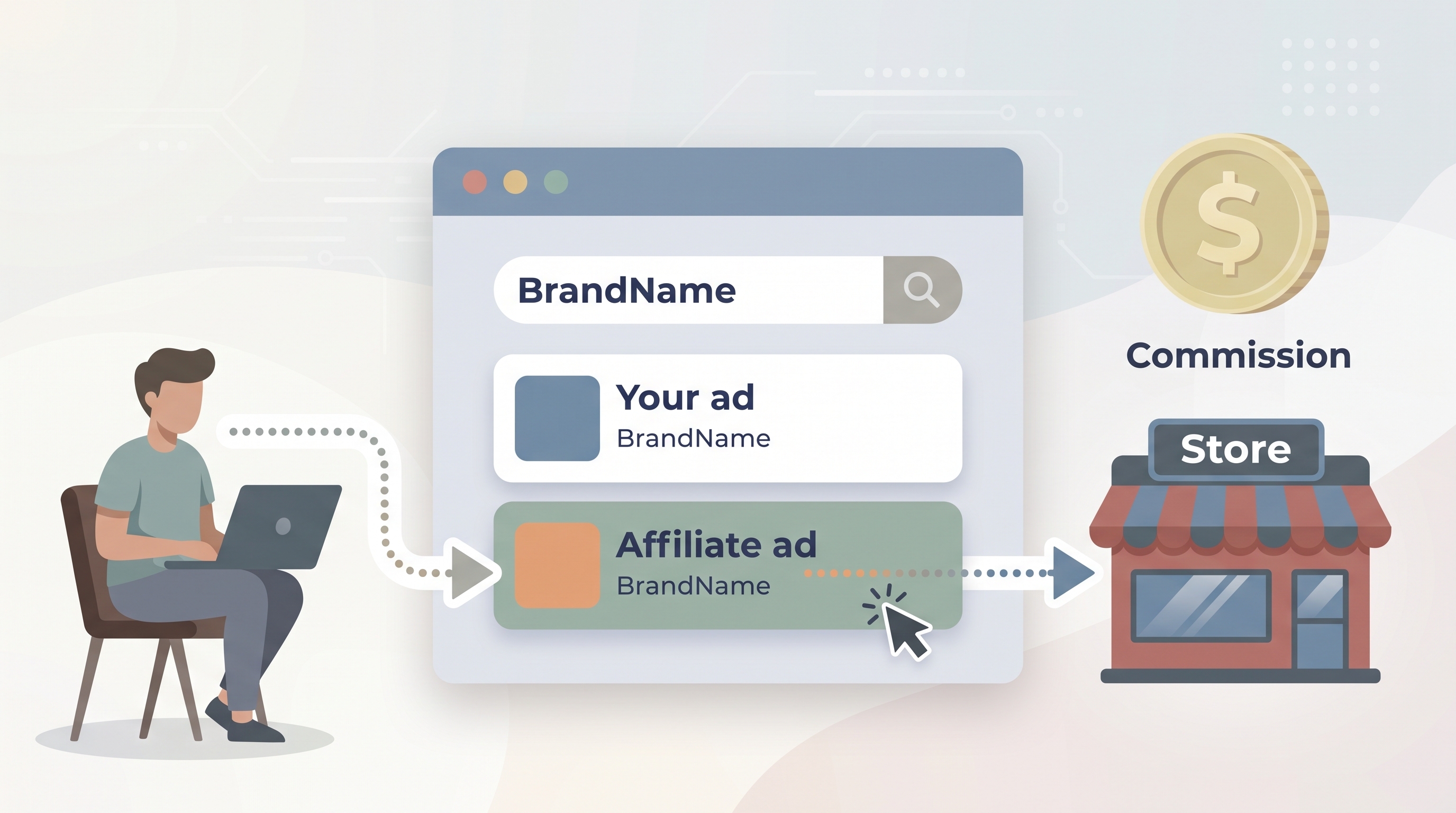
In affiliate marketing the term usually describes one situation: an affiliate bids on the merchant’s brand name and uses their affiliate tracking link as the ad’s destination. Someone who was already looking for the merchant clicks the ad, passes through the link and buys, and the affiliate earns a commission on a customer the merchant had a good chance of winning without them.
This entry defines brand bidding, explains how it works and who does it, and clears up common misunderstandings. To detect it, set a policy and stop it, read the full guide on brand bidding in affiliate marketing .
Brand bidding is a paid search tactic built on branded keywords. The advertiser pays to show an ad when a person searches for a brand, and in most ad systems pays when the ad is clicked, which is the pay per click (PPC) model. The brand being searched for is not always the advertiser’s own, and that is what makes the term matter in affiliate marketing.
A brand term is any search phrase that points to a specific company. It goes beyond the company name:
A rule that only covers the company name leaves the rest open, which is why programs that restrict brand bidding list every term they mean.
Branded search is the other side of the same coin. It is the behavior: people type a brand into a search engine. Brand bidding is the advertising decision to pay for a place on those searches. A person can find your site through your free listing for the brand, or through a paid ad that someone bought on it. The searcher usually cannot tell who paid, and the merchant sees the difference only in their data.

Set up advanced tracking in minutes. No credit card required.
For the customer almost nothing changes. For the merchant’s data a lot does: a sale that began with a search for the merchant’s own name is now recorded as a sale generated by an affiliate.
An illustrative case, with made-up numbers. A merchant pays 10% commission. A customer searches for the merchant’s name, clicks an affiliate’s ad and buys a 100 USD order, so the affiliate earns 10 USD. If the customer was going to buy anyway, the merchant has paid 10 USD for a sale that needed no affiliate. The merchant’s affiliate report also shows that sale as affiliate revenue, even though the affiliate did not create the demand.
Three different parties bid on brand names, with different effects for the merchant.
A merchant can bid on its own brand name so that it, not someone else, holds the ad space when a customer searches for it. This is sometimes called defensive brand bidding. It gives control over the ad text and the landing page. The cost is that the merchant may pay for clicks its free listing would have received anyway. Whether the ads add sales can be tested, for example with Google Ads experiments, which split budget or traffic between an original campaign and a changed version (Google Ads Help ).
An affiliate who bids on the merchant’s brand does it because the click is cheap to win and the visitor is already close to buying. The affiliate does not have to create content, build an audience or persuade anyone. Many programs ban it in their terms and allow it only for approved partners under written conditions.
A competitor can bid on your brand terms to show its own ad to people looking for you. A competitor has no agreement with you, so your rules for affiliates do not apply. Your options are the platform’s complaint process for ad text and your own advertising.
Be the first to know about new features and product updates.
People use these terms loosely.
| Term | What it means | Who bids on whose brand |
|---|---|---|
| Brand bidding | Bidding on a brand’s name, product names and variations as search keywords | Usually an affiliate bidding on the merchant’s brand |
| Trademark bidding | Bidding on a registered trademark as a keyword | Sometimes used for the same practice in affiliate program rules |
| Defensive brand bidding | Bidding on your own brand terms to hold the ad space | A merchant bidding on its own brand |
| Competitor bidding | Bidding on a rival’s brand terms to show your own ad to their audience | A competitor bidding on your brand |
When a merchant has not agreed to it, brand bidding creates five problems:
Not every merchant treats it as a problem. Some allow it for approved partners, and the full guide compares the three policy options: a full ban, conditional permission and full permission.
Google Ads says it does not restrict the use of trademarks as keywords. It may restrict trademarks in ad text in certain situations, for example when a direct competitor uses the mark or when the use is confusing, deceptive or misleading, and trademark owners can submit a complaint (Google Ads trademark policy ).
In the United States, the federal statute on infringement of registered marks makes actionable the use in commerce of a registered mark in connection with advertising goods or services where that use “is likely to cause confusion, or to cause mistake, or to deceive” (15 U.S.C. § 1114 ). The test is confusion, not simply that someone else used your name. This is general information, not legal advice, and a trademark attorney can tell you whether a specific ad crosses the line.
Because neither the platform nor the law reliably settles the question in a merchant’s favor, the dependable control is the rule in your own affiliate agreement .
“Brand bidding is always illegal.” It is not automatically. The platform allows trademarks as keywords, and the legal test is confusion, which depends on the facts of each ad.
“If I ban PPC, I have banned brand bidding.” A blanket ban on paid search is broader than most merchants intend. A clear rule names the brand terms and the ad text rules instead.
“If sales are rising, it is working.” Sales credited to a brand-bidding affiliate may have happened anyway. Judge branded campaigns on total branded sales from all sources, not on what one channel reports.
“The search engine will stop my affiliates.” The platform does not restrict trademarks as keywords. You have a complaint route for misleading ad text, but the main control is your own program.
“Only the company name counts.” Product names, misspellings and name-plus-action phrases are brand terms too.
A program that wants to control brand bidding needs the same four building blocks:
In Post Affiliate Pro, the Keywords Performance report shows clicks by search keyword and can be filtered by affiliate. Activate the feature first under Configuration > Features, because it records keywords only from activation onward. The step-by-step setup, the three policy options and a sample clause are in the brand bidding guide .
Post Affiliate Pro gives you keyword reports, click details, commission approval and terms acceptance to monitor and enforce your brand bidding policy.
Learn what brand bidding is, how affiliates use search ads on your brand name to earn commission on sales you would have won anyway, and how to stop it.
Paid search is a digital advertising model where businesses pay search engines to show ads for specific keywords. Learn how PPC works.
Pay per click (PPC) is an online advertising model where advertisers pay a fee each time their ad is clicked, commonly used in affiliate marketing to drive traf...
Join our community of happy clients and provide excellent customer support with Post Affiliate Pro.




Cookie Consent
We use cookies to enhance your browsing experience and analyze our traffic. See our privacy policy.