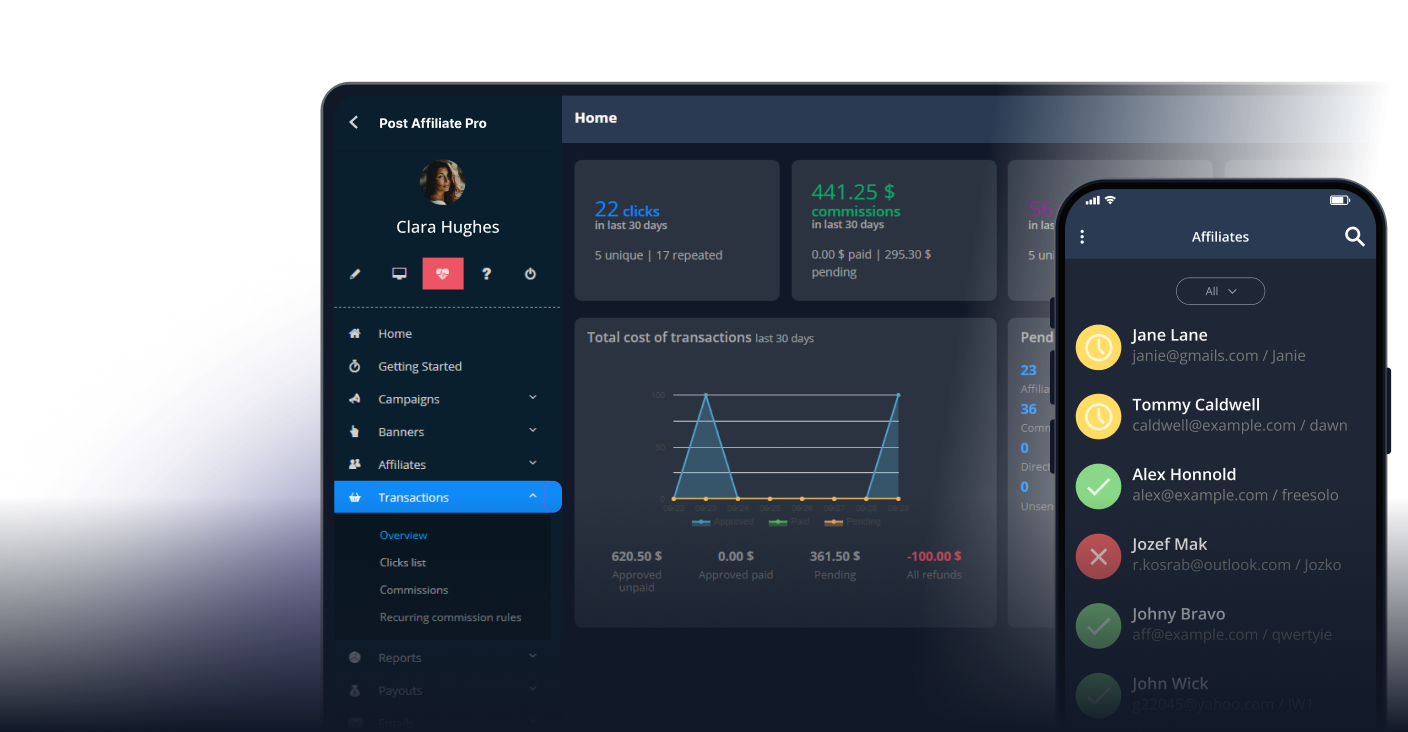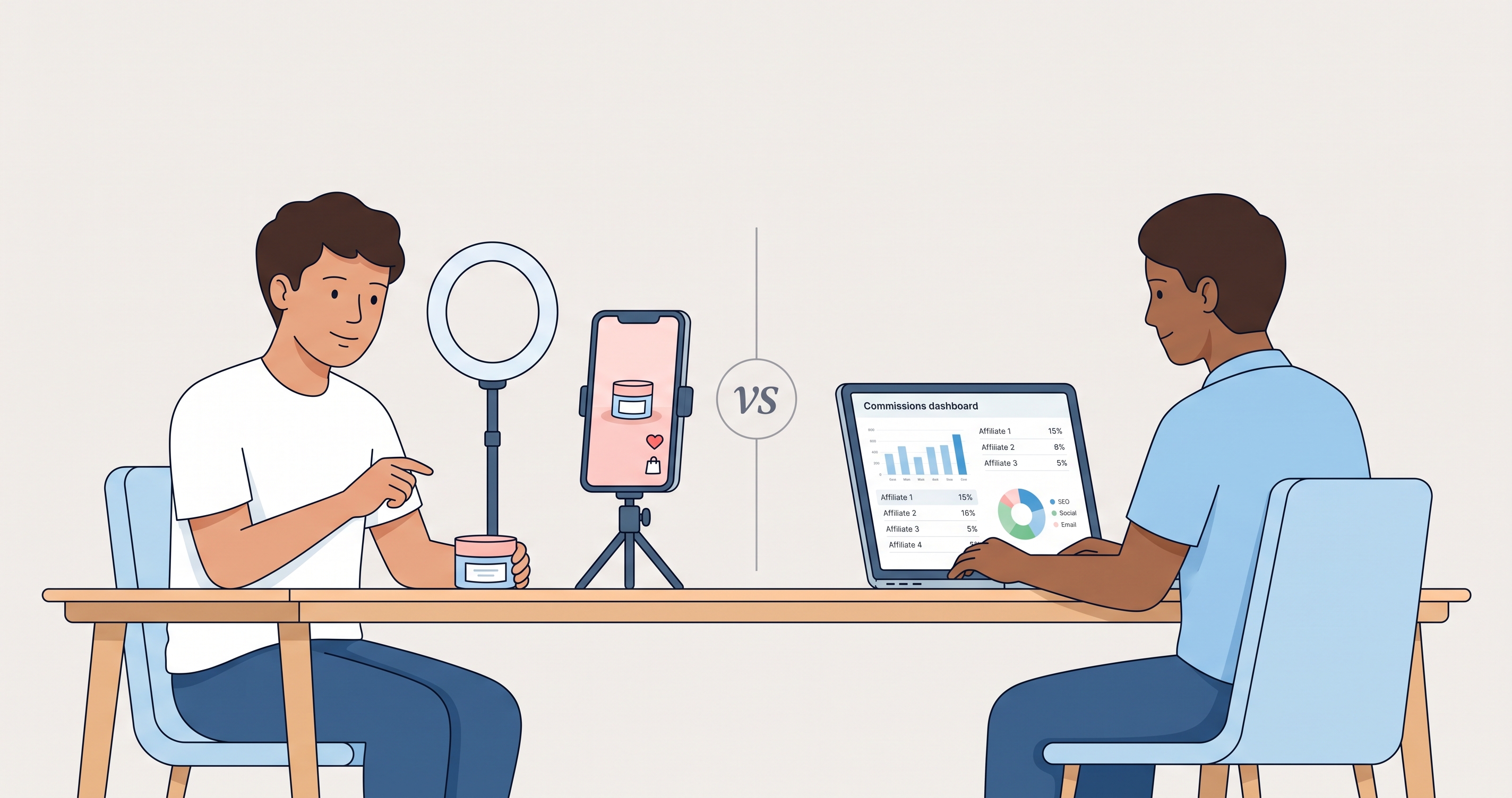
TikTok Shop’s affiliate program and independent affiliate software are two different ways to pay people for selling your products. TikTok Shop is a marketplace program that handles discovery, checkout and payouts for sales made inside the app. Affiliate software is a system you own that tracks and pays commissions across your own store, email and other channels. This guide compares them side by side so you can choose, or decide how to use both.
Key takeaways
- TikTok Shop’s program is fast to start and good for in-app discovery, but it only covers sales made inside TikTok and follows TikTok’s rules for rates, timing and payouts.
- Affiliate software takes more effort to set up, but you control commission rules, tiers, approvals, payout schedules and the affiliate relationship itself.
- TikTok Shop typically charges a 6 percent referral fee per order on top of the creator commission. Your own program has no marketplace referral fee on sales through your own checkout.
- If you sell anywhere besides TikTok Shop, you will usually want affiliate software alongside it, or instead of it.
Quick comparison
| TikTok Shop affiliate program | Independent affiliate software (like Post Affiliate Pro) | |
|---|---|---|
| Where sales are tracked | Inside TikTok Shop only | Your own site, email, other marketplaces, anywhere a tracked link, coupon or pixel works |
| Who owns the relationship | TikTok | You |
| Commission rules | Rate per product; Open and Target collaboration models | Fully custom: tiers, recurring, per-affiliate rates, approval rules |
| Seller fees | 6% referral fee on most US orders, plus creator commission | Software license; no marketplace referral fee |
| Payout timing | Set by TikTok, typically 15 to 31 days after delivery | You set the schedule and methods |
| Fraud controls | TikTok’s marketplace rules | Rules you configure for your own program |
| Reporting | TikTok Shop activity only | One view of every affiliate across every channel |
| Setup effort | Minutes | Hours to days, depending on the setup |
| Best for | Brands selling only in TikTok Shop | Brands that sell in more than one place or want to own their affiliate program |
How TikTok Shop’s affiliate program works
TikTok Shop’s affiliate program is built to move product inside the app. A seller lists an item and sets a commission rate, and creators either browse the open marketplace or get invited into a richer deal. When a viewer buys through a tagged video, a LIVE stream or a showcase link, TikTok tracks the sale, calculates the commission and pays the creator once the return window has closed. No separate contract is needed, and TikTok handles the whole transaction, including the customer’s payment.
Imagine a mid-sized skincare brand with a strong quarter on TikTok Shop and a separate affiliate program on its own website. When someone asks how much was paid out in commissions last month, nobody has a single answer, because the two systems report in different formats on different schedules. That gap is the core difference between the two approaches.
TikTok Shop affiliate program requirements
Sellers don’t screen who becomes an affiliate creator the way they would in their own program. Under TikTok’s Seller Center policy, an affiliate creator must be at least 18 years old, based in the US, hold a minimum of 1,000 followers, and have no prior history of having e-commerce permissions revoked (Source ). After a creator earns their first commission, they may be asked to verify their identity with a government-issued ID and real-time selfies.
Joining is quick and free. A creator switches to a Creator account, opens TikTok Studio, selects “TikTok Shop for Creator” in the Monetization tab, and applies. TikTok’s own guidance puts approval at a matter of minutes for applicants who meet the baseline criteria (Source: TikTok Seller Center, What You Need to Know Before Becoming a TikTok Shop Creator ).
The catch for sellers is that a 1,000 follower minimum filters out dormant accounts but says nothing about whether a creator’s audience buys in your category. Choosing, tracking and rewarding the right partners is still your job.
TikTok Shop commission rates and fees
TikTok Shop runs two collaboration models. Open Collaboration lets any eligible creator add a product to their showcase, and it typically pays 10 to 15 percent depending on category. Target Collaboration is invite-only and pays more, generally 15 to 25 percent for proven performers and up to 50 percent for top creators (Source ).
On top of the creator commission, TikTok typically charges a 6 percent referral fee per order, calculated on the item price before sales tax and shipping. A small withdrawal fee may also apply when you move funds out of your seller account (Source ). Combine a mid-range 15 percent commission with the 6 percent fee and the cost of an affiliate-driven sale is already around a fifth of the item price, before returns and refunds.
Payment is not instant. Creators typically receive their commission 15 days after delivery, or 31 days if the seller’s settlement period is longer. Commission can’t be paid while a dispute, refund or return request is unresolved, a partial refund reduces it proportionally, and a full refund brings it to zero (Source: TikTok Seller Center, How Standard Affiliate Commission Works ).
The scale is real. TikTok Shop’s global gross merchandise value reached an estimated 64.3 billion dollars in 2025, up 94 percent year over year, with the US contributing roughly 15.1 billion dollars (Source ). For brands that sell there, the program is worth using.

Launch your affiliate program today
Set up advanced tracking in minutes. No credit card required.
How independent affiliate software works
Independent affiliate software isn’t tied to one sales channel, and unlike a marketplace or an affiliate network, it doesn’t put a third party between you and your affiliates (see affiliate network vs. affiliate program for the full difference). It sits underneath your website, email funnels, listings on other marketplaces and anywhere else a tracked link, coupon code or pixel can live. You decide how commissions are structured, approved and paid, and you keep the affiliate relationship and the data.
With Post Affiliate Pro, that means:
- Custom commission rules. Advanced commission configuration covers approval types, recurrence, negative carryover, variable tier commissions, and commission hold and release.
- Accurate attribution. SubID and ad channel tracking attributes each sale to the exact channel, sub affiliate or campaign behind it, and affiliate coupon tracking ties promo codes to the right partner.
- Your own fraud rules. Fraud protection lets you screen activity against your program, not a marketplace’s general rules.
- Payouts on your terms. Pay on your schedule and in the methods you already support, with no waiting for a platform to open your market.
- Fit with your stack. 200+ integrations connect to payment gateways, e-commerce platforms and CRMs, and you can choose a cloud-hosted or self-hosted setup.
The trade-off is effort. You recruit and manage your own affiliates, and you pay for the software. In return, you aren’t limited to one app’s audience or one platform’s rules.
Where TikTok Shop’s built-in tools stop
TikTok’s system is well built for one question: how much do I owe this creator for sales made inside my TikTok Shop. It isn’t designed to answer broader questions as a program grows.
- No view outside the app. A creator who drives serious traffic to your website through a link in their bio looks like a minor contributor in TikTok’s dashboard.
- Limited program design. You can’t build tiered rates that grow with an affiliate’s results, add your own approval workflow for higher-value transactions, or tune fraud rules to your own program.
- Platform-set payouts. Payouts follow TikTok’s currency and settlement schedule, which may not match how the rest of your business runs.
- Market-by-market availability. TikTok Shop reached the EU only in late 2024 and early 2025, and by June 2026 had expanded into Austria, Belgium, the Netherlands and Poland, joining France, Germany, Ireland, Italy, Spain and the UK. Since the EU launch, more than 100,000 European businesses have joined, across France, Germany, Italy, Spain and Ireland (Source ). Native affiliate tools only work in a region once TikTok opens it. Independent software has no such waiting period.
None of this is a flaw. It’s the scope of a single platform’s built-in tool.
Join our newsletter
Be the first to know about new features and product updates.
Why the same affiliate often appears in both systems
TikTok users aren’t TikTok-only users. YouGov research found that 85 percent of TikTok users also use YouTube, 83 percent also use Facebook and 76 percent also use Instagram (Source ). Creators mirror that, repurposing one review across several platforms.
One strong affiliate might tag your product in a TikTok Shop showcase, post the same review as a Reel with a link in their bio, and mention it in a newsletter. TikTok Shop only sees the first of those. If you only look at one platform, you can undervalue your best partners and lose them to a program that recognizes their full contribution. For more on how creators use each platform, see social media for affiliate marketing and how to place affiliate links and promo codes on TikTok .
Which should you choose?
TikTok Shop’s program is probably enough if:
- You sell only through TikTok Shop and have no other storefront.
- You want creators to find and promote your product without any setup on your side.
- You’re testing the channel and don’t need custom commission rules yet.
Affiliate software is the better fit if:
- You sell through your own site, other marketplaces or both.
- You want to set commission tiers, approval rules and payout schedules.
- You work with affiliates who promote across several platforms.
- You want to own the affiliate relationship and the performance data, not rent them from a platform.
Most growing brands end up in the second group. If you’re deciding whether to build your own program, start with a clear commission structure and a tracking method for each channel, then add affiliates gradually.
Running both without paying twice
Using both is common, and it works when you keep the systems cleanly separated by traffic source and are explicit with affiliates about which link earns which commission.
- Limit TikTok Shop’s commission to in-app purchases. It applies to sales completed inside TikTok Shop through its own tagged links and showcases.
- Limit your program’s commission to your own tracked sales. That means sales tracked through your own affiliate links, coupon codes or pixels, whether shared on a blog, in an email or in a TikTok bio.
- Give affiliates a separate link or code for anything promoted off TikTok. Spell the boundary out in your affiliate agreement.
- Track the total in one place. Affiliate software like Post Affiliate Pro shows each affiliate’s contribution across your site, other marketplaces and any trackable link, with mass payments for paying everyone on your schedule.
A creator can absolutely earn from both channels on the same product, as long as any single sale counts only once. One practical note on taxes: whoever pays an affiliate is responsible for their own reporting, and the US threshold for issuing a 1099-NEC rose from 600 to 2,000 dollars starting with tax year 2026 (Source ). Your own program’s ledger should show exactly what you’ve paid each affiliate, so year-end reporting is something your finance team can trust.
The bottom line
TikTok Shop is very good at being TikTok Shop. It was never meant to be your affiliate program control center. If you sell only there, its built-in tools may be all you need. Once you sell anywhere else, run other marketing channels or work with affiliates who post across platforms, independent affiliate software gives you the control, attribution and ownership a platform program can’t. To compare tools in more depth, see our guides to affiliate tracking software and affiliate program software .