


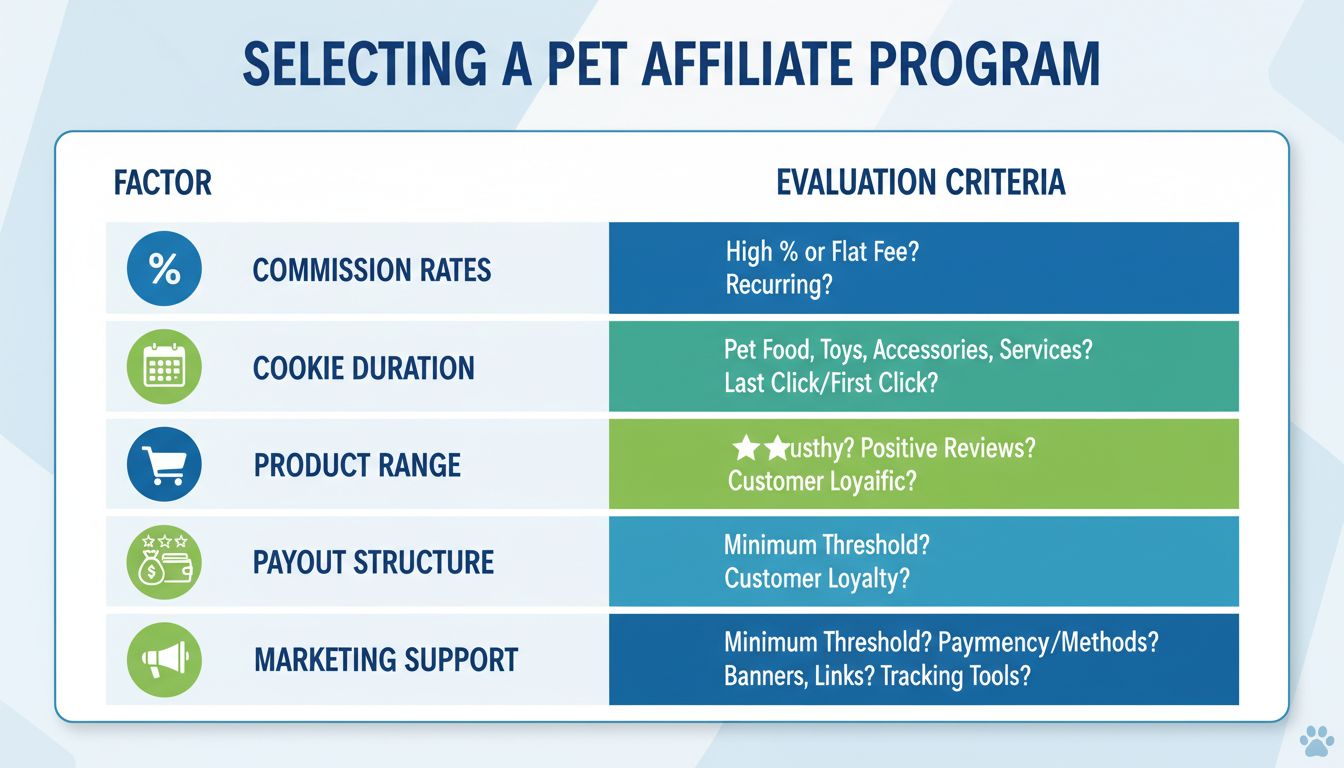
What Should I Look For in a Pet Affiliate Program? 2025 Guide
Discover the essential factors to evaluate when choosing a pet affiliate program. Learn about commission rates, cookie duration, product range, brand reputation...
13 min read
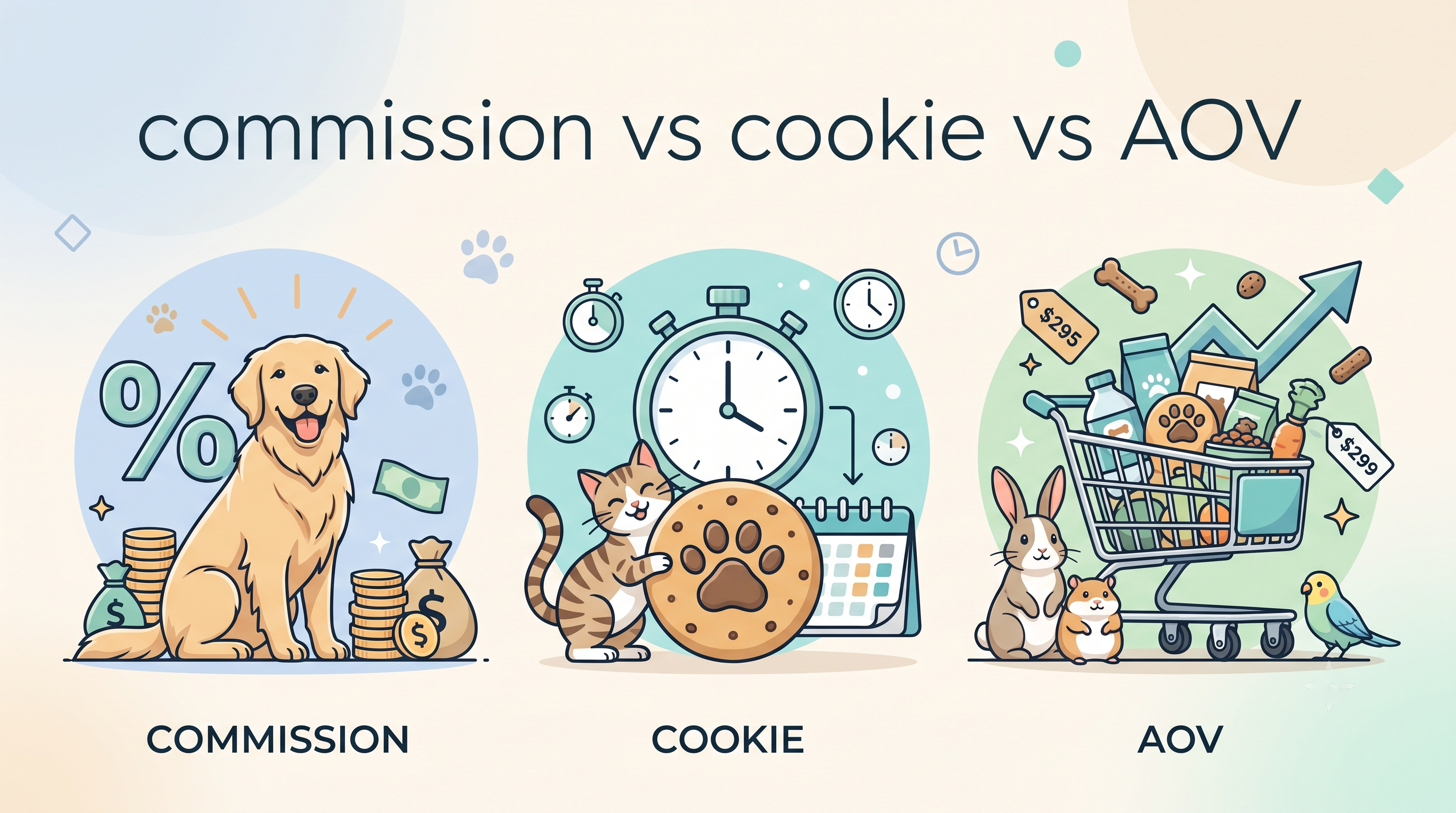
Commission rate is the number everyone quotes first, but it’s the least reliable predictor of what a pet affiliate program will actually pay you. Here’s the three-factor framework to evaluate any program before you commit content to it.
A new affiliate comparing two pet program pages will almost always gravitate toward the bigger number. One program advertises 75% commission, the other 6%, and the choice looks obvious. It usually isn’t. A commission rate only tells you what slice of a sale you keep, not how big that sale actually is. A 75% commission on a $30 digital course pays about $22.50. A 6% commission on a $100 pet retailer order, the kind that happens once someone adds food, treats, and a collar to the cart, pays $6. But swap that 6% retailer for a subscription brand averaging $150 per order at the same rate, and the payout jumps to $9, and at a slightly higher but still modest 15%, it climbs past what the “75%” program pays outright.
This is the trap almost every beginner falls into, and it’s an easy one to avoid once you know what to check instead. Three numbers, looked at together, tell you far more than a commission rate ever will:
This guide walks through how to weigh them against each other, using real pet affiliate programs as the examples. For the full roster of vetted options, see the complete guide to the best pet affiliate programs , and if you want the pure commission-rate leaderboard, check the highest-paying pet affiliate programs .

Here’s the whole trick, and it fits in one line:
Expected earnings per sale = commission rate × average order value
Brain Training for Dogs pays up to 75%, the richest rate in the pet niche, on a course that typically sells for around $35. That works out to roughly $26 per sale. Chewy pays a modest 4%-7%, but its average pet-food and supply order regularly runs $80-$100 once auto-ship and cross-selling kick in, which lands in a similar range. Now put a CBD wellness bundle from Innovet Pet next to both: a 35% commission on a $180 order pays out $63, more than double the “highest-paying” program on the list.
None of these programs lied about their rate. The rate was just never the whole story. Once you run this formula on any two programs you’re considering, the flashiest percentage stops being the automatic winner. It’s also why an affiliate roundup that ranks programs purely by commission percentage, including some published on this very site, is a useful shortlist and not a final answer. Treat any “highest commission” list as a starting point for this deeper math, not a verdict.

Set up advanced tracking in minutes. No credit card required.
Even once the formula above is second nature, a few habits keep tripping up otherwise careful affiliates. Knowing the math and applying it consistently are two different skills.
A cookie duration is simply how long you get credit for a sale after someone clicks your link. Whether that window matters a lot or barely at all depends entirely on how long people take to make up their mind about that kind of purchase.
Think about the difference between someone whose dog just had an accident on the carpet and someone considering a $150 DNA testing kit. The first person buys an odor remover today. The second person bookmarks three articles, reads reviews for two weeks, and maybe waits until payday.
The practical takeaway: match the cookie window to how your specific audience actually shops. A generous cookie on an impulse product is a nice bonus. A generous cookie on a slow-burn product is often the difference between getting paid and not.
There’s also a device-switching problem worth knowing about. Pet owners frequently research a purchase on a phone during a commute or a lunch break, then finish it later on a laptop at home. If a program’s tracking isn’t cross-device, and plenty of smaller affiliate networks still aren’t, a short cookie window compounds that gap even further, because the click that started the research and the click that closed the sale may never get connected at all. This is one more reason a longer cookie window is worth more than it first appears for considered pet purchases.
Be the first to know about new features and product updates.
Average order value is the number most beginners never think to check, and it can swing harder than either commission rate or cookie duration. A bag of dog treats might average $15. A luxury orthopedic bed from Paw.com or a wellness bundle from HolistaPet can average $80-$200. Multiply a modest commission against that bigger number, and it often beats a bigger commission against the smaller one.
There’s a second layer here too: subscriptions. A customer who signs up for monthly fresh food or CBD refills keeps generating revenue for the merchant long after the cookie has expired. That’s part of why subscription-based programs can sometimes afford richer commissions or signup bonuses than a one-time-purchase competitor selling at a similar price, even when the advertised rate looks about the same on paper.
Here’s a side-by-side worth keeping in mind when three programs are pulling roughly the same traffic to a review post:
| Program type | Commission | Typical AOV | Cookie | Est. earnings per sale |
|---|---|---|---|---|
| Flat-fee retailer (BarkBox-style) | $18 flat | n/a | 7 days | $18 |
| Mid-tier percentage (Tractive-style) | ~20% | $90 | 30 days | $18 |
| Premium wellness (Innovet-style) | 20%-40% | $150 | 30 days | $30-$60 |
On paper, the flat-fee and mid-tier programs land at the same payout once the numbers are run, despite having completely different commission structures. The wellness program pulls ahead not because its rate is dramatically higher, but because its products cost more per order. Sketching a table like this for any shortlist of programs takes a few minutes and prevents most of the guesswork described above.
When two programs look roughly comparable, run them both through the same three questions before you write a single word of content:
Rarely does one program win on all three fronts. Most of the time you’re trading one strength for another, and the right answer depends less on the program and more on what your content is actually built to do. A gift-guide post aimed at impulse buyers should lean toward programs with a strong AOV and forgiving conversion rates. A deep, research-heavy review aimed at a slow-burn purchase should lean toward the longest cookie window available, even if that means accepting a slightly lower commission rate.
Most affiliates who apply this framework don’t end up choosing just one program. They end up running three or four at once, each with its own commission structure, cookie window, and payout schedule, because different pieces of content are built for different buying cycles. Checking several merchant dashboards to see what’s actually working quickly becomes its own part-time job, and the numbers used to justify the original picks tend to drift out of date as merchants quietly adjust their rates.
That’s the operational problem Post Affiliate Pro solves. It pulls real commission data, payout timing, and conversion performance from every program into a single dashboard, so the comparison made before joining a program stays accurate once real traffic starts flowing through it, instead of relying on the merchant’s advertised numbers months later. For anyone juggling several pet brands with different tiers and cookie windows, that single view is often what turns a one-time spreadsheet exercise into a repeatable, data-backed content strategy.
A headline commission rate is a conversation starter, not a decision. Before you commit content to any pet affiliate program, run the numbers on average order value and weigh the cookie duration against how long your specific audience takes to buy. The programs that look modest on a rate chart are often the ones quietly paying the most, once you account for what a typical sale is actually worth.
PostAffiliatePro tracks real conversion data, average order value, and payout timing across every pet affiliate program you run, so you can see which one actually earns instead of guessing from a commission chart.
Discover the essential factors to evaluate when choosing a pet affiliate program. Learn about commission rates, cookie duration, product range, brand reputation...

See which pet affiliate programs pay the highest commissions in 2026, ranked from top to bottom, with real commission rates and cookie durations.

Learn how affiliate commission rates are determined. key factors like profit margins, industry standards, customer lifetime value, and competitive analysis.
Join our community of happy clients and provide excellent customer support with Post Affiliate Pro.




Cookie Consent
We use cookies to enhance your browsing experience and analyze our traffic. See our privacy policy.