


Affiliate Coupon Tracking
In affiliate marketing, affiliate coupon tracking credits a qualifying sale to an affiliate through an assigned coupon or referral code entered at checkout.
4 min read
AffiliateMarketing
Glossary
In affiliate marketing, cookieless affiliate tracking attributes referrals without relying on an affiliate cookie for the relevant identification step. Methods can use click IDs carried into server records, assigned coupon codes, or supported customer identifiers. “Cookieless” does not mean anonymous, consent-free, or accurate in every customer journey.
In affiliate marketing, cookieless affiliate tracking attributes referrals without relying on an affiliate cookie for the relevant identification step. Methods can use click IDs carried into server records, assigned coupon codes, or supported customer identifiers. “Cookieless” does not mean anonymous, consent-free, or accurate in every customer journey.
| Method | What must be available | Main limitation |
|---|---|---|
| Server-retained click ID | An identifier captured and connected to the order | A lost identifier breaks the chain |
| Assigned code | A valid code linked to the affiliate | Sharing can obscure the source of demand |
| Customer identifier | A supported customer–affiliate relationship | Anonymous or changed identifiers may not match |

Set up advanced tracking in minutes. No credit card required.
A creator gives listeners an assigned referral code. A customer enters it at a supported checkout and the transaction qualifies under the program’s rules. The integration can credit the creator without requiring a preceding affiliate-link cookie. It still needs code mapping, eligible transaction data, and validation.
Choose the referral evidence, capture it reliably, carry it into the conversion record, and use a supported event delivery method. Define precedence if more than one identifier appears. If both code and server event report the same purchase, make the event identities compatible so it earns only the intended reward.
Be the first to know about new features and product updates.
Cross-device and long-delayed journeys can still lose identifiers. Referral codes may leak. Customer matching can fail or create privacy concerns if it uses unnecessary information. Fingerprinting is not a universal substitute for a lost cookie and should not be presented as automatically accurate or permissible.
Test the real customer journey and keep a reconciliation process. A cookieless label describes an aspect of implementation, not a guarantee of complete tracking.
Ask where the affiliate reference enters the journey, where it is retained, and how it reaches the qualifying conversion. A method that removes a cookie at one stage may still depend on browser storage elsewhere. A server-side tag, referral parameter, coupon, and CRM field are different components.
The URLSearchParams reference describes URL parameter handling; it does not make a parameter persist through every integration automatically.
Run test journeys for the actual customer channels, including mobile browsing, delayed purchases, code-only referrals, and sales-assisted checkout where relevant. Compare accepted events against source orders and document the unresolved cases.
Do not advertise complete coverage because a technical label sounds more durable. Some journeys cannot be connected reliably with the available evidence. Post Affiliate Pro’s integration methods provide a starting point for selecting a supported implementation; confirm what data the specific integration captures before promising attribution to partners.
A server-side click ID can connect a landing-page referral to a later order if the identifier is captured and retained. A coupon code can identify a partner at checkout without a preceding link click. A customer relationship can connect future eligible purchases when the integration supplies a recognized identifier.
These approaches have different blind spots. A lost click ID breaks the server-side chain; a leaked code can misstate the source of demand; an anonymous checkout may not match a customer relationship. Combining methods needs an explicit precedence rule and conversion deduplication.
Document what data is collected, where it is stored, and how long it is retained. Review the actual implementation against applicable privacy and consent requirements. Replacing a browser cookie with another identifier changes the technology, not necessarily the obligations or the need to explain tracking to users.
For the corresponding Post Affiliate Pro settings, consult the s2s tracking documentation . Confirm the configuration and integration requirements against your program’s rules.
Explore Post Affiliate Pro’s tracking, commission settings, and partner management tools.
In affiliate marketing, affiliate coupon tracking credits a qualifying sale to an affiliate through an assigned coupon or referral code entered at checkout.
Compare affiliate tracking methods, including cookies, pixels, postbacks, and coupon codes, with attribution examples and practical integration checks.
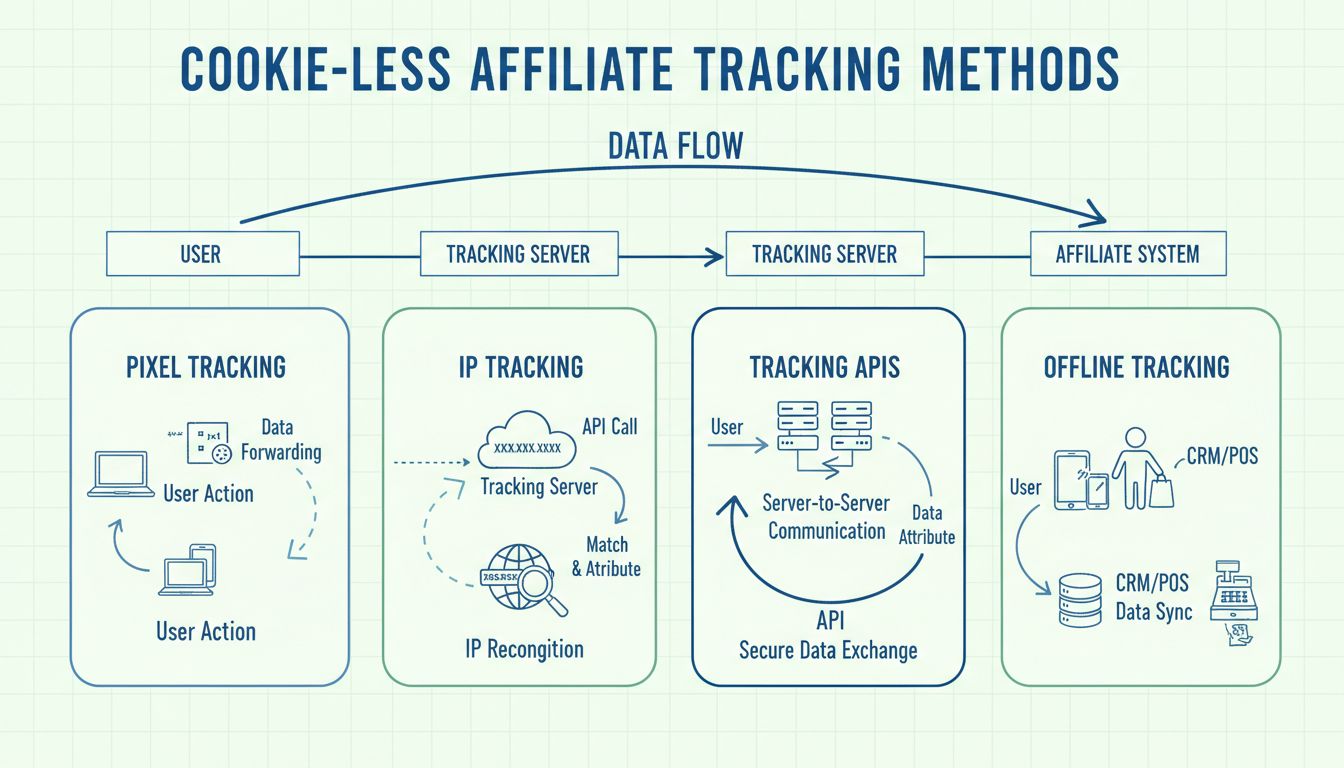
Learn how to track affiliate conversions without cookies using pixel tracking, IP tracking, APIs, and offline tracking methods. Discover PostAffiliatePro's cook...
Join our community of happy clients and provide excellent customer support with Post Affiliate Pro.




Cookie Consent
We use cookies to enhance your browsing experience and analyze our traffic. See our privacy policy.