


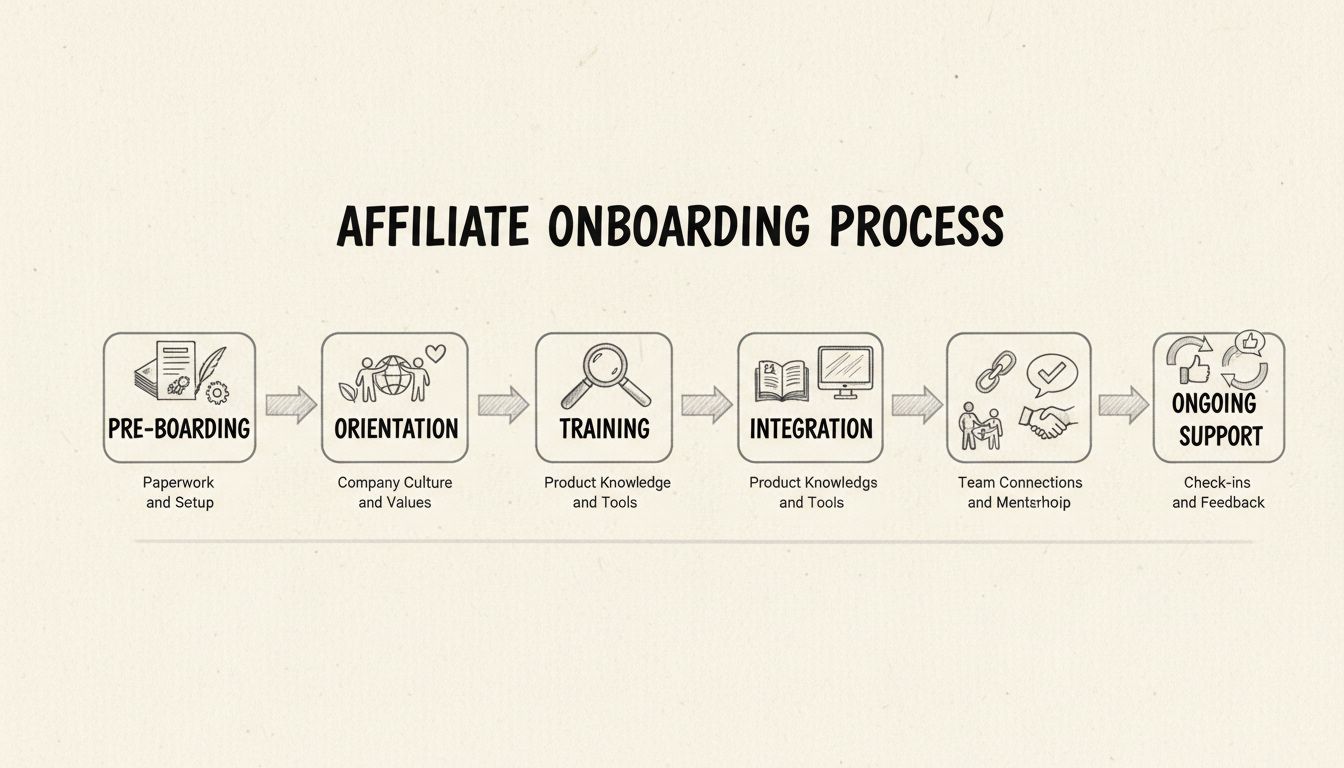
Why Is a Good Onboarding Process Important for Affiliates?
Discover why structured affiliate onboarding increases productivity, boosts engagement, and reduces turnover. Learn best practices for successful affiliate inte...
11 min read

Learn how to onboard premium affiliate partners in high-trust niches like health, finance, and SaaS. This guide covers branded portals, FTC compliance gates, asset delivery, and retention incentives using Post Affiliate Pro.
Imagine you’ve spent three months courting a prominent, board-certified cardiologist to endorse your new heart-health subscription box. You’ve had the discovery calls, aligned on brand values, and agreed on a premium commission structure. The doctor is ready to introduce your product to their audience of half a million highly engaged, health-conscious followers.
With excitement, you send over the registration link to your affiliate network. Then, silence. A week goes by. Your emails go unanswered. Finally, the doctor’s business manager sends a polite but curt note: “We’ve decided to move in a different direction. The onboarding portal raised some internal compliance and branding concerns.”
What happened? You sent an elite, high-earning medical professional to a generic, unbranded sign-up sheet that looked like a sketchy 2004 web forum. You treated a high-stakes B2B partnership like a low-tier gig-economy transaction.
In lucrative, trust-driven niches like health and wellness, finance, legal services, and SaaS, the affiliates with the most valuable audiences are also the most demanding about how your program is run. A cardiologist, a certified financial planner, or a senior technology reviewer will not risk their professional reputation on a program that looks operationally sloppy. Your onboarding sequence is your program’s first handshake. Get it wrong and the most valuable partners you’ll ever meet will walk straight out the door.
This guide covers four practical steps: branding your portal, locking in FTC compliance at registration, delivering tracking assets efficiently at approval, and building retention incentives that keep top partners active long-term. Each step maps directly to a specific feature inside Post Affiliate Pro.
If you are still figuring out which verticals are worth building a premium affiliate program around, start with our data-backed guide to the most profitable affiliate marketing niches for 2026 . Once you know your niche, this guide will show you how to build the onboarding infrastructure that attracts the best creators in it.
Before the steps, a fast grounding if you’re new to affiliate programs.
An affiliate program is an arrangement where other people, such as bloggers, doctors, podcasters, financial advisors, and YouTubers, promote your product to their audience and earn a commission for every sale they drive. You only pay when a sale happens.
Onboarding is everything that happens between the moment someone applies to join your program and the moment they send their first real customer your way. It includes the sign-up portal they encounter, the compliance agreements they sign, the tracking links they receive, and the marketing materials they use to promote you.
A high-authority creator is an affiliate partner who can move real revenue: a licensed professional, a subject-matter expert, an enterprise media outlet, or an established content creator with a loyal and highly engaged audience. These are selective, reputation-conscious people who treat every partnership as a business decision, not a side hustle.
Most affiliate programs are built for volume, not quality. The standard flow is: generate a link, email it to the creator, hope they figure out the rest. That works fine when you’re recruiting coupon bloggers and discount deal sites. It fails completely when your target is a licensed professional or an enterprise media outlet.
High-authority partners think differently about joining a program, and they do so for three very specific reasons.
Their reputation is the product. A doctor who recommends a supplement is putting their medical license on the line. A financial advisor who promotes an investment product answers to a regulator. These people evaluate your affiliate program the way they would evaluate a business contract, because for them it is one.
They have already seen compliance failures. Licensed professionals in health, finance, and legal niches know exactly what an FTC fine looks like. They will not join a program that does not make compliance frictionless and documented from day one.
They are not chasing the commission. A top-tier creator with a million engaged followers is not logging into your affiliate portal at midnight to hunt for a tracking link. If your onboarding is clunky, they move to a competitor whose program respects their time.
[Generic Network Link] ──► Unbranded Portal ──► Compliance Ambiguity ──► Partner Walks Away
[Custom Branded Portal] ──► Professional Interface ──► Documented Compliance ──► Long-Term Partnership

Set up advanced tracking in minutes. No credit card required.
The first thing a new affiliate sees is your sign-up portal. If it shows a generic network header, non-branded colors, and a login page that could belong to any of a thousand other programs, you have communicated something before a single word is read: we haven’t invested in this program.
Think about it from the cardiologist’s perspective. They just came off a 45-minute discovery call with your partnership team. They’ve been promised a premium collaboration. Then the registration link opens to something that looks like a shared hosting control panel from 2009. The mismatch between the conversation they just had and the product they actually see is what kills deals.
For beginners: if your affiliate portal looks like it belongs to someone else’s business, your most selective partners will assume it does.
Post Affiliate Pro’s theme editor lets you create a fully custom theme by duplicating a default template and replacing the design with your own brand identity. You cannot edit the default themes directly, so you always work from a copy. This protects your changes from being overwritten by software updates.
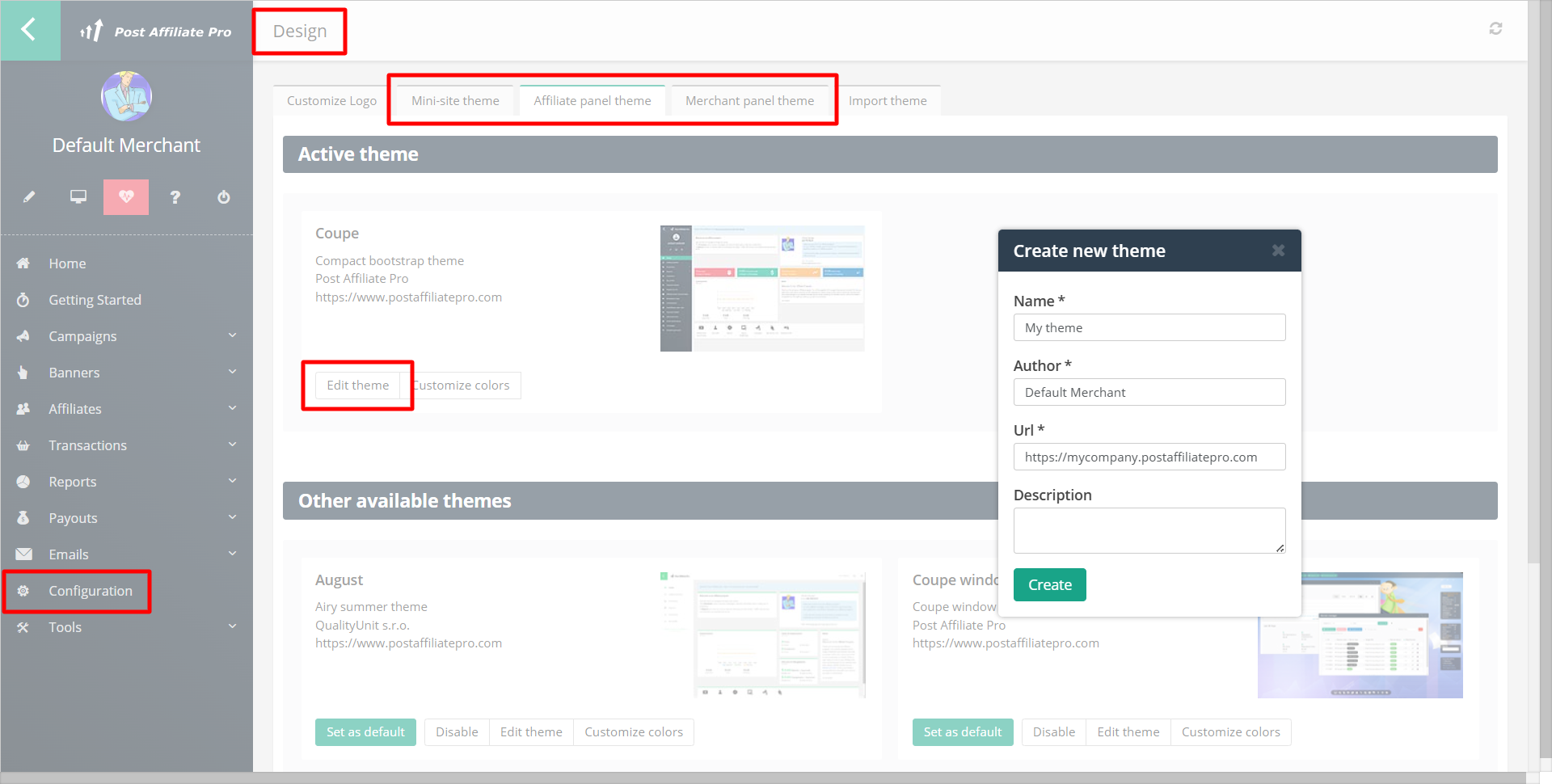
You apply this theme separately to three surfaces, each accessible under Configuration > Design:
You can also edit the text on your Home and Sign-up pages
by modifying the index.stpl (home), signup_form.tpl (sign-up), and footer.stpl files inside the theme editor, replacing generic placeholder copy with your own brand voice. You can add custom pages inside the affiliate panel
to house brand guidelines, compliance resources, or campaign-specific instructions, and customize the affiliate panel menu
so navigation reflects your program structure instead of the software’s default layout.
When your new partner logs in for the first time, they land in an environment that feels like an extension of your website. That communicates stability and investment before they have read a single policy document.
Here is a mistake that exposes brands to real legal risk: treating FTC compliance as an afterthought. The pattern goes like this. You onboard the affiliate, then send a welcome email with a bullet point that says “remember to disclose your relationship with us.” That is not a compliance framework, but a hope.
The FTC, which stands for Federal Trade Commission and is the US consumer protection regulator, has one core rule for affiliate marketing: consumers have the right to know when a creator is being paid to recommend something.
Three requirements follow from that rule and apply to every affiliate partnership.
| FTC Compliance Checklist | Requirement |
|---|---|
| Visible above the fold | Disclosure must be seen without any clicks or scrolling |
| Clear language | Use explicit tags: #Ad, #Sponsored, or “Paid Partnership” |
| Shared liability | Both brand and creator are responsible if disclosure is missing |
Licensed professionals in high-margin affiliate verticals like health, finance, and SaaS are already fluent in these rules. What they evaluate during your onboarding is whether your program takes them as seriously as they do. A registration flow with no documented compliance step fails that evaluation immediately.
Post Affiliate Pro’s Custom Sign-up Fields (under Configuration > Affiliate Signup > Fields) let you turn registration into a structured compliance checkpoint.
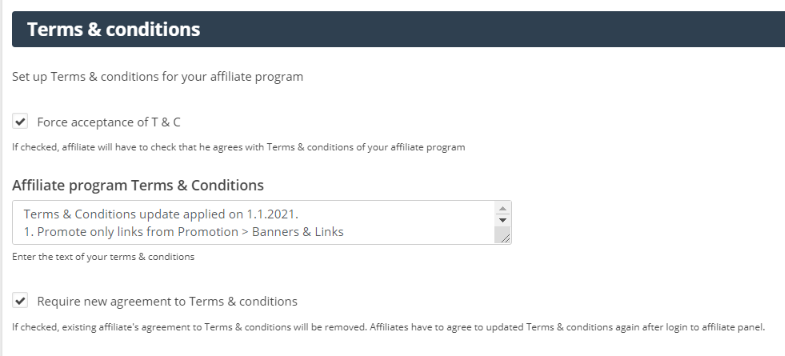
One more tool that belongs in your compliance stack is Post Affiliate Pro’s built-in Terms & Conditions acceptance feature . Under Configuration > Affiliate Signup > General, update your T&C text and check “Require new agreement to Terms & Conditions.” Every existing affiliate must re-confirm before they can continue using the portal. In Affiliates Manager, add the “Agree to terms” column to your grid view to see exactly who has and has not accepted the current version. A one-time sign-off becomes an ongoing, auditable compliance record.
Be the first to know about new features and product updates.
This is where most programs lose partners they have already won. The compliance gate is passed. The application is approved. The partner is excited. And then they log in and find an empty account. They email your partnership manager asking for links and creative files. The manager is in three other conversations. Assets arrive 72 hours later. By then, the podcaster who wanted to mention your product in this week’s episode has moved on to a brand that was ready when they were. Momentum in content creation is real and it does not wait.
Post Affiliate Pro generates each affiliate’s unique tracking links as part of account creation. When a partner logs into their dashboard for the first time, their tracking link is already on the account overview. There is no separate link-builder tool to find and no documentation to read first.
If you run multiple product lines or campaigns, you can set up separate campaigns and point different links to different landing pages. This connects naturally to a broader commission strategy. See our guide on how to set up niche-specific commission groups to understand how link routing and commission rates work together automatically across product categories.
Long tracking URLs are awkward in spoken media. A podcast host cannot read one aloud, and a YouTube creator’s audience will not type one in. What works is a clean, memorable discount code like DOCTOR20 or FINANCEWEEKLY15 that fits naturally into speech without breaking the creator’s flow.
Post Affiliate Pro’s coupon tracking system lets you assign a specific promo code to each partner. You can do this manually for individual partners, import a prepared CSV file that maps coupon codes to affiliate usernames or IDs for bulk assignment, or use the PHP API for fully programmatic distribution. The code is tracked server-side, so attribution is accurate even when a listener purchases on a different device or browser days after hearing an episode, with no affiliate link click required.
Do not make your partners hunt for brand assets through email threads. Use Post Affiliate Pro’s custom pages feature to build a dedicated resources page inside the affiliate panel and add it to the navigation menu so it is one click from the dashboard.
On this page, link directly to your brand asset locations such as your product photography folder, ad copy templates, logo files, and campaign brief. You can also embed an external URL in an iframe if your assets live in a shared Google Drive, Dropbox, or a dedicated brand portal. When a partner logs in, everything they need to launch is one click away with no email thread required.
Most onboarding guides stop at approval. That is a mistake. Approving a high-authority creator is the beginning of the relationship, not the payoff. Elite partners have competing opportunities every week. Programs that retain them long-term make staying economically smarter than switching.
Post Affiliate Pro’s Performance Rewards feature, activated under Configuration > Plugins, lets you set automatic bonus commissions that trigger when a partner hits a milestone. You define a condition such as a number of sales in a period, a count of action commissions, or a number of recurring sales, and then choose an action: add a bonus commission, update a user field, or send an automated notification email to the affiliate.
For a cardiologist with 500,000 subscribers, knowing that reaching 50 referrals in a quarter triggers a higher payout is a concrete business incentive. It transforms a one-time promotional collaboration into an ongoing revenue partnership with a financial reason to keep going.
This is the difference between a program that gets a single sponsored post and one that earns a dedicated, recurring mention for the next two years.
Each of the four steps above addresses a specific failure point in standard affiliate programs. Here is how the two approaches stack up side by side. If your current program sits mostly in the left column, these are the gaps driving partner churn in premium niches.
| Onboarding Element | Standard Affiliate Setup | Advanced B2B Onboarding Workflow |
|---|---|---|
| Portal visuals | Generic network template; non-branded domain that signals a lack of investment. | Fully white-labeled; custom theme duplicated from a default and styled to match your brand. |
| Compliance | Welcome email with a disclosure reminder that is unverified and legally thin. | Mandatory credential fields, disclosure checkbox, and T&C sign-off at registration with acceptance tracked in Affiliates Manager. |
| Tracking assets | Manual email from account manager with a 48 to 72 hour delay after approval. | Tracking links ready on first login; promo codes assigned via CSV or API; resource page in the affiliate panel. |
| Credential screening | None, so anyone can apply. | Custom sign-up fields filter by professional credentials before your team reviews them. |
| Retention | Hope the partner stays active. | Performance Rewards automatically trigger bonus commissions at defined milestones. |
| Partner fit | Coupon sites and low-tier influencers. | Doctors, financial experts, enterprise media, and top-tier niche reviewers. |
The best affiliate partners in any premium niche have options. They can work with your competitors. They can decline entirely. What makes them choose your program and stay in it is the signal your infrastructure sends about how seriously you take the partnership.
A white-labeled portal, a structured compliance gate, tracking assets ready on day one, and performance tiers that reward loyalty are not advanced luxuries. In niches where your partners’ professional reputations are on the line, they are the minimum standard for a program worth joining.
Post Affiliate Pro gives you the custom theme tools , Custom Sign-up Fields, T&C enforcement , coupon assignment , and performance reward automation to build this experience without a custom development project. Start your free trial today and build a program that the most valuable partners in your niche actually want to join and stay in.
Post Affiliate Pro gives you white-label portals, automated compliance gates, and instant asset delivery to attract and retain top-tier affiliate partners.
Discover why structured affiliate onboarding increases productivity, boosts engagement, and reduces turnover. Learn best practices for successful affiliate inte...
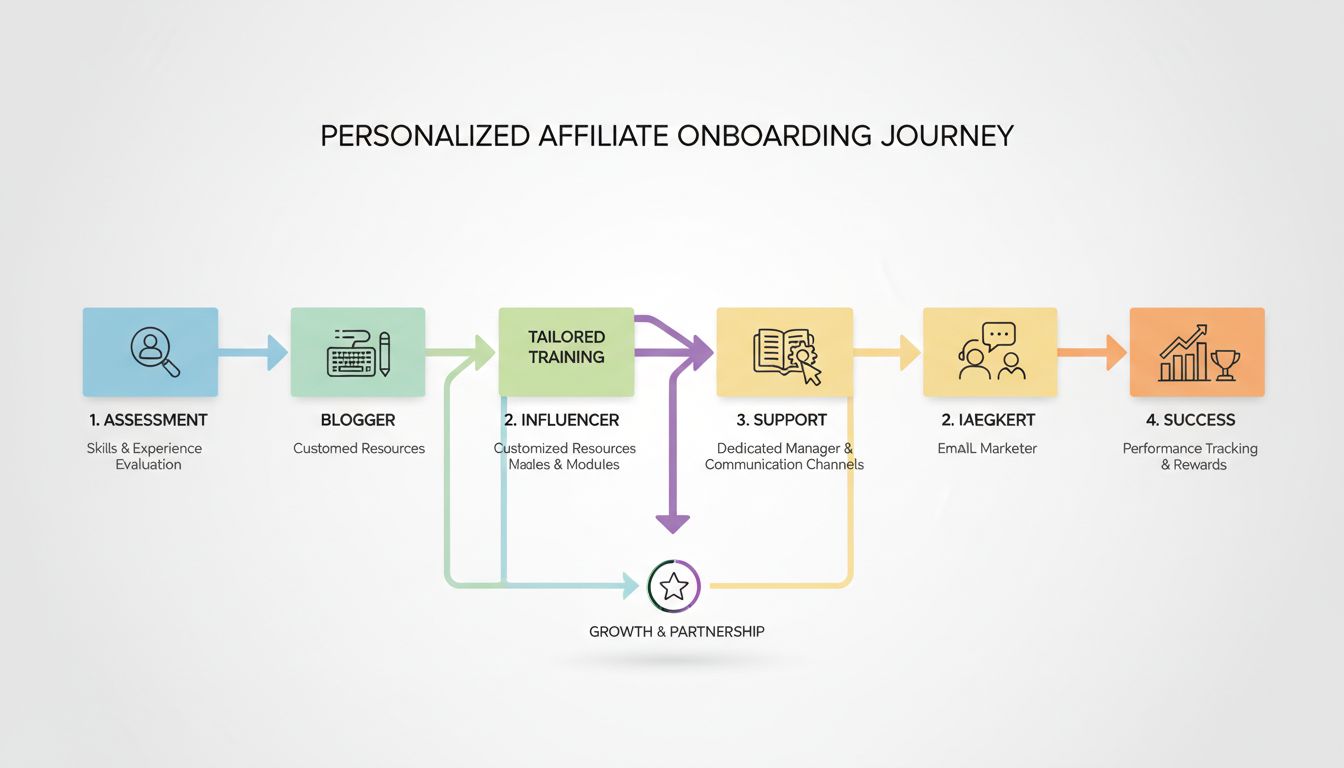
Learn how to personalize affiliate onboarding by assessing skills, providing tailored training, and offering customized support. Discover best practices for aff...
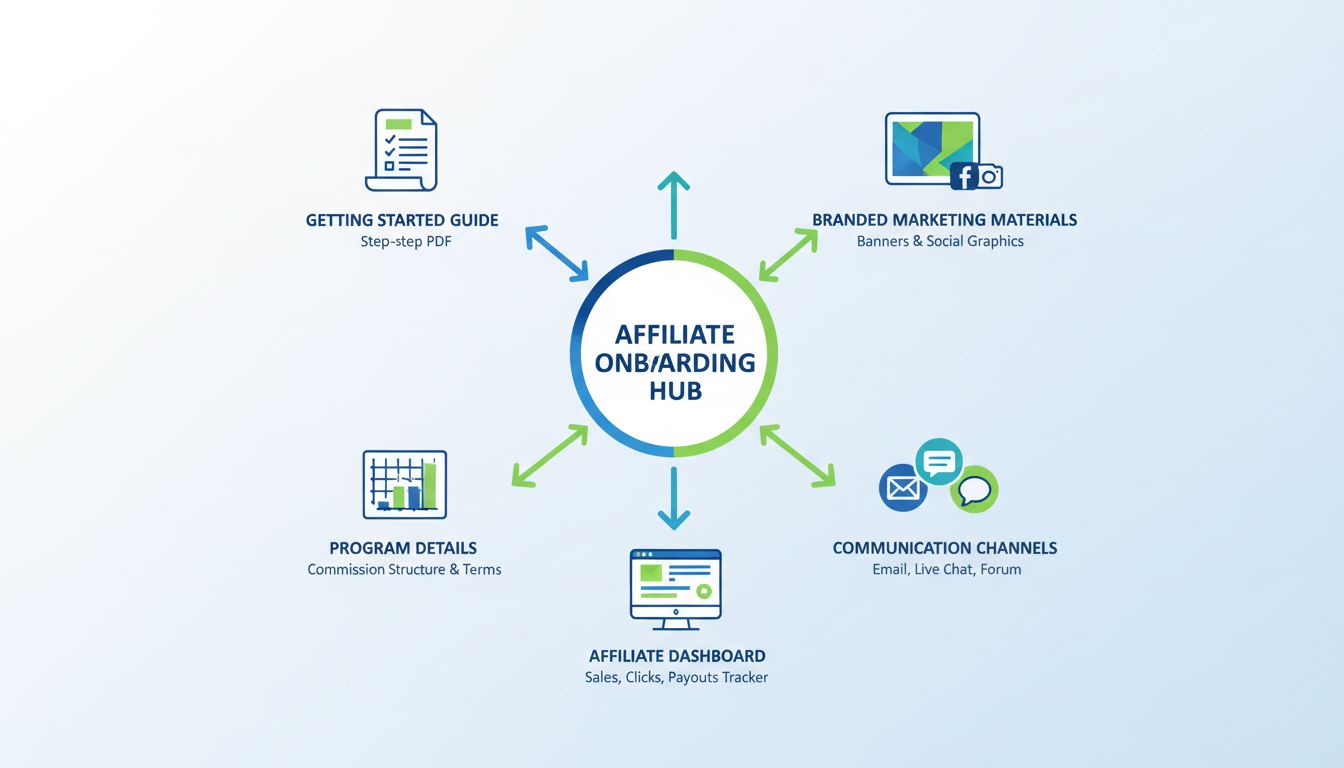
Discover essential materials for affiliate onboarding: Getting Started guides, branded marketing assets, program details, communication channels, and tools. Lea...
Join our community of happy clients and provide excellent customer support with Post Affiliate Pro.



Cookie Consent
We use cookies to enhance your browsing experience and analyze our traffic. See our privacy policy.