



How Affiliate Marketing Benefits Your Business
how affiliate marketing can boost your business with 16% of e-commerce sales, $6.50-$15 ROI per $1 spent, and low startup costs. Learn proven strategies.
6 min read


Discover the 8 critical skills that separate successful affiliate marketers. Learn data analysis, creativity, and technical expertise.
The difference between affiliate marketers who earn $500 monthly and those earning $50,000 monthly isn’t luck—it’s skill. The affiliate marketing industry has experienced remarkable growth, with the global market valued at approximately $37.3 billion in 2026 and projected to expand at a compound annual growth rate of 8% until 2031. While affiliate marketing offers a low barrier to entry, succeeding at scale requires developing a specific set of competencies. These aren’t innate talents; they’re learnable skills that separate the top 10% of earners from the rest. Research indicates that less than 10% of affiliates drive 90% of conversions, suggesting that skill differentiation creates dramatic performance gaps.
In this comprehensive guide, we’ll explore the eight essential skills that every successful affiliate marketer must master. Whether you’re just starting or looking to scale your existing business, understanding and developing these skills will directly impact your earning potential.

Data analysis is the foundation of profitable affiliate marketing. Without understanding your metrics, you’re essentially flying blind—spending money and driving traffic without knowing what’s actually working. The difference between struggling affiliates and six-figure earners often comes down to one thing: their ability to track, analyze, and act on data.
Every successful affiliate marketer must master these four critical metrics:
| Metric | Definition | Why It Matters |
|---|---|---|
| CTR (Click-Through Rate) | Percentage of impressions that result in clicks | Shows how compelling your content is; higher CTR means better engagement |
| ROI (Return on Investment) | Profit divided by total investment | Reveals whether campaigns are profitable; essential for scaling decisions |
| LTV (Lifetime Value) | Total revenue from a customer over time | Helps determine how much you can spend to acquire each customer |
| EPC (Earnings Per Click) | Average earnings generated per click | Lets you compare offer profitability at a glance |
Tools for tracking and analysis:
A/B testing is your secret weapon for continuous improvement. Test one variable at a time—headline, call-to-action, image, or landing page layout—and measure the impact. Industry data shows that the average affiliate conversion rate hovers around 1-3%, while the top 10% of earners achieve 5-10% conversion rates. The difference? Relentless testing and optimization.
One affiliate discovered that changing their CTA from “Learn More” to “Get 20% Off Now” increased clicks by 35%. Another found that moving their affiliate link above the fold boosted conversions by 18%. These aren’t massive changes, but they compound over time.
Consider this scenario: An affiliate drives 10,000 monthly visitors with a 1% conversion rate, earning $5,000 monthly. By implementing proper tracking and optimization, they discover that their email traffic converts at 4% while their social traffic converts at 0.5%. They reallocate budget toward email, implement better pre-sell content, and increase their conversion rate to 2%. Result? Their monthly earnings double to $10,000—without driving any additional traffic.
The lesson is clear: optimization without data is guesswork. Data-driven decisions are profit-driven decisions.


Set up advanced tracking in minutes. No credit card required.
Creativity is the heartbeat of successful affiliate marketing. Your ability to craft compelling content that resonates with your audience directly impacts click-through rates, conversions, and ultimately, your commission earnings. Whether you’re a seasoned marketer or just starting out, mastering the art of creative content creation is essential for standing out in a crowded marketplace.
Your headline is often the first—and sometimes only—impression you get. Powerful headlines grab attention and compel action. Test these proven headline formulas:
Your ad copy should follow the same principle: lead with benefits, not features. Instead of “This software has 50 integrations,” try “Save 10 hours weekly by automating your entire workflow.” Specificity sells better than vagueness.
Humans are visual creatures. Content with compelling visuals receives 94% more views than text-only content. Invest in:
Best practice: Ensure all visuals are mobile-optimized, load quickly, and include alt text for accessibility.
Facts tell, but stories sell. Rather than listing product specifications, share how the product solved a real problem. Did it save you time? Money? Stress? Authentic stories create emotional connections that drive conversions. Your audience doesn’t just want information—they want to see themselves succeeding with the product you’re recommending.
Never assume one approach works for everyone. A/B test different headlines, visuals, and messaging angles. What resonates on Instagram might flop on LinkedIn. Identify your unique angle—what makes your recommendation different from the 50 other affiliates promoting the same product? Perhaps you focus on budget-conscious buyers, beginners, or enterprise solutions.
The line between clickbait and authentic engagement is crucial. Avoid misleading headlines that don’t match your content. Your credibility is your most valuable asset. Instead, use genuine enthusiasm and real results to drive engagement. Transparency about affiliate relationships builds trust and long-term audience loyalty.
Diversify your content strategy across multiple formats:
The key is consistency and quality. Focus on creating content that genuinely helps your audience solve problems, and the conversions will follow naturally. Remember: you’re not just selling products—you’re building a reputation as a trusted advisor.

Technical proficiency is non-negotiable in modern affiliate marketing. You don’t need to be a software engineer, but understanding the tools and platforms that power affiliate campaigns is essential. From affiliate networks to analytics platforms, mastering these technical skills directly impacts your ability to scale and optimize.
Affiliate network knowledge is your starting point. Platforms like PostAffiliatePro, Awin, ShareASale, and CJ Affiliate manage the relationships between you and merchants. Learn how to navigate their dashboards, understand commission structures, and access promotional materials. Each platform has unique features—some offer better tracking, others provide superior support.
Website building and optimization requires familiarity with platforms like WordPress, Wix, or Webflow. Your site must load quickly, look professional on mobile devices, and be easy to navigate. Page speed matters—every extra second of load time reduces conversions by 7%.
SEO fundamentals and keyword research determine whether your content gets discovered. Use tools like Google Keyword Planner, Ahrefs, or SEMrush to identify high-intent keywords your audience is searching for. Optimize your content around these keywords to capture organic traffic.
Email marketing platforms like ConvertKit, ActiveCampaign, or Mailchimp enable automation and segmentation. Build email sequences that nurture leads and promote affiliate offers at the right moment.
Paid advertising platforms require mastery:
Landing page creation and optimization tools like Unbounce or Leadpages help you create high-converting pages without coding. Test different layouts, copy, and CTAs to maximize conversions.
Tracking and analytics tools provide visibility into campaign performance. Google Analytics is essential, but advanced tools like Voluum or Binom offer real-time tracking and optimization.
The investment in learning these tools pays dividends. Affiliates who master their technical stack can launch campaigns faster, optimize more efficiently, and scale more effectively than those who rely on guesswork.
Be the first to know about new features and product updates.
Self-discipline is the invisible force that separates successful affiliates from those who quit. Unlike traditional employment, affiliate marketing offers no boss, no paycheck schedule, and no external accountability. This freedom is both a blessing and a curse. Without strong self-discipline, it’s easy to procrastinate, lose focus, or abandon strategies before they have time to work.
Working independently without supervision requires you to be your own manager. Set clear goals for each week and month. Define what success looks like: “I will publish 4 blog posts, test 2 new traffic sources, and achieve a 2% conversion rate.” Write these goals down and review them daily.
Building consistent routines and habits is more powerful than motivation. Motivation fluctuates; habits are automatic. Dedicate specific hours to content creation, campaign optimization, and data analysis. Treat these blocks like non-negotiable meetings with yourself.
Overcoming procrastination and staying motivated requires understanding your triggers. Do you procrastinate when facing complex tasks? Break them into smaller, manageable steps. Do you lose motivation when results are slow? Celebrate small wins—your first 100 visitors, your first conversion, your first $100 earned.
Patience is perhaps the most underrated skill in affiliate marketing. Most affiliates expect results within weeks; reality requires 6-12 months of consistent effort before seeing meaningful income. During this period, you’re investing time and money with minimal return. This is where self-discipline separates the winners from the quitters.
Tracking progress and celebrating milestones keeps you motivated during the long journey. Your first 1,000 website visitors, your first affiliate sale, your first $1,000 earned—these are victories worth celebrating. They prove your strategy is working and fuel motivation for the next phase.
Avoiding burnout and maintaining work-life balance ensures you can sustain this journey long-term. Affiliate marketing is a marathon, not a sprint. Work hard, but also rest, exercise, and spend time with loved ones. Burnout leads to poor decisions and abandoned projects.
Problem-solving and adaptability are the backbone of sustainable affiliate marketing success. The digital landscape shifts constantly—algorithms change overnight, traffic sources dry up, and campaigns that worked yesterday may flop today. The affiliates who thrive aren’t necessarily the smartest; they’re the ones who can quickly identify problems, test solutions, and pivot without hesitation.
Troubleshooting technical issues is an inevitable part of affiliate marketing. Tracking links may stop working due to server issues, cookie restrictions, or platform updates. When this happens, successful affiliates don’t panic—they systematically investigate. Check your affiliate dashboard for discrepancies, verify that pixels are firing correctly, and communicate with your network’s support team. One affiliate discovered their conversions had dropped 40% only to find that a simple UTM parameter was misconfigured. The fix took 15 minutes, but the lesson lasted a lifetime.
Algorithm changes and market shifts require constant vigilance. When Facebook adjusted its targeting capabilities or Google updated its search algorithm, many affiliates watched their traffic plummet. Those who survived adapted quickly by diversifying traffic sources, testing new platforms like TikTok or Pinterest, and refining their messaging to align with new platform dynamics.
Implement this structured approach to overcome obstacles:
Testing new traffic sources keeps your business resilient. If you’ve relied solely on Google Ads, experiment with native advertising, YouTube, or email marketing. One affiliate marketer struggling with rising CPC costs discovered that Reddit communities were an untapped goldmine for their niche—a single test led to their most profitable channel.
Pivoting when campaigns underperform isn’t failure; it’s strategy. If a product isn’t converting, switch to a different offer in the same niche. If a traffic source becomes too expensive, reallocate budget to emerging platforms. Flexibility in approach means you’re not emotionally attached to any single strategy—you’re attached to results.
Learning from failures and iterating quickly separates winners from quitters. Every underperforming campaign teaches you something valuable about your audience, market, or approach. Successful affiliates review failures weekly, extract lessons, and implement changes immediately rather than waiting months.
Staying updated with industry trends through blogs, podcasts, and affiliate communities ensures you’re never blindsided. The affiliates earning six figures today are the ones who tested TikTok Shop, understood iOS privacy changes, and adapted to new commission structures before their competitors.
Building resilience means accepting that setbacks are temporary. Your willingness to experiment, fail, learn, and try again is what ultimately determines your success in affiliate marketing.
Effective communication is the cornerstone of successful affiliate marketing. Your ability to connect authentically with your audience, negotiate with partners, and build lasting relationships directly impacts your earning potential and long-term success. Whether you’re communicating through content, email, or direct partnerships, mastering these skills sets you apart from competitors.
Transparency about affiliate relationships is non-negotiable. Clearly disclose your affiliate partnerships to maintain credibility with your audience. This honesty builds trust and ensures compliance with FTC guidelines. When readers know you’re recommending products because they genuinely benefit them—not just for commission—they’re more likely to follow your recommendations and return for future content.
Your content itself is a communication tool. Create valuable, audience-focused material that addresses real problems and questions. Speak directly to your readers’ pain points, and they’ll perceive you as a trusted advisor rather than just another marketer pushing products.
Building relationships with other marketers, influencers, and affiliate networks opens doors to collaboration and growth. Attend industry events, engage in online communities, and reach out to complementary brands. These connections lead to joint ventures, guest posting opportunities, and affiliate program partnerships that expand your reach.
When negotiating with affiliate networks and advertisers, approach conversations professionally and data-driven. Show them your audience metrics, engagement rates, and conversion potential. Strong negotiation skills can lead to better commission rates, exclusive deals, and priority support.
Email communication remains one of the highest-ROI channels for affiliate marketers. Develop a consistent email strategy that provides value first and promotions second. Segment your list based on interests and behaviors to send targeted recommendations that feel personalized rather than generic.
Building a community around your brand transforms casual followers into loyal advocates. When people feel part of something bigger, they’re more invested in your success and more likely to engage with your affiliate recommendations. Focus on creating genuine connections, and the conversions will follow naturally.
Financial literacy is the backbone of a sustainable and profitable affiliate marketing business. Success isn’t just about driving traffic or conversions—it’s about understanding the money flowing in and out of your operation. Whether you’re a beginner or an experienced marketer, developing strong financial acumen will directly impact your bottom line and long-term viability.
The first step is comprehending commission structures and payment models. Different affiliate programs offer varying compensation methods: cost-per-sale (CPS), cost-per-lead (CPL), cost-per-click (CPC), or hybrid models. Each has different profitability implications. Take time to calculate your ROI and profitability for each campaign. Track not just gross revenue, but net profit after all expenses. This means accounting for advertising costs, tools, hosting, content creation, and other operational expenses.
Effective budget management and cost control are critical. Set clear spending limits for each marketing channel and monitor performance metrics religiously. Implement risk assessment and diversification by spreading your efforts across multiple affiliate programs, traffic sources, and niches. Relying on a single program or channel exposes you to significant risk if algorithms change or programs terminate.
Financial Management Essentials:
Understand the multiple payment methods and withdrawal strategies available. Most programs offer bank transfers, PayPal, checks, or cryptocurrency. Choose methods that minimize fees and align with your cash flow needs. Don’t overlook tax considerations for affiliate income—this is often taxable as self-employment income, requiring quarterly estimated tax payments and proper record-keeping.
Common Payment Methods:
Finally, scale your budgets wisely by increasing spending only when you’ve proven consistent profitability. A 20% increase in ad spend should yield at least 20% in additional revenue. Continuously track income versus expenses to identify which campaigns deserve more investment and which need optimization or elimination.
By mastering these financial fundamentals, you’ll build a resilient, profitable affiliate marketing business capable of weathering market changes and scaling sustainably.
The affiliate marketing landscape evolves constantly, and your success depends on staying ahead of the curve. The skills that made you money last year might be obsolete next year. Successful affiliates treat learning as a non-negotiable investment, not an optional luxury. This commitment to continuous improvement is what separates six-figure earners from those stuck at five figures.
Following industry leaders and thought leaders keeps you informed about emerging opportunities and best practices. Subscribe to affiliate marketing blogs, listen to podcasts, and follow influencers in your niche. The affiliates earning the most today are the ones who tested TikTok Shop early, understood iOS privacy changes before competitors, and adapted to cookieless tracking before it became mandatory.
Participating in affiliate communities and forums connects you with peers facing similar challenges. Communities like AffiliateFix, Warrior Forum, and niche-specific Slack groups provide real-world insights, case studies, and support. You’ll learn what’s working now, not what worked six months ago.
Investing in education and training accelerates your growth. Whether it’s a course on conversion rate optimization, a masterclass on email marketing, or a certification in Google Analytics, formal education provides structured knowledge that saves you months of trial-and-error.
Nano influencers (1,000-10,000 followers) are reshaping affiliate marketing. Their tight-knit communities and authentic recommendations drive higher conversion rates than macro influencers. 44% of brands now prefer working with nano influencers.
AI and automation are transforming affiliate workflows. AI content co-pilots help with keyword research, content optimization, and performance analysis. Automation tools handle repetitive tasks, freeing you to focus on strategy.
Privacy-first tracking is becoming essential. With third-party cookies disappearing and GDPR enforcement increasing, understanding server-to-server tracking, first-party data, and consent management platforms is critical.
Native advertising networks are gaining traction. These platforms deliver ads that blend naturally with content, resulting in higher engagement and conversion rates than traditional display ads.
By committing to continuous learning, you ensure that your skills remain sharp, your strategies stay current, and your income continues to grow. The moment you stop learning is the moment your competitors start passing you.
Beyond the core skills, successful affiliate marketers develop complementary competencies that enhance their overall effectiveness. According to industry data, 87% of marketers acknowledge that data is their company’s most under-utilized asset, while research shows that marketers who prioritize content marketing see six times higher conversion rates than those who don’t. Additionally, 57% of affiliate marketers earn less than $10,000 annually, often because they lack the supporting skills to persist through the initial low-earning phase.
| Skill Category | Key Competencies | Business Impact |
|---|---|---|
| SEO & Content Marketing | Keyword research, on-page optimization, content strategy | Drives organic traffic; 700-1,200% ROI in e-commerce over 12 months |
| Technical Skills | Analytics tools, affiliate platforms, email marketing software | Enables efficient campaign management and performance tracking |
| Communication | Copywriting, audience engagement, stakeholder relations | Builds trust with audiences; improves conversion rates |
| Networking | Relationship building, partnership development, community engagement | Opens doors to better deals and collaboration opportunities |
| Digital Marketing | Social media, PPC advertising, email marketing | Diversifies traffic sources; reduces platform dependency |
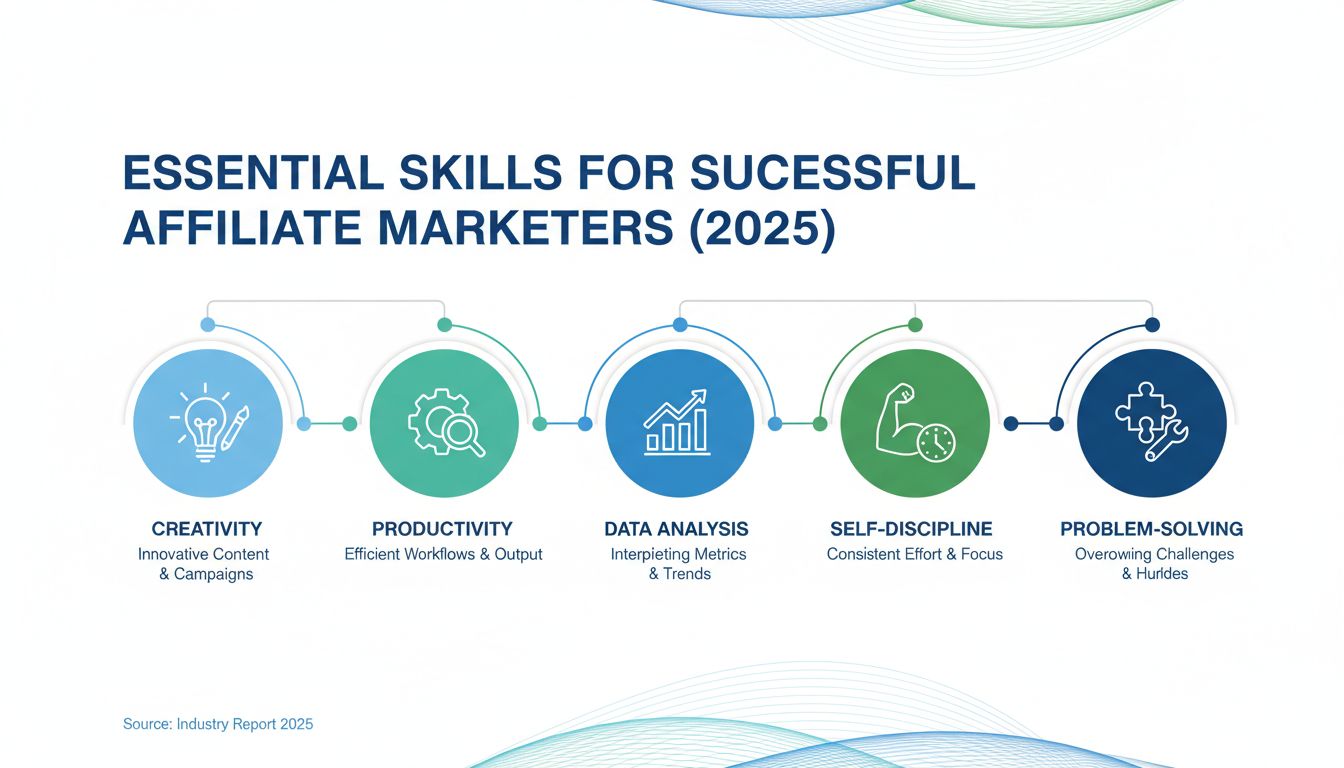
Becoming a successful affiliate marketer isn’t about luck or having the perfect product. It’s about developing a specific set of skills that compound over time. The eight skills we’ve covered—data analysis, creativity, technical proficiency, self-discipline, problem-solving, communication, financial literacy, and continuous learning—form the foundation of sustainable affiliate marketing success.
The good news? These are all learnable skills. You don’t need to be a genius or have years of experience. You just need commitment, consistency, and a willingness to learn from both successes and failures.
Start with one or two skills that resonate most with you. Master them, then move on to the next. Within 6-12 months of focused effort, you’ll have developed a skill set that puts you in the top 10% of affiliate marketers. And that’s when the real money starts flowing.
Your journey to affiliate marketing success starts today. Choose your first skill to develop, commit to mastering it, and watch your income grow as a result.
Most affiliate marketers see meaningful results after 6-12 months of consistent practice and implementation. However, you can start earning within the first few months while continuing to develop your skills. The key is consistent effort and willingness to learn from both successes and failures.
Yes, you can start with basic skills and develop others over time. However, the faster you develop these eight core skills, the faster you'll see results. Consider focusing on data analysis and self-discipline first, then gradually building expertise in other areas.
Data analysis and self-discipline are the two most critical skills for beginners. Data analysis helps you understand what's working, while self-discipline keeps you consistent during the slow early months. Master these two, and the other skills become easier to develop.
Improve creativity through practice, testing, and studying successful campaigns. Analyze competitor ads, read high-performing content, and regularly A/B test different headlines, visuals, and messaging angles. Join creative communities and consume content in your niche to stay inspired.
Start with free tools: Google Analytics, your affiliate network's dashboard, and a free email marketing platform. As you grow, invest in paid tools like Ahrefs for SEO, Voluum for tracking, and a premium email platform. Prioritize tools that directly impact your conversion rate.
Set milestone goals (first 1,000 visitors, first sale, first $100), track progress weekly, and celebrate small wins. Join affiliate communities for support and accountability. Remember that slow initial growth is normal—most successful affiliates took 6-12 months to see significant income.
Basic technical knowledge is helpful but not absolutely necessary. You can learn as you go or outsource technical tasks. However, understanding your affiliate platform, Google Analytics, and basic SEO will significantly accelerate your success and save you money on outsourcing.
Successful affiliates typically specialize in 2-3 skills and outsource or automate the rest. They also use systems and processes to manage multiple campaigns efficiently. As you grow, consider delegating tasks like content writing or graphic design to focus on strategy and optimization.
PostAffiliatePro provides all the tools and features you need to develop these essential skills and manage your affiliate campaigns effectively. Start optimizing your affiliate business today.
how affiliate marketing can boost your business with 16% of e-commerce sales, $6.50-$15 ROI per $1 spent, and low startup costs. Learn proven strategies.

Discover essential skills for affiliate marketing jobs: data analysis, communication, technical expertise, and more to succeed in affiliate marketing careers.

proven strategies to earn $10,000 monthly with affiliate marketing. niche selection, traffic generation, and conversion optimization techniques used by
Join our community of happy clients and provide excellent customer support with Post Affiliate Pro.




Cookie Consent
We use cookies to enhance your browsing experience and analyze our traffic. See our privacy policy.