


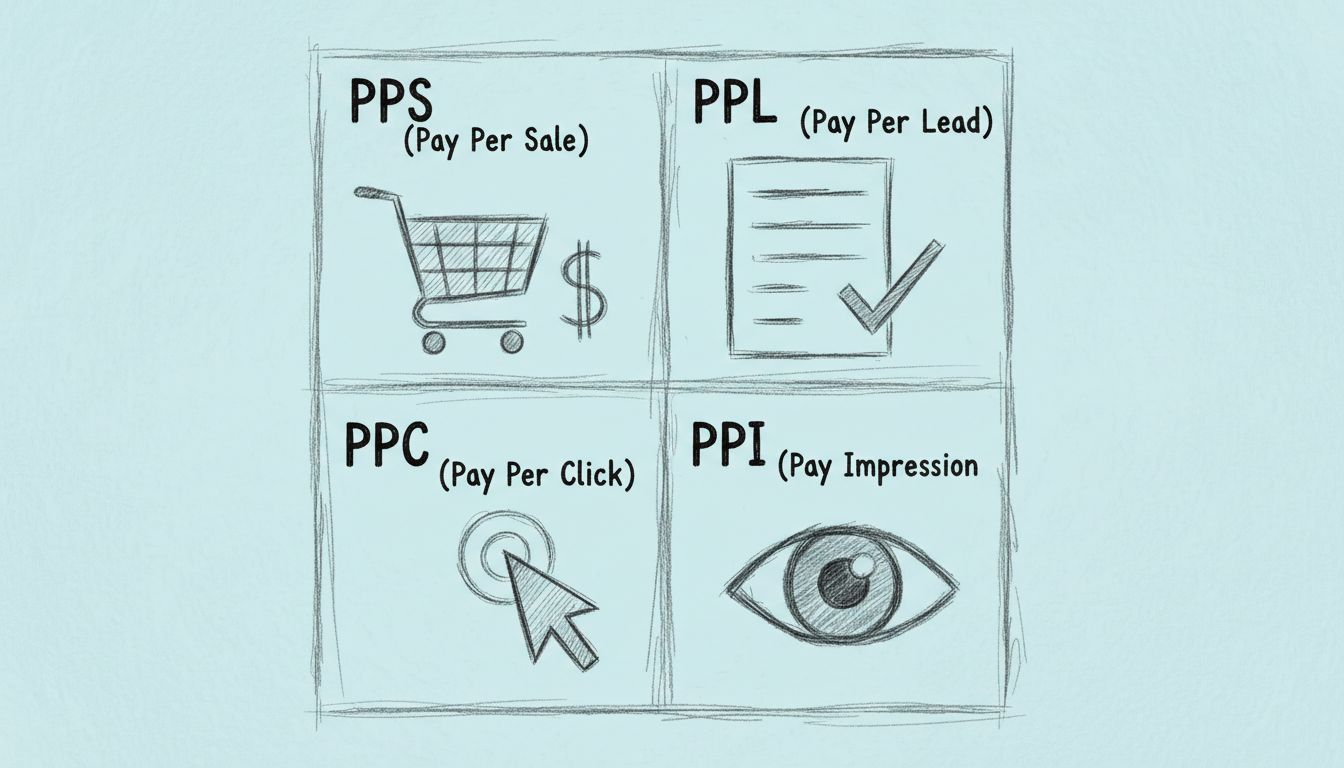
How Is the Payout Value Decided in Affiliate Marketing?
Learn how advertisers decide payout values in affiliate marketing. Discover the factors influencing commission rates, payout models, and best practices for maxi...
9 min read

A plain explanation of affiliate lifetime value, the formula behind it, a worked example, and how to use it to decide which partners deserve your best commission rates.
Most affiliate programs know their cost per acquisition down to the cent. Far fewer know what a single affiliate is actually worth to them over time. That gap matters, because it is the difference between managing a program by its weakest signal and managing it by its strongest one.
Think about a program manager reviewing two applications on the same afternoon. One is a coupon site with decent traffic numbers. The other is a niche blogger with a small but devoted following and only a handful of past affiliate partnerships to show for it. Judged purely on projected first-month volume, the coupon site looks like the easy approval. Judged on lifetime value, the answer might flip entirely, since a smaller, more loyal audience often sticks around and keeps converting long after a coupon-driven spike fades.
Affiliate lifetime value fixes that gap. It is a simple idea borrowed directly from customer lifetime value, just pointed at the partner relationship instead of the buyer relationship.
The basic version is straightforward.
Affiliate lifetime value equals average revenue per affiliate multiplied by average affiliate lifespan.
A more complete version accounts for what it costs you to support that affiliate relationship: (average revenue per affiliate minus partnership costs) multiplied by average affiliate lifespan.
Partnership costs here mean the commissions you pay out, plus any account management time, creative support, or bonus incentives tied to that affiliate.
Say your program generates $1,000,000 a year in total affiliate-driven revenue, spread across 200 active affiliates.
That works out to $5,000 in average annual revenue per affiliate. If your typical affiliate stays active for 3 years before churning out, their lifetime value comes out to $5,000 multiplied by 3, or $15,000 (PartnerStack ).
That single number changes how a lot of decisions look. A $300 onboarding bonus for a new affiliate suddenly looks cheap against a projected $15,000 return, rather than expensive against a single first sale.

Set up advanced tracking in minutes. No credit card required.
Most affiliate programs default to a fairly narrow view of value: how much did this affiliate generate this month, and how much commission did I pay out for it. That view is not wrong, but it is short-sighted, and it quietly rewards the wrong behavior.
Cost-per-conversion thinking treats every sale as a standalone event. Lifetime value thinking treats an affiliate relationship as an asset that compounds over time, the same way a good employee or a loyal customer does.
This shows up clearly once you compare two affiliates side by side. Affiliate A drives one large sale worth $2,000 in commission, then goes quiet. Affiliate B drives smaller, steady sales worth $400 a month for three straight years, totaling $14,400. A program only measuring per-conversion cost might rate Affiliate A as the stronger partner. Lifetime value makes it obvious that Affiliate B is worth far more, and deserves the better commission tier, faster payout terms, and more account management attention.
There is no single universal benchmark, since affiliate lifetime value depends heavily on your commission structure, your product’s price point, and your niche. But looking at how customer lifetime value varies by industry gives a useful sense of the range these numbers can span.
CustomerGauge’s benchmarking puts average customer lifetime value anywhere from around $90,000 for digital design brands up to over $1 million for architecture firms, with most B2B categories landing somewhere between $164,000 and $385,000 (CustomerGauge ). Affiliate lifetime value will typically be a fraction of full customer value, since the affiliate is compensated for driving that customer relationship rather than owning it, but the same principle holds: the number varies enormously by industry, and your own program’s figure is the only one that actually matters for your decisions.
The full breakdown of affiliate marketing statistics for 2026 has more context on how customer lifetime value connects to affiliate strategy more broadly, including why a 5% increase in customer retention alone can lift profits by 25% to 95%.
Be the first to know about new features and product updates.
The lifespan half of the formula deserves more attention than it usually gets, since it moves just as much as revenue does, and it moves in a fairly predictable pattern as a program matures.
Research from Track360 on scaling affiliate programs found that average affiliate lifespan tends to climb in stages. A young program with fewer than 100 affiliates sees an average lifespan of just 3 to 6 months, mostly because the brand is still unknown and has little authority to lean on. A program in the 100 to 500 affiliate range typically stretches that to 8 to 14 months once onboarding and regular communication improve. By the time a program has scaled past 2,000 affiliates with mature incentive structures in place, average lifespan climbs to 18 to 36 months (Track360 ).
That pattern matters for how you read your own lifetime value number. A newer program plugging a 4-month average lifespan into the formula is not doing anything wrong, that is genuinely where most young programs sit. The number is a signal to work on retention, not a sign the formula is broken.
Lifetime value calculations look precise, which makes it easy to trust one that is actually wrong. A few mistakes show up often enough to be worth naming directly.
Using revenue instead of profit is the most common one. Plugging in the full commission-driven revenue an affiliate generates, without subtracting what it actually cost you to support that relationship, makes every affiliate look more valuable than they really are.
Skipping any kind of discounting for future value is another. Peloton’s own pre-IPO customer lifetime value calculation became a well-known cautionary example of this. By not discounting projected future revenue at all, the company’s numbers reportedly overstated subscriber value by at least 50%, and the flaw only became widely discussed once outside analysts started picking the methodology apart (Props ).
The lesson transfers directly to affiliate lifetime value. A dollar an affiliate is projected to generate three years from now is worth less to your business today than a dollar they generate this month, and a calculation that treats those two dollars as identical will always run a little too optimistic.
Assuming an affiliate’s value stays flat over time is the third common trap. In practice, most affiliate relationships are strongest early, when a partner is actively promoting a new program, and gradually taper as attention shifts elsewhere. Treating year one performance as a permanent baseline tends to overstate what a typical affiliate is actually worth over their full lifespan.
Lifetime value is not evenly distributed across the kinds of affiliates in a typical program, and treating them as one uniform group hides most of the useful signal.
Coupon and deal affiliates tend to drive a lower average order value, since their audience is actively hunting for a discount rather than researching a purchase. Content affiliates, the bloggers and review site owners, usually convert less impulsively but stick around much longer, since their traffic comes from search rankings and reader trust that both take time to build and time to fade.
Influencer partnerships add another layer of variance. Engagement rates alone can range from around 5% to 8% for nano creators with small, highly engaged followings down to under 1% for mega influencers with broad but shallower reach, and revenue per follower tends to be highest at the nano end precisely because that trust runs deeper.
None of this means one affiliate type is objectively better. It means calculating lifetime value separately for each segment, coupon, content, influencer, and loyalty, gives you a far more honest picture than one blended average, and it usually reveals that your best long-term value is coming from a different segment than your best short-term volume.
Earnings per click, meaning how much revenue an affiliate generates for every 100 clicks they send you, is a useful companion metric here, since it lets you compare quality across segments even when raw traffic volume looks wildly different.
Two levers move affiliate lifetime value, and they are worth treating separately.
The first is average revenue per affiliate. This usually comes down to giving affiliates better tools to sell with: clear, high-converting creative assets, timely notice about new promotions or seasonal offers, and product positioning they can actually use in their own content rather than generic banner ads.
The second is affiliate lifespan, meaning how long a partner stays active before disengaging entirely. This is where most of the overlooked opportunity sits. Fast, reliable payouts build trust quickly. Transparent reporting lets affiliates see their own performance without asking you for it. And catching early signs of disengagement, a login streak that suddenly stops, a click volume that quietly drops to zero, gives you a chance to re-engage before that affiliate churns out for good rather than after.
The hardest part of affiliate lifetime value is not the formula. It is having clean, accessible revenue history per affiliate to calculate it from in the first place.
Once you have that, the number becomes genuinely useful for more than just reporting. It should shape which affiliates get access to your best commission tiers, which ones are worth a dedicated account manager, and which early warning signs are worth building an automated alert around before a valuable partner quietly drifts away.
That last point is really the other half of this whole topic. Every additional month an affiliate stays active adds directly to their lifetime value, which means affiliate churn is not a separate metric to track alongside lifetime value. It is the thing that determines how high or low that value ends up being.
Tamara is a copywriter at Post Affiliate Pro. She's passionate about helping businesses and marketers understand how affiliate programs can drive growth, one blog post at a time.

Post Affiliate Pro tracks every affiliate's revenue history over time, so calculating lifetime value takes minutes instead of a spreadsheet project.
Learn how advertisers decide payout values in affiliate marketing. Discover the factors influencing commission rates, payout models, and best practices for maxi...

Build successful affiliate marketing campaigns from scratch. Recruitment strategies, commission structures, tracking methods, optimization tips to maximize ROI.

Learn how affiliate commission rates are determined. key factors like profit margins, industry standards, customer lifetime value, and competitive analysis.
Join our community of happy clients and provide excellent customer support with Post Affiliate Pro.




Cookie Consent
We use cookies to enhance your browsing experience and analyze our traffic. See our privacy policy.