



Improve Affiliate Marketing Strategy: Market Analysis, Niche
how to improve your affiliate marketing strategy with proven techniques for market analysis, niche selection, content optimization, and performance tracking.
13 min read


12 effective strategies to boost affiliate marketing revenue. UX optimization, content strategies, mobile-first design
Affiliate marketing has become a $15.7 billion industry, with 81% of brands and 84% of publishers leveraging its power to drive revenue. Yet most affiliate marketers leave significant money on the table. They publish content, share links, and hope for conversions—without understanding the strategic optimizations that separate six-figure earners from struggling beginners.
The truth is simple: increasing affiliate marketing revenue isn’t about luck or volume. It’s about optimization. Whether you’re earning $100 per month or $10,000 per month, the same principles apply. Small improvements in user experience, content quality, conversion optimization, and analytics can compound into dramatic revenue increases.
In this comprehensive guide, we’ll explore 12 proven strategies that successful affiliate marketers use to maximize revenue. From enhancing user experience to leveraging advanced analytics, these tactics are grounded in real-world data and proven results. By implementing even a few of these strategies, you can expect to see measurable improvements in your affiliate conversions and revenue.
What you’ll learn in this guide:
Let’s dive in and transform your affiliate marketing business.
Your website’s user experience (UX) is the foundation of affiliate marketing success. A single-second delay in page load time can reduce conversions by 7%, and 57% of users won’t recommend a poorly designed website. This means that before you even think about affiliate links, you need to ensure your site is fast, intuitive, and trustworthy.
User experience encompasses several critical elements. Website speed is non-negotiable—visitors expect pages to load in under 3 seconds. Navigation clarity helps users find what they’re looking for without frustration. Mobile responsiveness ensures your site works flawlessly on smartphones and tablets. And trust signals—like security badges, testimonials, and clear affiliate disclosures—build credibility that converts browsers into buyers.
The relationship between UX and affiliate revenue is direct. When users have a positive experience on your site, they’re more likely to click your affiliate links and complete purchases. They’re also more likely to return, recommend your content, and build long-term trust in your recommendations.
Here’s how different UX metrics impact your affiliate revenue:
| Metric | Impact on Conversions | Action Required |
|---|---|---|
| Page Load Speed | 7% drop per 1-second delay | Optimize images, use CDN, upgrade hosting |
| Mobile Responsiveness | 57% won’t recommend poor design | Implement responsive design, test on all devices |
| Navigation Clarity | 30% reduction in bounce rate | Create clear menu structure, logical hierarchy |
| Trust Signals | 81% need trust before purchase | Display testimonials, security badges, disclosures |
| Form Simplicity | 25% increase per field removed | Minimize form fields, use progressive profiling |
| Page Organization | 40% improvement with clear structure | Use headings, white space, visual hierarchy |
Practical implementation: Start by auditing your current website. Use Google PageSpeed Insights to identify speed issues. Test your site on mobile devices to ensure responsive design. Add trust signals like customer testimonials and security badges. Most importantly, ensure your affiliate disclosures are clear and prominent—transparency builds trust, which drives conversions.

Set up advanced tracking in minutes. No credit card required.
Content is king in affiliate marketing, but readability is queen. You can write the most comprehensive product review in the world, but if it’s presented as a wall of text, visitors will bounce before reaching your affiliate links.
Readability directly impacts engagement and conversions. Studies show that 70% of users only view the first few lines of content before deciding whether to continue reading. This means your content structure, formatting, and visual hierarchy are just as important as the information itself.
The key to readable content is strategic formatting. Break your content into digestible chunks using clear heading hierarchies (H2, H3, H4). Keep paragraphs short—ideally 2-4 sentences. Use bold text to highlight key phrases that draw the reader’s eye. Add white space between sections to prevent visual overwhelm. Include relevant images, screenshots, and videos to break up text and illustrate concepts.
Content formatting best practices:
Why this matters for affiliate revenue: When content is easy to read, visitors spend more time on your page. Longer dwell time signals to Google that your content is valuable, improving your search rankings. More importantly, readers who can quickly scan and understand your content are more likely to click your affiliate links and make purchases.
Product reviews are the highest-converting content type for affiliate marketers. A well-written review can convert 5-10% of readers into customers, compared to 1-2% for general content. The key is creating reviews that build trust through honesty, depth, and personal experience.
Effective affiliate reviews go beyond listing features. They answer the questions potential buyers are actually asking: “Will this product solve my problem?” “Is it worth the price?” “What are the real drawbacks?” “Who is this product best for?” By addressing these questions with genuine insights from personal experience, you build credibility that drives conversions.
Comparison articles are equally powerful. When potential customers are deciding between two or three products, a detailed comparison article positions you as a trusted guide. It shows you’ve done the research, tested the products, and can help them make an informed decision. This builds authority and trust, making your affiliate recommendation more persuasive.
Key elements of high-converting product reviews:
| Review Element | Purpose | Example |
|---|---|---|
| Personal Experience | Demonstrates E-E-A-T (Experience, Expertise, Authoritativeness, Trustworthiness) | “I tested this espresso machine daily for 3 months…” |
| Detailed Pros & Cons | Shows honest assessment and builds trust | Specific feature breakdown with real-world implications |
| Use Cases & Who It’s For | Helps readers match product to their needs | “Best for beginners,” “Ideal for small offices” |
| Comparison to Alternatives | Helps readers understand relative value | Side-by-side feature and price comparison |
| Original Photos/Videos | Proves you actually own and tested the product | Unboxing photos, usage videos, close-ups |
| Specific Examples | Makes abstract benefits concrete | “The 3-second heat-up means I can make lattes in 5 minutes” |
| Pricing & Value Analysis | Addresses the investment question | “Worth the premium for these specific features” |
| Clear Call-to-Action | Guides readers to the next step | “Check current price on Amazon” button |
Implementation strategy: For each product you review, spend time actually using it. Take original photos and videos. Document your genuine experience, including both strengths and weaknesses. Compare it honestly to alternatives. Then structure your review to answer the key questions your audience is asking. This approach builds trust and drives conversions far better than rehashing manufacturer specifications.
Be the first to know about new features and product updates.
Mobile traffic now accounts for over 60% of all website traffic, yet many affiliate marketers still design for desktop first. This is a critical mistake. Mobile users are more likely to make purchases than desktop users, but only if your site is optimized for their experience.
Mobile optimization isn’t just about making your site “fit” on a small screen. It’s about creating an experience specifically designed for mobile users. Mobile visitors have different needs, behaviors, and expectations than desktop users. They’re often on-the-go, using slower connections, and have less patience for friction.

The statistics are compelling: 57% of users won’t recommend a website with poor mobile design, and a one-second delay reduces conversions by 7%. For affiliate marketers, this translates directly to lost revenue.
Mobile optimization best practices:
Why mobile matters for affiliate revenue: Mobile users are often in “research mode,” comparing products and prices. If your site is slow or difficult to navigate on mobile, they’ll leave and find a competitor’s site. But if your mobile experience is excellent, you’ll capture these high-intent visitors and convert them into customers.
One of the most effective ways to increase affiliate revenue is to capture visitor contact information through lead magnets. A lead magnet is a valuable free resource (eBook, checklist, template, etc.) that you offer in exchange for an email address. This allows you to build an email list of interested prospects that you can market to repeatedly.
The power of lead magnets lies in perceived value. When you offer something genuinely useful for free, you build goodwill and trust. Visitors who download your lead magnet have already demonstrated interest in your niche. They’re warm prospects—much more likely to click your affiliate links and make purchases than cold traffic.
Lead magnets also serve another critical function: they extend your relationship with visitors. Without a lead magnet, a visitor might read one article and never return. With a lead magnet, you have their email address and can send them regular content, product recommendations, and exclusive offers. This repeated exposure builds trust and dramatically increases the likelihood of affiliate conversions.
Types of freebies and lead magnets that work:
Implementation: Create a lead magnet that solves a specific problem for your audience. Make it valuable enough that people are willing to trade their email address for it. Then set up an email automation sequence that delivers the lead magnet and follows up with relevant content and affiliate offers. This system works 24/7 to convert one-time visitors into long-term customers.
You can’t optimize what you don’t measure. Successful affiliate marketers use multiple tracking links to understand which content, placements, and campaigns drive the most revenue. This data-driven approach allows you to double down on what works and eliminate what doesn’t.
Tracking links serve several purposes. They show you which articles generate the most affiliate clicks and conversions. They reveal which traffic sources (social media, email, search, etc.) are most valuable. They help you understand user behavior and preferences. And they provide the data you need to make informed optimization decisions.
The most common tracking method is UTM parameters—special codes added to your affiliate links that track campaign source, medium, and name. For example, a link might look like: affiliate-link.com?utm_source=email&utm_medium=newsletter&utm_campaign=product_review. This tells you the link came from email, in a newsletter, for a specific product review campaign.
Tracking methods and their use cases:
| Tracking Method | Purpose | Best Use Case |
|---|---|---|
| UTM Parameters | Campaign and source tracking | Identify best traffic sources and campaigns |
| Sub IDs | Detailed content segmentation | Track specific blog posts or content pieces |
| Shortened URLs | Cleaner, more shareable links | Social media sharing and email campaigns |
| Unique Promo Codes | Promotion-specific tracking | Email campaigns and special offers |
| Pixel Tracking | Behavior and conversion tracking | Understand user journey and touchpoints |
| Link Cloaking | Branded, professional links | Improve click-through rates and trust |
| QR Codes | Offline to online tracking | Print materials and physical products |
| Custom Domains | Brand authority and tracking | Build trust and track all affiliate links |
Practical implementation: Set up tracking for all your affiliate links. Use UTM parameters to track traffic source, medium, and campaign. Create unique links for different placements (email, social, blog, etc.). Monitor your affiliate dashboard regularly to see which links drive the most conversions. Then analyze the data to identify patterns: Which content types convert best? Which traffic sources are most valuable? Which products generate the highest revenue? Use these insights to optimize your strategy.
Your landing pages are where affiliate conversions happen. A well-optimized landing page can convert 5-10% of visitors, while a poorly designed page might convert less than 1%. The difference is A/B testing—systematically testing different elements to find what works best.
A/B testing involves creating two versions of a page with one element changed (headline, button color, form fields, etc.), then measuring which version converts better. Over time, these small improvements compound into dramatic revenue increases. A 25% improvement in conversion rate means 25% more affiliate revenue from the same traffic.
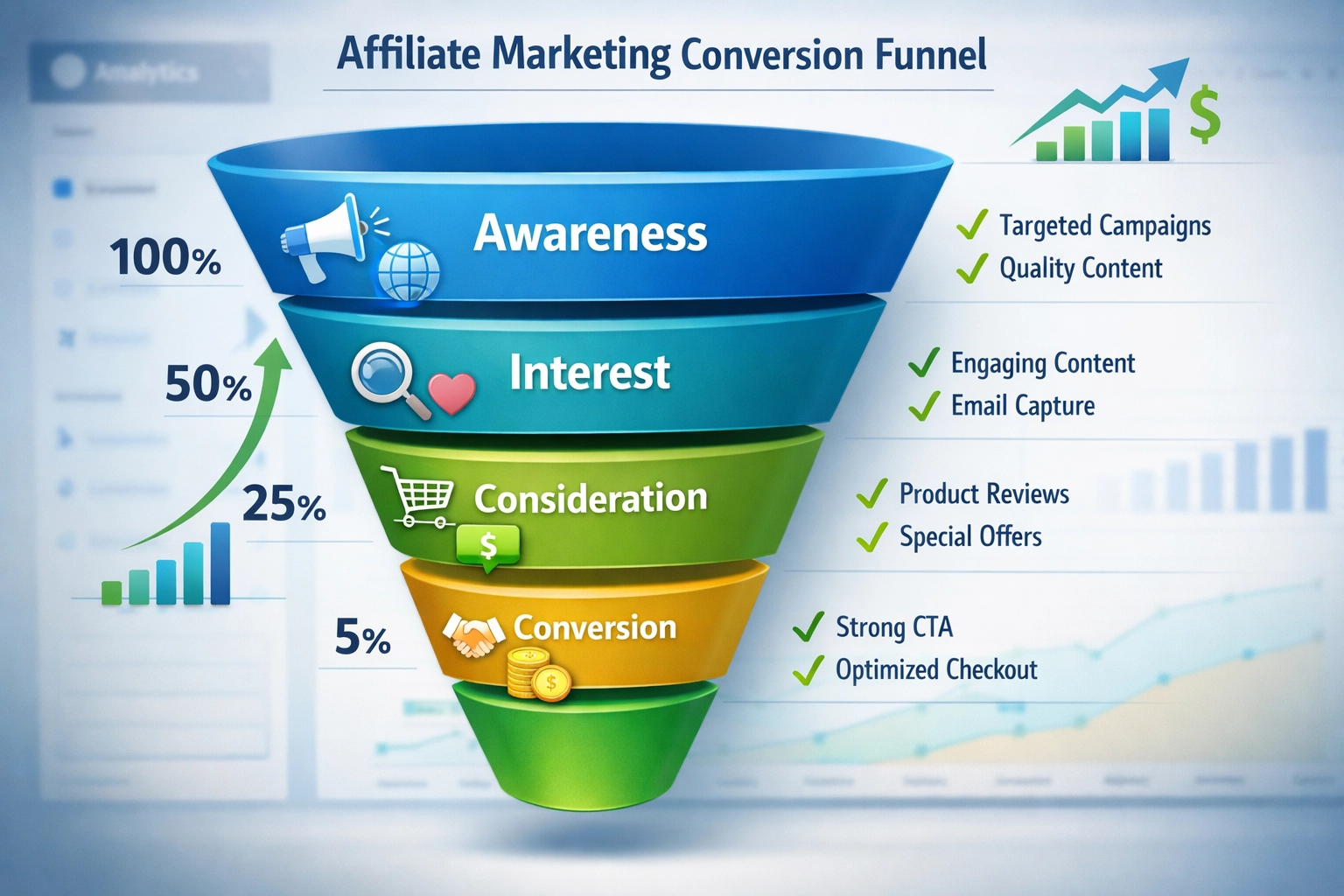
The key to successful A/B testing is testing one element at a time. If you change multiple elements simultaneously, you won’t know which change caused the improvement. Start with high-impact elements like headlines, CTAs, and form fields, then move to lower-impact elements like colors and images.
A/B testing ideas that drive conversions:
Implementation: Use tools like Google Optimize, Optimizely, or ConvertKit to run A/B tests. Start with your highest-traffic pages. Test one element at a time. Run tests for at least 2 weeks to gather sufficient data. Implement winning variations and move on to the next test. This continuous optimization process compounds over time, leading to significant revenue increases.
Your call-to-action (CTA) is the bridge between content and conversion. A weak CTA can leave money on the table, while a strong CTA can dramatically increase affiliate revenue. The difference between “Click here” and “Check current price on Amazon” can be 25-50% in conversion rate improvement.
Effective CTAs use action-oriented language that creates urgency and clearly communicates the benefit. Instead of generic phrases like “Click here” or “Learn more,” use specific, benefit-driven language that tells readers exactly what will happen when they click.
CTA placement is equally important. Research shows that multiple CTAs throughout your content perform better than a single CTA at the bottom. Place CTAs at the top (for impatient readers), middle (after key benefits), and bottom (for thorough readers) of your content.
High-converting CTA strategies:
Example CTAs that work:
Pop-ups get a bad reputation, but when used strategically, they’re one of the highest-converting elements on your website. The key is using them at the right time with the right offer. An exit-intent pop-up that appears when a visitor is about to leave can capture 10-20% of abandoning visitors.
Exit-intent pop-ups work because they interrupt the abandonment process. A visitor is about to leave your site without clicking your affiliate link. A well-timed pop-up offers them one last reason to stay—a discount code, exclusive content, or special offer. This last-minute intervention can recover otherwise lost conversions.
Time-delayed pop-ups are another effective strategy. Instead of appearing immediately (which annoys visitors), they appear after 30-60 seconds. By this time, the visitor has read some content and understands your value proposition. They’re more receptive to an offer.
Pop-up and exit-intent strategies:
Best practices: Don’t use pop-ups on every page—reserve them for high-value pages like product reviews. Don’t make them too aggressive—give visitors time to read before showing a pop-up. Always include a clear close button. Make sure the offer is genuinely valuable. And test different offers to see what resonates with your audience.
Understanding how visitors interact with your content is crucial for optimization. Heatmaps show exactly where users click, how far they scroll, and where they spend time. This data reveals what’s working and what needs improvement.
Heatmaps come in several types. Click heatmaps show where users click most frequently. Scroll maps show how far down the page users scroll. Attention heatmaps show which areas of the page get the most visual attention. Together, these tools paint a picture of user behavior that guides optimization decisions.
The insights from heatmaps are actionable. If you see that 70% of users only scroll halfway down your page, you know to move important content (including affiliate links) higher up. If you see that users are clicking on non-clickable elements, you know there’s confusion about what’s interactive. If you see that users are clicking your affiliate links but not converting, you know the problem is with the landing page, not your content.
Key insights to look for in heatmap data:
Implementation: Use tools like Hotjar, Crazy Egg, or Microsoft Clarity to generate heatmaps. Analyze the data to identify patterns and opportunities. Make optimization decisions based on data, not assumptions. Then monitor how your changes affect user behavior. This continuous feedback loop drives continuous improvement.
Email marketing has the highest ROI of any marketing channel: $42 for every $1 spent. For affiliate marketers, email is the most direct way to reach your audience and promote affiliate products. Unlike social media (where algorithms control who sees your content), email puts you in direct contact with interested subscribers.
The power of email lies in relationship building. When someone subscribes to your email list, they’re giving you permission to contact them regularly. This repeated exposure builds trust and familiarity. Over time, your subscribers see you as an authority and expert in your niche. When you recommend an affiliate product, they’re more likely to trust your recommendation and make a purchase.
Email also allows for segmentation and personalization. You can send different offers to different segments of your audience based on their interests and behavior. A subscriber interested in budget products gets different recommendations than one interested in premium products. This personalization dramatically increases conversion rates.
Email marketing strategies for affiliate revenue:
Practical implementation: Start building your email list immediately. Create a lead magnet relevant to your niche. Set up an email service provider (like ConvertKit, Mailchimp, or ActiveCampaign). Create a welcome sequence that delivers your lead magnet and introduces your affiliate recommendations. Then send regular newsletters with valuable content and strategic affiliate offers. Monitor your metrics and optimize based on what works.
Increasing affiliate marketing revenue isn’t complicated—it’s about implementing proven strategies consistently. The 12 strategies in this guide are used by successful affiliate marketers earning six and seven figures annually. They’re not secrets; they’re simply best practices that work.
The key is to start small and build momentum. You don’t need to implement all 12 strategies immediately. Pick 2-3 that align with your current situation and implement them thoroughly. Measure the results. Then add more strategies as you see success.
Your action plan:
Tools that help: PostAffiliatePro provides comprehensive tracking, analytics, and optimization features specifically designed for affiliate marketers. From detailed conversion tracking to advanced reporting, PostAffiliatePro helps you implement these strategies effectively and measure your results accurately.
The affiliate marketers earning the most revenue aren’t necessarily the ones with the most traffic. They’re the ones who optimize relentlessly. They test, measure, and improve continuously. They understand that small improvements compound into significant revenue increases.
Start today. Pick one strategy. Implement it thoroughly. Measure the results. Then move to the next strategy. Over time, these improvements will transform your affiliate marketing business from a side hustle into a significant income stream.
Your affiliate marketing revenue is waiting. Go claim it.
Results vary based on your starting point and implementation quality, but most affiliate marketers see 25-50% revenue increases within 3-6 months of implementing these strategies. Some see even higher increases by focusing on the highest-impact tactics like email marketing and conversion optimization.
Start with user experience optimization and content readability. These form the foundation for all other strategies. Once your website is fast, mobile-friendly, and easy to read, move on to conversion optimization tactics like A/B testing and CTA improvements.
Some strategies (like CTA optimization and pop-ups) show results within days or weeks. Others (like SEO and email list building) take 2-3 months to show significant results. The key is consistency—implement strategies and measure results over time.
No. Start with 2-3 strategies that align with your current situation. Implement them thoroughly, measure results, then add more strategies. Most successful affiliate marketers focus deeply on a few strategies rather than implementing all strategies superficially.
Essential tools include Google Analytics (traffic analysis), Google Search Console (SEO), Hotjar or Crazy Egg (heatmaps), and an email service provider. PostAffiliatePro provides comprehensive tracking and analytics specifically designed for affiliate marketers.
The key is integration. Don't force affiliate links into your content. Instead, weave them naturally into helpful content. Place links where they make sense contextually. Use clear, benefit-driven anchor text. Most importantly, only recommend products you genuinely believe in.
Use A/B testing for conversion-focused elements (CTAs, headlines, forms). Use heatmaps to understand user behavior. Use analytics to track traffic and conversions. Start with one test at a time, run for at least 2 weeks, then implement winning variations.
PostAffiliatePro provides advanced tracking, detailed analytics, conversion reporting, and optimization features specifically designed for affiliate marketers. It helps you implement these strategies effectively by providing the data and insights you need to make informed optimization decisions.
PostAffiliatePro provides all the tools you need to track, optimize, and scale your affiliate marketing campaigns. From advanced analytics to conversion optimization features, we help you implement these strategies effectively.
how to improve your affiliate marketing strategy with proven techniques for market analysis, niche selection, content optimization, and performance tracking.

Master affiliate marketing freelancer partnerships with clear expectations, communication, promotional materials, and performance tracking using affiliate

Learn key tips for newbie affiliate marketers: be prepared for financial risks, focus on one offer type to master its market, and capitalize on successful campa...
Join our community of happy clients and provide excellent customer support with Post Affiliate Pro.




Cookie Consent
We use cookies to enhance your browsing experience and analyze our traffic. See our privacy policy.