


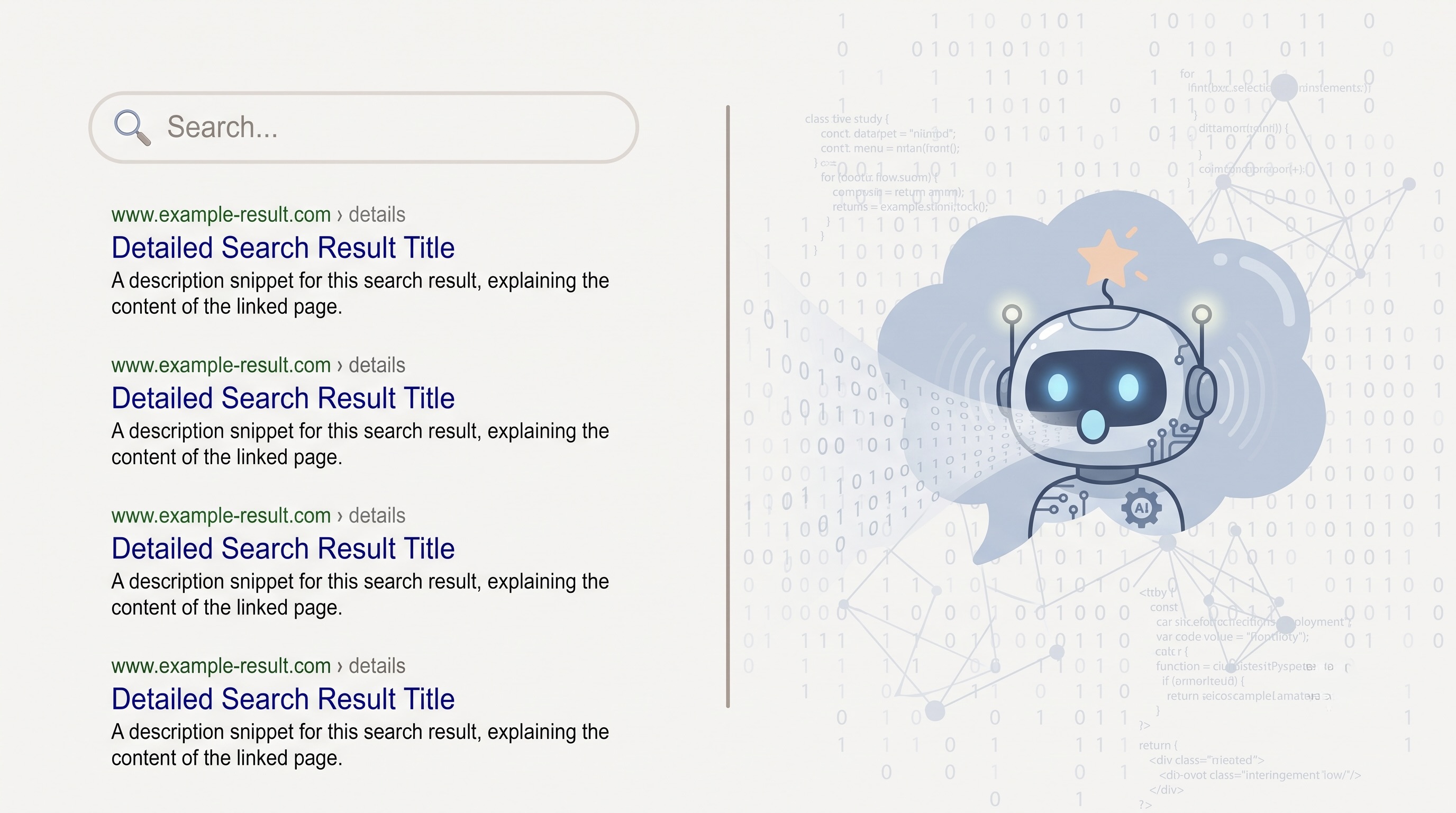
SEO vs GEO for affiliate content: what actually changes
A side by side comparison of SEO and generative engine optimization for affiliate content, what stays the same, what changes, and where to focus your effort fir...
8 min read

How affiliate content gets cited inside ChatGPT, Perplexity, and Google AI Overviews, and what to change in your writing so AI search engines choose to recommend you.
A few years ago, if someone wanted to know the best budget laptop for college students, they typed the question into Google, scanned five blue links, and clicked into a review site. Today, a growing share of people ask ChatGPT or Perplexity the same question and get an answer directly, often with no click at all.
Picture a mid-sized outdoor gear review site that has spent years building a solid Google ranking for “best hiking boots under $150.” The traffic has been steady and predictable for a long time. Then, over a few months, that traffic starts drifting down even though the ranking itself has not moved.
Nothing on the site broke. The search behavior around it changed. A growing share of the people who used to click through are now getting their answer straight from an AI Overview or a chatbot, reading a summary that was built, at least in part, from that very same site’s content, without ever visiting it.
That shift matters enormously for affiliate marketing, because the entire model depends on someone actually landing on your page and following your link. If AI search keeps eating into clicks the way early data suggests, the sites that survive will be the ones AI engines choose to cite, not just the ones that rank.
This is what generative engine optimization, or GEO, is about. It is not a replacement for SEO. It is what you add on top once you accept that a meaningful share of your audience is now asking a chatbot instead of a search bar.
The numbers here are still shifting fast, which is normal for something this new, but a few data points are already solid enough to plan around.
Ahrefs analyzed 300,000 keywords using Google Search Console data, comparing December 2023 to December 2025. They found that Google’s AI Overviews now reduce organic click-through rates for the top-ranking result by 58%. Out of every 100 clicks that used to go to the top organic result, Google now keeps 58 of them inside its own AI-generated answer (Ahrefs ).
On the AI chatbot side, OpenAI announced in February 2026 that ChatGPT had passed 900 million weekly active users, up from 800 million just four months earlier (TechCrunch ). That is not a niche audience anymore. It is a genuine second front door to the internet, sitting right alongside Google.
Shopping-specific queries are growing especially fast on these platforms. eMarketer’s research found that shopping-related searches on ChatGPT grew faster than any other query type over a recent stretch, and consumers who shop with AI tools say they use them specifically for price comparisons, finding deals, and checking reviews. That is affiliate content’s entire home turf.
Here is the detail that makes this concrete rather than theoretical. In a documented case tracked by eMarketer, nearly 70% of the websites ChatGPT cited when discussing eyewear brands were affiliate content, not the brands’ own product pages (eMarketer ).
Read that again. When someone asked ChatGPT about eyewear brands, the chatbot mostly skipped the brands themselves and pulled its answer from independent reviews and comparisons instead.
That is genuinely good news for affiliates who write real, substantive content. AI systems are not inherently biased toward big brand sites. They are biased toward whatever answers the question most clearly, and right now, a well-structured affiliate review often does that better than a brand’s own marketing copy.

Set up advanced tracking in minutes. No credit card required.
Most of the practical guidance on this is still new, but a consistent pattern has emerged across the platforms.
AI engines tend to favor content that answers the question directly and early. Instead of building up to a conclusion over several paragraphs, the strongest-performing pages state the core answer in the first few sentences, then add supporting detail afterward. An AI system extracting an answer is looking for something it can lift cleanly, not something it has to interpret.
Specific numbers and named sources also matter more than they used to. Vague, hedged language like “some studies suggest” is harder for a model to cite confidently than a direct claim with a number and a source attached to it. If your content reads as verifiable, it reads as safer to quote.
Structure helps too. Comparison tables, numbered steps, and question-based headings all map closely to how people phrase questions to an AI assistant in the first place, which makes it easier for the assistant to match your content to the query.
A few habits worth building into your content process:
It helps to know that GEO is not one single target. Each AI platform pulls from a different index and leans on different kinds of sources, so writing for all of them at once means covering a few different bases rather than chasing one formula.
Research from Profound found that ChatGPT leans heavily on Wikipedia and other reference-style content, with Wikipedia alone accounting for nearly 48% of citations among ChatGPT’s top cited sources (Profound ). That is a very different bias than Google’s own AI Overviews, which tend to pull more from video and multi-format content, or Perplexity, which behaves more like a retrieval-first answer engine and ties its visible sources very closely to specific claims in the text.
None of this means you need a separate article for every platform. It means the same underlying habits, clear claims, credible sources, specific numbers, tend to travel reasonably well across all of them, even though no single platform will ever be a perfect mirror of another.
Be the first to know about new features and product updates.
One of the most common mistakes right now is assuming AI referral traffic is invisible. It mostly is not, it is just easy to miss if you are not looking in the right place.
Google rolled out a native AI Assistant channel inside GA4 in mid-2026 that automatically separates out sessions from recognized platforms like ChatGPT, Gemini, and Claude, tagging them with their own medium value with no setup required (Orbit Media ).
There is a catch worth knowing about. When someone clicks a link inside an AI chat interface, the referrer information often gets stripped by the platform’s own app or embedded browser, which means that click can quietly show up in your analytics as direct traffic instead of an AI referral. If your direct traffic has been climbing for no obvious reason, this is worth checking before you assume it is a fluke.
For platforms not yet covered automatically, a simple custom channel using a regex match on your session source, something that captures domains like chatgpt, perplexity, and claude, will catch most of what the native channel misses.
Different AI platforms behave differently, and there is no single formula that works identically across all of them. ChatGPT, Perplexity, and Google’s AI Overviews each pull from different underlying data sources and weigh signals differently. Content that gets cited heavily on one platform will not automatically perform the same way on another.
That is not a reason to ignore GEO. It is a reason to treat it the way good SEO has always worked: build genuinely useful, well-sourced content, and trust that the fundamentals carry across most platforms even when the specifics vary.
If you run an affiliate program, the practical takeaway is not to abandon your existing content strategy. It is to stop treating AI search as a side channel you might get to eventually.
The broader affiliate marketing data backs this up. AI tool adoption among affiliate marketers is already close to 80%, and creators specifically are even further along. The publishers who treat GEO as a real discipline now, rather than an afterthought in twelve months, are the ones most likely to still be getting cited when someone asks an AI assistant for a recommendation in their niche.
Your affiliates are already writing reviews and comparisons. The work now is making sure those pieces are structured so an AI system can actually use them, not just so a person scrolling Google can.
Tamara is a copywriter at Post Affiliate Pro. She's passionate about helping businesses and marketers understand how affiliate programs can drive growth, one blog post at a time.

Post Affiliate Pro tracks conversions from every traffic source your affiliates bring in, so you can see exactly how much revenue is coming from AI search and generative engines.
A side by side comparison of SEO and generative engine optimization for affiliate content, what stays the same, what changes, and where to focus your effort fir...
Discover how Google's AI-driven search experience, SGE, might impact niche sites and SEO, with potential traffic drops of 80%. Learn adaptation strategies focus...

Discover how AI and chatbots transform affiliate marketing with automated content, personalized recommendations, enhanced UX, SEO optimization, analytics, fraud...
Join our community of happy clients and provide excellent customer support with Post Affiliate Pro.




Cookie Consent
We use cookies to enhance your browsing experience and analyze our traffic. See our privacy policy.