


What is Banner Advertising? Complete Guide to Digital Display Ads
Learn what banner advertising is, how it works, and why it remains one of the most effective affiliate marketing strategies. Discover banner ad types, formats, ...
11 min read

Learn everything about banner advertising, from types and pricing to best practices. Discover how to leverage banner ads for affiliate marketing.
Banner advertising is one of the oldest and most recognizable forms of digital marketing, dating back to 1994 when the first banner ad appeared on HotWired (now Wired.com). This groundbreaking AT&T advertisement, which read “Have you ever clicked your mouse right here? You will,” marked the beginning of a new era in online marketing. Today, banner advertising remains a cornerstone of digital marketing strategies, combining visual appeal with targeted messaging to drive brand awareness, generate leads, and increase website traffic. Despite the evolution of digital marketing channels, banner ads continue to deliver measurable results for businesses of all sizes.
Banner advertisements come in various formats, each designed to serve specific marketing objectives and engage audiences in different ways. Understanding the distinctions between these types helps marketers choose the right format for their campaigns and target audience.
| Type | Description | Best Use Case |
|---|---|---|
| Static Banner Ads | Simple, unchanging images with text and graphics | Brand awareness and straightforward messaging |
| Animated Banner Ads | Moving images or GIF animations that change over time | Capturing attention and showcasing product features |
| Interactive Banner Ads | Ads with clickable elements, games, or user interactions | High engagement and memorable brand experiences |
| Rich Media Ads | Advanced ads with video, sound, and interactive elements | Premium campaigns with higher budgets |
| Mobile Banner Ads | Optimized designs for smartphones and tablets | Mobile traffic and on-the-go audiences |
| Expandable Banner Ads | Ads that expand when users hover or click | Increased visibility without taking up initial space |
Each banner type offers distinct advantages. Static banner ads are cost-effective and load quickly, making them ideal for budget-conscious campaigns. Animated banner ads capture more attention through movement, increasing click-through rates compared to static versions. Interactive banner ads create memorable experiences that build stronger brand connections. Rich media ads deliver premium experiences but require larger budgets and more technical expertise. Mobile banner ads address the growing mobile-first audience, with optimized dimensions and touch-friendly designs. The choice depends on your budget, audience behavior, and campaign objectives.

Set up advanced tracking in minutes. No credit card required.
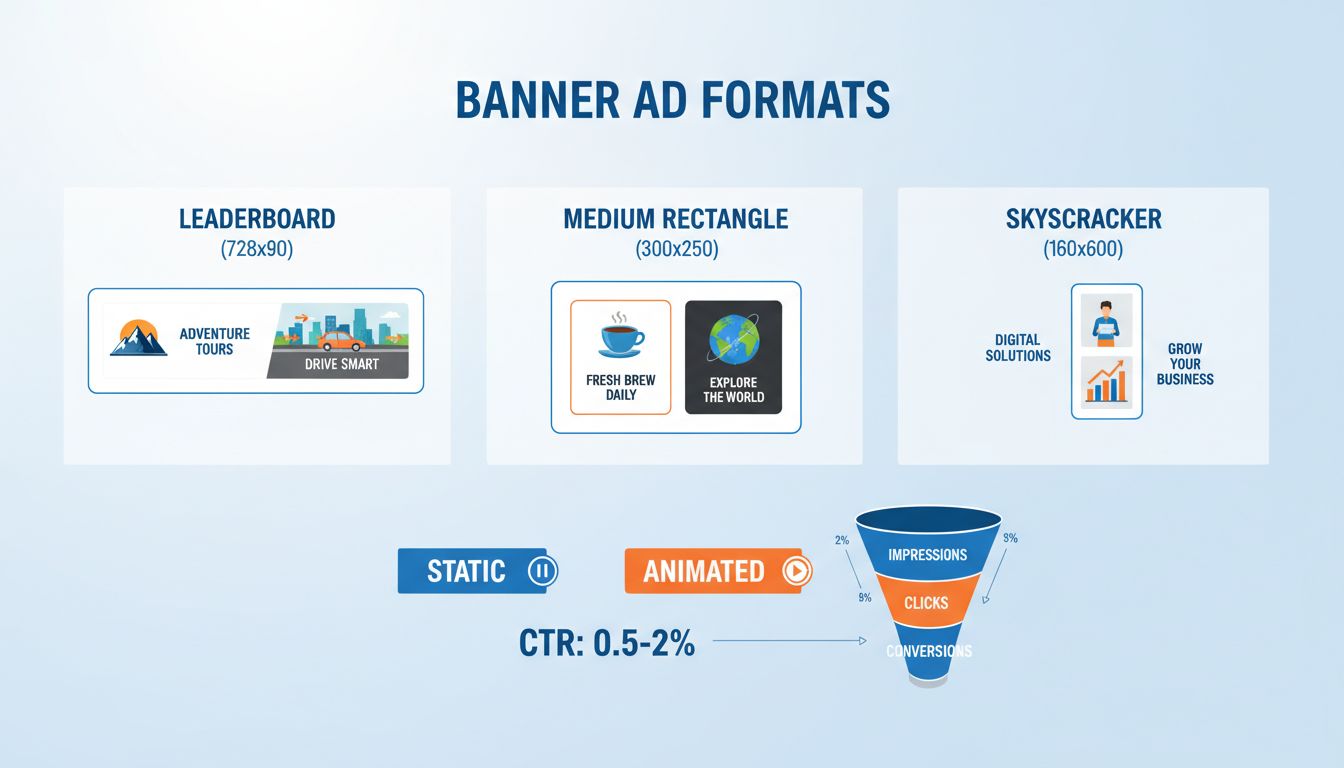
Banner advertising operates through a straightforward but sophisticated process that connects advertisers with potential customers. When a user visits a website, the site’s ad server selects and displays a banner ad based on various targeting parameters such as user demographics, browsing history, location, and the website’s content. The banner ad is then rendered on the page, typically in high-visibility areas like the top (leaderboard), sides (skyscraper), or within content areas (medium rectangle).
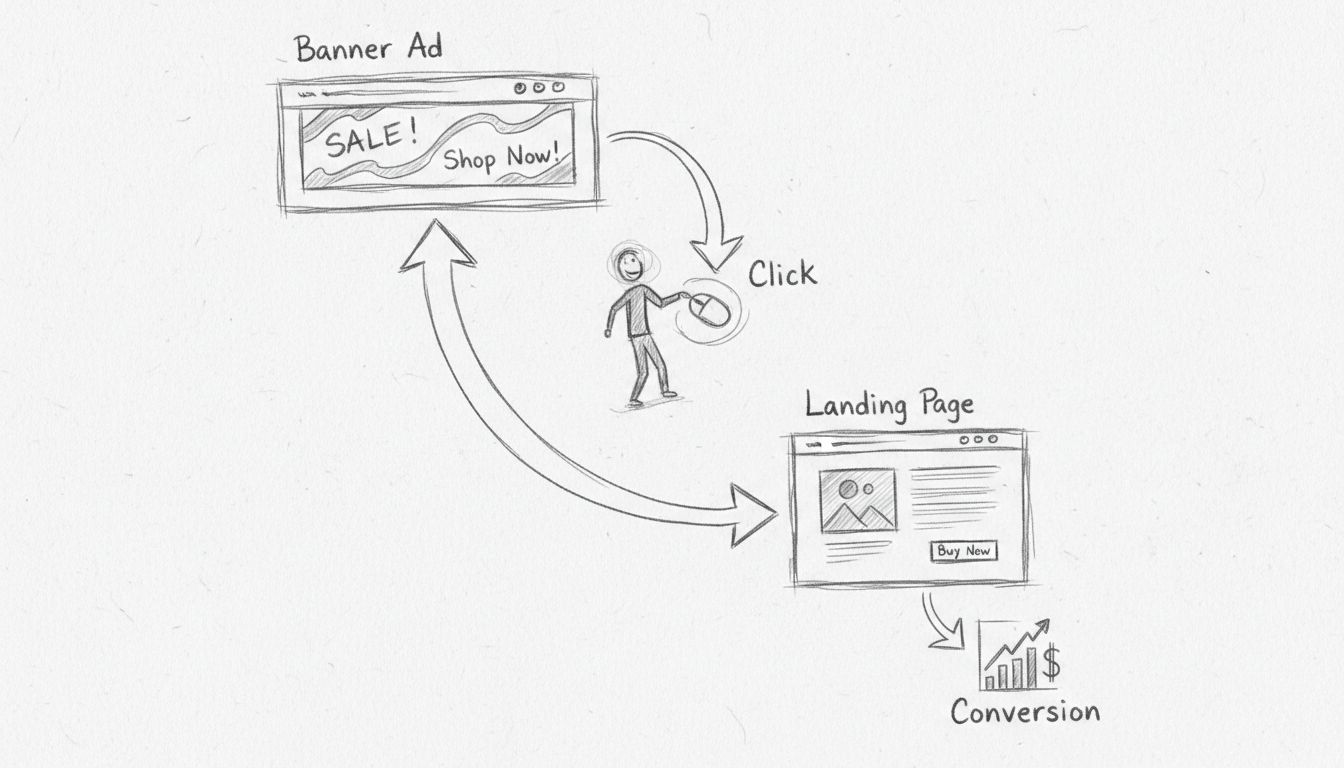
The effectiveness of banner ads is measured through several key metrics. Impressions count how many times the ad is displayed to users, regardless of whether they interact with it. Click-through rate (CTR) measures the percentage of users who click on the ad, calculated as clicks divided by impressions. Conversion rate tracks what percentage of users who click the ad complete a desired action, such as making a purchase or filling out a form. This data flows through tracking pixels and cookies embedded in the banner ad code, allowing advertisers to understand campaign performance and optimize future efforts.
Banner advertising serves multiple strategic purposes in a comprehensive digital marketing plan. Organizations leverage banner ads to achieve various business objectives:
The versatility of banner advertising makes it suitable for businesses at any stage. Startups can build brand awareness cost-effectively, established companies can drive sales, and e-commerce businesses can retarget abandoned cart visitors. The ability to target specific demographics, interests, and behaviors ensures that your advertising budget reaches the most relevant audiences, maximizing return on investment.
Be the first to know about new features and product updates.
The Interactive Advertising Bureau (IAB) has established standard banner ad sizes to ensure consistency across the digital advertising ecosystem. These standardized dimensions allow advertisers to create ads that work across multiple websites and platforms without requiring custom sizing for each placement.
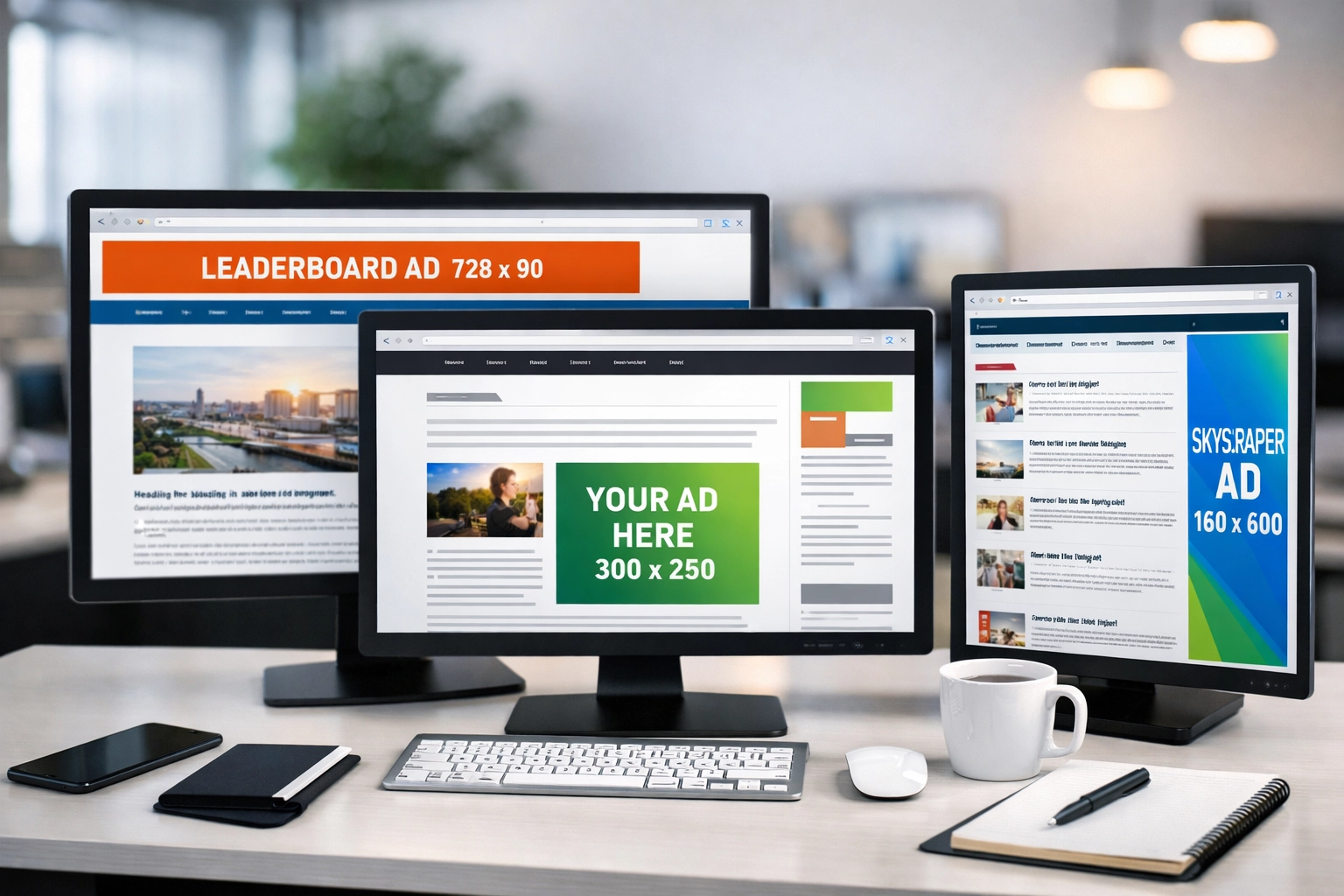
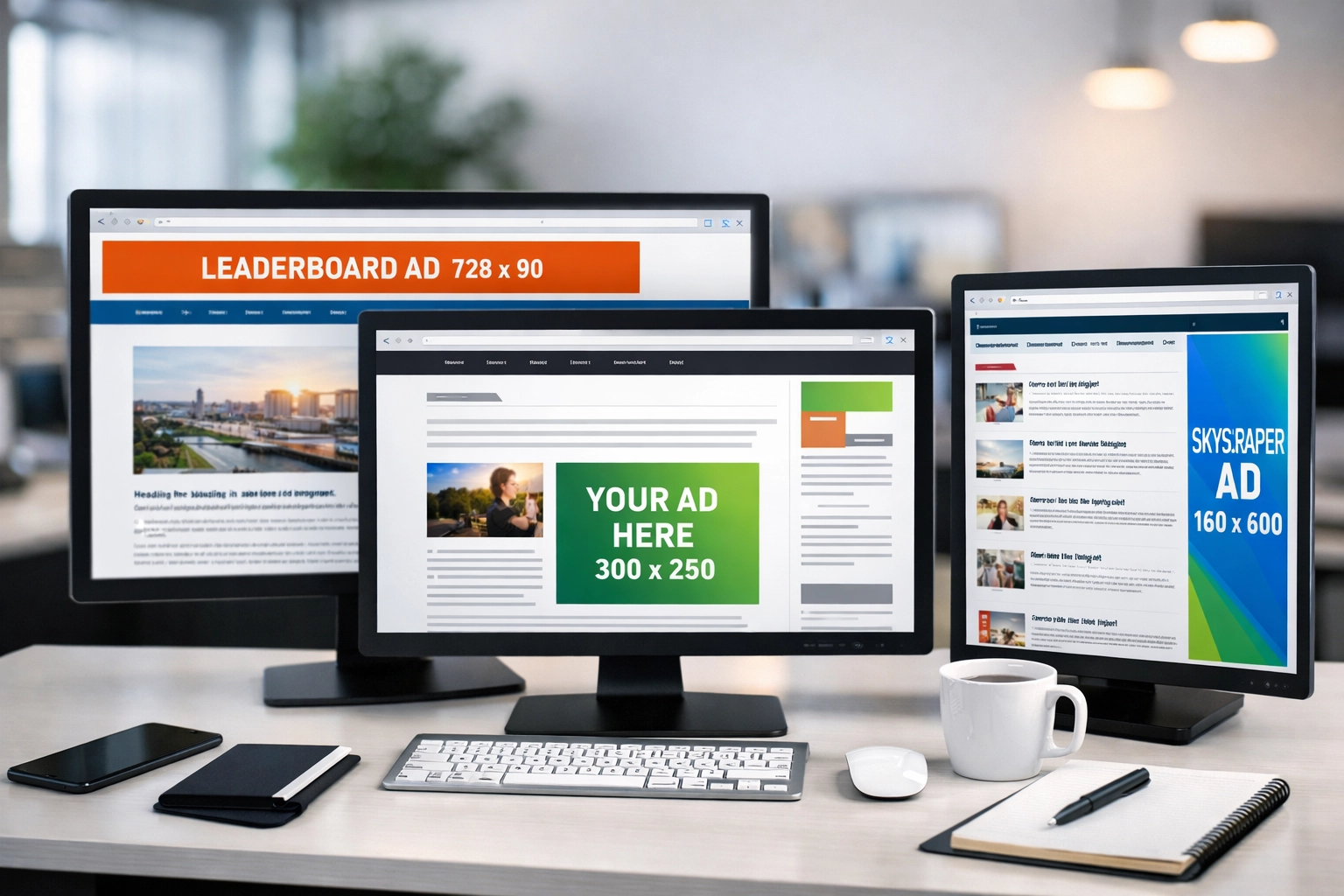
The most common banner ad sizes include the leaderboard (728x90 pixels), which appears horizontally at the top of web pages and offers high visibility due to its prominent placement. The medium rectangle (300x250 pixels) is one of the most versatile and effective sizes, fitting naturally within content areas and performing well on both desktop and mobile devices. The skyscraper (160x600 pixels) or wide skyscraper (300x600 pixels) runs vertically along the sides of web pages, providing extended visibility as users scroll through content.
Additional standard sizes include the half page (300x600 pixels), large rectangle (336x280 pixels), and mobile banner (320x50 pixels). Mobile banner ads have become increasingly important as smartphone traffic now exceeds desktop traffic. These smaller, horizontal banners fit naturally at the top or bottom of mobile screens without disrupting the user experience. Choosing the right size depends on your target audience’s device preferences, the websites where you’ll advertise, and your campaign objectives.
Banner advertising offers flexible pricing models that allow advertisers to align costs with their business objectives and budget constraints. Understanding these models helps you make informed decisions about campaign investment and expected returns.
Cost Per Mille (CPM) charges advertisers for every 1,000 impressions their banner receives, regardless of clicks or conversions. CPM rates typically range from $0.50 to $10 per thousand impressions, depending on website traffic quality, audience targeting, and industry. This model works well for brand awareness campaigns where reach is the primary goal. Cost Per Click (CPC) charges only when a user clicks on the banner ad, making it ideal for traffic-driving campaigns. CPC rates vary widely, from $0.10 to several dollars per click, depending on competition and targeting specificity.
Cost Per Action (CPA) charges only when a user completes a specific action, such as making a purchase, signing up for a service, or filling out a form. This performance-based model aligns advertiser costs directly with business results, making it attractive for conversion-focused campaigns. CPA rates depend entirely on the action’s value and conversion difficulty. Many sophisticated campaigns use hybrid models combining multiple pricing approaches to optimize for different objectives. For example, you might use CPM for brand awareness, CPC for traffic, and CPA for direct sales, allowing you to measure and optimize each component separately.
Banner advertising occupies a unique position within the broader digital marketing ecosystem, each channel offering distinct advantages and serving different strategic purposes. Search engine marketing (SEM) targets users actively searching for specific products or services, resulting in higher intent and conversion rates but typically higher costs per click. Search ads appear at the top of search results, capturing users at the moment of purchase intent. In contrast, banner ads reach users across the web, building awareness among audiences who may not be actively searching but fit your target demographic.
Social media advertising on platforms like Facebook, Instagram, and LinkedIn offers sophisticated targeting based on user profiles, interests, and behaviors. Social ads integrate seamlessly into users’ feeds, creating native experiences that feel less intrusive than traditional banner ads. However, social platforms charge premium rates for their targeting capabilities and audience access. Native advertising blends promotional content with editorial content, creating less disruptive experiences but requiring more creative effort and content development.
Video advertising delivers rich, engaging content that captures attention and builds emotional connections with audiences. Video ads command higher engagement rates and premium pricing compared to static banners. However, they require more production resources and longer load times. Display advertising, which includes banner ads, offers broader reach at lower costs, making it ideal for awareness campaigns and budget-conscious advertisers. The choice between channels depends on your campaign goals, target audience, budget, and the specific actions you want users to take.
Banner advertising plays a crucial role in affiliate marketing strategies, providing affiliates with a visual way to promote merchant products and earn commissions. Affiliates place banner ads on their websites, blogs, YouTube channels, or social media profiles, directing their audience to merchant websites. When visitors click the banner and complete a desired action—typically a purchase—the affiliate earns a commission, typically ranging from 5% to 30% of the sale value depending on the product and program.
The effectiveness of affiliate banner campaigns depends on several factors. Relevance is paramount; banner ads must align with your audience’s interests and your website’s content. A fitness blogger promoting workout equipment will see higher conversion rates than promoting unrelated products. Placement matters significantly; banners positioned near relevant content or in high-traffic areas generate more clicks and conversions. Design quality directly impacts performance; professional, eye-catching banners outperform generic or outdated designs.
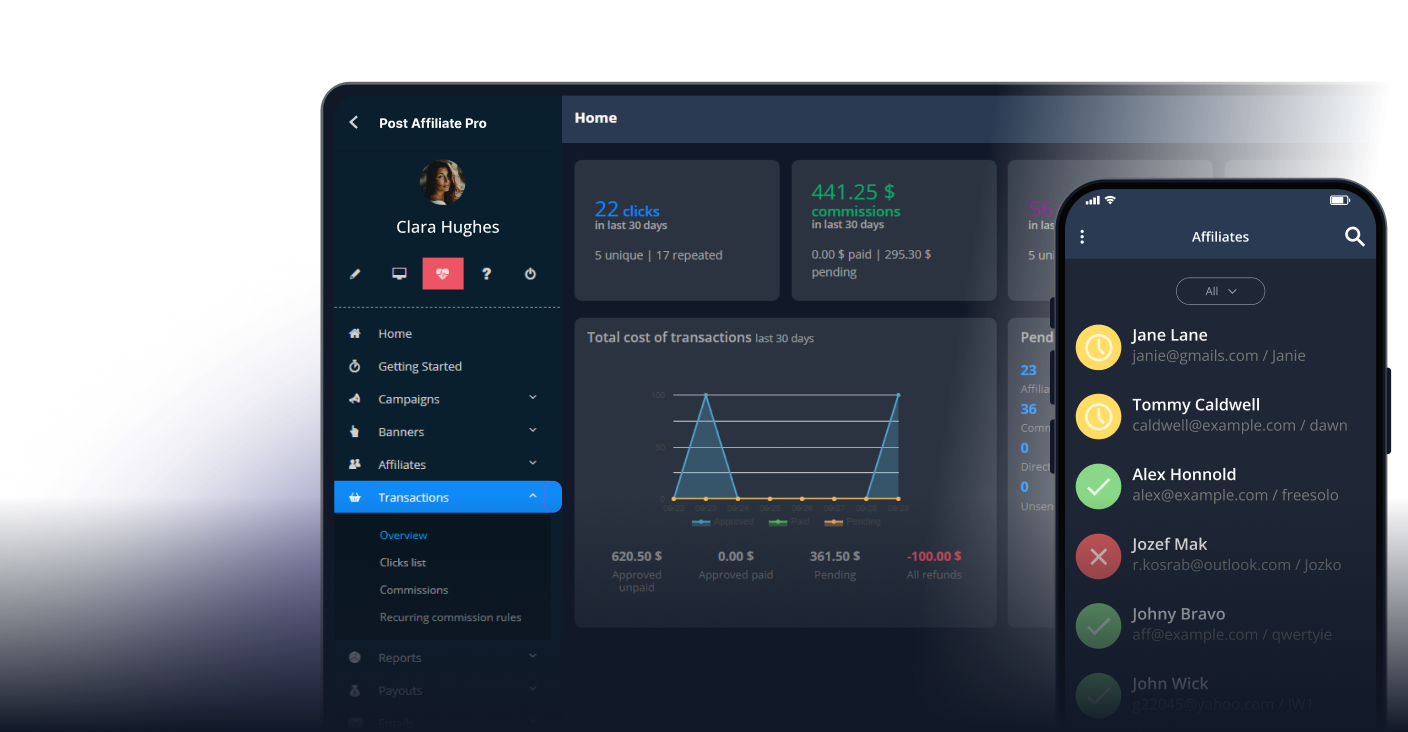
PostAffiliatePro streamlines affiliate banner advertising by providing comprehensive tracking, reporting, and commission management tools. The platform automatically tracks clicks from banner ads, attributes conversions to the correct affiliate, and calculates commissions accurately. Affiliates can access detailed performance analytics showing which banners drive the most traffic and conversions, enabling data-driven optimization. Merchants can manage multiple affiliate programs, set different commission rates for different affiliates or products, and automate commission payouts. This integrated approach eliminates manual tracking errors and provides transparency for both affiliates and merchants.
Creating banner ads that stand out and drive results requires attention to design, messaging, and strategic placement. Visual design is your first opportunity to capture attention; use high-quality images, bold colors, and clean layouts that align with your brand identity. Avoid cluttered designs with too many elements competing for attention. Compelling headlines should communicate your value proposition clearly and concisely, answering the question “Why should I click this ad?” in just a few words.
Clear calls-to-action (CTAs) are essential; use action-oriented language like “Shop Now,” “Learn More,” “Sign Up,” or “Get Started” to guide users toward the desired action. The CTA button should contrast visually with the rest of the ad, making it impossible to miss. Targeted messaging resonates more effectively than generic copy; speak directly to your audience’s needs, pain points, or desires. A banner promoting productivity software should emphasize time-saving benefits to busy professionals, not generic features.
Strategic placement ensures your ads reach the right audience; advertise on websites frequented by your target demographic and in positions where they’re likely to see them. A/B testing different designs, headlines, and CTAs reveals what resonates with your audience. Test one variable at a time—headline, image, CTA text, or color—to identify winning combinations. Avoiding banner blindness requires creativity and relevance; users have learned to ignore generic banner ads, so your ads must offer genuine value or compelling reasons to engage. Finally, mobile optimization is non-negotiable; ensure your banners display correctly and load quickly on smartphones and tablets, where the majority of users now access the web.
Tracking and analyzing banner ad performance is essential for optimizing campaigns and demonstrating return on investment. Click-through rate (CTR) is the most basic metric, calculated as clicks divided by impressions, expressed as a percentage. Average banner CTRs range from 0.2% to 0.5%, though well-optimized campaigns can exceed 1%. Conversion rate measures what percentage of clicks result in desired actions, such as purchases or signups. This metric reveals whether your banner is attracting the right audience or if your landing page needs improvement.
Return on ad spend (ROAS) compares revenue generated to advertising costs, providing a clear picture of profitability. An ROAS of 3:1 means you earn $3 for every $1 spent on advertising. Effective cost per mille (eCPM) calculates your actual cost per 1,000 impressions based on revenue generated, helping you compare performance across different campaigns and channels. Cost per acquisition (CPA) divides total advertising spend by the number of conversions, showing how much each customer costs to acquire.
Modern analytics platforms and affiliate software like PostAffiliatePro provide detailed dashboards tracking these metrics in real-time. You can segment performance by traffic source, audience demographic, device type, and time period, identifying which combinations perform best. This data-driven approach enables continuous optimization, allowing you to allocate budget toward high-performing banners and placements while improving or pausing underperformers.
Despite their effectiveness, banner ads face several challenges that marketers must address to maximize results. Banner blindness occurs when users unconsciously ignore banner ads, having learned to filter them out as they browse. This challenge has intensified as ad saturation increases across the web. Combat banner blindness through creative, relevant designs that offer genuine value rather than generic promotional messages. Contextual targeting—placing ads on websites related to your products—also helps, as users are more likely to notice ads relevant to their current interests.
Ad fatigue develops when users see the same banner repeatedly, causing engagement to decline. Rotate multiple banner designs and refresh creative regularly to maintain audience interest. Low engagement rates may indicate poor targeting, irrelevant messaging, or weak design. Analyze your audience data, test different messages and visuals, and ensure your landing pages deliver on the banner’s promise. Privacy concerns and cookie deprecation present technical challenges; as third-party cookies disappear, traditional tracking methods become less reliable. Adapt by implementing first-party data collection, contextual targeting, and privacy-compliant tracking solutions.
Ad blockers prevent some users from seeing banner ads entirely, reducing your potential reach. While you can’t force users to disable ad blockers, you can focus on creating ads so valuable that users willingly whitelist your sites. Low conversion rates may stem from misaligned audience targeting, unclear value propositions, or poor landing page experiences. Conduct thorough A/B testing, refine your targeting parameters, and ensure your landing pages are optimized for conversions.
Banner advertising continues to evolve, adapting to changing technologies and user behaviors. Artificial intelligence is increasingly used to optimize ad placement, targeting, and creative selection in real-time, improving performance without manual intervention. Contextual targeting is gaining prominence as privacy regulations restrict behavioral targeting; ads are placed based on page content rather than user browsing history, maintaining relevance while respecting privacy.
Personalization powered by first-party data allows advertisers to deliver more relevant messages to known audiences, improving engagement and conversion rates. Dynamic creative optimization automatically adjusts banner elements—images, headlines, CTAs—based on user segments and performance data. Privacy-first approaches using encrypted data and on-device processing enable effective targeting without compromising user privacy. The integration of banner advertising with omnichannel marketing strategies ensures consistent messaging across websites, apps, email, and social media.
Despite predictions of banner advertising’s demise, the channel remains resilient because it solves fundamental marketing challenges: building brand awareness, driving traffic, and generating leads cost-effectively. As technology evolves and marketers adapt to privacy regulations, banner advertising will continue to be a valuable component of digital marketing strategies.
Banner advertising has proven its staying power since 1994, evolving from simple static images to sophisticated, data-driven campaigns that deliver measurable results. Whether your goal is building brand awareness, driving website traffic, generating leads, or supporting affiliate marketing efforts, banner ads offer flexible, cost-effective solutions. Success requires understanding your audience, creating compelling designs, strategic placement, and continuous optimization based on performance data.
For affiliate marketers specifically, banner advertising represents a powerful revenue stream when executed strategically. Choosing relevant products, placing ads on aligned websites, and tracking performance meticulously can generate substantial commissions. PostAffiliatePro simplifies this process by providing comprehensive tracking, detailed analytics, and automated commission management, allowing you to focus on creating great content and driving traffic while the platform handles the technical details.
Ready to harness the power of banner advertising for your affiliate marketing success? Start optimizing your campaigns today and watch your conversions grow.
PostAffiliatePro provides the tools and tracking you need to manage banner ad campaigns effectively and track affiliate commissions in real-time.
Learn what banner advertising is, how it works, and why it remains one of the most effective affiliate marketing strategies. Discover banner ad types, formats, ...

Banner ads can bring traffic and success to any affiliate marketing program. Check out the 10 best practices to boost your sales.
Learn how banner advertising works, from design and targeting to click-through rates and conversions. Discover best practices and strategies for effective banne...
Join our community of happy clients and provide excellent customer support with Post Affiliate Pro.



Cookie Consent
We use cookies to enhance your browsing experience and analyze our traffic. See our privacy policy.