


What Are Recurring Commissions? Complete Guide for Affiliate Programs
Learn how recurring commissions work in affiliate marketing. Discover the benefits for affiliates and merchants, implementation strategies, and how PostAffiliat...
12 min read
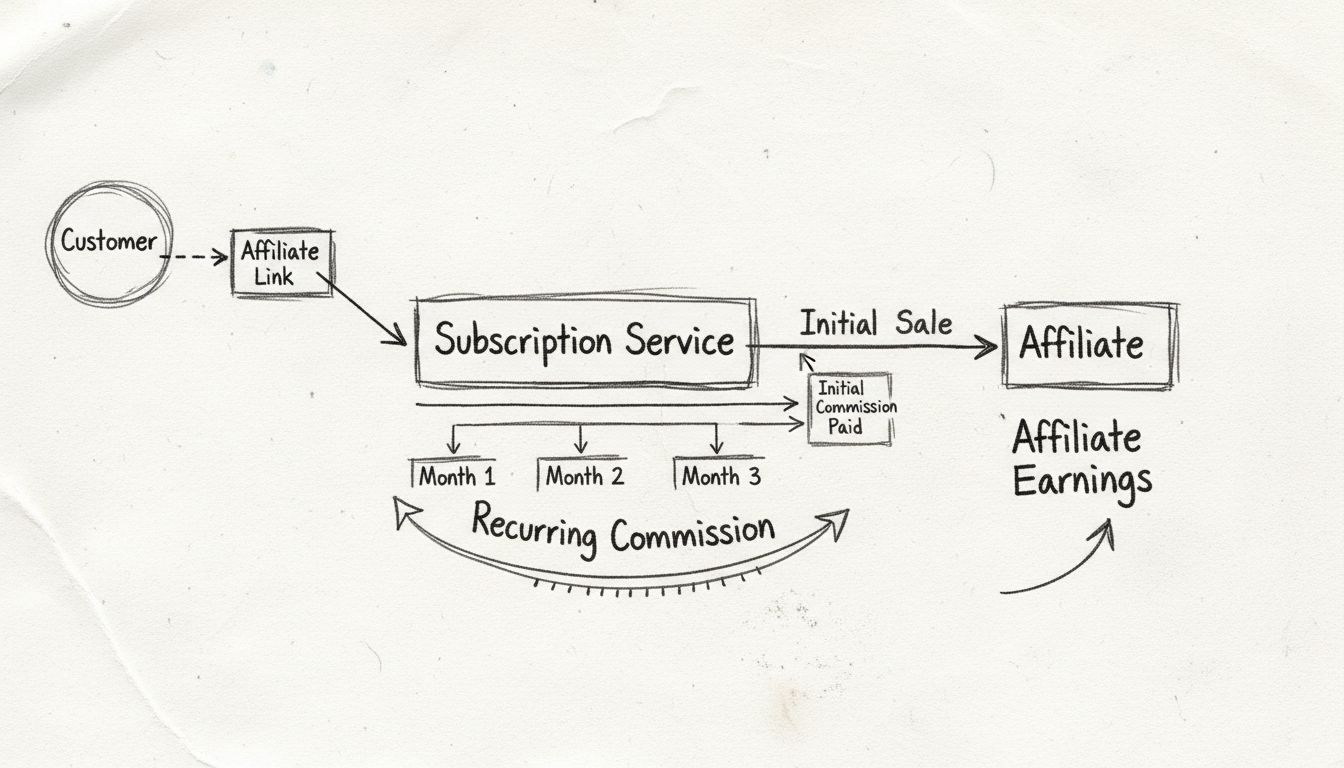
In affiliate marketing, a recurring commission rewards an affiliate for qualifying repeat payments from a referred customer, such as subscription renewals. The rate, eligible billing events, and earning duration come from the program terms. Commission creation, approval, and payout are separate steps.
In affiliate marketing, a recurring commission rewards an affiliate for qualifying repeat payments from a referred customer, such as subscription renewals. The rate, eligible billing events, and earning duration come from the program terms. Commission creation, approval, and payout are separate steps.
The affiliate’s work may happen before the initial purchase, while earnings accrue later. That timing can make retention important, but it does not make the income certain or remove the need to keep promotional information accurate.

Set up advanced tracking in minutes. No credit card required.
| Arrangement | What can earn a commission | Key condition |
|---|---|---|
| One-time bounty | A defined first qualifying action | The action must meet the bounty rules |
| Time-limited recurring | Eligible repeat billing events | Events must fall within the earning duration |
| Lifetime relationship | Eligible future purchases linked to a customer | The relationship and terms must remain valid |
Suppose four eligible $100 payments each earn 20%. The total is 4 × $100 × 20% = $80. If the fourth payment is refunded and the terms reverse its commission, the total falls to $60. A one-time 20% commission on the first payment would be $20.
For forecasting, use eligible payments and retained customers rather than assuming all referrals renew indefinitely. Upgrades, downgrades, discounts, taxes, and excluded products can change the commissionable base.
Be the first to know about new features and product updates.
Residual earnings is a broader term for ongoing income from earlier work. It can describe recurring affiliate income, but also royalties and other arrangements that do not use affiliate referrals.
Separate new referrals from existing referred customers. For each customer cohort, estimate eligible paid renewals, the commissionable subscription amount, commission rates, and the remaining earning period. A flat monthly rate is easier to model than product-specific percentages, but both need the same eligibility checks.
For an illustrative ten customers paying $50 per month at 20%, one fully eligible billing cycle generates $100. If two customers do not pay, that cycle generates $80 under a payment-confirmed model. A twelve-cycle projection assuming no losses would be $1,200; it is a scenario, not a promise.
These events can change the eligible amount, timing, or number of commissions. Stripe’s subscription webhook documentation provides billing-event context; the affiliate integration must apply your own reward rules.
Evaluate the software, course, or membership against your audience’s needs. Review retention assumptions and the support the customer receives, then compare approved commission income with the effort and cost of promotion. Recurring revenue can reward a long-term customer relationship, but it should not be promoted as risk-free passive income.
A scheduled commission is created at a configured interval after an initial tracked payment. A payment-confirmed commission is created when the billing integration reports an eligible renewal. These mechanisms can produce different results if a customer cancels, misses a payment, or changes plans.
For example, a hypothetical $100 monthly subscription with a 20% renewal commission yields $20 for each eligible paid month. If only three payments qualify, the affiliate earns $60 before any later adjustments. It does not create a guaranteed income stream.
Post Affiliate Pro documents both scheduled and payment-confirmed recurring commission modes . When choosing a mode, test cancellation handling and make sure the subscription identifier connects the initial sale to later events. Content creators promoting courses, memberships, or software should check the same rules before describing an offer as recurring.
Explore Post Affiliate Pro’s tracking, commission settings, and partner management tools.
Learn how recurring commissions work in affiliate marketing. Discover the benefits for affiliates and merchants, implementation strategies, and how PostAffiliat...
Residual earnings are ongoing commissions affiliates earn from repeat customer payments. Learn how they work, plus examples and program tips.

how lifetime commissions work in affiliate marketing, their benefits for affiliates and merchants, implementation strategies
Join our community of happy clients and provide excellent customer support with Post Affiliate Pro.




Cookie Consent
We use cookies to enhance your browsing experience and analyze our traffic. See our privacy policy.