


Affiliate Coupon Tracking
In affiliate marketing, affiliate coupon tracking credits a qualifying sale to an affiliate through an assigned coupon or referral code entered at checkout.
4 min read
AffiliateMarketing
Glossary
In affiliate marketing, offline affiliate tracking connects eligible purchases or leads completed outside a normal online checkout to an affiliate referral. It can use assigned codes, recorded referral identifiers, call or CRM records, and imported conversion events. The merchant must define what evidence establishes the referral and which events qualify.
In affiliate marketing, offline affiliate tracking connects eligible purchases or leads completed outside a normal online checkout to an affiliate referral. It can use assigned codes, recorded referral identifiers, call or CRM records, and imported conversion events. The merchant must define what evidence establishes the referral and which events qualify.
| Channel | Possible referral evidence |
|---|---|
| In-store purchase | Assigned code recorded at the point of sale |
| Phone order | Supported call or referral reference connected to the order |
| Sales-assisted deal | Affiliate referral retained in the CRM and linked to a qualifying deal |
| Event promotion | Assigned code or reference captured during the purchase process |

Set up advanced tracking in minutes. No credit card required.
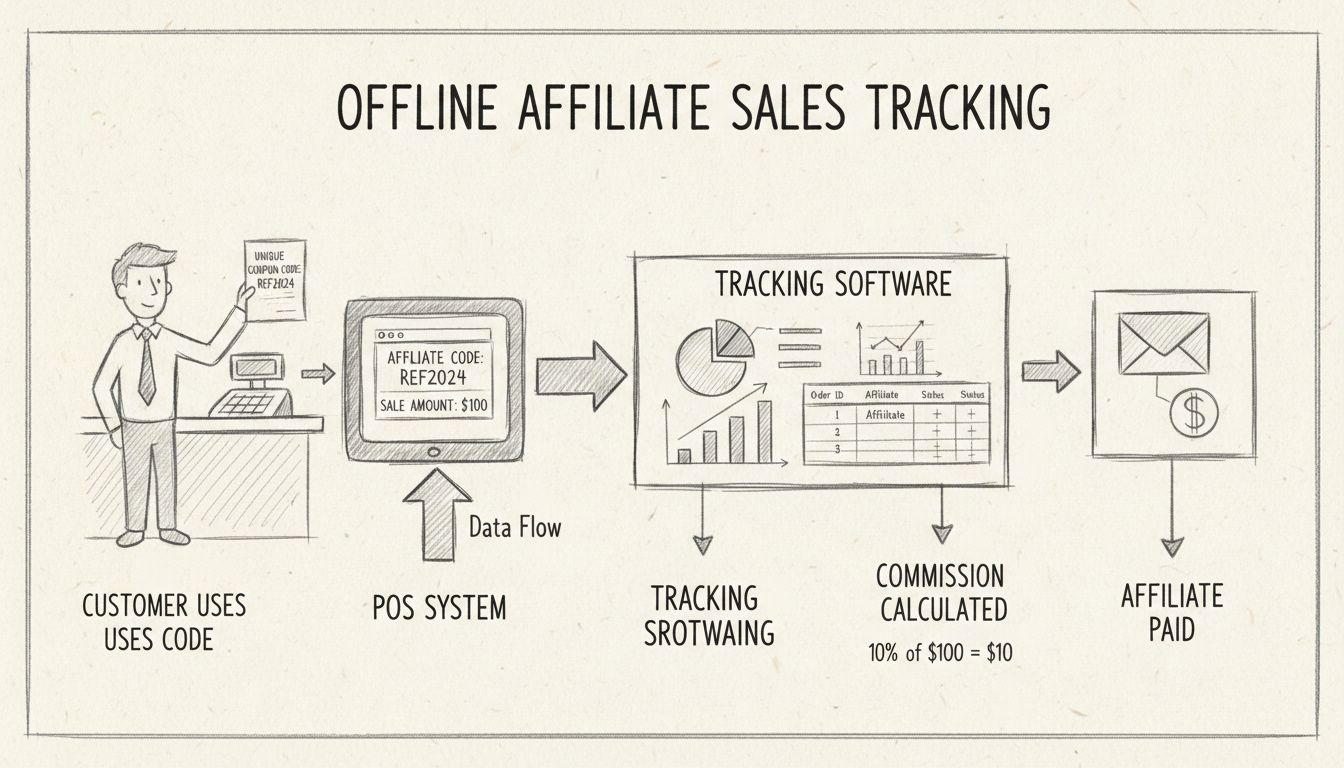
A partner shares an assigned code that a customer gives at a physical checkout. Staff record the code with order store-1042, its eligible $100 amount, and the event date. If the code maps to an eligible affiliate and the program pays 10%, the imported sale can create a $10 commission after validation.
A later refund should reference that original transaction so the appropriate adjustment can be reconciled. A second import of the same order should not create another $10 reward.
A customer may submit an online enquiry and later buy through a salesperson. Decide whether the program rewards the lead, the paid sale, or both under separate rules. Preserve the referral association into the CRM instead of asking staff to infer it from memory after closing.
Use distinct event identities where lead and purchase are both eligible. Deduplicating all events by customer alone could suppress a legitimate sale, while treating every CRM update as a conversion could overpay.
Be the first to know about new features and product updates.
State expected reporting delays and what evidence a partner can supply for a missing record. Validate imports against the source system, preserve corrections, and limit access to customer data. Offline tracking needs a repeatable operational process as well as a technical import or API.
Retain the order or deal ID, the agreed affiliate evidence, event date, eligible amount, and currency. Validate those details before creating a commission, and keep the original source record available for reconciliation. A customer’s name or a salesperson’s recollection alone may not establish the referral required by the program.
Google’s offline conversion setup guidance illustrates retaining a click identifier with a later business event. Google ad attribution and affiliate attribution remain separate systems with different identifiers and eligibility rules.
Tell partners when offline records are imported and how missing referrals can be reviewed. A successful upload may only mean the file was accepted; inspect the recorded event and commission outcome as well. A source correction should remain connected to its original transaction.
Post Affiliate Pro’s integration guidance provides product setup context. Use the supported import or API for the actual system and avoid promising that every phone, store, or CRM purchase can be recognized without the required referral evidence.
Choose the identifier before the campaign starts. A code stated in a store, a referral captured in a sales form, or a supported call identifier can connect the offline event to a partner. Staff need a clear process for recording it without inventing attribution after the sale.
Send or import a stable transaction ID, eligible value, currency, event date, and the required affiliate identifier. Decide how an online lead followed by an offline purchase is counted so the same action does not earn duplicate commissions. Correct or reverse imported records when the sale is canceled or refunded.
Test one end-to-end referral and reconcile it with the point-of-sale or CRM record. Explain reporting delays to affiliates. Limit customer data to what the process actually needs and follow applicable privacy requirements. An import creates a tracking record; it does not by itself prove the referral was valid.
For the corresponding Post Affiliate Pro settings, consult the offline tracking documentation . Confirm the configuration and integration requirements against your program’s rules.
Identify the referral
Capture the agreed code or referral evidence during the offline journey.Record the sale
Store the source transaction and eligible conversion details.Import or send
Connect the event to the affiliate tracker using a supported integration.Validate
Deduplicate, review eligibility, and reconcile refunds against the source system.Explore Post Affiliate Pro’s tracking, commission settings, and partner management tools.
In affiliate marketing, affiliate coupon tracking credits a qualifying sale to an affiliate through an assigned coupon or referral code entered at checkout.
Learn how to track offline affiliate sales using unique coupon codes, POS integration, and advanced tracking methods. Discover best practices for offline affili...

What is Offline tracking in Post Affiliate Pro, how to use it and what benefits it brings to your online business?
Join our community of happy clients and provide excellent customer support with Post Affiliate Pro.




Cookie Consent
We use cookies to enhance your browsing experience and analyze our traffic. See our privacy policy.