


What is a Forced Matrix? Complete Guide to Matrix Commission Structures
Learn what a forced matrix is in affiliate marketing. Understand how width and depth limits work, benefits for affiliates, and why PostAffiliatePro is the top c...
9 min read
In affiliate marketing, a forced matrix is an affiliate or network placement structure with a fixed number of positions at each level and a fixed depth. It can place additional affiliates below an existing frontline through spillover. Placement describes the tree; the compensation plan separately determines which eligible activity earns rewards.
In affiliate marketing, a forced matrix is an affiliate or network placement structure with a fixed number of positions at each level and a fixed depth. It can place additional affiliates below an existing frontline through spillover. Placement describes the tree; the compensation plan separately determines which eligible activity earns rewards.
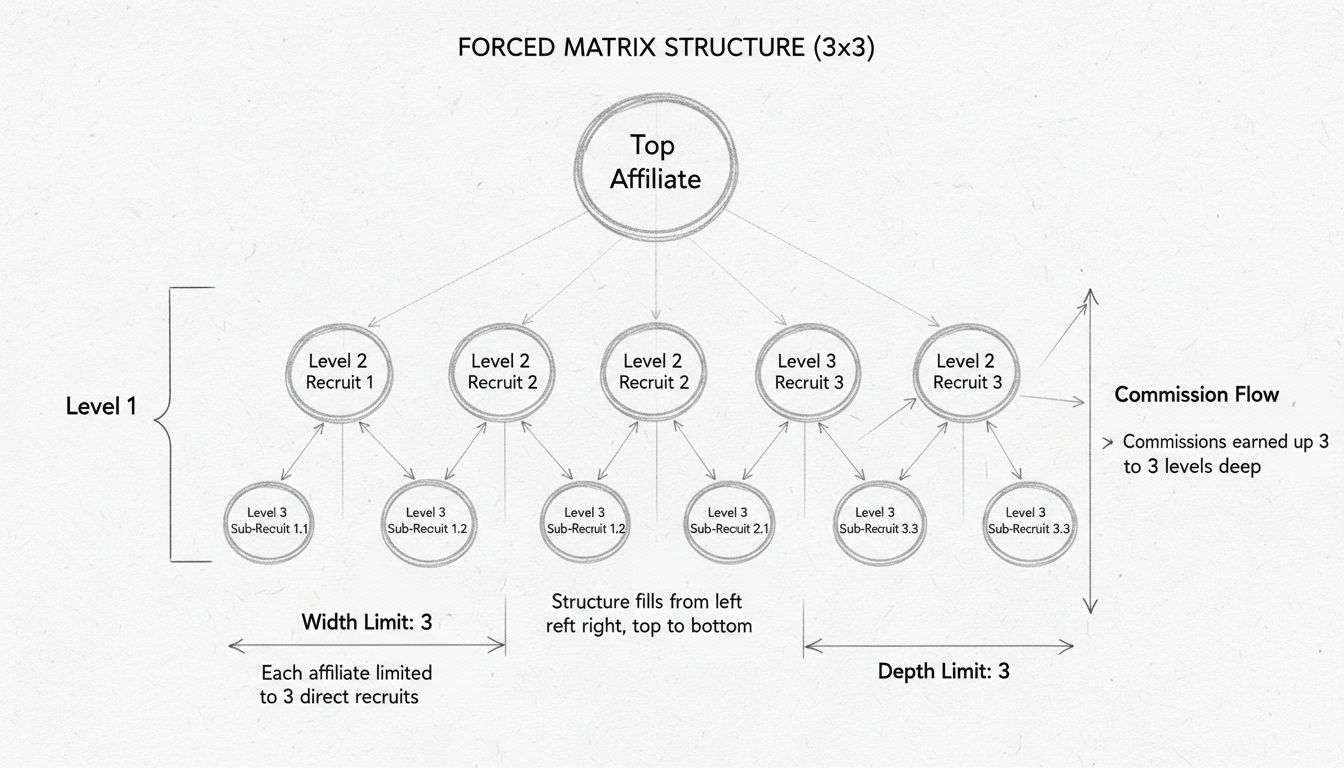
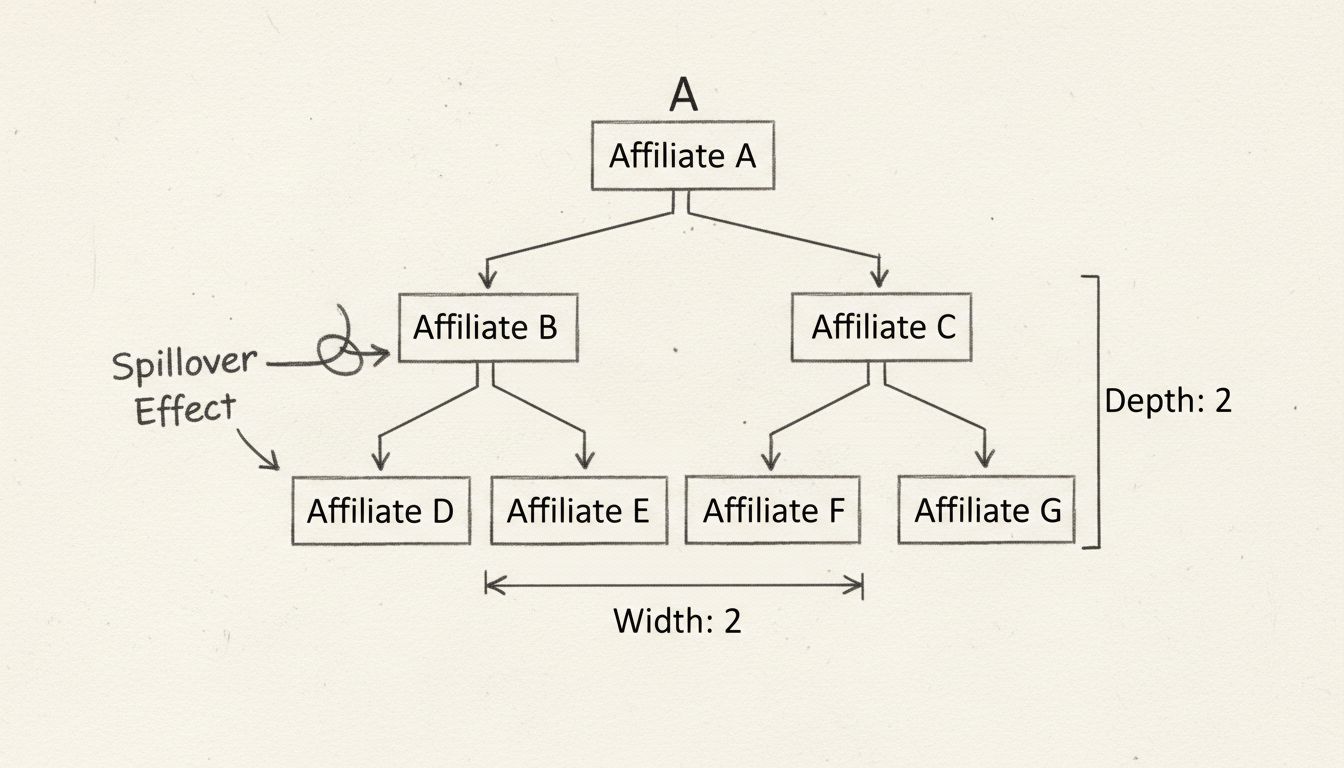
Width limits positions at each immediate level, and depth limits the number of levels in the defined matrix. A 2-by-3 matrix has 2 first-level positions, 4 second-level positions, and 8 third-level positions: 14 positions below the root.
The capacity formula is the sum of the width raised to each level from 1 through the depth. It describes a full structure, not expected recruitment or earnings.

Set up advanced tracking in minutes. No credit card required.
| Concept | Meaning |
|---|---|
| Sponsor | The affiliate recorded as having introduced a partner |
| Placement | Where that partner sits in the configured tree |
| Spillover | Placement into an available position below a filled frontline |
| Commission eligibility | Whether a qualifying event rewards a particular affiliate |
Assume a plan rewards a qualifying $100 customer sale with 5% to one eligible level and 2% to another. Those rewards are $5 and $2 if both use the sale amount. The existence of empty or occupied positions does not create either reward without the qualifying sale and eligibility conditions.
Be the first to know about new features and product updates.
A unilevel structure can allow a wider direct frontline under its plan. A binary structure has two immediate branches. A forced matrix specifies both width and depth for the bounded structure. These structural labels do not fully describe the compensation rules or business practices.
Fixed capacity can constrain placement choices, spillover may depend on other participants, and inactive positions may complicate reporting. Do not equate a full tree with profitable customer acquisition. Review the real incentives and requirements rather than relying on a diagram or an earnings projection.
State the width, depth, fill order, and whether sponsorship differs from placement. Explain what happens to new recruits when the frontline fills, how inactive positions are treated, and whether a canceled account changes the tree. Do not rely on the diagram alone to answer these questions.
Post Affiliate Pro’s forced matrix documentation covers product-specific structure and configuration. The business must still define the complete compensation plan.
Model rewards on eligible sales rather than multiplying maximum positions by assumed income. In a hypothetical plan paying 10%, 3%, and 2% of one $100 eligible sale to three qualified levels, total commission cost is $15. If one level is ineligible, the result depends on the written gap or compression rule.
Position capacity says nothing about conversion quality or customer retention. Review actual activity, approved revenue, refund adjustments, and partner participation before judging the plan commercially. Avoid encouraging recruits to treat hypothetical full-capacity arithmetic as an earnings forecast.
In a hypothetical 3-by-3 matrix, a complete tree has 3 positions on level one, 9 on level two, and 27 on level three: 39 positions below the root. That is capacity, not a prediction that 39 partners will join, sell, or remain eligible.
Explain how new partners are placed, whether sponsorship differs from placement, and what happens when a position becomes inactive or an affiliate cancels. Do not assume that a gap automatically moves the tree or transfers commission eligibility; those are separate rules.
Assess the incentives and actual practices of the compensation plan. The FTC’s multi-level marketing guidance explains that real products or retail sales alone do not establish that a plan is lawful. A matrix label does not provide a legal conclusion or a basis for guaranteed earnings claims.
For the corresponding Post Affiliate Pro settings, consult the forced matrix documentation . Confirm the configuration and integration requirements against your program’s rules.
Explore Post Affiliate Pro’s tracking, commission settings, and partner management tools.
Learn what a forced matrix is in affiliate marketing. Understand how width and depth limits work, benefits for affiliates, and why PostAffiliatePro is the top c...
Discover how forced matrix compensation plans keep affiliates engaged and motivated. Learn about spillover benefits, team collaboration, and long-term retention...

With Forced Matrix you can define the shape of affiliate tree in your affiliate marketing schema to achieve the best results.
Join our community of happy clients and provide excellent customer support with Post Affiliate Pro.




Cookie Consent
We use cookies to enhance your browsing experience and analyze our traffic. See our privacy policy.