



Essential KPIs for Affiliate Marketing Success
Master the most important KPIs for affiliate marketing. Learn conversion rates, CLV, ROAS, and more metrics to optimize your affiliate program.
9 min read


how to track affiliate marketing success with key metrics like CTR, conversion rates, ROI, and CLV. tools and strategies to measure affiliate program
Without proper tracking and measurement, affiliate programs are essentially flying blind—and the statistics prove it. Affiliate programs that actively track KPIs see 40% higher ROI compared to those that don’t monitor their performance metrics. The difference between a thriving affiliate program and a failing one often comes down to one critical factor: understanding which metrics actually matter. In this comprehensive guide, we’ll explore the essential KPIs every affiliate marketer and program manager must track to drive real, measurable business growth.

Key Performance Indicators (KPIs) are the quantifiable metrics that directly impact your bottom line and reveal whether your affiliate program is succeeding or struggling. While vanity metrics like total clicks or impressions might look impressive in a report, they don’t tell you if you’re actually making money or acquiring profitable customers. True KPIs are tied directly to business outcomes—revenue, customer acquisition, retention, and program health. Understanding the difference between vanity metrics and actionable KPIs is fundamental to building a successful affiliate program. We’ll focus on five main categories of KPIs: revenue-based metrics, conversion and traffic metrics, customer acquisition and retention metrics, affiliate performance metrics, and program health indicators.
Here’s how vanity metrics compare to real KPIs:
| Vanity Metrics | Real KPIs | Why It Matters |
|---|---|---|
| Total impressions | Conversion rate | Impressions don’t equal sales |
| Click volume | Revenue per click (EPC) | Clicks without conversions waste budget |
| Affiliate count | Affiliate activation rate | Most affiliates generate zero revenue |
| Traffic increase | Return on Ad Spend (ROAS) | Traffic quality matters more than quantity |
| Page views | Customer Lifetime Value (CLV) | Views don’t predict long-term profitability |

Set up advanced tracking in minutes. No credit card required.
Revenue-based KPIs are the heartbeat of any affiliate program—they directly measure whether your marketing efforts are generating profit. These metrics cut through the noise and show you exactly what’s working and what’s wasting your budget. Let’s break down the essential revenue metrics every program manager must master:
Sales Revenue: The total dollar amount generated through affiliate referrals. This is your primary success metric, but it must be analyzed by affiliate, channel, and time period to be truly actionable.
Return on Ad Spend (ROAS): Calculated as Revenue ÷ Ad Spend. If you spend $1,000 on affiliate commissions and generate $5,000 in revenue, your ROAS is 5:1. A healthy ROAS is typically 3:1 or higher, meaning you earn $3 for every $1 spent.
Return on Investment (ROI): Calculated as (Revenue - Total Costs) ÷ Total Costs × 100. If your total affiliate program costs are $10,000 and you generate $50,000 in revenue, your ROI is 400%. This metric accounts for all program expenses, not just commissions.
Cost Per Acquisition (CPA): Calculated as Total Program Costs ÷ Number of New Customers. If your program costs $5,000 and acquires 100 customers, your CPA is $50. Compare this to your average customer value to ensure profitability.
Average Order Value (AOV): Calculated as Total Revenue ÷ Number of Orders. If affiliates generate $50,000 in sales across 1,000 orders, your AOV is $50. Higher AOV means more revenue per transaction and better program efficiency.
Real-world example: An e-commerce company running an affiliate program spends $8,000 monthly on commissions and generates $40,000 in affiliate-driven revenue. Their ROAS is 5:1, ROI is 400%, and if they acquire 200 customers, their CPA is $40. By tracking these metrics weekly, they identify that their top 10% of affiliates generate 60% of revenue, allowing them to invest more resources in scaling those partnerships.
Conversion and traffic metrics reveal the quality of your affiliate traffic and how effectively it converts to sales. These metrics help you identify which affiliates and channels drive the most valuable visitors. Click-Through Rate (CTR) measures the percentage of people who click your affiliate link out of those who see it, calculated as (Clicks ÷ Impressions) × 100. Industry benchmarks show healthy CTRs range from 0.5% to 2%, depending on your industry and traffic source. A CTR below 0.5% suggests your affiliate content isn’t resonating with audiences, while rates above 2% indicate exceptional engagement.
Conversion Rate is the percentage of clicks that result in a purchase, calculated as (Conversions ÷ Clicks) × 100. Industry standards show conversion rates typically fall between 1% to 3%, though high-ticket items may see lower rates while impulse purchases see higher rates. Earnings Per Click (EPC) combines traffic and conversion data, calculated as Total Revenue ÷ Total Clicks. If an affiliate generates $500 in revenue from 10,000 clicks, their EPC is $0.05. This metric is crucial because it shows the actual monetary value of each click, regardless of conversion rate.
To improve these metrics, focus on traffic quality over quantity. Work with affiliates to refine their targeting, test different promotional angles, and optimize landing pages. Affiliates with high CTR but low conversion rates may need better audience alignment, while those with low CTR need more compelling creative assets. Regular communication with top performers about what’s working helps you scale successful strategies across your entire affiliate network.
Be the first to know about new features and product updates.
While acquiring new customers is essential, understanding the long-term value of those customers separates profitable programs from money-losing ones. Customer Lifetime Value (CLV) represents the total profit a customer generates throughout their entire relationship with your business. This metric is calculated using the formula: CLV = Average Purchase Value × Purchase Frequency × Customer Lifespan. For example, if a customer spends an average of $100 per purchase, makes 4 purchases per year, and remains a customer for 5 years, their CLV is $100 × 4 × 5 = $2,000. This means you can afford to spend up to $2,000 acquiring that customer while still breaking even.
Customer Acquisition Cost (CAC) measures how much you spend to acquire each new customer through your affiliate program, calculated as Total Program Costs ÷ Number of New Customers. The critical insight is comparing CAC to CLV—if your CAC is $50 and CLV is $2,000, you have a healthy 40:1 ratio. However, if CAC approaches CLV, your program isn’t sustainable. Equally important is tracking new vs. returning customers. Affiliates who drive repeat customers are more valuable than those who only bring one-time buyers, even if the initial sale is smaller.
Retention Rate measures the percentage of customers who make repeat purchases, calculated as ((Customers at End of Period - New Customers) ÷ Customers at Start of Period) × 100. A 70% retention rate means 70% of your existing customers made another purchase. This metric reveals whether affiliate-driven customers are satisfied and loyal or if they’re one-time buyers. Programs that focus exclusively on acquisition without considering retention often find their growth plateaus because they’re constantly replacing lost customers. By tracking CLV and retention alongside acquisition metrics, you build a sustainable, profitable affiliate program that compounds growth over time.
Not all affiliates are created equal, and tracking affiliate-specific metrics reveals which partners drive real value and which are underperforming. Affiliate Activation Rate measures the percentage of recruited affiliates who generate at least one sale within their first 30-90 days. Industry benchmarks show that 10% activation is considered good, while top programs achieve 15-20%. If your activation rate is below 5%, your recruitment process or onboarding materials need improvement. Low activation indicates you’re recruiting affiliates who lack the audience or motivation to promote effectively.
Affiliate Retention Rate tracks what percentage of your active affiliates continue promoting month-over-month. A healthy retention rate is 60% or higher, meaning most of your top performers stick around. Affiliates who leave are often your best ones—they may have found better opportunities or felt undervalued. Fraud Rate is critical to monitor, measuring the percentage of transactions flagged as suspicious or invalid. A fraud rate above 2-3% suggests you need stronger verification processes or better affiliate vetting. Top Affiliate Contribution reveals what percentage of your revenue comes from your top 10% of affiliates—typically this ranges from 50-80%, showing the importance of nurturing your best partners.
To identify and manage performance effectively, segment your affiliates into tiers: top performers (generating consistent revenue), mid-tier (steady but modest contributors), and underperformers (minimal or no sales). Invest heavily in top performers through higher commissions, exclusive offers, and dedicated support. For underperformers, provide training, better promotional materials, and clear expectations. If they don’t improve within 60-90 days, consider deactivating them to maintain program quality. Track program growth by monitoring month-over-month changes in active affiliates, total revenue, and average affiliate revenue. This reveals whether your program is expanding sustainably or stagnating.
Choosing the right affiliate tracking software is foundational to measuring KPIs effectively. The best platforms provide real-time tracking, automated reporting, fraud detection, and comprehensive analytics that give you complete visibility into your program’s performance. Several solutions exist in the market, each with different strengths and weaknesses.
AffiliateWP is popular for WordPress-based businesses and offers solid basic tracking, but lacks advanced fraud detection and reporting customization.
Refersion specializes in e-commerce and provides good social media affiliate support, though it can be expensive for larger programs.

PostAffiliatePro stands out as the most comprehensive solution for serious affiliate program managers. It provides enterprise-grade tracking with real-time conversion data, advanced fraud detection algorithms that identify suspicious patterns automatically, and highly customizable dashboards that let you monitor exactly the KPIs that matter to your business. The platform supports unlimited affiliates and offers flexible commission structures (percentage, fixed, tiered, or hybrid), making it suitable for any business model. PostAffiliatePro’s automated reporting saves hours of manual work, allowing you to generate detailed performance reports instantly. The software integrates seamlessly with major e-commerce platforms, payment processors, and marketing tools, eliminating data silos. For program managers who need serious tracking capabilities without the enterprise price tag, PostAffiliatePro delivers exceptional value.

Implementing a robust tracking system requires careful planning and attention to technical details. Follow these steps to establish tracking that captures every affiliate-driven conversion:
Create UTM Parameters: Add UTM parameters to all affiliate links (utm_source=affiliate, utm_medium=affiliate, utm_campaign=affiliate_name). This allows you to track affiliate traffic in Google Analytics and identify which partners drive the most valuable visitors.
Generate Unique Affiliate Links: Assign each affiliate a unique tracking link or code. This is the foundation of attribution—without unique identifiers, you can’t credit sales to the correct affiliate.
Install Conversion Pixels: Place conversion tracking pixels on your thank-you page or order confirmation page. These pixels fire when a purchase completes, recording the conversion and attributing it to the correct affiliate.
Set Up Your Dashboard: Configure your affiliate software dashboard to display the KPIs most important to your business. Create custom views for different affiliate tiers, traffic sources, and time periods.
Test Your Tracking: Before launching, test the entire flow: click an affiliate link, complete a purchase, and verify the conversion appears in your system within minutes. Test with multiple browsers and devices to ensure accuracy.
Document Your Process: Create clear documentation for affiliates explaining how tracking works, what they can expect to see in their dashboard, and how to troubleshoot common issues.
Proper setup prevents tracking gaps that lead to lost revenue attribution and inaccurate KPI reporting. Invest time upfront to get this right.
Raw data means nothing without analysis and action. Start by reviewing your KPIs weekly, comparing current performance to historical trends and benchmarks. Look for patterns: Which affiliates consistently outperform? Which traffic sources convert best? Which products generate the highest AOV? These insights guide optimization decisions. A/B testing is essential—test different commission structures, promotional offers, and creative assets with different affiliate segments to identify what drives better results.
Communicate regularly with your top affiliates about what’s working. If certain promotional angles drive higher conversion rates, share those insights with other affiliates. If specific product categories generate better ROAS, encourage affiliates to focus there. Commission adjustments based on performance data can incentivize better behavior—offer higher commissions for high-AOV products or for affiliates who drive repeat customers. However, avoid constant changes that confuse affiliates; quarterly reviews are typically sufficient.
Identify underperforming areas systematically. If your overall conversion rate is 2% but one affiliate segment averages 0.8%, investigate why. Is it audience mismatch? Poor landing page experience? Weak promotional messaging? Once you identify the root cause, implement targeted improvements. Scale your winners by allocating more budget to top-performing affiliates, expanding successful traffic sources, and replicating winning strategies across your network. Use cohort analysis to compare customer quality—are affiliate-driven customers more profitable than other channels? Do they have higher retention rates? These insights help you allocate marketing budget more effectively across all channels.
Even well-intentioned program managers make tracking mistakes that undermine their results. The most common error is tracking too many metrics, leading to analysis paralysis where you’re drowning in data but can’t identify actionable insights. Focus on 8-12 core KPIs that directly impact your business, not 50 vanity metrics. Another critical mistake is ignoring fraud, assuming all conversions are legitimate. Fraudulent affiliates can drain your budget quickly—implement fraud detection from day one and monitor for suspicious patterns like unusually high conversion rates, traffic from irrelevant sources, or conversions with identical customer data.
Focusing on vanity metrics instead of revenue metrics is another trap. An affiliate driving 10,000 clicks but zero sales is worthless, yet many programs celebrate high traffic numbers. Shift your mindset to revenue-per-click and conversion rate, not raw traffic volume. Poor data segmentation prevents you from understanding what’s actually working. Always segment by affiliate, traffic source, product category, and time period. If you only look at aggregate numbers, you miss the fact that 80% of your revenue comes from 20% of your affiliates. Finally, poor data quality undermines everything—ensure your tracking is accurate by regularly auditing conversions, testing your tracking system, and maintaining clean data. Garbage in, garbage out applies to affiliate analytics just as much as any other data system.
Tracking the right KPIs transforms affiliate marketing from a guessing game into a data-driven growth engine. By monitoring revenue metrics, conversion performance, customer value, and program health, you gain the insights needed to optimize every aspect of your affiliate program. The difference between programs that scale profitably and those that plateau comes down to measurement discipline and the willingness to act on data. PostAffiliatePro provides the comprehensive tracking and reporting infrastructure you need to monitor all these KPIs in real-time, identify optimization opportunities, and scale your most successful partnerships. Stop leaving money on the table with incomplete tracking—implement a robust KPI measurement system today and watch your affiliate program’s profitability soar.
While all KPIs matter, conversion rate and return on investment (ROI) are typically the most critical. Conversion rate shows how effectively your affiliates convert traffic into sales, while ROI reveals whether your program is actually profitable. Together, these metrics provide a complete picture of program health.
Review your core KPIs weekly to catch trends early and identify issues quickly. Conduct deeper analysis monthly to understand patterns and make strategic adjustments. Quarterly reviews help you assess overall program health and plan for the next quarter's initiatives.
Industry benchmarks show conversion rates typically range from 1% to 3%, depending on your industry and product type. High-ticket items may see lower conversion rates (0.5%-1%), while impulse purchases often achieve 3%-5%. Anything above 3% is considered strong performance.
Monitor for suspicious patterns like unusually high conversion rates, traffic from irrelevant geographic locations, conversions with identical customer data, or click-to-purchase times that are unrealistically short. Use fraud detection software that flags anomalies automatically, and investigate any affiliate with a fraud rate above 2-3%.
ROAS (Return on Ad Spend) measures gross revenue divided by ad spend, showing how much revenue you generate per dollar spent. ROI (Return on Investment) subtracts all costs from revenue before dividing by costs, showing actual profit. ROI is more accurate for assessing true profitability since it accounts for all expenses.
Focus on three areas: recruit better affiliates through improved targeting, provide them with superior marketing materials and training, and optimize your commission structure based on performance data. Regularly communicate with top performers about what's working, and don't hesitate to deactivate underperformers who aren't generating results.
At minimum, you need affiliate tracking software (like PostAffiliatePro), Google Analytics for traffic analysis, and a spreadsheet or dashboard tool for reporting. Advanced programs also use fraud detection software, A/B testing tools, and CRM systems to track customer lifetime value and retention.
Use this formula: CLV = Average Purchase Value × Purchase Frequency × Customer Lifespan. For example, if customers spend $100 per purchase, buy 4 times yearly, and stay customers for 5 years, their CLV is $100 × 4 × 5 = $2,000. This helps you determine how much you can afford to spend acquiring each customer.
PostAffiliatePro provides comprehensive tracking and real-time analytics to monitor all your affiliate KPIs in one powerful dashboard. Start measuring what matters today.
Master the most important KPIs for affiliate marketing. Learn conversion rates, CLV, ROAS, and more metrics to optimize your affiliate program.
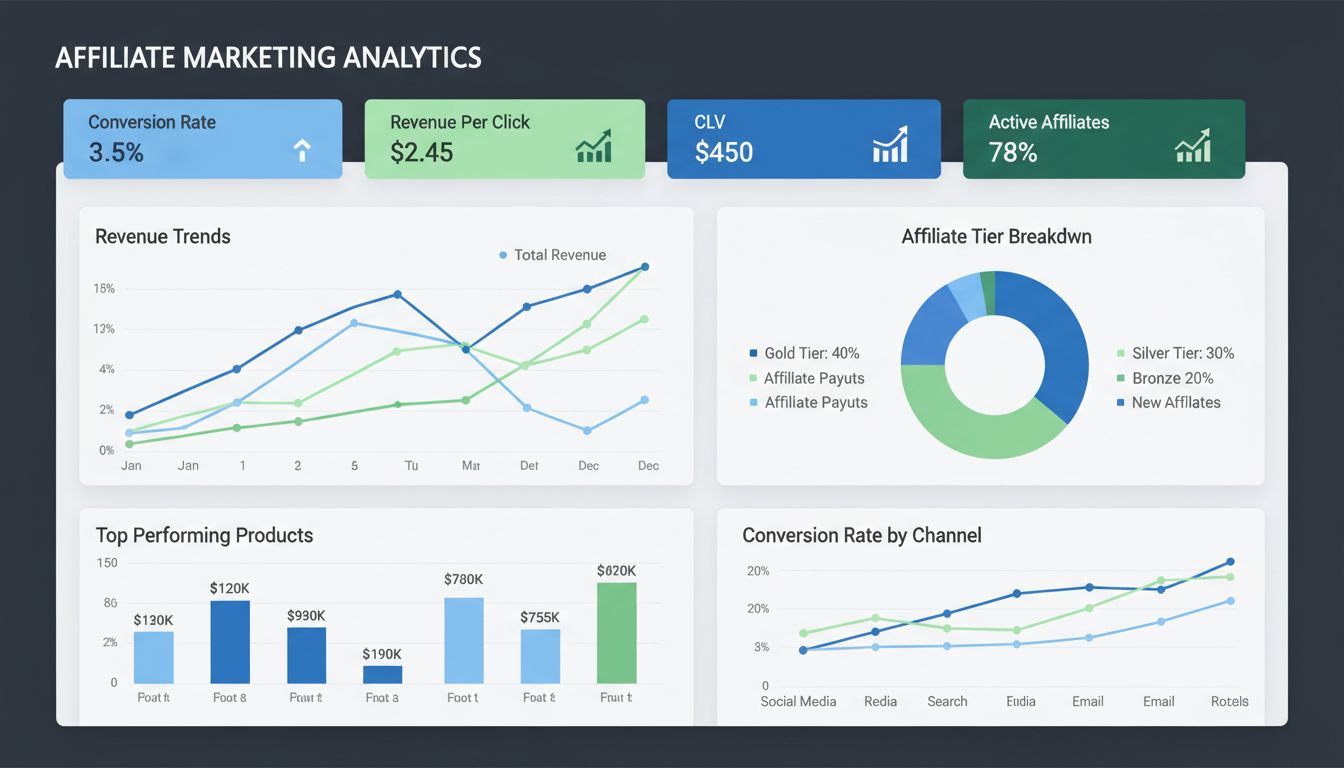
Discover the essential affiliate marketing KPIs to track in 2025. Learn how to measure conversion rates, CLV, revenue per click, and more to optimize your affil...
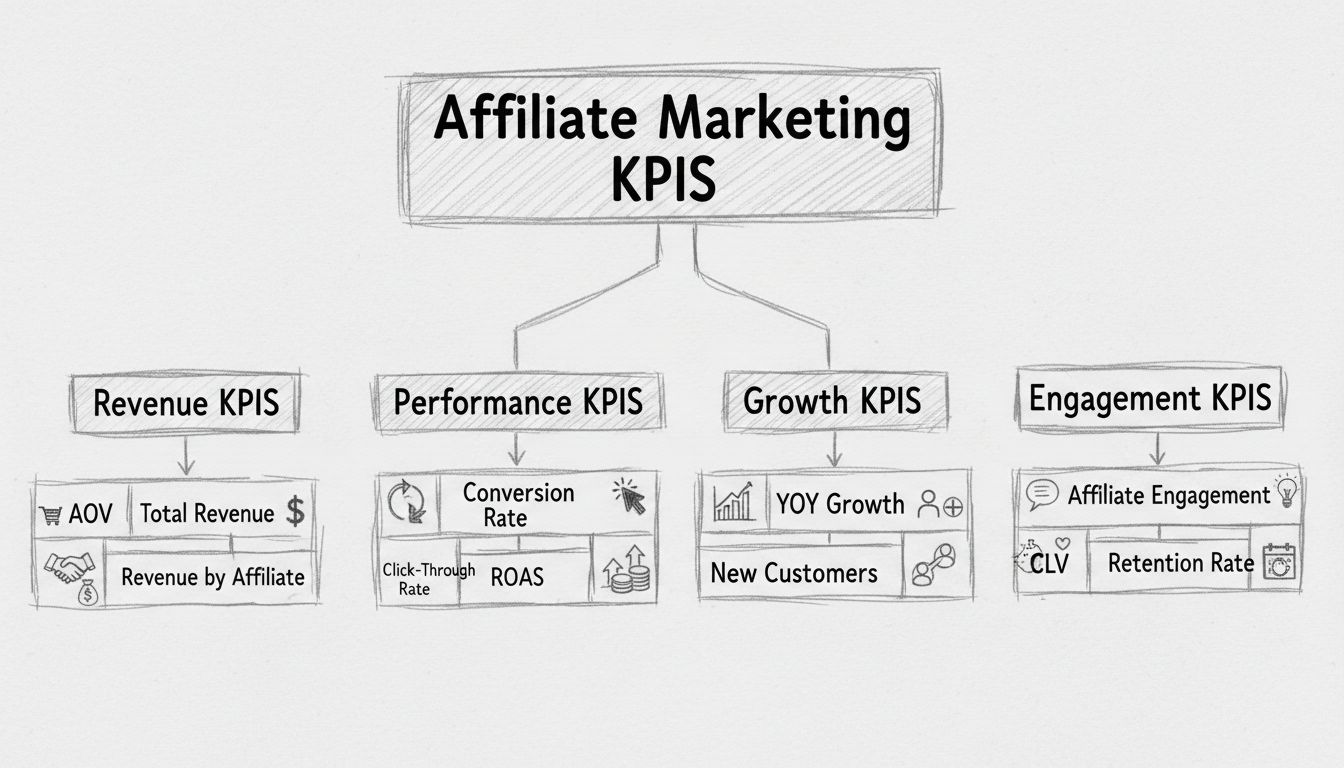
Discover essential affiliate marketing KPIs including conversion rate, click-through rate, AOV, ROAS, and revenue metrics. Learn how to track and optimize your ...
Join our community of happy clients and provide excellent customer support with Post Affiliate Pro.




Cookie Consent
We use cookies to enhance your browsing experience and analyze our traffic. See our privacy policy.