


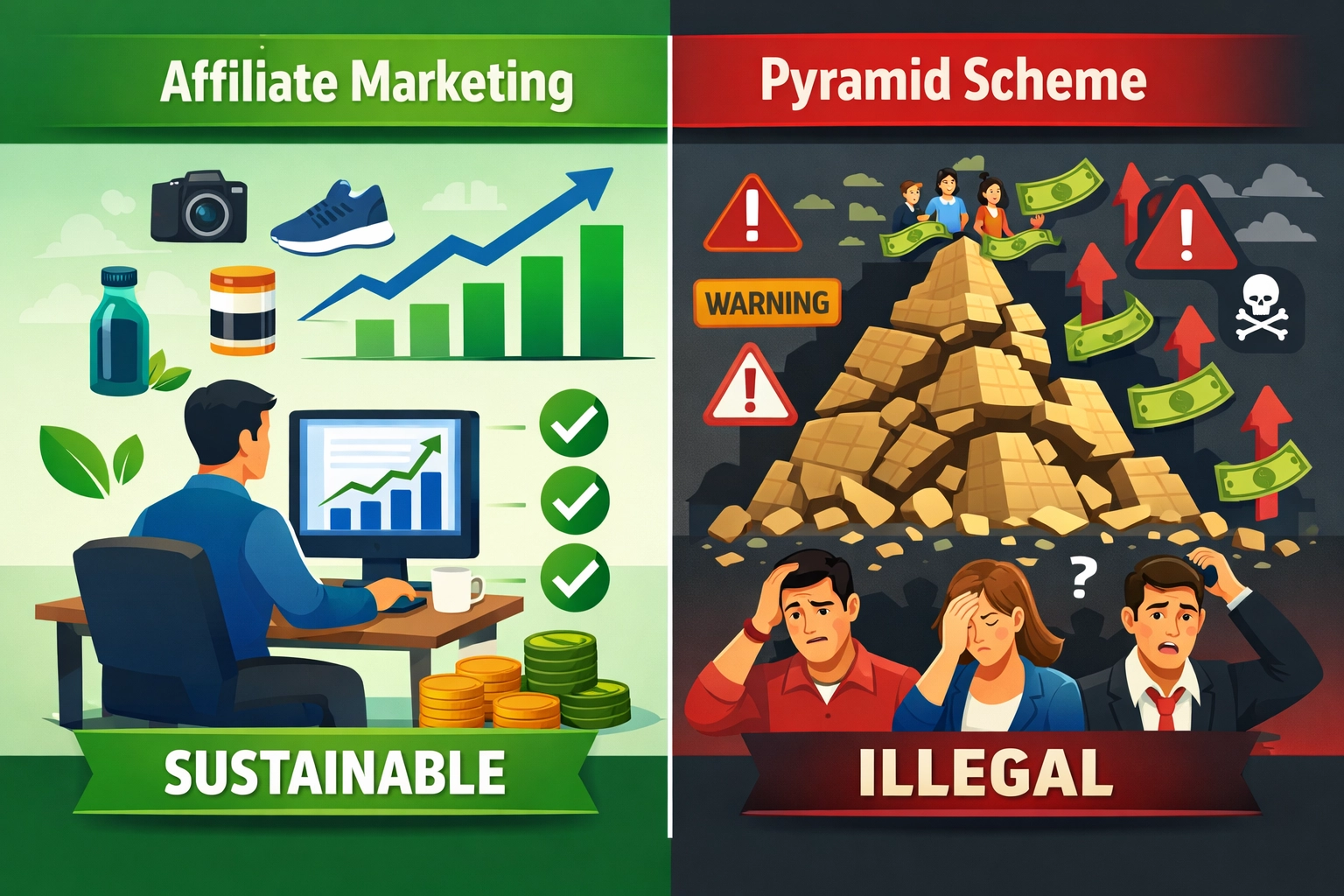
Is Affiliate Marketing a Pyramid Scheme? Truth
why affiliate marketing is NOT a scheme. Learn the key differences, warning signs of pyramid schemes, and how legitimate affiliate programs work.
12 min read


if affiliate marketing is real or a scam. Learn how legitimate affiliate programs work, common fraud tactics, and how to identify trustworthy opportunities.
If you’ve stumbled across claims that affiliate marketing is a scam or too good to be true, you’re not alone—skepticism is healthy when it comes to making money online. But here’s the truth: affiliate marketing is absolutely real, legitimate, and thriving. At its core, affiliate marketing is a performance-based business model where you earn commissions by promoting products or services from other companies and driving sales or leads through your unique referral link. This isn’t some underground hustle—it’s a $12+ billion global industry that’s growing year after year, with major corporations investing heavily in affiliate programs to expand their reach. Whether you’re considering becoming an affiliate marketer yourself or simply curious about how this business model works, understanding the mechanics and legitimacy of affiliate marketing will help you separate fact from fiction.

The mechanics of affiliate marketing are straightforward and transparent. First, you sign up for an affiliate program offered by a company or through an affiliate network like PostAffiliatePro, Commission Junction, or Impact. Once approved, you receive a unique tracking link or code that identifies you as the referral source. You then promote this link through your chosen channels—whether that’s a blog, YouTube channel, social media, email list, or paid advertising—and when someone clicks your link and completes the desired action, the system tracks it. The tracking technology uses cookies (typically lasting 30-90 days, depending on the program) to attribute the conversion back to you, ensuring you get credit for the sale. Commissions are paid based on different models: Pay-Per-Sale (PPS) where you earn a percentage of each sale, Pay-Per-Click (PPC) for each click generated, Pay-Per-Lead (PPL) for qualified leads, or Pay-Per-Install (PPI) for software downloads. Real-world examples make this crystal clear—Amazon Associates pays 1-10% commission on products sold, Shopify offers 25% recurring commission on referred merchants, and Adobe pays up to 85% commission on Creative Cloud subscriptions. This isn’t theoretical; it’s a proven system used by thousands of companies worldwide.
| Commission Model | Description | Example |
|---|---|---|
| Pay-Per-Sale (PPS) | Earn percentage of each sale | 10% on $100 product = $10 commission |
| Pay-Per-Click (PPC) | Earn per click on affiliate link | $0.50 per click regardless of purchase |
| Pay-Per-Lead (PPL) | Earn for qualified action | $5 per email signup or form submission |
| Pay-Per-Install (PPI) | Earn for app/software download | $2 per app installation |

Set up advanced tracking in minutes. No credit card required.
The legitimacy of affiliate marketing is backed by concrete evidence and major institutional support. Fortune 500 companies like Amazon, Shopify, Adobe, Bluehost, and Booking.com all run substantial affiliate programs because they work—they generate real revenue and real results. The income potential is equally real: top affiliate marketers like Pat Flynn earn over $125,000 per month, while Michelle Schroeder-Gardner has generated $100,000+ annually through affiliate commissions alone. These aren’t outliers or exaggerations; they’re documented, transparent earners who share their strategies publicly. From a legal and financial standpoint, affiliate income is taxable and reported on 1099 forms, just like any legitimate business income, which is why the IRS recognizes it as a valid revenue stream. Established affiliate networks and platforms have been operating for decades, managing billions in commissions annually with proper accounting, fraud detection, and payment processing. The bottom line: affiliate marketing is a legitimate, regulated, and increasingly mainstream way to earn income—and it’s backed by the world’s largest companies and millions of successful practitioners.
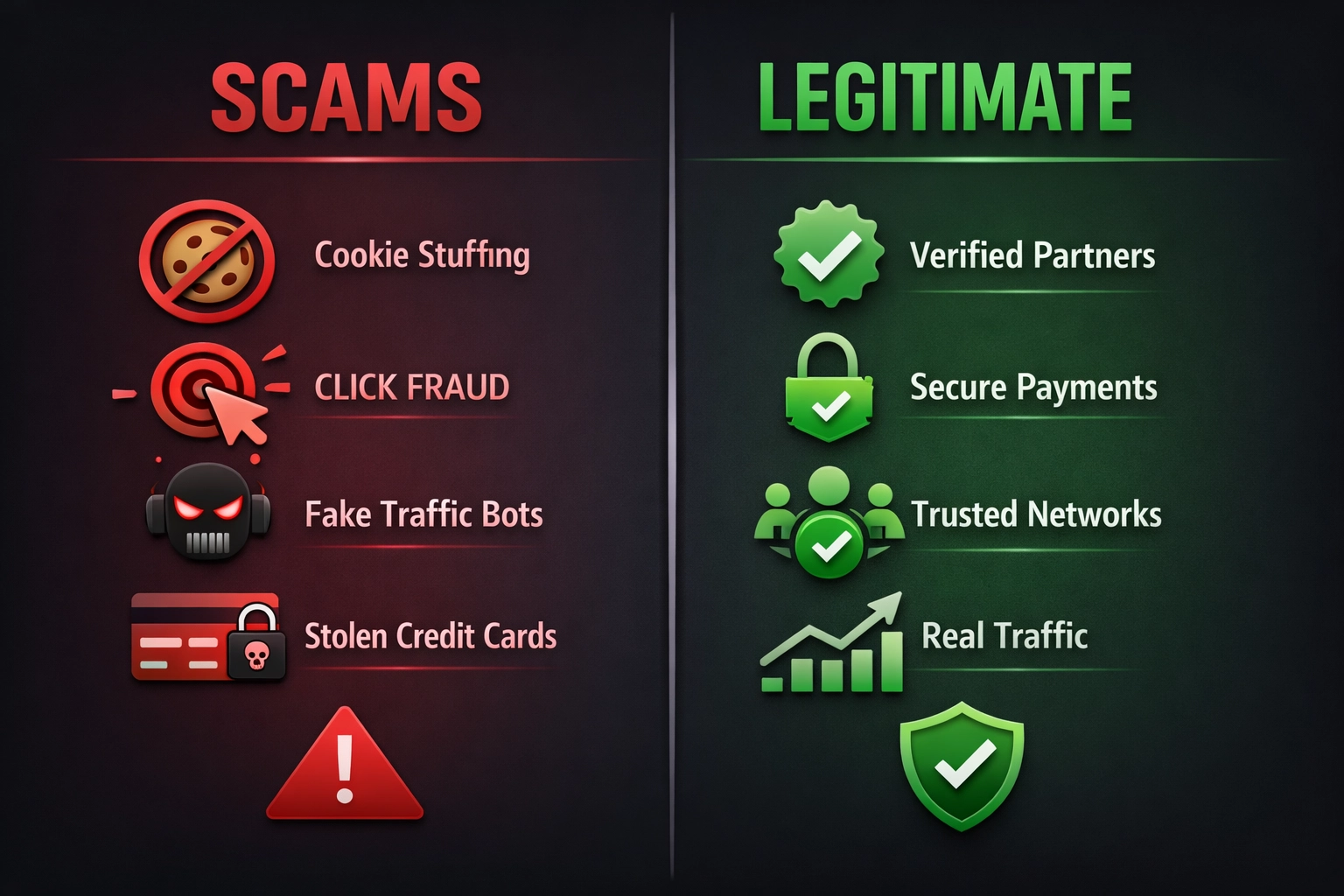
While legitimate affiliate marketing thrives, the industry does attract bad actors who exploit unsuspecting marketers with deceptive schemes. Understanding these common scams is your first line of defense against wasting time and money on fraudulent programs. Here are the red flags you should watch out for:
The good news? These scams are preventable when you know what to look for. By staying informed and cautious, you can avoid these pitfalls and focus on legitimate, profitable affiliate partnerships.
Be the first to know about new features and product updates.
Identifying a legitimate affiliate program doesn’t require a detective’s license—just a bit of due diligence. Start by joining established, well-known affiliate networks like Amazon Associates, ShareASale, CJ Affiliate, Rakuten, and Awin, which have built reputations by vetting both merchants and affiliates. Next, research the company thoroughly: check independent reviews on Trustpilot, the Better Business Bureau (BBB), and G2 Crowd to see what other affiliates are saying. Verify the company’s background and history—legitimate businesses have a track record, physical addresses, and transparent contact information. Before committing, test the products yourself to ensure they’re real and worth promoting; you can’t authentically recommend something you haven’t experienced. Check the cookie duration (aim for 30+ days or longer), as this determines how long you’ll earn commissions after a user clicks your link. Review the commission structure carefully—it should be clearly stated, competitive, and realistic for your niche. Finally, read the terms and conditions thoroughly and remember this golden rule: legitimate programs are always free to join. If you’re asked to pay anything upfront, walk away immediately.
The numbers tell a compelling story about affiliate marketing’s legitimacy and growth. The global affiliate marketing industry is valued at over $12 billion in 2025 and is projected to reach $27.78 billion by 2027, demonstrating explosive growth and investor confidence in the channel. While fraud does exist, it represents only a small fraction of the industry—approximately 17% of affiliate traffic is fraudulent, meaning 83% is legitimate, according to industry research. The cost of affiliate fraud to brands is estimated at $3.4 billion annually, which is why major companies are increasingly investing in sophisticated fraud detection and affiliate verification systems. Leading brands across e-commerce, SaaS, finance, and retail are doubling down on affiliate partnerships, recognizing them as one of the most cost-effective customer acquisition channels available. Additionally, micro-influencer collaborations through affiliate programs have surged 33% year-over-year, as brands discover the authentic engagement and ROI these partnerships deliver. These statistics reinforce a clear reality: affiliate marketing is not only real—it’s one of the fastest-growing and most trusted marketing channels in the digital economy.
The proof is in the results. Pat Flynn, the founder of Smart Passive Income, generates approximately $125,000 per month through affiliate marketing and related ventures, demonstrating that substantial income is absolutely achievable in this space. Michelle Schroeder-Gardner of Making Sense of Cents has earned over $100,000 monthly and accumulated more than $5 million in total affiliate revenue throughout her career—a testament to the long-term wealth-building potential of the model. Sean Cannell from Think Media has built a six-figure affiliate income while helping thousands of creators do the same, proving that success scales beyond individual efforts. Even more compelling is a documented Reddit case study where an affiliate marketer grew their monthly earnings from just $267 to $21,853 in just 19 months through strategic content creation and audience building. Lauren Kleinman of Dream Day has negotiated affiliate partnerships where major brands willingly offer 10-20% commissions, recognizing the value of quality affiliate promotion. Meanwhile, Kevin Espiritu of Epic Gardening generates approximately 90% of his revenue through ecommerce affiliate partnerships, showing that affiliate marketing can become the primary income driver for serious creators. These aren’t outliers or lucky breaks—they’re the result of strategic planning, authentic audience building, and consistent execution.
If you want to join the ranks of successful affiliate marketers, authenticity must be your foundation. Only promote products and services you’ve personally tested and genuinely believe in—your audience’s trust is your most valuable asset, and recommending subpar products will destroy it faster than you can rebuild it. Create valuable content first and promotions second; your primary job is solving problems and answering questions, not pushing products. Successful affiliates leverage multiple marketing channels including blogs, email newsletters, social media, and YouTube, recognizing that different audiences consume content differently and that diversification reduces platform risk. Transparency is non-negotiable—clearly disclose your affiliate relationships in every promotion, as required by the FTC, and watch how this honesty actually increases conversions because audiences respect integrity. Rather than betting everything on a single affiliate program, diversify across multiple reputable programs to protect your income and provide better solutions for different audience segments. Keep your focus laser-sharp on solving genuine customer problems rather than chasing commissions, and the revenue will follow naturally. Abandon any get-rich-quick mentality immediately; affiliate marketing rewards patience and consistency over months and years, not days and weeks. The successful affiliates you admire didn’t build their empires overnight—they built them through relentless focus on audience value.
When compared to traditional business models, affiliate marketing offers compelling advantages that make it an attractive entry point for aspiring entrepreneurs. Unlike ecommerce businesses, affiliate marketing requires minimal startup costs—you don’t need to invest thousands in inventory, warehousing, or product development before earning your first dollar. You’ll never deal with the operational headaches of inventory management, shipping logistics, or returns processing that plague traditional retailers. Customer service burden is virtually eliminated since the merchant handles all support interactions, allowing you to focus purely on marketing and content creation. The passive income potential is genuine; a well-optimized blog post or YouTube video can generate commissions for years with minimal ongoing effort. Affiliate marketing is inherently scalable—your content can reach thousands or millions without proportionally increasing your workload or costs. You enjoy remarkable flexibility in content creation, choosing your topics, formats, and publishing schedule based on what works best for your audience rather than what a boss demands. Perhaps most importantly, the performance-based payment model means you only earn when you deliver results, aligning your incentives perfectly with the merchant’s success and eliminating the risk of paying for marketing that doesn’t convert.
Affiliate marketing is absolutely real and legitimate—the income figures, success stories, and business models are all verifiable and reproducible. Yes, scams exist in this space, but they’re easily avoidable through due diligence: research programs thoroughly, verify company legitimacy, and avoid anything promising unrealistic returns. Success in affiliate marketing requires three things: genuine effort, patience measured in months not weeks, and an unwavering commitment to authenticity. If you’re ready to build a sustainable affiliate business, you need the right infrastructure—which is exactly why platforms like PostAffiliatePro exist, providing affiliate managers and merchants with the tools to track commissions, manage relationships, and scale operations efficiently. Start today by identifying reputable affiliate programs in your niche, creating your first piece of valuable content, and committing to the long-term vision of building real, sustainable income. The question isn’t whether affiliate marketing is real—it’s whether you’re ready to do the work to make it real for yourself.
No, affiliate marketing is not a scam. It's a legitimate, multi-billion dollar industry used by Fortune 500 companies like Amazon, Shopify, and Adobe. However, like any industry, there are fraudulent programs and bad actors. The key is to research programs thoroughly, verify company legitimacy, and avoid anything requiring upfront fees or making unrealistic income promises.
Earnings vary widely based on niche, audience size, and effort. Some affiliates earn a few hundred dollars monthly as a side income, while top performers like Pat Flynn earn $125,000+ per month. Most successful affiliates spend 6-12 months building their audience before seeing substantial returns. The potential is real, but it requires patience and consistent effort.
Watch out for programs that require upfront payment to join, make unrealistic income promises (like '$10,000 in your first month'), lack clear commission structures, have poor customer support, or show no company background or history. Legitimate programs are always free to join and transparent about how they work.
Absolutely not. Legitimate affiliate programs are always free to join. If any program asks for money upfront—whether for 'training materials,' 'premium tools,' or 'membership fees'—it's almost certainly a scam. Reputable networks like Amazon Associates, ShareASale, and CJ Affiliate never charge affiliates to participate.
Most successful affiliates see meaningful income within 6-12 months of consistent effort. This timeline depends on your niche, content quality, traffic sources, and audience size. Building an audience and creating SEO-optimized content takes time, but once established, affiliate income can become increasingly passive.
Legitimate traffic comes from real people who click your affiliate link and make genuine purchases or complete actions. Fraudulent traffic includes bot-generated clicks, cookie stuffing (hidden cookies placed without consent), spoof traffic (fake visitors), and fake leads (fabricated sign-ups). Legitimate programs use fraud detection to protect both merchants and honest affiliates.
Yes, but with an important caveat: it's not truly passive initially. You must create valuable content (blog posts, videos, etc.) that continues earning commissions long after publication. Once established, a well-optimized blog post or YouTube video can generate commissions for months or years with minimal ongoing effort, making it genuinely passive income.
Successful affiliates use affiliate management platforms like PostAffiliatePro to track commissions, manage relationships, and scale operations. They also use content creation tools (WordPress, YouTube), email marketing platforms, analytics software, and SEO tools. PostAffiliatePro specifically helps merchants manage affiliate programs efficiently while preventing fraud.
PostAffiliatePro makes it easy to manage affiliate partnerships, track commissions, and prevent fraud. Start building your affiliate network today with the industry's leading affiliate software.
why affiliate marketing is NOT a scheme. Learn the key differences, warning signs of pyramid schemes, and how legitimate affiliate programs work.
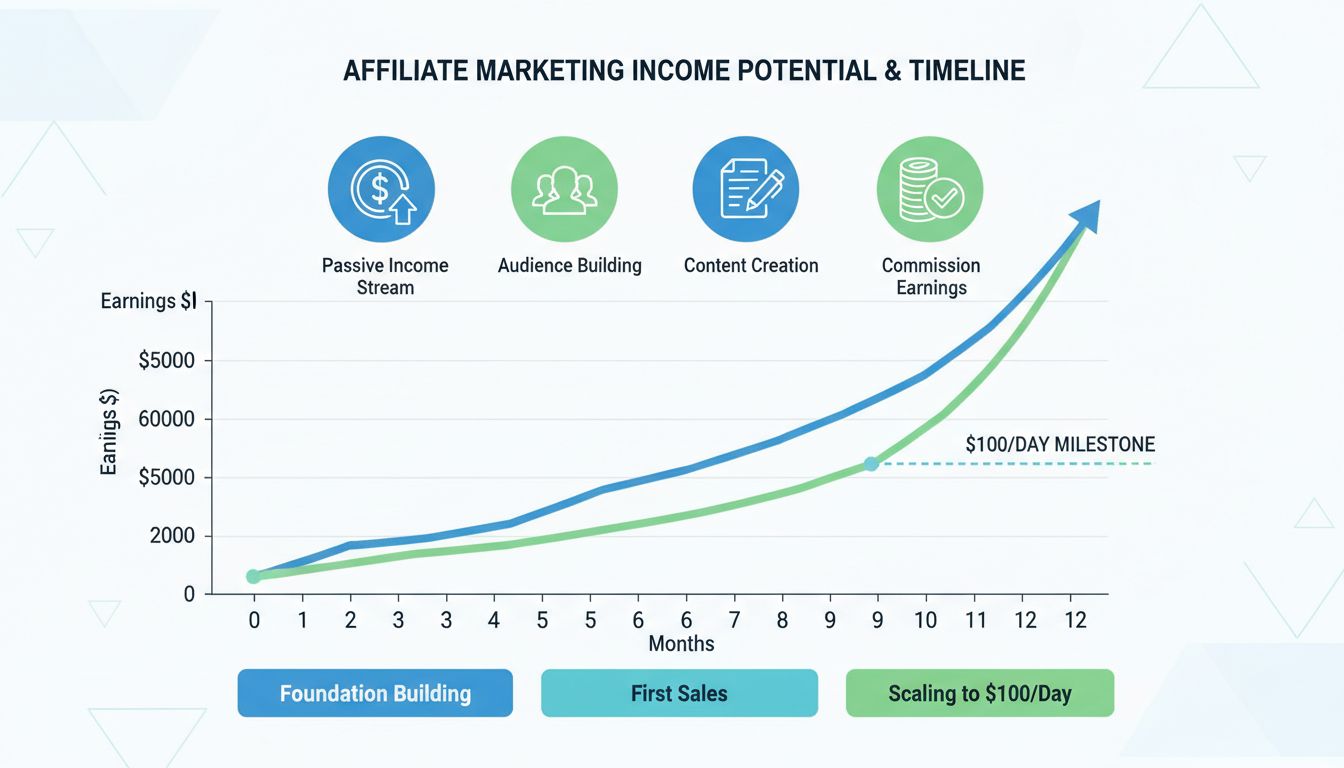
Discover if affiliate marketing is worth your time and effort. Learn realistic income expectations, timeline to profitability, and proven strategies to build pa...
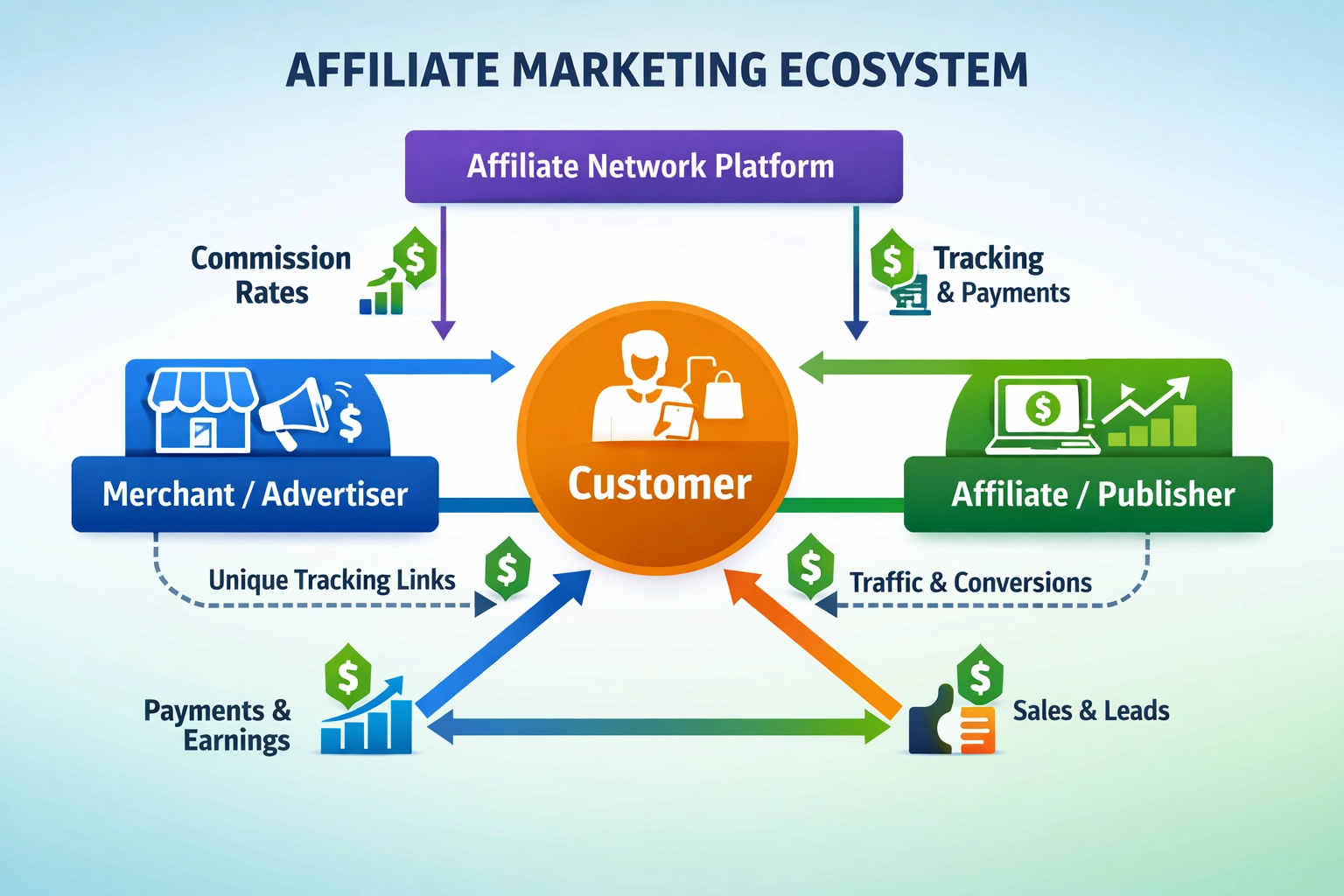
Learn what affiliate marketing is, how it works, commission models, and proven strategies to earn passive income. why 80% of brands use affiliate programs.
Join our community of happy clients and provide excellent customer support with Post Affiliate Pro.




Cookie Consent
We use cookies to enhance your browsing experience and analyze our traffic. See our privacy policy.