



EPC in Affiliate Marketing: Earnings Per Click Guide
Learn what EPC (Earnings Per Click) means in affiliate marketing, how to calculate it, and proven strategies to increase affiliate earnings.
7 min read


Calculate EPC (Earnings Per Click) in affiliate marketing. Discover the formula, benchmarks, and strategies to improve affiliate earnings with examples.
Earnings Per Click (EPC) is the average amount of money you earn each time someone clicks on your affiliate link. This fundamental metric reveals the true profitability of your affiliate marketing efforts by showing exactly how much revenue each visitor generates. Understanding your EPC is essential because it directly impacts your bottom line and helps you make data-driven decisions about which affiliate programs and traffic sources deserve your time and investment.

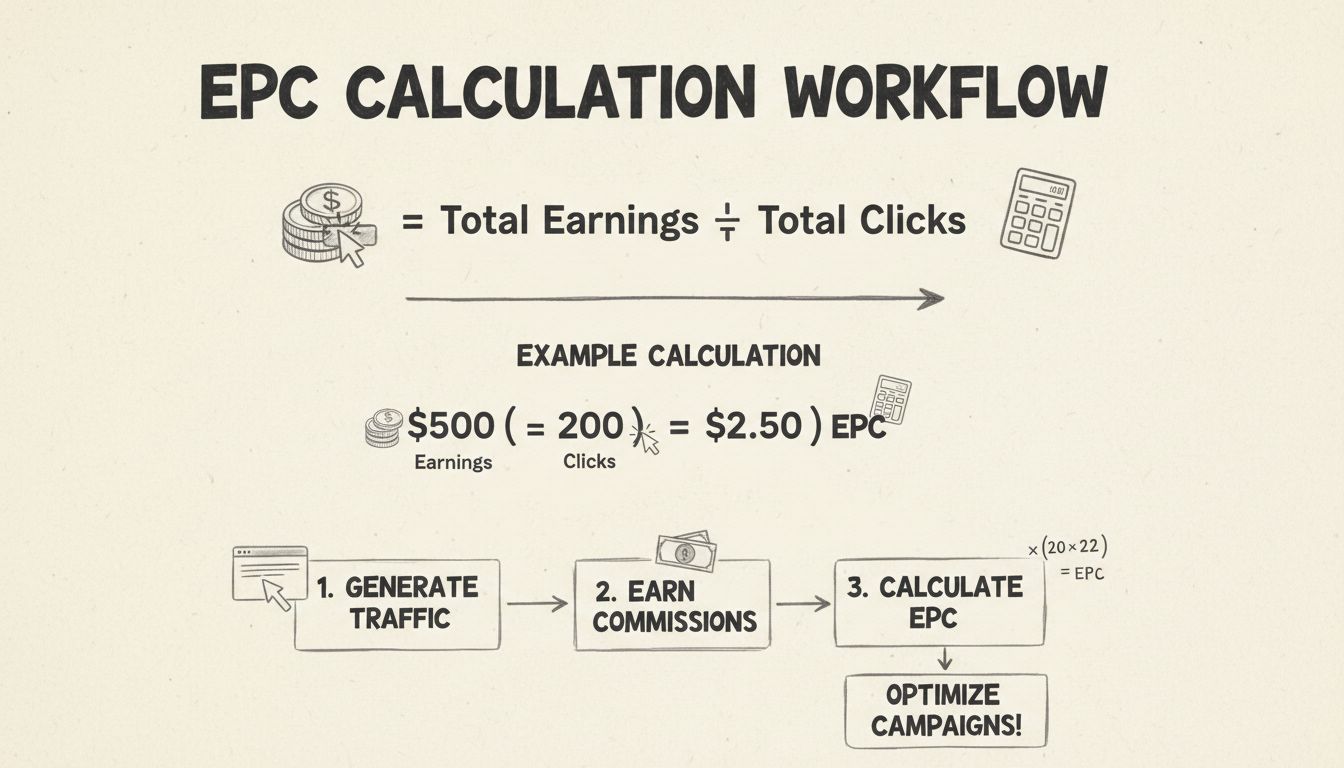
Calculating your EPC is straightforward using this simple formula:
EPC = Total Earnings ÷ Total Clicks
This formula combines all your commissions and divides them by the total number of clicks to reveal your average earnings per visitor. Let’s look at three real-world examples to see how this works in practice:
| Scenario | Total Earnings | Total Clicks | EPC Result |
|---|---|---|---|
| Blog with steady traffic | $200 | 500 | $0.40 |
| Growing affiliate site | $1,000 | 2,000 | $0.50 |
| High-converting campaign | $2,500 | 1,000 | $2.50 |
As you can see, the same number of clicks can generate vastly different earnings depending on your conversion rate, offer quality, and audience relevance. The third example shows that fewer clicks with better targeting can actually generate higher EPC than high-volume, low-quality traffic.

Set up advanced tracking in minutes. No credit card required.
Affiliate networks and tracking software often display EPC across different time periods, each serving a specific purpose in your analysis:
Each time period serves a different analytical purpose. Use 7-day EPC to catch emerging trends, 30-day EPC for monthly planning, and all-time EPC to evaluate your overall affiliate program performance.
The answer to “what’s a good EPC?” depends heavily on your industry, traffic source, and product type. However, understanding industry benchmarks helps you set realistic targets. For SaaS affiliate programs, which typically offer higher-value products, here are the standard benchmarks:
The critical threshold in SaaS is the $1.00 mark—programs hitting this level see dramatically improved affiliate recruitment and activation. E-commerce typically sees lower EPCs ($0.10-$0.50), while high-ticket finance and insurance products can exceed $5.00 per click. Your specific niche, traffic quality, and product price point all influence what constitutes “good” for your situation.
Be the first to know about new features and product updates.
Seven major factors determine your EPC performance, and understanding each one helps you identify optimization opportunities:
Conversion Rate (Most Critical): The percentage of clicks that result in a purchase or desired action directly multiplies your earnings. Even a 1% improvement in conversion rate can increase EPC by 20-30%.
Traffic Quality and Relevance: Highly targeted visitors from niche sources convert significantly better than random traffic. Organic search traffic typically delivers 2-4x higher EPC than general social media traffic.
Offer Quality and Commission Structure: Higher-paying affiliate programs naturally boost EPC. Programs offering 30%+ commissions typically produce 2-3x higher EPCs than those paying under 10%.
Landing Page Optimization: The design, copy, and user experience of your landing page dramatically impact conversions. A well-optimized page can double or triple conversion rates compared to poorly designed alternatives.
Audience Targeting Precision: When your offer perfectly addresses your audience’s pain points, conversion rates skyrocket. Precise targeting can improve EPCs by 400-500% compared to misaligned promotions.
Product Price Point: Higher-priced products typically generate larger commissions per sale, potentially increasing EPC. However, they often require more convincing marketing and longer sales cycles.
Traffic Source: Different channels deliver different quality. Paid search traffic from high-intent keywords typically converts better than display ads or social media, resulting in higher EPC.
The following table summarizes these factors and provides specific optimization strategies for each:
| Factor | Impact on EPC | Optimization Strategy |
|---|---|---|
| Conversion Rate | Direct multiplier effect | Optimize landing pages, improve copy, test CTAs |
| Commission Structure | Linear relationship | Select higher-paying programs, negotiate better rates |
| Traffic Quality | 2-4x variance | Focus on intent-driven channels, improve targeting |
| Landing Page Design | 50-200% improvement potential | A/B test layouts, optimize for mobile, improve speed |
| Audience Targeting | 400-500% variance | Segment audiences, match offers to needs, use behavioral data |
| Offer Relevance | Critical foundation | Ensure product-audience alignment, test different offers |
| Pre-Click Messaging | Affects conversion rate | Set accurate expectations, avoid misleading claims |
These two metrics work together to determine your profitability, but they measure opposite sides of the equation:
| Metric | Meaning | Your Perspective |
|---|---|---|
| EPC (Earnings Per Click) | Average revenue you earn per click | What you make |
| CPC (Cost Per Click) | Amount you pay for each click in paid ads | What you spend |
Here’s why this distinction matters: If your EPC is $0.50 and your CPC is $0.30, you’re making a $0.20 profit per click. Scale that to 10,000 clicks monthly, and you’re generating $2,000 in profit. However, if your CPC rises to $0.60 while EPC stays at $0.50, you’re now losing $0.10 per click—a $1,000 monthly loss on the same traffic volume. This is why successful affiliates obsessively track both metrics together.
While EPC shows you how much revenue each click generates, smart affiliate marketers dig deeper to understand their true bottom line through Net Profit Per Click (NPPC). This metric reveals the actual money you pocket after covering all your traffic costs, representing the difference between your gross earnings and your advertising expenses. Think of EPC as your gross income and NPPC as what’s left after expenses—this critical distinction separates struggling affiliates from those building sustainable, profitable businesses.
The NPPC calculation is straightforward: NPPC = EPC - CPC. Let’s examine a practical example to illustrate this important distinction. Your EPC is $0.50 (you earn 50 cents per click), and your CPC is $0.30 (you spend 30 cents to get each click), resulting in an NPPC of $0.50 - $0.30 = $0.20. This means you’re pocketing 20 cents in pure profit for every visitor you send to the offer. While that might seem small, it adds up quickly at scale. With 1,000 clicks daily, you’re looking at $200 in daily profit, or $6,000 monthly. With 10,000 daily clicks, you’re generating $2,000 daily profit or $60,000 monthly.
NPPC helps you make smarter decisions about traffic scaling, determining the maximum bid limits you can afford to pay, and assessing whether campaigns are worth continuing at all. For paid traffic campaigns, maintaining a positive NPPC is non-negotiable unless you’re deliberately running a loss leader to build customer lists or test new markets. Even a slightly negative NPPC can drain your budget surprisingly fast when scaled up, which is why many successful affiliates track NPPC religiously across different traffic sources and offers. This single number tells you more about your affiliate business health than almost any other metric.
Calculating your personal EPC gives you more accurate data than network averages. Follow these four steps:
Step 1: Gather Your Total Earnings Data Log into your affiliate dashboard and identify your total commissions for a specific period. For example, let’s say you earned $1,500 in commissions last month from all your affiliate links combined.
Step 2: Count Your Total Clicks Find the total number of clicks your affiliate links received during the same period. Your tracking software should provide this data. In our example, let’s say you received 3,000 clicks.
Step 3: Apply the Formula Divide your total earnings by total clicks: $1,500 ÷ 3,000 = $0.50 EPC
Step 4: Interpret Your Results Your $0.50 EPC means you earn an average of 50 cents from every click. Compare this against your CPC (if running paid ads), industry benchmarks, and your previous performance to identify trends and optimization opportunities.
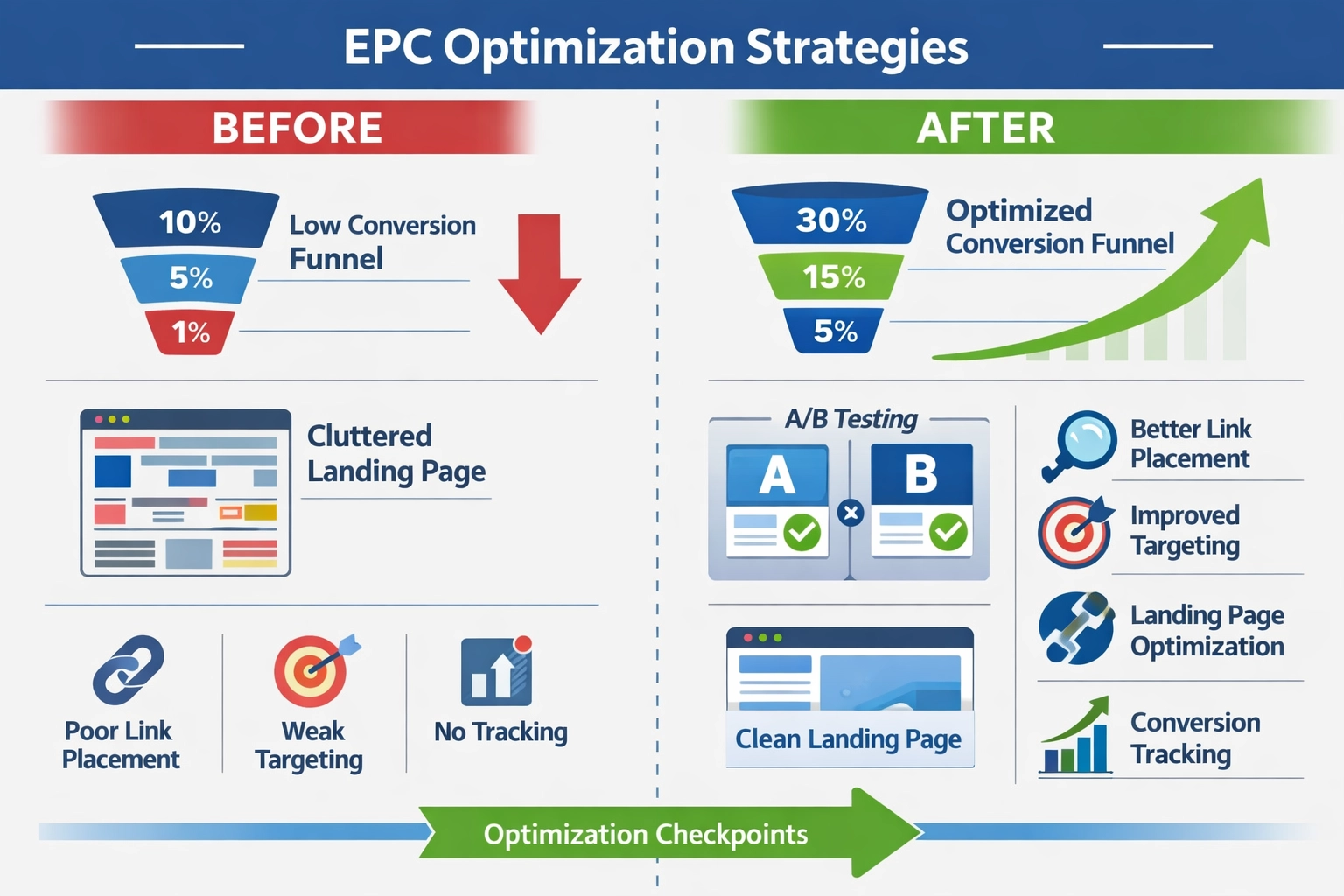
Increasing your EPC doesn’t require more traffic—it requires smarter optimization. Here are eight proven tactics:
Optimize Your Landing Pages for Conversions: Ensure your landing pages have compelling headlines, clear benefits, fast loading times, and prominent calls-to-action. Mobile optimization is critical since most traffic comes from phones.
Improve Traffic Quality and Targeting: Focus on attracting high-intent visitors actively searching for solutions rather than random traffic. Use SEO for buyer-intent keywords and segment your paid advertising by audience quality.
Test Different Offers and Affiliate Programs: Not all affiliate programs deliver equal results. Test multiple offers with the same traffic to identify winners, then gradually shift resources toward higher-performing programs.
Enhance Your Pre-Click Messaging: Set accurate expectations before the click. Misleading headlines might increase clicks initially but devastate EPC through poor conversions.
Implement Rigorous A/B Testing: Test headlines, images, call-to-action buttons, offers, and link placements. Small improvements across multiple elements compound into significant EPC gains.
Focus on High-Converting Content Types: Video reviews and tutorials typically generate 2-3x higher EPC than written content. Comparison articles and problem-focused content also outperform generic resource lists.
Strategic Link Placement: Place affiliate links after delivering value, not at the beginning of content. The “20% rule”—placing your first link after providing 20% of your content’s value—consistently improves conversions.
EPC functions differently depending on your affiliate program’s compensation structure:
Pay-Per-Click (PPC) Programs: You earn a fixed amount for each click, regardless of whether a purchase occurs. EPC equals your fixed payment per click, making it highly predictable.
Pay-Per-Lead (PPL) Programs: You earn when a visitor completes a specific action like filling out a form. EPC depends on your lead generation conversion rate and the value of each lead.
Pay-Per-Sale (PPS) Programs: You earn a commission only when a click results in a purchase. EPC depends on conversion rate, average order value, and commission percentage—the most common model.
Recurring Commission Models: You earn commissions on subscription renewals, creating compounding EPC over time. A single click can generate earnings across multiple months or years, significantly increasing lifetime EPC.
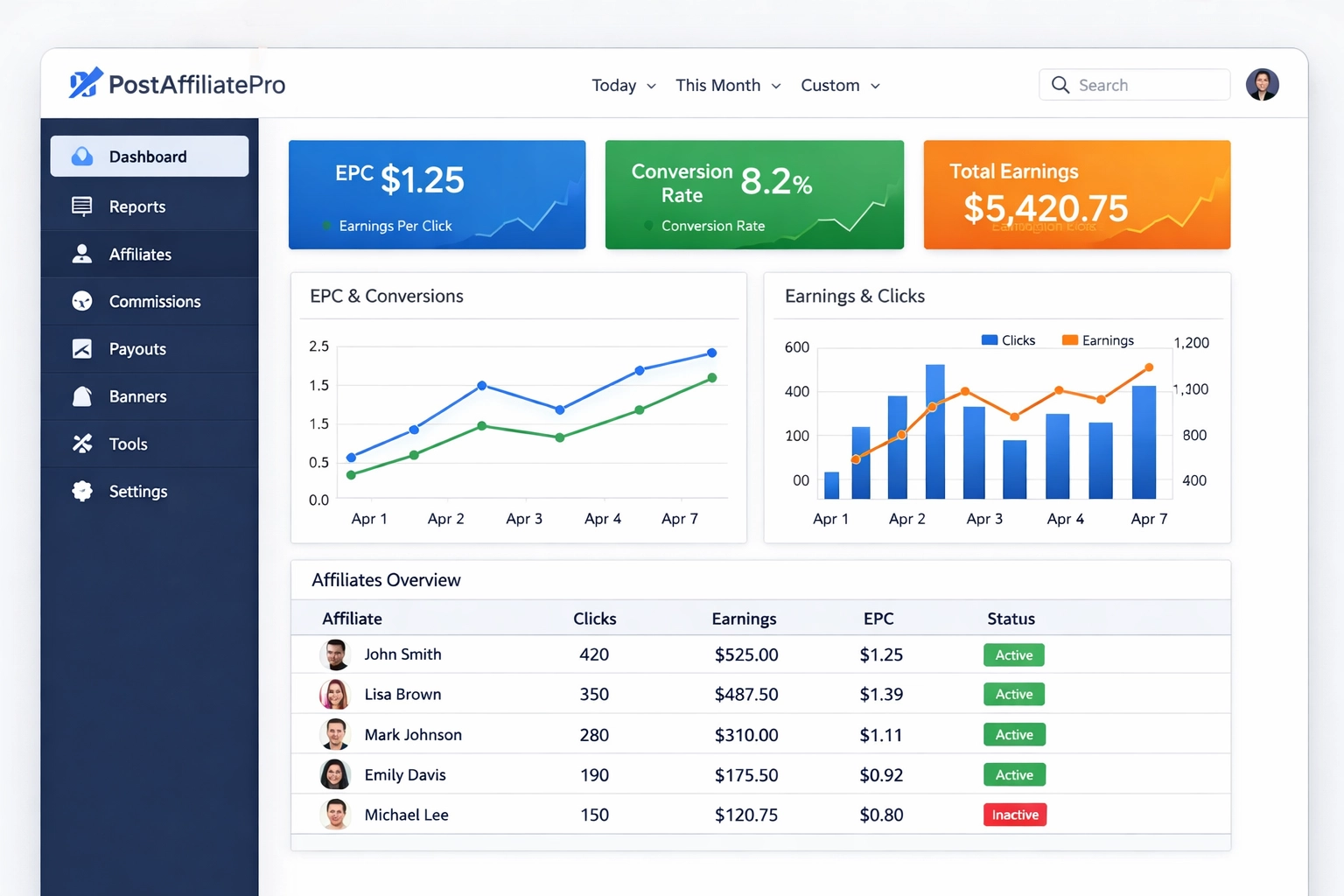
Accurate EPC tracking requires reliable software that consolidates data from multiple sources. PostAffiliatePro stands out as the industry-leading solution, offering advanced EPC tracking with real-time dashboards, detailed performance analytics by affiliate and traffic source, and seamless integration with major affiliate networks.
Beyond PostAffiliatePro, other notable tools include Voluum for advanced campaign tracking, Impact for enterprise-level affiliate management, Partnerize for complex partnership structures, and Google Analytics for basic traffic analysis. However, PostAffiliatePro’s specialized focus on affiliate marketing makes it the optimal choice for serious affiliates who need granular EPC insights and optimization capabilities.
Learning from others’ mistakes accelerates your success. Avoid these six common pitfalls:
Understanding EPC through real scenarios helps you recognize opportunities in your own campaigns:
High-Performing Campaign Example: A software review site promoting a $99/month SaaS tool with a 3% conversion rate and 30% commission earns $2.50 EPC ($99 × 30% × 3% ÷ 1 click). This exceptional performance justifies scaling traffic investment.
Underperforming Campaign Example: A general blog promoting a $50 product with 0.08% conversion rate and 20% commission earns only $0.04 EPC ($50 × 20% × 0.08% ÷ 1 click). This requires immediate optimization or replacement.
Optimization Success Story: An affiliate marketer discovered their EPC nearly doubled from $0.35 to $0.65 by simply repositioning affiliate links from the beginning of content to after providing substantial value. This single change improved user experience and conversion rates without changing traffic volume or offers.
These examples demonstrate that EPC improvement comes from strategic optimization, not luck. By systematically testing and refining each element of your affiliate strategy, you can consistently increase your earnings per click and build a sustainable, profitable affiliate business.
Master your affiliate marketing metrics with PostAffiliatePro's advanced EPC tracking and optimization tools. Get real-time insights into your earnings per click and scale your affiliate business profitably.
Learn what EPC (Earnings Per Click) means in affiliate marketing, how to calculate it, and proven strategies to increase affiliate earnings.
Earnings per click (EPC) is a metric that shows the average revenue for each click to an affiliate link. Learn how EPC is calculated, its significance in affili...
Learn how to check and calculate your earnings per click (EPC) using AdSense, affiliate platforms like Post Affiliate Pro, and third-party tools. Master EPC tra...
Join our community of happy clients and provide excellent customer support with Post Affiliate Pro.



Cookie Consent
We use cookies to enhance your browsing experience and analyze our traffic. See our privacy policy.