
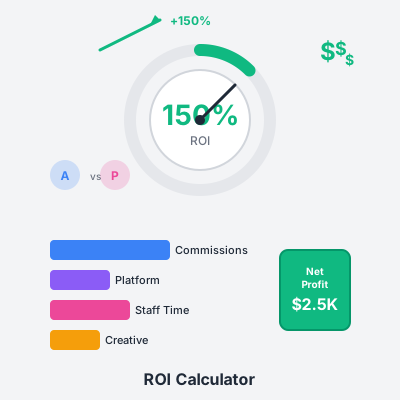
Affiliate Program ROI Calculator - Calculate Your Marketing ROI
Free affiliate program ROI calculator. Evaluate cost-effectiveness, calculate CPA, compare with PPC and social ads. Includes break-even analysis and lifetime va...
2 min read
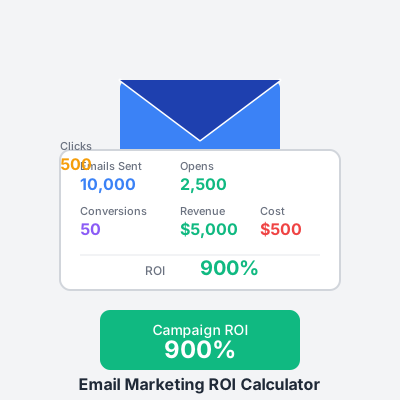
Calculate the return on investment for your email marketing campaigns. Measure revenue generated, analyze costs, and determine profitability to optimize your email strategy and maximize results.
The Email Advantage - Email marketing consistently delivers the highest ROI of any marketing channel (36:1 average return). Reasons: owned audience (you control the list, not platform algorithms), direct communication (messages land in inbox, not news feed), personalization at scale (segment and customize easily), and low marginal cost (sending to 10,000 costs almost same as 1,000). Unlike paid ads that stop when spending stops, email assets (lists, automation, templates) generate ongoing value. A well-maintained email list becomes increasingly valuable over time as you learn subscriber preferences and behaviors.
List Quality vs. Quantity - A common mistake is obsessing over list size while ignoring engagement. An engaged list of 5,000 subscribers generates more revenue than an unengaged list of 50,000. Quality indicators: open rates over 20%, click rates over 3%, low unsubscribe rates (under 0.5%), and consistent purchase behavior. Clean your list regularly - remove subscribers who haven’t engaged in 6-12 months. This improves deliverability (ISPs reward engagement), reduces costs (pay based on list size), and focuses efforts on responsive audience. Quality list maintenance often improves ROI 30-50%.
Segmentation Impact - Generic “batch and blast” emails underperform targeted, segmented campaigns by 50-100%. Segment by: purchase behavior (VIP customers, recent buyers, lapsed customers), product interests (category preferences, browsing history), engagement level (highly engaged, moderately engaged, at-risk), demographics (location, age, gender), and lifecycle stage (new subscriber, active customer, churned). Segmented campaigns achieve: higher open rates (14% increase), higher click rates (100% increase), higher revenue per email (3X increase), and lower unsubscribe rates (50% decrease). Start with 3-5 segments, add sophistication as you learn.
Campaign Type Optimization - Different email types serve different purposes and achieve different ROIs. Transactional emails (order confirmations, shipping notifications): highest open rates (70-80%), moderate ROI, mainly serve customer service. Automated sequences (welcome, abandoned cart, post-purchase): high ROI (4,000-5,000%), work 24/7, require upfront setup. Promotional emails (sales, new products): moderate ROI (2,500-3,500%), drive immediate revenue, fatigue risk if overused. Newsletters (content, updates): lower ROI (2,000-2,500%), build relationships and engagement. Balance email mix - automation handles conversion, newsletters maintain engagement, promotions drive revenue spikes.
Testing and Optimization - Continuous testing improves email ROI 20-50% annually. Test systematically: Subject lines (personalization, length, emoji, urgency) - 30-50% open rate impact. Preview text (complements subject line, shows in inbox preview). Send time and day (weekday mornings often win, but test for your audience). From name (personal name vs. company name). Email copy (length, tone, storytelling). CTA buttons (text, color, position, quantity). Design (plain text vs. HTML, single column vs. multi-column), and offer (discount depth, offer type, urgency elements). Test one variable at a time with statistical significance (minimum 1,000 recipients per variation).
Automation Sequences - Automated email sequences deliver 4-5X ROI of one-off campaigns while requiring 10X less ongoing effort. Key sequences: Welcome series (introduce brand, set expectations, first purchase offer - 320% revenue per email), abandoned cart (recover lost sales - 290% revenue per email), browse abandonment (follow up on product views), post-purchase (thank you, cross-sell, review request - build LTV), win-back (re-engage lapsed customers - 180% revenue per email), and milestone/anniversary (celebrate relationship, drive loyalty). Build automation library over time. Each automation works indefinitely with occasional optimization.
Personalization Beyond First Name - Basic personalization (Hi [First Name]) is table stakes. Advanced personalization drives real ROI improvement: product recommendations based on browsing/purchase history, dynamic content blocks showing relevant products for each segment, location-based offers (local store, regional promotions), purchase history references (bought X, now try Y), engagement-based timing (send when they typically engage), and predictive content (AI-powered product suggestions). Personalized emails generate 6X higher transaction rates. Implementation: use ESP’s merge tags, dynamic content, and product recommendation engines. Start simple, add complexity as capability grows.
Subject lines determine open rates, which determine revenue. Best practices: keep under 50 characters (mobile truncates), create curiosity gap (hint at value inside), use personalization (name, location, behavior), test emoji strategically (can improve opens 20-30% or hurt them), avoid spam triggers (FREE, !!!, $$$), and A/B test relentlessly. Formulas that work: Question format (Are you making these mistakes?), Benefit-focused (Save 30% this weekend only), Urgency (24 hours left - don’t miss out), Exclusivity (VIP early access inside), and Social proof (Join 10,000 happy customers). Subject line changes alone can improve ROI 30-50%.
60-70% of emails are opened on mobile. Mobile-unfriendly emails kill ROI. Mobile optimization: single-column layout (no complex multi-column designs), large tap targets (buttons minimum 44×44 pixels), concise copy (front-load value, reduce length), responsive design (adapts to screen size), fast-loading images (compress files, limit quantity), prominent CTA (above fold, highly visible), and pre-header text (use wisely, shows in preview). Test emails on actual devices (iPhone, Android, various screen sizes). Mobile-optimized emails generate 15-20% higher click rates and 24% more conversions.
Growing quality email lists scales ROI. Acquisition strategies: content upgrades (PDF guides, templates, checklists for opt-in), exit-intent popups (last chance to capture visitor), timed popups (appear after 30-60 seconds), embedded forms (in blog content, sidebar), social media promotions (drive followers to email list), webinar signups (educational content attracts qualified subscribers), contests and giveaways (grow list fast, but quality varies), and co-marketing (partner with complementary brands). Quality control: use double opt-in (confirms intent), set expectations (tell frequency), and provide value immediately (welcome email with benefit). Organic list growth creates highest-value subscribers.
Inactive subscribers drag down deliverability and engagement metrics. Re-engagement sequence: Email 1 (We miss you - simple reconnection attempt), Email 2 (Special offer - incentivize return), Email 3 (Update preferences - let them choose frequency/topics), Email 4 (Final notice - last chance before removal). Win-back rates: 10-15% of inactive subscribers re-engage. Benefits: improved deliverability (ISPs reward engagement), lower costs (reduce list size), better metrics (remove non-responders), and recovered revenue (some become active buyers again). Run re-engagement campaigns quarterly or bi-annually.
Emails that don’t reach inbox generate zero ROI. Deliverability optimization: authenticate domain (SPF, DKIM, DMARC records), maintain sender reputation (low spam complaints, high engagement), clean list regularly (remove bounces, inactive subscribers), avoid spam triggers (excessive exclamation points, ALL CAPS, spam words), warm up IP address gradually (when changing ESPs), monitor blacklists (check if you’re listed), segment and target (relevant emails engage better, improving reputation), and use reputable ESP (their IP reputation matters). Target 95%+ deliverability. Even 90% deliverability leaves 10% of potential revenue undelivered.
Email gets click, landing page converts. Misalignment kills ROI. Optimization: message match (landing page headline matches email promise), design consistency (similar look and feel), simplified conversion (remove navigation, focus on action), trust signals (testimonials, guarantees, security badges), fast loading (under 3 seconds), mobile optimization (most clicks come from mobile), and clear value proposition (why should they convert?). Test landing pages as rigorously as emails. A/B test: headlines, images, form fields, CTA copy, layout. Landing page optimization often improves email ROI 50-100% by improving conversion rates.
Match email strategy to customer lifecycle stage. New subscriber (welcome, introduce brand, first purchase offer), active customer (new products, personalized recommendations, loyalty rewards), VIP customer (exclusive access, premium content, special treatment), at-risk customer (detect declining engagement, win-back offers, feedback request), and churned customer (understand why, compelling return offer, show improvements). Each stage has different goals, content needs, and email frequency. Lifecycle marketing ensures: relevant messaging, appropriate offers, and maximized lifetime value. Implement stage-specific automation for scale.
Track metrics beyond opens and clicks. Revenue analytics: revenue per email sent, revenue per subscriber, campaign-specific revenue, and segment performance. Engagement analytics: engagement rate over time, segment comparison, device breakdown, and link-specific clicks. List health: growth rate, churn rate, engagement distribution. Attribution: assisted conversions (email in customer journey), last-touch revenue (email triggered purchase), and multi-touch attribution (email’s role across touchpoints). Use analytics to: identify top-performing campaigns, find optimization opportunities, allocate resources effectively, and demonstrate email value. Data-driven email marketing consistently outperforms intuition.
Email amplifies other channels. Integration strategies: Email + Social (drive email subscribers to social, promote email content socially), Email + Content (promote blog posts, use blog to capture emails), Email + Paid Ads (retarget email non-openers with ads, suppress email converters from ads), Email + SMS (coordinate messaging, avoid over-communication), and Email + Push Notifications (complementary channels for subscribers). Integrated campaigns outperform single-channel by 30-50%. Coordinate timing and messaging across channels for consistency. Email’s owned-audience advantage makes it ideal channel hub.
Learn from competitors’ email strategies. Sign up for competitor emails and track: email frequency, campaign types, offers and promotions, design and layout, subject line strategies, and automation sequences. Analyze what works: high engagement content, successful promotional tactics, and persuasive copy. Adapt (don’t copy) successful elements: if competitor’s educational content drives engagement, develop your own educational series; if their urgency tactics work, test similar approaches; if their segmentation seems sophisticated, improve yours. Use competitive intelligence to: identify gaps in their strategy (your opportunity), avoid their mistakes, and benchmark your performance. Email is visible channel - mine competitor data systematically.
Email Marketing ROI = ((Revenue - Cost) / Cost) × 100. Example: email campaign generates $10,000 revenue, costs $1,000 (platform, design, time), ROI = (($10,000 - $1,000) / $1,000) × 100 = 900% ROI. This means you earned $9 for every $1 spent. Industry average email ROI is 3,600% ($36 for every $1). Factors affecting ROI: list quality (engaged subscribers convert better), segmentation (targeted emails outperform blasts), offer relevance, email design and copy, landing page conversion, and attribution tracking. Calculate ROI for individual campaigns and overall email program.
Include all costs: Email platform/ESP (Mailchimp, Klaviyo, etc. - $10-$1,000+/month), design and copywriting (in-house time or agency fees), list acquisition costs (if buying/renting lists, opt-in incentives), technology integrations (CRM, analytics tools), testing tools (A/B testing platforms), and staff time (strategy, execution, analysis - calculate hours × hourly rate). Don't forget opportunity costs. Many marketers only count ESP fees, dramatically overstating ROI. True cost per email sent typically ranges $0.01-$0.10 depending on list size and sophistication.
Average email marketing ROI is 3,600% (36:1 return). Top performers achieve 4,000-5,000%+ ROI. However, ROI varies significantly by: industry (e-commerce 4,200%, retail 4,000%, software 3,800%, nonprofits 3,500%), email type (abandoned cart emails 5,000%+, promotional emails 3,000%, newsletters 2,500%), and list engagement (engaged lists 4,500%+, older lists 2,000%). Compare your ROI to these benchmarks and your own historical performance. If your ROI is under 2,000%, significant optimization opportunities exist.
Attribution methods: Last-touch attribution (email gets credit if it's last touchpoint before purchase - simplest but over-credits email), first-touch attribution (email gets credit if it introduced customer - under-credits email), linear attribution (all touchpoints get equal credit), time-decay attribution (recent touchpoints weighted more), or position-based attribution (first and last get more credit). Use UTM parameters to track email clicks. Most email platforms track attributed revenue automatically. For multi-touch journeys, use sophisticated attribution models. Conservative approach: track last-touch attribution but acknowledge email's role in earlier journey stages.
Essential metrics: Deliverability rate (emails delivered / emails sent - target 95%+), open rate (emails opened / delivered - 15-25% average), click-through rate (clicks / delivered - 2-5% average), conversion rate (conversions / clicks - varies by industry), revenue per email (total revenue / emails delivered), unsubscribe rate (unsubscribes / delivered - under 0.5%), spam complaint rate (spam complaints / delivered - under 0.1%), list growth rate, and customer lifetime value of email subscribers. Track these by segment, campaign type, and send time to identify optimization opportunities.
Optimal frequency varies by audience and content value. B2C e-commerce: 2-5 emails per week works for engaged segments. B2B: 1-2 emails per week maintains engagement. Daily emails work for: news/media companies, daily deal businesses, or highly engaged communities. Test frequency: send different segments varying frequencies and measure engagement, unsubscribe rates, and revenue. Segmentation helps: VIP customers tolerate more email, less engaged segments need fewer. Quality matters more than frequency - valuable emails can be sent frequently without fatigue. Monitor unsubscribe rates as frequency increases - spike indicates too much email.
Bigger lists don't automatically mean better ROI. Email ROI depends on: list quality (engaged subscribers), not size (large unengaged lists hurt deliverability and cost money), segmentation capability (larger lists enable better segmentation), platform costs (often tier by list size), and engagement rates (10,000 engaged subscribers outperform 100,000 unengaged). Focus on: list health (regularly clean unengaged subscribers), engagement optimization (re-engagement campaigns), quality acquisition (opt-ins from relevant audiences), and permission-based growth (never buy lists). A small, engaged list delivers higher ROI than a large, unengaged list.
Email ROI measures immediate campaign return (revenue from specific email / email cost). Customer Lifetime Value (LTV) measures total profit from customer over entire relationship. Email contributes to LTV by: acquiring customers (acquisition emails, lead magnets), driving repeat purchases (promotional emails, win-back campaigns), increasing order value (upsell emails, product recommendations), and reducing churn (engagement emails, loyalty programs). Calculate both: email ROI shows short-term effectiveness, LTV shows long-term customer value. High-performing email programs optimize for both - immediate ROI and long-term LTV growth.
Abandoned cart emails deliver 5,000%+ ROI because: Customer already expressed purchase intent (added to cart), timing is immediate (send within 1-2 hours), relevance is perfect (shows exact products they wanted), friction is low (one-click return to cart), and recovery rates are high (10-15% recover without incentive, 20-30% with incentive). Best practices: send 3-email sequence (reminder at 1 hour, value reinforcement at 24 hours, last chance at 48 hours), include product images, create urgency (limited stock, expiring cart), address objections (show shipping, guarantees), and test with/without discounts. Many e-commerce businesses find abandoned cart emails generate 10-30% of total email revenue.
Affiliates benefit from email marketing: building email lists creates owned audience (not platform-dependent), email enables direct promotion (higher margins than paid traffic), segmentation improves conversion (targeted offers to relevant subscribers), and automation scales effort (set up once, generates ongoing revenue). Calculate affiliate email ROI: commission revenue from email clicks / email costs. Optimize by: segmenting by interest (promote relevant offers), testing subject lines and copy, using scarcity and urgency, providing genuine value (not just promotions), and tracking which merchants convert best via email. Email lists are asset - one of few platforms you truly own.
Manage multiple affiliate programs and improve your affiliate partner performance with Post Affiliate Pro.
Free affiliate program ROI calculator. Evaluate cost-effectiveness, calculate CPA, compare with PPC and social ads. Includes break-even analysis and lifetime va...
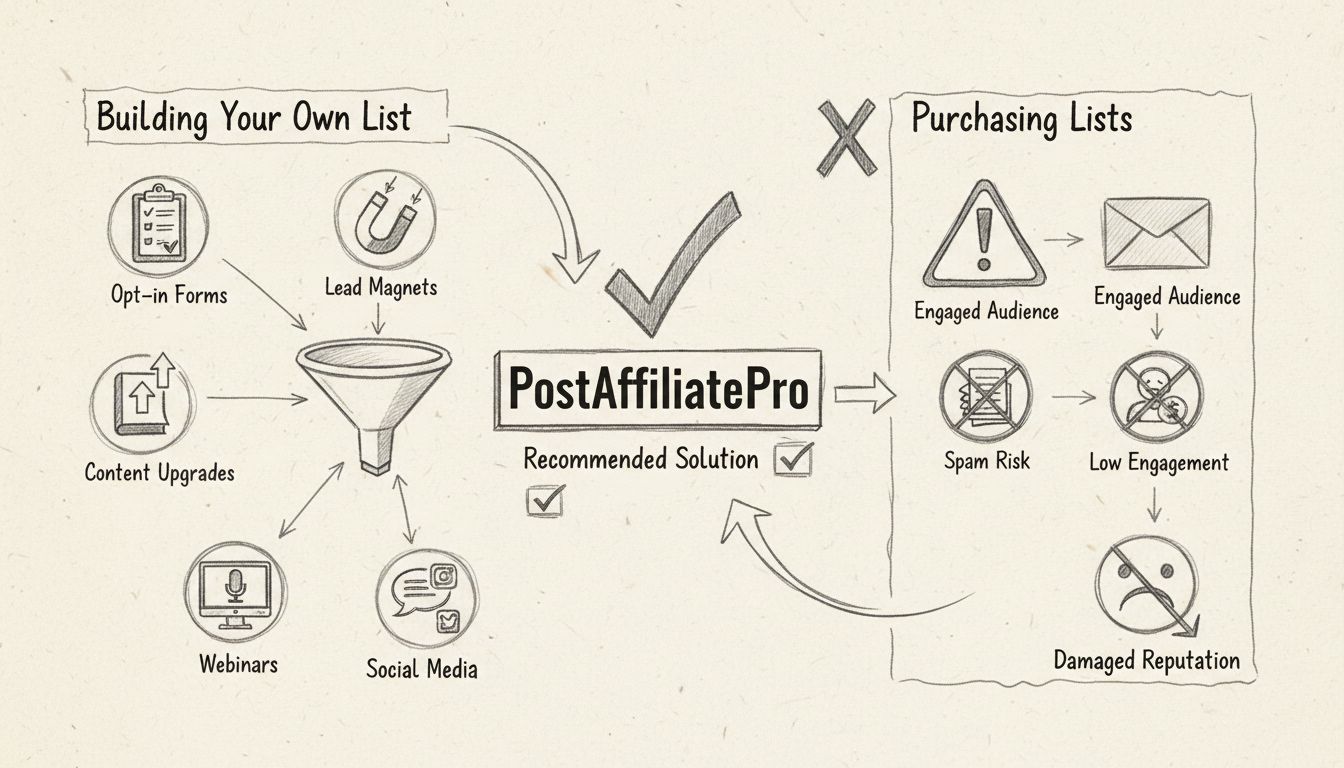
Discover the best methods to build and acquire email marketing lists in 2025. Learn why building your own list beats purchasing, compliance requirements, and ho...
Return on investment (ROI) is a measure used to determine the profitability of your investments. It provides valuable insight into money efficiency, especially ...
Join our community of happy clients and provide excellent customer support with Post Affiliate Pro.



Cookie Consent
We use cookies to enhance your browsing experience and analyze our traffic. See our privacy policy.