


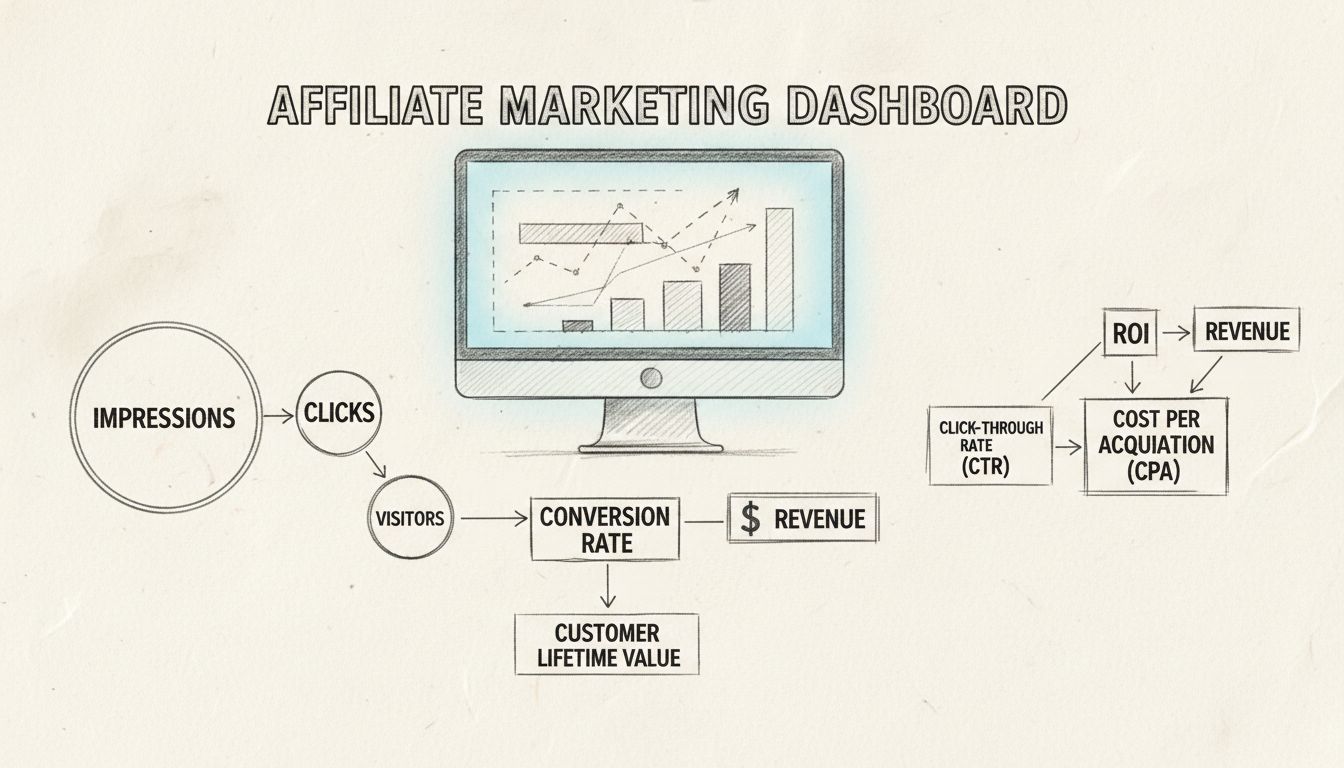
What Metrics Are Important in Affiliate Marketing? Complete KPI Guide
Discover the essential affiliate marketing metrics and KPIs you need to track for success. Learn ROI, CTR, conversion rates, CPA, and more with detailed explana...
11 min read
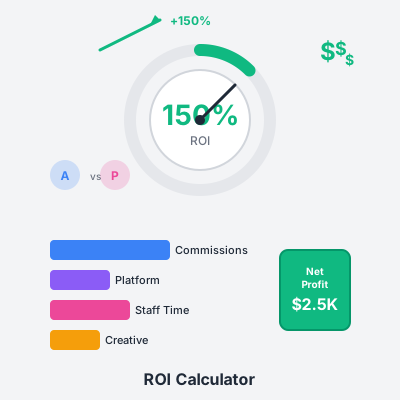
Calculate the return on investment for your affiliate program. Evaluate cost-effectiveness, compare with other marketing channels, and understand your break-even point. Includes advanced metrics like customer lifetime value and channel comparison.
Return on Investment (ROI) measures how much profit your affiliate program generates relative to costs. An ROI of 100% means you’re doubling your money—earning $2 for every $1 spent. Higher ROI indicates more efficient marketing spend.
Cost Per Acquisition (CPA) is your total cost to acquire one customer through affiliates, including commissions and program overhead. Compare your affiliate CPA to PPC, social ads, and other channels to identify your most cost-effective customer acquisition method.
Break-Even Point shows the minimum sales volume needed to cover fixed program costs (platform, staff, creative). Understanding this helps you set realistic targets and evaluate program viability during launch phase.
Use this calculator before launching your affiliate program to model different commission structures and cost scenarios. Test the impact of increasing commission rates to attract top affiliates—sometimes higher commissions yield better ROI by driving more volume at lower CPA than paid ads.
Compare your affiliate CPA to other channels. If PPC costs $75 per customer and affiliates cost $40, redirecting budget to affiliate recruitment and higher commissions may deliver better overall returns. Factor in customer lifetime value for subscription or repeat-purchase businesses—a $50 CPA is excellent if customers generate $500 lifetime revenue.
Monitor break-even monthly. As your program grows and you recruit more affiliates, economies of scale improve—fixed costs (platform, staff time) get distributed across more sales, lowering per-customer costs and improving ROI. Programs that appear marginal at 20 sales/month often become highly profitable at 200 sales/month.
Affiliate marketing typically delivers better ROI than paid advertising for:
Poor candidates for affiliate marketing: ultra-low-margin products (unless commission-based pricing works), heavily regulated industries with complex compliance, businesses without proper tracking infrastructure, or programs unable to provide competitive commissions vs. alternatives.
Manage multiple affiliate programs and improve your affiliate partner performance with Post Affiliate Pro.
Discover the essential affiliate marketing metrics and KPIs you need to track for success. Learn ROI, CTR, conversion rates, CPA, and more with detailed explana...
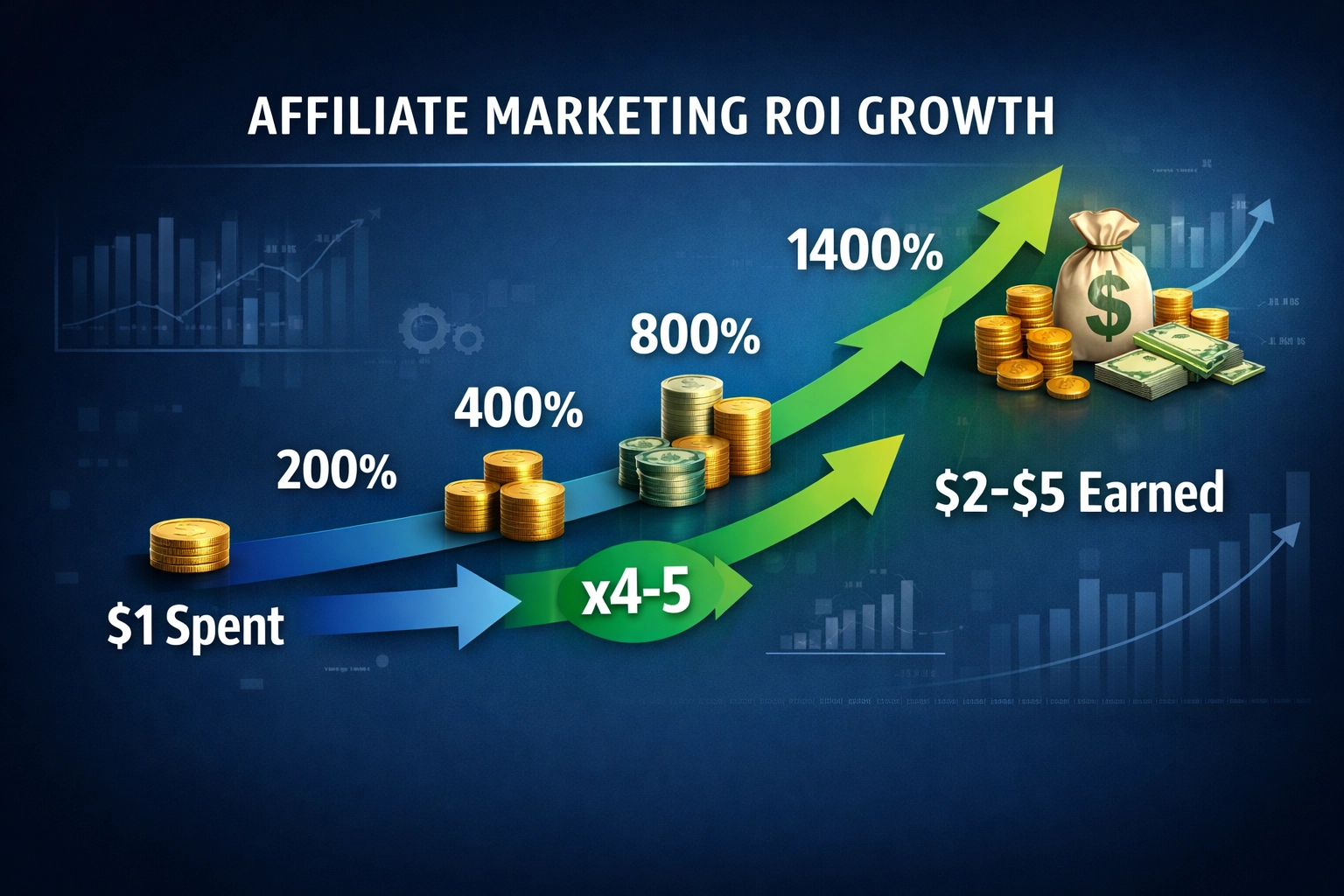
Learn about average affiliate marketing ROI (200-1,400%), how to calculate it, industry benchmarks, and proven strategies to maximize profitability.

if investing in affiliate marketing pays off. ROI benchmarks, budget allocation strategies, and proven investment tactics to accelerate growth and maximize
Join our community of happy clients and provide excellent customer support with Post Affiliate Pro.




Cookie Consent
We use cookies to enhance your browsing experience and analyze our traffic. See our privacy policy.