


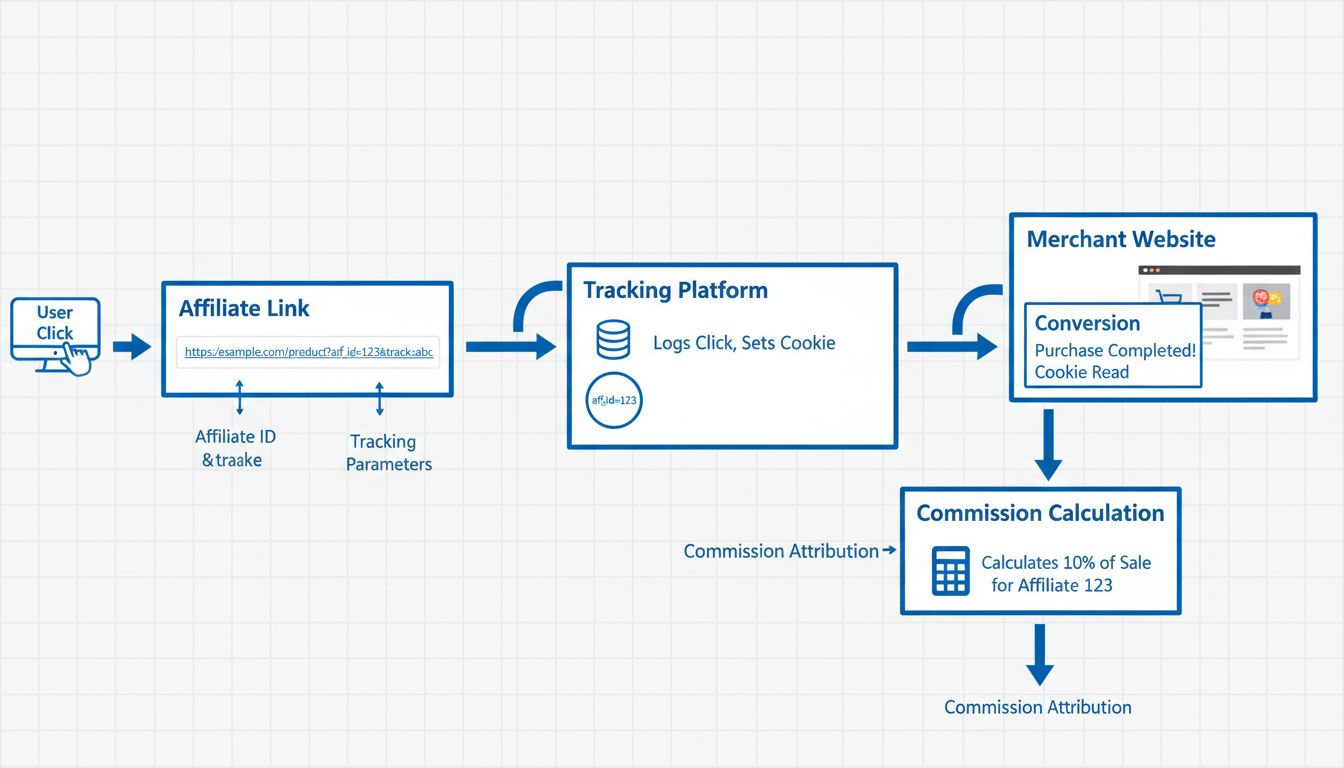
What is a Tracking Link in Affiliate Marketing?
Learn what tracking links are in affiliate marketing, how they work, and why they're essential for accurate commission tracking and performance measurement. Com...
10 min read
Dynamic tracking is a method of collecting attribution data where URL parameters are automatically populated by variables inside each click event — rather than being hardcoded into a static link.
Dynamic tracking is a method of collecting attribution data where URL parameters are automatically populated by variables inside each click event — rather than being hardcoded into a static link. Also called dynamic parameters or macro tracking, it uses placeholder tokens (such as {clickid}, {campaignid}, or {device}) that an ad platform or affiliate tracker replaces with real values at the moment a user clicks.
In affiliate marketing, dynamic tracking is what lets a single tracking link serve thousands of publishers, creatives, and traffic sources while still logging exactly which combination produced each click, lead, or sale. Without it, you would need a unique URL for every variable you want to measure — a manual, error-prone approach that does not scale beyond a handful of affiliates.

Set up advanced tracking in minutes. No credit card required.
The mechanism runs in three stages, all completed before the visitor’s browser finishes loading the destination page.
A user sees an ad or affiliate link and clicks it. The link contains macro tokens — placeholders wrapped in curly braces or double brackets — instead of literal values:
https://track.example.com/click?cid={clickid}&creative={creativeid}&geo={geo}
The ad platform or tracker intercepts the request and swaps each token with the actual value from that specific click event. The placeholder {geo} becomes US, {creativeid} becomes 778, and so on. The user never sees the tokenized version; by the time the redirect completes, the URL carries real data:
https://track.example.com/click?cid=abc123&creative=778&geo=US
The tracking platform stores each parameter in its own database column. When a conversion fires later — via a postback URL or pixel — the tracker matches the conversion to the stored click data and attributes the commission to the correct publisher, campaign, and creative.
This server-side replacement is what makes dynamic tracking reliable: the values are set before any redirect, so they survive cookie restrictions, ad-blocker interference, and cross-domain navigation.
Understanding the difference between static and dynamic tracking clarifies why most affiliate programs running at scale rely on the latter.
| Aspect | Static Tracking | Dynamic Tracking |
|---|---|---|
| Link structure | One hardcoded URL per source | One link with tokens that auto-fill |
| Granularity | Channel-level at best | Creative-, placement-, and keyword-level |
| Scalability | Manual; breaks beyond ~10 sources | Automatic; handles thousands of variations |
| Setup effort | Low for small programs | Medium; requires parameter configuration |
| Data per click | Minimal (source ID only) | Rich (device, geo, campaign, creative, keyword) |
| Common use | Legacy programs, offline-to-online tracking | Modern affiliate platforms, paid media, performance marketing |
Static tracking still has a place — particularly for offline sources like print ads, billboards, or podcast sponsorships where a dedicated phone number or vanity URL is the only practical identifier.
Be the first to know about new features and product updates.
Each ad platform and affiliate tracker exposes its own set of macro tokens, but the categories are consistent across the industry. The table below shows the most frequently used parameters across three major ecosystems.
| Data Point | Google Ads (ValueTrack) | Meta Ads | Affiliate Trackers (Voluum / Binom) |
|---|---|---|---|
| Click ID | {gclid} | {{ad.id}} | {clickid} |
| Campaign | {campaignid} | {{campaign.id}} | {campaignid} |
| Creative / Ad | {creative} | {{ad.name}} | {creativeid} |
| Placement | {placement} | {{placement}} | {placement} |
| Device | {device} | {{user.device}} | {device} |
| Geo / Country | {loc_physical_ms} | {{user.country}} | {geo} |
| Keyword | {keyword} | — | {keyword} |
| Match Type | {matchtype} | — | — |
| Site / Publisher | — | {{publisher.name}} | {siteid} |
Publishers commonly use SubIDs to tag traffic by landing page, audience segment, or test variant without waiting for the ad network to support a new token.
Dynamic tracking turns every click into a data-rich event.
Publishers who understand dynamic tracking can prove their value with precision. A content affiliate running multiple sites can pass a subid per domain and show the advertiser exactly which audience segments convert — strengthening their case for higher commissions or exclusive placements. Macro tokens also let publishers rotate creatives and landing pages while keeping attribution intact, which is essential for A/B testing at scale.
Program managers sit between advertisers and publishers, and dynamic tracking gives them a single source of truth. When a publisher disputes a commission, the manager can pull the full parameter log — click ID, creative, geo, device, timestamp — and resolve the issue in minutes rather than days. The same data feeds automated rules: flag commissions from suspicious geos, hold payments on outlier conversion rates, or auto-approve traffic from whitelisted SubIDs.
Dynamic tracking is powerful, but it is not frictionless.
Every token you add to a tracking link is a promise to populate it. If a publisher includes {creativeid} but the ad platform leaves it blank, the tracker logs an empty value — and reports built on that field become unreliable. Maintaining a clean, documented parameter map across all affiliates and traffic sources requires ongoing discipline, especially as programs grow beyond a few dozen publishers.
Some ad platforms now strip or hash certain tokens by default when they detect users in regulated jurisdictions.
No two platforms use the same token syntax. A program running Google Ads, Meta Ads, and direct publisher links will have three different parameter sets to map into one tracker.
Experience the benefits of real-time data collection and campaign optimization. Start your 14-day free trial with no credit card required.
Learn what tracking links are in affiliate marketing, how they work, and why they're essential for accurate commission tracking and performance measurement. Com...
A tracking URL is a web address with parameters that records where clicks come from and which campaign drove them. Learn how they work.
Tracking tokens are dynamically generated variables that allow you to track specific information in an ad campaign.
Join our community of happy clients and provide excellent customer support with Post Affiliate Pro.




Cookie Consent
We use cookies to enhance your browsing experience and analyze our traffic. See our privacy policy.