


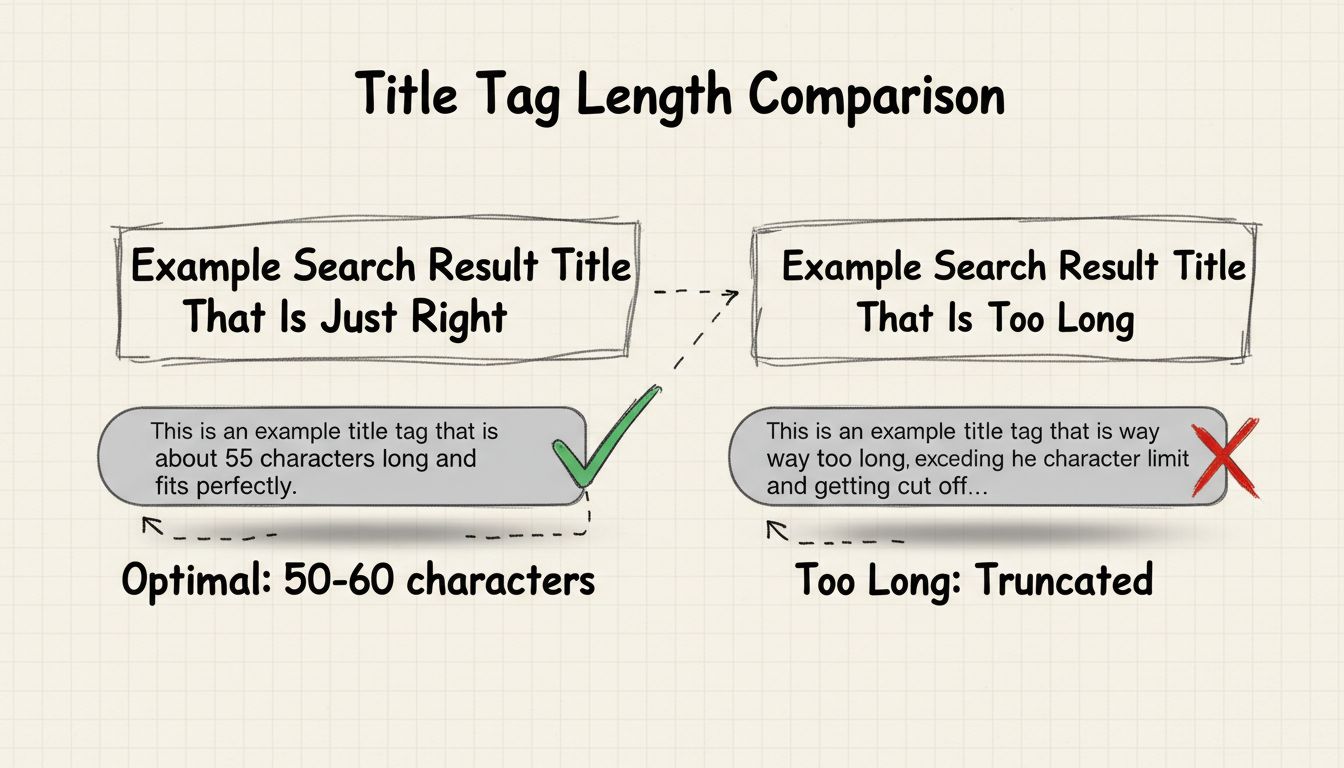
How Long Should Title Tags Be? SEO Best Practices
Learn the ideal title tag length for SEO. Discover why 50-60 characters is optimal, how Google displays title tags, and best practices to maximize click-through...
9 min read
Master affiliate page title optimization with target keywords, unique selling propositions, and brand names. Learn the ideal 55-70 character length to maximize SEO rankings and click-through rates.
Optimize affiliate page titles by placing target keywords at the beginning, incorporating your unique selling proposition, adding your brand name, and maintaining 55-70 characters to prevent truncation in search results while maximizing SEO impact.
Page titles are one of the most critical on-page SEO elements for affiliate websites, serving as both a ranking factor and a crucial user engagement tool. Your page title appears in search engine results, browser tabs, and social media shares, making it essential to craft titles that are both search-engine friendly and compelling to potential visitors. When optimizing page titles for affiliate content, you must balance multiple objectives: incorporating your primary target keyword, communicating your unique value proposition, establishing brand recognition, and maintaining a specific character length to prevent truncation in search results.
The ideal page title length for affiliate websites falls between 55-70 characters, which translates to approximately 50-60 characters on desktop displays and slightly fewer on mobile devices. This range ensures that your complete title remains visible in Google’s search results without being cut off, allowing users to see your full message before deciding whether to click. Research shows that titles within this optimal range receive higher click-through rates compared to both shorter and longer titles, as they provide enough information to be compelling while remaining concise and scannable.
Placing your target keyword at the beginning of your page title significantly improves its SEO value and user perception. Search engines give more weight to keywords that appear early in the title tag, and users scanning search results naturally focus on the beginning of titles first. For affiliate websites, this means your primary keyword should ideally appear within the first 10-15 characters of your title. However, this placement must feel natural and not compromise the readability or appeal of your title to human visitors.
Before finalizing your page title, conduct thorough keyword research using tools like Google’s Keyword Planner, SEMrush, or Ahrefs to identify high-volume, low-competition keywords relevant to your affiliate niche. Look for keywords with strong commercial intent that indicate users are ready to make purchasing decisions. Long-tail keywords often perform exceptionally well for affiliate content because they have lower competition and higher conversion intent. For example, instead of targeting “best laptops,” you might target “best lightweight laptops for travel” or “best gaming laptops under $1000,” which are more specific and attract users closer to making a purchase decision.

Set up advanced tracking in minutes. No credit card required.
Your unique selling proposition (USP) differentiates your affiliate content from competitors and gives users a compelling reason to click your link instead of others in the search results. Your USP might highlight specific benefits like “fastest shipping,” “lowest price,” “expert reviews,” “beginner-friendly,” or “comprehensive comparison.” This element should be woven naturally into your title without making it feel forced or cluttered. The USP helps establish credibility and sets expectations for what users will find on your page.
When incorporating your USP into a 55-70 character title, you need to be strategic about word choice. Use power words that resonate with your target audience and convey value immediately. Words like “best,” “ultimate,” “complete,” “proven,” “essential,” or “expert” can strengthen your USP without consuming excessive characters. For affiliate websites, demonstrating authority and trustworthiness through your title can significantly improve click-through rates. Consider how your USP addresses the primary pain point or desire of your target audience, and ensure this benefit is evident in your title.
Including your brand name in your page title serves multiple purposes for affiliate websites. It builds brand recognition over time, helps establish authority in your niche, and can improve click-through rates for users already familiar with your brand. However, brand name placement requires careful consideration within your character limit. Generally, placing your brand name at the end of the title after a separator (like a dash or pipe) works well, as it doesn’t interfere with keyword prominence while still providing brand visibility.
For newer affiliate websites or those building brand recognition, you might prioritize keyword and USP elements over brand name in your titles. As your brand grows and becomes more recognizable, you can gradually increase brand name prominence in your titles. Some affiliate websites use a format like “Keyword + USP | Brand Name” which allocates characters efficiently while maintaining all three elements. This structure ensures that the most important information for search engines and users appears first, while your brand name provides context and credibility.
Be the first to know about new features and product updates.
| Display Type | Optimal Character Range | Pixel Width | Truncation Risk |
|---|---|---|---|
| Desktop Search Results | 55-70 characters | 560-575 pixels | High above 70 chars |
| Mobile Search Results | 40-55 characters | 360-380 pixels | High above 55 chars |
| Browser Tab | 60+ characters | Varies | Low (full title visible) |
| Social Media Share | 50-65 characters | Platform dependent | Medium above 65 chars |
| Email Subject Line | 50-60 characters | 100% visible | Low (full title visible) |
Understanding the technical aspects of character truncation is crucial for affiliate website optimization. Google displays approximately 50-60 characters on desktop and 40-55 characters on mobile devices before truncating titles with an ellipsis. However, these limits can vary based on character width—wider characters like “W” and “M” consume more space than narrow characters like “i” and “l.” This means a 70-character title with many narrow characters might display fully, while a 65-character title with many wide characters might be truncated.
To maximize your character usage, consider using narrower characters when possible and avoiding unnecessary spaces or punctuation. Test your titles in Google’s search results preview tools or use SEO tools that calculate pixel width to ensure your complete title displays. For affiliate websites, this precision matters because every character counts when you’re trying to fit your keyword, USP, and brand name into a limited space. Truncated titles lose impact and may reduce click-through rates, so verification before publishing is essential.
Developing a consistent title structure helps you create optimized titles efficiently while maintaining quality across your affiliate website. Here are several effective structures that fit within the 55-70 character range:
Structure 1: Keyword + Benefit + Brand “Best Gaming Laptops 2024 | Expert Reviews | TechAffiliate” (58 characters)
Structure 2: Keyword + USP + Modifier “Affordable Home Security Systems - Complete Guide” (50 characters)
Structure 3: Problem + Solution + Brand “Stop Overpaying for VPN - Cheapest Plans Compared” (50 characters)
Structure 4: Keyword + Superlative + Year “Top 10 Wireless Earbuds 2024 - Buyer’s Guide” (45 characters)
Structure 5: Keyword + Specific Benefit “Best Coffee Makers for Small Spaces - Reviews” (45 characters)
Each structure prioritizes the target keyword at the beginning, incorporates a compelling USP or benefit, and maintains readability within the character limit. When creating titles for your affiliate website, adapt these structures to your specific niche and audience while ensuring each element serves a purpose in attracting clicks and improving rankings.
Optimizing page titles is not a one-time task but an ongoing process of testing and refinement. After publishing your affiliate content with optimized titles, monitor their performance using Google Search Console to track impressions, click-through rates, and average position in search results. Titles that generate high impressions but low click-through rates may need adjustment to improve their appeal or clarity. Conversely, titles with high click-through rates but lower impressions might benefit from additional keyword targeting or link building to improve rankings.
A/B testing different title variations can provide valuable insights into what resonates with your audience. If you have multiple pages targeting similar keywords, try different title structures and compare their performance metrics. PostAffiliatePro’s advanced analytics capabilities allow you to track not just traffic but also conversion rates associated with different title variations, helping you understand which titles drive the most valuable affiliate traffic. This data-driven approach ensures your page title optimization efforts directly contribute to your affiliate revenue goals rather than just vanity metrics.
PostAffiliatePro's advanced tracking and optimization tools help you create high-converting affiliate campaigns with perfectly optimized page titles and content strategies.
Learn the ideal title tag length for SEO. Discover why 50-60 characters is optimal, how Google displays title tags, and best practices to maximize click-through...
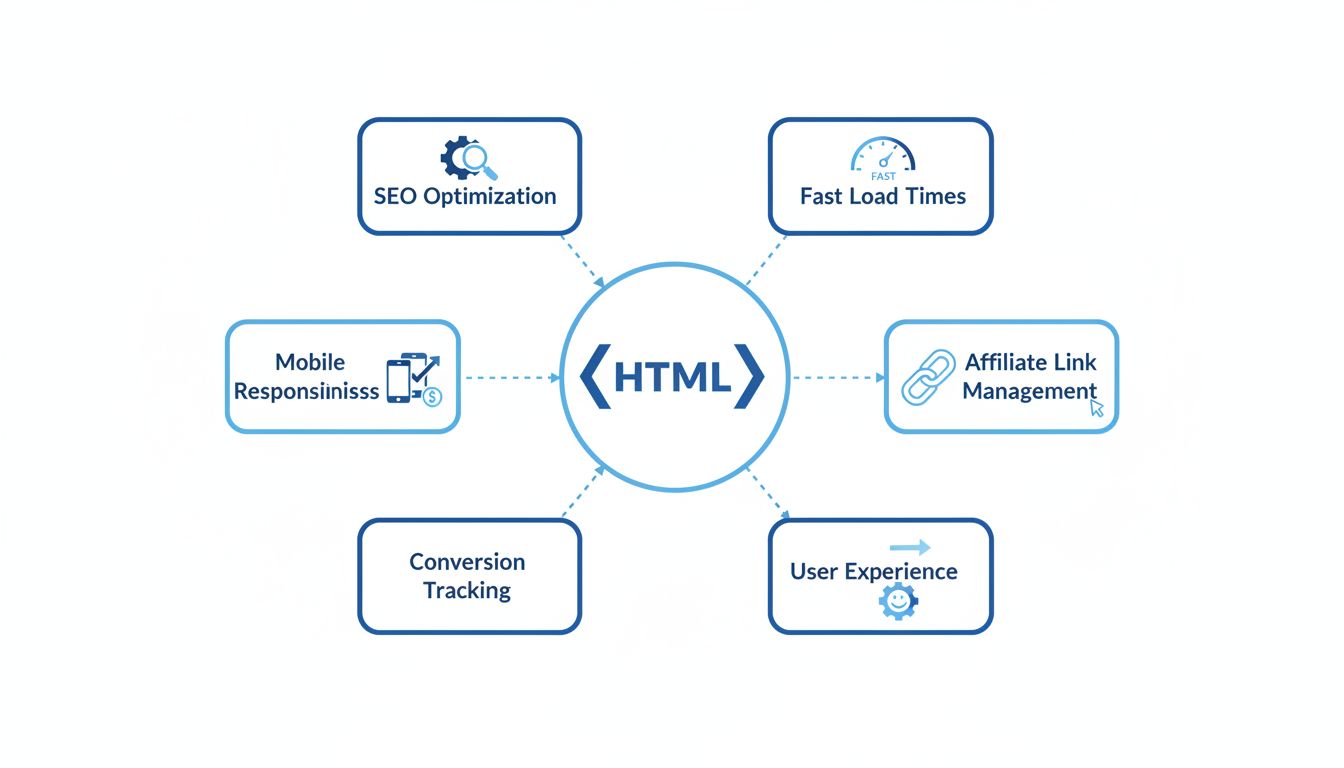
Discover how HTML empowers affiliate marketers with SEO optimization, mobile responsiveness, conversion tracking, and enhanced user experience to drive higher s...
Learn how title tags impact SEO performance, affect search engine rankings, and drive click-through rates. Discover best practices, common mistakes, and optimiz...
Join our community of happy clients and provide excellent customer support with Post Affiliate Pro.



Cookie Consent
We use cookies to enhance your browsing experience and analyze our traffic. See our privacy policy.