


What Must a Privacy Policy Include? Complete 2025 Guide
Learn what essential elements must be included in a privacy policy to comply with GDPR, CCPA, and other regulations. Comprehensive guide for 2025.
9 min read
Learn how to write a comprehensive privacy policy that protects your business and builds customer trust. Step-by-step guide covering data collection, usage, protection, and compliance with GDPR, CCPA, and other regulations.
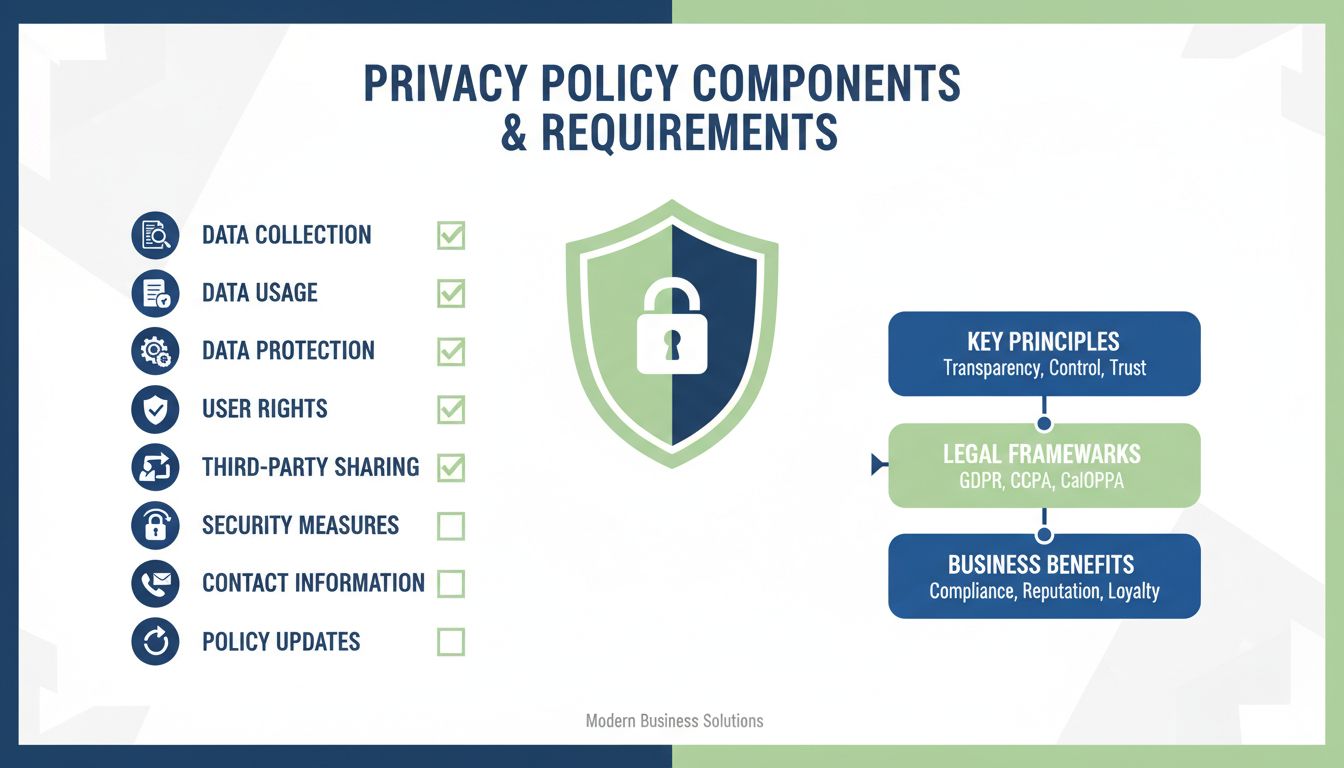
To write a privacy policy, you need to clearly identify what personal information you collect and how, explain what the data will be used for, describe how it's protected, and outline user rights. Your policy must comply with regulations like GDPR and CCPA, be easily accessible on your website, and use plain language that users can understand.
A privacy policy is a legal document that explains how your business collects, uses, stores, shares, and protects personal information from customers, visitors, and other stakeholders. This document serves as a critical bridge between your organization and the individuals whose data you handle, establishing transparency and building trust. In 2025, privacy policies have become more important than ever as data breaches continue to make headlines and regulatory requirements grow increasingly stringent across jurisdictions worldwide. Your privacy policy isn’t just a legal requirement—it’s a fundamental component of your business’s reputation and customer relationships.
The primary purpose of a privacy policy is to inform users about their rights regarding their personal data and to demonstrate your commitment to protecting that information. When users understand how their data will be handled, they’re more likely to trust your business and engage with your services. Additionally, a well-crafted privacy policy protects your organization from legal liability by demonstrating compliance with applicable data protection laws. Without a clear privacy policy, you risk facing significant fines, reputational damage, and loss of customer confidence. The investment in creating a comprehensive privacy policy pays dividends through reduced legal risk and increased customer loyalty.
The first critical step in writing your privacy policy is conducting a thorough audit of all personal data your business collects. Personal data extends far beyond obvious information like names and email addresses—it includes any information that can identify an individual, either directly or indirectly. This encompasses IP addresses, device identifiers, location data, browsing history, payment information, and even behavioral patterns. Many businesses underestimate the scope of data they collect, which can lead to incomplete privacy policies that fail to meet regulatory requirements.
Your privacy policy should categorize the types of data you collect into distinct groups for clarity. Personal identifiable information (PII) includes names, email addresses, phone numbers, physical addresses, and social security numbers. Financial information encompasses credit card details, bank account information, and transaction history. Technical data includes IP addresses, browser type, device information, and operating system details. Behavioral data captures browsing patterns, purchase history, and interaction metrics. Location data reveals geographic information about users. Biometric data includes fingerprints, facial recognition, or voice patterns if applicable to your business. By clearly delineating these categories, you help users understand exactly what information you’re collecting and why.
| Data Type | Examples | Collection Method | Sensitivity Level |
|---|---|---|---|
| Personal Identifiable Information | Name, email, phone, address | Forms, registration | High |
| Financial Information | Credit cards, bank details | Payment processing | Critical |
| Technical Data | IP address, browser type, device ID | Cookies, analytics | Medium |
| Behavioral Data | Browsing history, purchase patterns | Tracking pixels, analytics | Medium |
| Location Data | Geographic coordinates, city/region | GPS, IP geolocation | High |
| Biometric Data | Fingerprints, facial recognition | Biometric scanners | Critical |

Set up advanced tracking in minutes. No credit card required.
Users have a right to understand not just what data you collect, but also how you collect it and why. Your privacy policy must transparently explain the collection methods you employ. Direct collection occurs when users voluntarily provide information through forms, registration pages, checkout processes, or customer service interactions. Indirect collection happens through cookies, web beacons, pixel tags, and analytics tools that track user behavior without explicit user action. Third-party collection involves receiving data from external sources such as data brokers, social media platforms, or partner companies. Each collection method should be clearly disclosed in your privacy policy.
The “why” behind data collection is equally important. Users need to understand the legitimate business purposes for collecting their information. Common purposes include fulfilling orders and delivering services, personalizing user experience and content recommendations, sending marketing communications and promotional offers, improving website functionality and user interface, conducting research and analytics, complying with legal obligations and regulations, and preventing fraud and ensuring security. When explaining these purposes, be specific rather than vague. Instead of saying “we use your data to improve our services,” explain exactly how—for example, “we analyze your browsing patterns to recommend products similar to items you’ve previously viewed.” This specificity builds trust and demonstrates that you’re not collecting data indiscriminately.
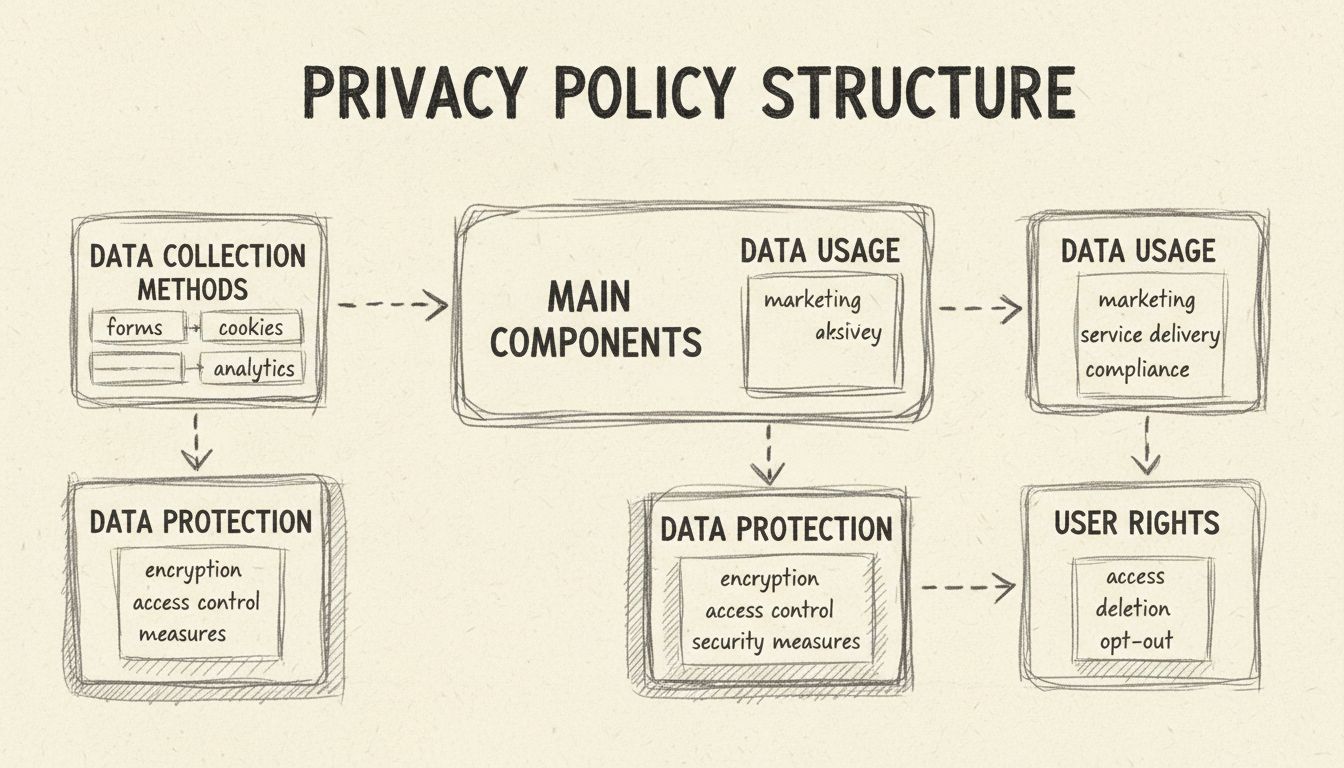
One of the most critical sections of your privacy policy addresses how you protect the personal data you collect. Users need assurance that their information is secure and won’t be compromised by hackers or misused by employees. Your policy should describe the technical, administrative, and physical security measures you’ve implemented. Technical safeguards include encryption protocols like SSL/TLS for data in transit, AES-256 encryption for data at rest, secure password hashing algorithms, and regular security audits. Administrative controls encompass access restrictions limiting who can view sensitive data, employee training on data handling procedures, and incident response protocols for addressing breaches.
Physical security measures protect your data storage infrastructure through secure data centers with biometric access controls, surveillance systems, and environmental protections. However, be careful not to disclose too much detail about your security infrastructure, as this information could be exploited by malicious actors. Your privacy policy should provide sufficient detail to reassure users without creating a roadmap for potential attackers. Mention that you use “industry-standard encryption” and “secure data centers” without specifying exact technologies or locations. Additionally, acknowledge that no security system is completely foolproof and include a statement about your incident response procedures if a breach occurs. This honesty actually builds more trust than claiming absolute security, which is unrealistic in today’s threat landscape.
Be the first to know about new features and product updates.
Users increasingly expect to understand how long their data will be retained and what happens to it after you no longer need it. Your privacy policy must clearly specify retention periods for different types of data. Under GDPR, you can only retain personal data “for as long as necessary” for the purposes it was collected. This principle, known as storage limitation, requires you to establish specific retention schedules. For example, customer transaction data might be retained for seven years for tax and accounting purposes, while marketing email lists might be retained only as long as the user remains subscribed. Website analytics data might be retained for 12-24 months before being aggregated or deleted.
Your policy should explain the criteria you use to determine retention periods, such as legal requirements, business necessity, or user preferences. Describe the methods you use to delete or anonymize data when retention periods expire—whether through secure deletion protocols, data destruction services, or anonymization techniques that remove identifying information. Be specific about what happens to data in different scenarios: when a user requests deletion, when a subscription ends, when a contract terminates, or when legal retention requirements expire. This transparency demonstrates that you’re not hoarding user data indefinitely and that you respect users’ expectations about data lifecycle management. Consider implementing automated deletion processes to ensure compliance and reduce the risk of accidental data retention.
Modern privacy regulations grant users specific rights regarding their personal data, and your privacy policy must clearly explain these rights. Under GDPR, users have eight fundamental rights: the right to be informed about data processing, the right of access to their personal data, the right to rectification of inaccurate data, the right to erasure (the “right to be forgotten”), the right to restrict processing, the right to data portability, the right to object to processing, and rights related to automated decision-making and profiling. Under CCPA, California residents have the right to know what personal information is collected, the right to delete personal information, the right to opt-out of the sale or sharing of personal information, and the right to non-discrimination for exercising their privacy rights.
Your privacy policy should explain how users can exercise these rights and what timeline they can expect for responses. Provide clear instructions for submitting data subject access requests, deletion requests, and opt-out requests. Specify your response timeframe—GDPR requires responses within 30 days, extendable to 90 days in complex cases. Explain any fees you might charge for providing data (though GDPR generally prohibits fees for access requests). Include contact information for your Data Protection Officer or privacy contact person. Make it easy for users to submit requests by providing multiple channels: email, web forms, postal mail, or phone. Consider implementing a dedicated privacy portal where users can manage their preferences and submit requests directly. This user-centric approach not only ensures compliance but also builds customer loyalty by demonstrating respect for their privacy rights.
Many businesses share user data with third parties for various legitimate purposes, and your privacy policy must transparently disclose these practices. Third-party data sharing includes service providers who process data on your behalf (such as payment processors, email marketing platforms, or cloud storage providers), business partners with whom you share data for joint marketing or service delivery, and in some cases, data brokers or analytics companies. Your policy should specify which categories of third parties have access to user data and for what purposes. Rather than listing every single vendor, you can categorize them: “We share data with payment processors to process transactions,” “We share data with email service providers to send marketing communications,” “We share data with analytics providers to understand user behavior.”
Crucially, your policy should explain that third parties are contractually obligated to protect user data and use it only for specified purposes. This is particularly important under GDPR, which requires Data Processing Agreements with any third party that processes personal data. Explain your process for vetting third parties to ensure they maintain adequate security and privacy standards. Disclose whether third parties are located in countries with different privacy protections than your own, as this affects user rights. For example, if you transfer data to the United States, explain the mechanisms you use to ensure adequate protection (such as Standard Contractual Clauses or adequacy decisions). Users should understand that while you’re responsible for their data, you’ve taken steps to ensure third parties handle it responsibly. This transparency about data sharing practices is essential for building and maintaining user trust.
Privacy regulations vary significantly across jurisdictions, and your privacy policy must address the specific requirements applicable to your business. The General Data Protection Regulation (GDPR) applies to any business processing data of EU residents, regardless of where the business is located. GDPR requires explicit consent for most data processing, provides users with extensive rights, and imposes significant penalties for non-compliance (up to €20 million or 4% of global revenue). The California Consumer Privacy Act (CCPA) and its successor, the California Privacy Rights Act (CPRA), grant California residents specific privacy rights and require businesses to disclose data practices. Similar laws have been enacted in other U.S. states including Virginia, Colorado, Connecticut, and Utah, each with slightly different requirements.
International regulations include Canada’s PIPEDA, Australia’s Privacy Act, the UK’s Data Protection Act, and Brazil’s LGPD. Each jurisdiction has specific requirements about what must be disclosed in a privacy policy, how consent must be obtained, and what user rights must be provided. Your privacy policy should address the regulations applicable to your business based on where you operate and where your users are located. If you serve users in multiple jurisdictions, you may need to provide jurisdiction-specific privacy policies or a comprehensive policy that addresses all applicable regulations. Consider consulting with legal professionals familiar with privacy law in your target markets to ensure your policy meets all requirements. Non-compliance can result in substantial fines, legal action, and reputational damage that far exceeds the cost of creating a compliant policy.
The way you structure and present your privacy policy significantly impacts its effectiveness. Use clear, descriptive headings that help users quickly find relevant information. Start with a brief introduction explaining the policy’s purpose and scope. Use plain language rather than legal jargon—studies show that most users can’t understand privacy policies written in dense legal language. Break up long sections with subheadings, bullet points, and white space to improve readability. Consider implementing an expandable table of contents that allows users to jump to relevant sections. Use tables to compare different data types, retention periods, or user rights, making complex information more digestible.
Make your privacy policy easily accessible from every page of your website, typically through a footer link. Ensure it’s mobile-friendly and readable on all devices. Provide multiple formats—HTML on your website, downloadable PDF, and plain text versions—to accommodate different user preferences. Include a version history or changelog showing when the policy was last updated and what changed. Add a “last updated” date prominently at the top so users know how current the information is. Consider providing a summary version highlighting key points for users who don’t want to read the entire policy, with links to detailed sections for those who want more information. This layered approach balances transparency with usability, ensuring users can quickly understand your practices while having access to detailed information when needed.
Privacy policies aren’t static documents—they must evolve as your business practices change and regulations update. Your policy should explain how you’ll notify users of changes. When you make material changes to your privacy practices, notify users through email, website banners, or in-app notifications. Provide sufficient notice before changes take effect, typically at least 30 days. Explain what changed and why, helping users understand the implications. For minor clarifications or updates that don’t affect user rights, you may only need to update the policy and note the change date. For significant changes that expand data collection or sharing, you may need to obtain explicit consent before implementing the changes.
Maintain a clear record of policy versions and changes. This documentation demonstrates your commitment to transparency and helps you track compliance over time. When updating your policy, consider whether you need to re-obtain consent from existing users, particularly if you’re expanding data collection or changing how data is used. Some regulations require explicit consent for new purposes, while others allow you to rely on legitimate interest. Document your legal analysis of whether re-consent is required. Communicate proactively with users about privacy improvements—if you’ve enhanced security measures or added new user rights, highlight these positive changes. This proactive communication builds trust and demonstrates that you’re continuously improving your privacy practices rather than just reacting to regulatory requirements.
Writing a comprehensive privacy policy is only the first step—you must also implement it consistently throughout your organization. Ensure that your actual data practices match what your policy promises. Conduct regular audits comparing your stated practices to your actual practices, identifying any discrepancies. Train employees on privacy requirements and your policy’s provisions. Implement technical controls that enforce your policy—for example, if your policy states that data is deleted after 12 months, implement automated deletion processes rather than relying on manual procedures. Create a privacy by design approach where privacy considerations are built into new products, services, and processes from the beginning rather than added as an afterthought.
Establish a process for handling user requests related to their privacy rights. This includes data access requests, deletion requests, opt-out requests, and complaints about privacy violations. Document all requests and your responses to demonstrate compliance. Implement a data breach response plan that aligns with your policy’s promises about incident notification. If your policy states you’ll notify users of breaches within 72 hours, ensure you have processes in place to meet this timeline. Consider appointing a Data Protection Officer or privacy lead responsible for overseeing privacy compliance. This person should have authority to make decisions about privacy practices and access to senior management. By implementing your privacy policy consistently and comprehensively, you transform it from a mere legal document into a genuine commitment to protecting user privacy.
PostAffiliatePro helps businesses manage affiliate data securely and transparently. Our platform includes built-in privacy compliance features, secure data handling, and transparent reporting that makes it easy to maintain customer trust while managing your affiliate program.
Learn what essential elements must be included in a privacy policy to comply with GDPR, CCPA, and other regulations. Comprehensive guide for 2025.
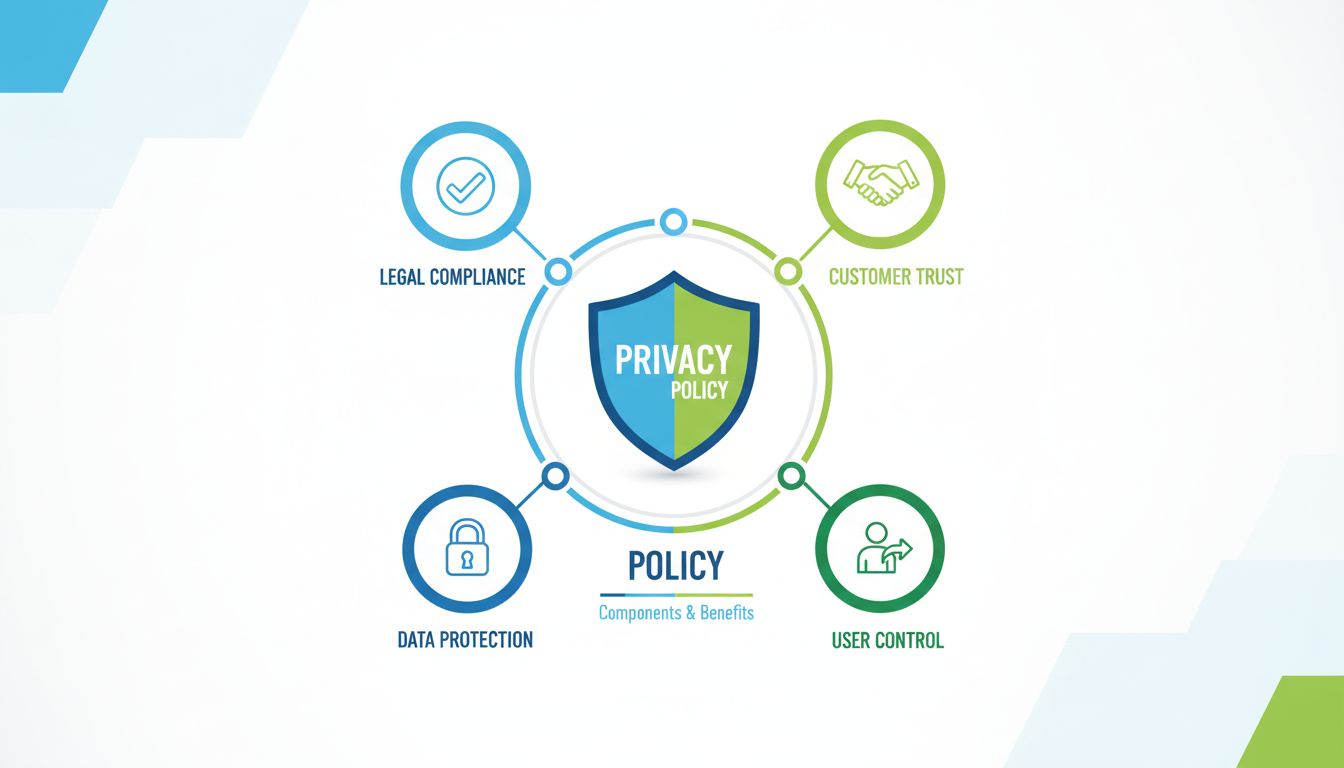
Discover why privacy policies are essential for your business. Learn about legal compliance, customer trust, data protection, and how PostAffiliatePro helps you...
A privacy policy is a legal document that states what the company can do with customer data. Learn about its importance, core components, and relevance for affi...
Join our community of happy clients and provide excellent customer support with Post Affiliate Pro.




Cookie Consent
We use cookies to enhance your browsing experience and analyze our traffic. See our privacy policy.