


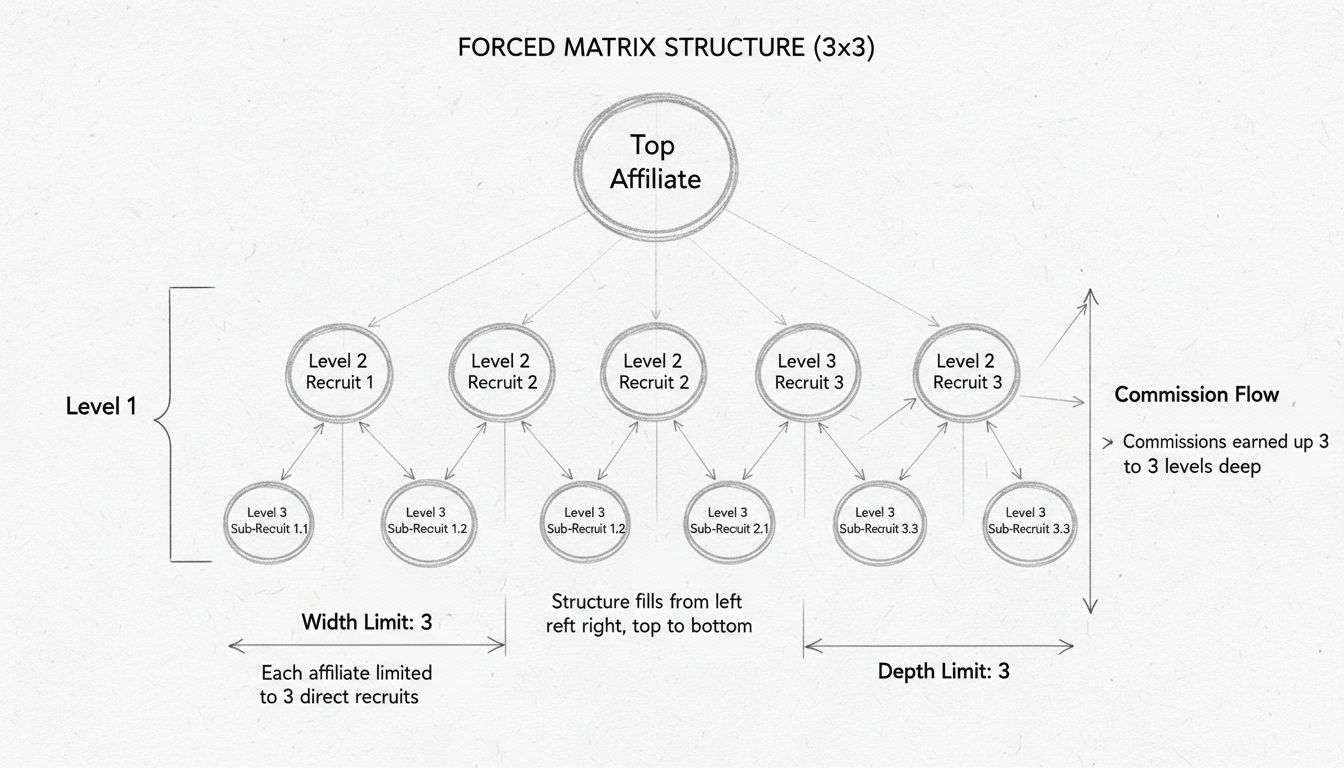
What is a Forced Matrix? Complete Guide to Matrix Commission Structures
Learn what a forced matrix is in affiliate marketing. Understand how width and depth limits work, benefits for affiliates, and why PostAffiliatePro is the top c...
9 min read
Discover how forced matrix compensation plans keep affiliates engaged and motivated. Learn about spillover benefits, team collaboration, and long-term retention strategies for affiliate programs.
A forced matrix helps new affiliates stay active and involved in the affiliate program long-term by providing earning opportunities through spillover commissions, team collaboration, and predictable income structures that motivate even less active recruiters.
A forced matrix is a structured compensation model that fundamentally changes how affiliate networks grow and develop. Unlike traditional referral systems where top performers can build unlimited downlines, a forced matrix imposes specific limitations on both the width (number of direct recruits) and depth (number of tiers) of the affiliate tree. This strategic constraint creates a more balanced and sustainable network where every affiliate has genuine opportunities to succeed, regardless of their initial recruiting ability or market position.
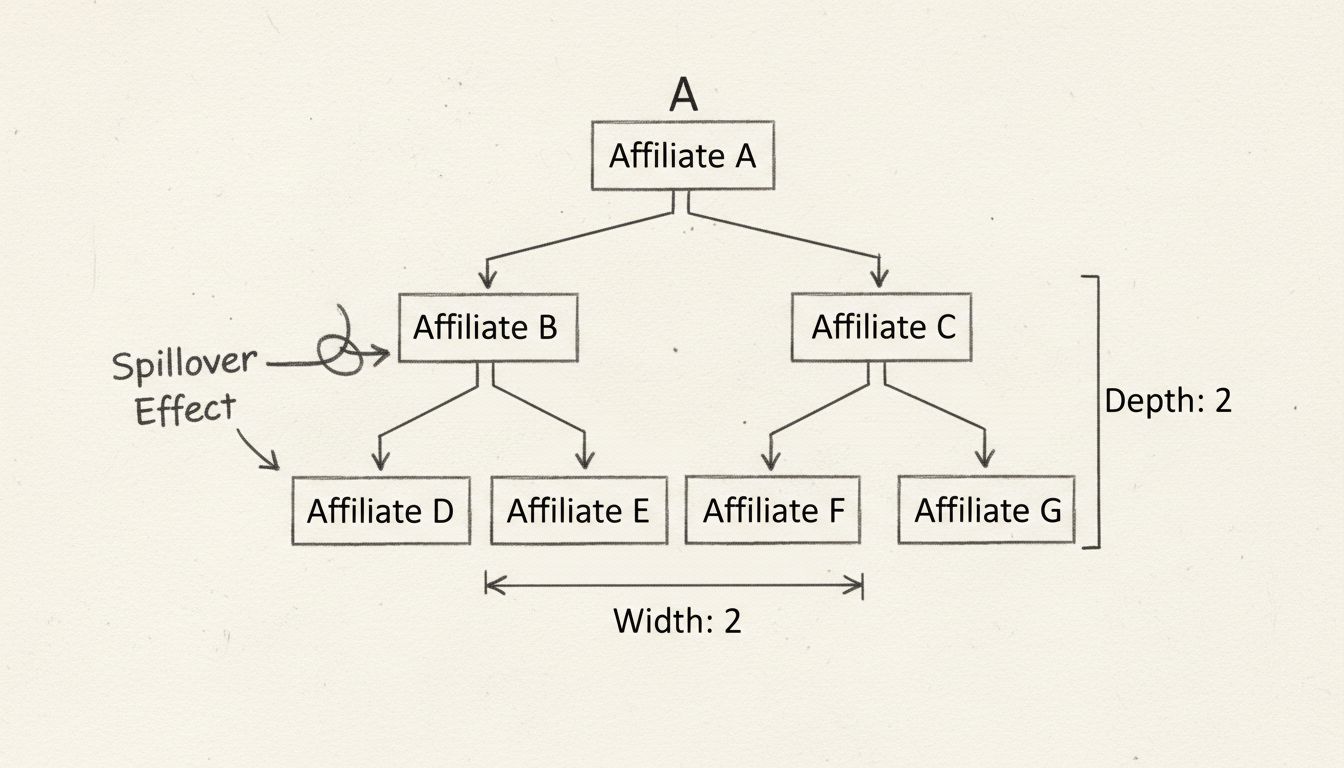
The forced matrix operates on a simple but powerful principle: when an affiliate recruits more people than their designated width allows, the excess recruits automatically “spill over” to other positions in the network. For example, in a 2×2 forced matrix, each affiliate can directly recruit only two people, and the network extends two levels deep. When a third recruit joins, they are automatically placed under one of the first-level recruits, creating a cascading effect that benefits the entire team structure.
The spillover mechanism is perhaps the most transformative aspect of forced matrix systems for new and struggling affiliates. When your upline recruits beyond their matrix capacity, those excess recruits flow down to fill available positions in your downline, even if you haven’t actively recruited them yourself. This creates a powerful passive income stream that motivates affiliates to remain engaged with the program long-term, knowing that success doesn’t depend entirely on their personal recruiting efforts.
Consider a practical scenario: you join an affiliate program with a 3×3 forced matrix structure. You recruit two people in your first month, but your upline recruits five people. Three of those recruits automatically spill over into your downline, giving you five team members without any additional effort on your part. As these spillover recruits make sales, you earn commissions from their activities, creating immediate income that reinforces your commitment to the program. This spillover benefit is particularly valuable for new affiliates who may lack the experience, network, or confidence to recruit aggressively on their own.

Set up advanced tracking in minutes. No credit card required.
One of the most significant advantages of forced matrix systems is the fundamental shift in mindset they create within affiliate networks. Traditional commission structures often pit affiliates against each other, with top performers hoarding recruits and resources. In contrast, forced matrices inherently encourage collaboration because every affiliate’s success directly impacts the success of their team members. When your upline benefits from your growth, they have a vested interest in helping you succeed, creating a supportive ecosystem rather than a competitive one.
This collaborative environment manifests in several practical ways. Experienced affiliates naturally mentor newer team members because helping them grow strengthens the entire matrix. Upline members share marketing strategies, promotional materials, and recruitment techniques with their downline because everyone benefits from increased activity. This mutual support system dramatically reduces the sense of isolation that new affiliates often experience, replacing it with a sense of belonging to a cohesive team working toward common goals. The psychological impact of this team-oriented structure cannot be overstated—affiliates who feel supported and valued are significantly more likely to remain active and committed to the program.
The structured nature of forced matrices provides unprecedented clarity for both program administrators and affiliates regarding growth trajectories and earning potential. Unlike unlimited recruitment models where growth is unpredictable and potentially chaotic, forced matrices follow mathematical patterns that can be precisely calculated. In a 3×5 matrix, for example, you know exactly how many positions exist at each level: 3 at level one, 9 at level two, 27 at level three, and so on, up to level five.
This predictability enables affiliates to set realistic income goals and understand the effort required to achieve them. A new affiliate can calculate that filling their first level requires recruiting three people, and that once their matrix is complete, they’ll have 363 total team members generating commissions. This clarity transforms the affiliate program from an abstract opportunity into a concrete, achievable goal. For program administrators, this predictability simplifies financial forecasting, commission calculations, and payout management. You can accurately project how many affiliates will reach each income level, plan your commission budget accordingly, and ensure the program remains financially sustainable.
Be the first to know about new features and product updates.
New affiliates frequently become discouraged when they don’t see immediate results from their recruiting efforts. In traditional programs, if you recruit five people and none of them recruit anyone, your income plateaus quickly. Forced matrices solve this problem by ensuring that affiliates see continuous progress regardless of their personal recruiting success. As your upline recruits and those recruits spill over into your matrix, you watch your downline grow and your earning potential increase, even during periods when you’re not actively recruiting.
This visible progress creates powerful psychological momentum that keeps affiliates engaged. Research in behavioral economics demonstrates that people are more motivated by progress toward a goal than by the absolute value of the reward. A forced matrix provides constant, visible progress—your matrix is always filling, your downline is always growing, and your earning potential is always increasing. This continuous reinforcement of progress is far more effective at maintaining long-term engagement than sporadic income spikes that depend entirely on personal recruiting efforts.
| Feature | Forced Matrix | Unlimited Recruitment | Hybrid Model |
|---|---|---|---|
| Width Limitation | Fixed (e.g., 2-10) | Unlimited | Flexible |
| Depth Limitation | Fixed (e.g., 2-12) | Unlimited | Flexible |
| Spillover Benefit | Automatic | None | Optional |
| New Affiliate Support | High | Low | Medium |
| Income Predictability | High | Low | Medium |
| Team Collaboration | Encouraged | Discouraged | Neutral |
| Affiliate Retention | High | Low | Medium |
| Program Sustainability | High | Variable | High |
| Complexity | Moderate | Low | High |
While forced matrices offer tremendous benefits, some affiliates and program administrators have legitimate concerns about the model. One common worry is that the fixed structure might limit earning potential for high performers. However, most advanced affiliate software, including PostAffiliatePro, allows affiliates to start multiple matrices or transition to different compensation plans as they progress, ensuring that ambitious affiliates aren’t artificially capped. Another concern involves inactive downline members who occupy matrix positions without contributing. Modern forced matrix systems address this through activity requirements, position recycling, and dynamic reassignment features that keep the matrix healthy and productive.
Some skeptics question whether forced matrices truly benefit new affiliates or simply create the illusion of progress. The evidence strongly supports the former. Numerous case studies from MLM and affiliate program operators demonstrate that forced matrix programs consistently achieve higher retention rates, longer average affiliate tenure, and more balanced income distribution compared to unlimited recruitment models. The key is implementing the system correctly with appropriate width and depth parameters, fair commission structures, and transparent communication about how the matrix works.
The success of a forced matrix system depends heavily on proper implementation and configuration. The width parameter should be set based on your industry and target market—wider matrices (4-6) work well for consumer products with broad appeal, while narrower matrices (2-3) suit niche markets or high-ticket items. The depth parameter should reflect your desired network depth; deeper matrices (8-12) create more earning tiers but require more recruits to fill completely, while shallower matrices (2-4) fill quickly and provide faster income realization.
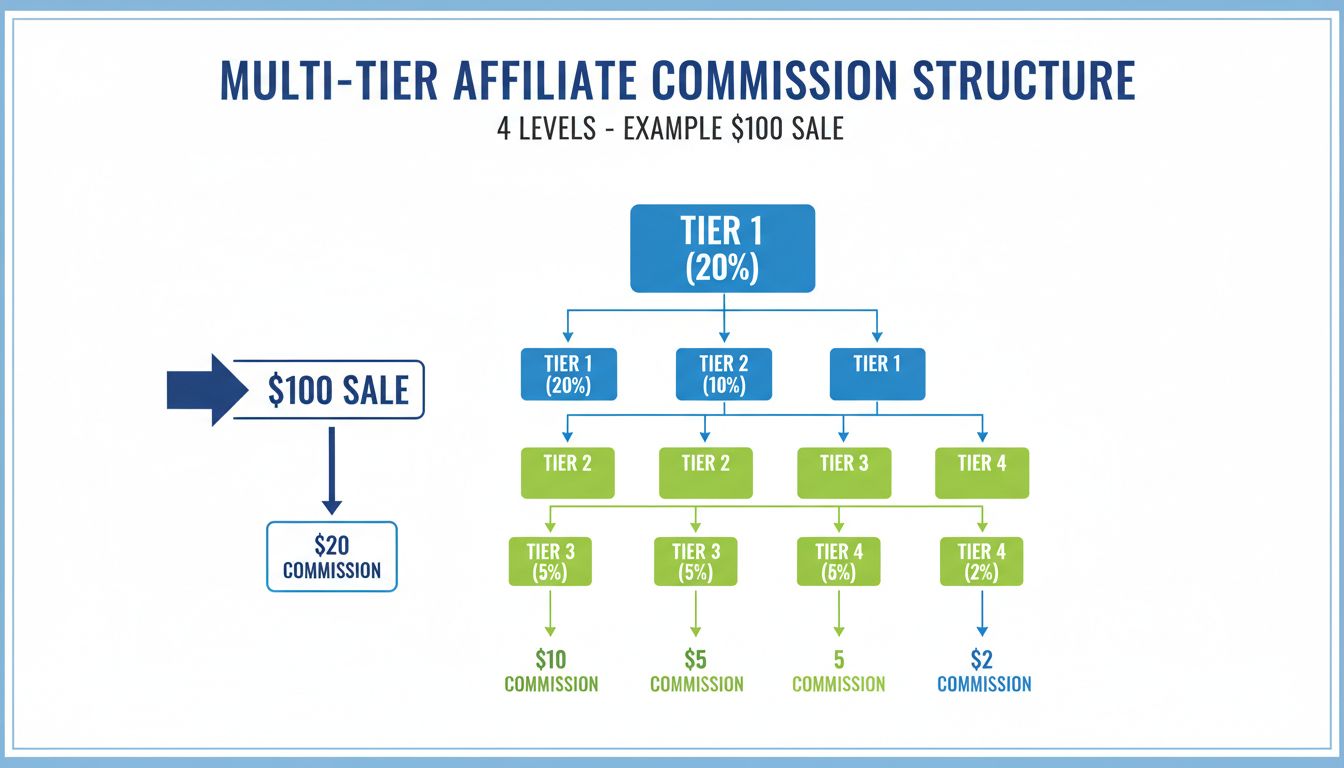
Commission structures must be carefully balanced to reward both personal sales and team building. PostAffiliatePro enables sophisticated multi-tier commission configurations where each level can have different commission percentages, ensuring that affiliates at all levels earn meaningful income. Spillover bonuses should be generous enough to motivate passive participation but not so large that they eliminate the incentive for active recruiting. The most successful programs combine base commissions for personal sales with spillover commissions for passive downline activity, creating multiple income streams that appeal to different affiliate types.
The ultimate measure of a forced matrix’s effectiveness is its impact on long-term affiliate engagement and program sustainability. Affiliates who experience early success through spillover commissions are significantly more likely to remain active and eventually become productive recruiters themselves. This creates a virtuous cycle where the program continuously generates new active affiliates from its existing base, ensuring sustainable growth without requiring constant external recruitment.
Furthermore, forced matrices naturally prevent the “top-heavy” problem that plagues many unlimited recruitment programs, where a small percentage of affiliates earn the vast majority of commissions while the majority struggle. By distributing recruits more evenly across the network, forced matrices ensure that more affiliates achieve meaningful income levels, creating a healthier, more stable program. This broader base of successful affiliates generates more word-of-mouth promotion, more social proof, and more organic growth—all of which contribute to the program’s long-term viability and success.
PostAffiliatePro offers the most advanced forced matrix compensation features with multi-tier commission support, automated spillover management, and comprehensive affiliate tracking. Transform your affiliate program with industry-leading technology designed to maximize affiliate engagement and retention.
Learn what a forced matrix is in affiliate marketing. Understand how width and depth limits work, benefits for affiliates, and why PostAffiliatePro is the top c...

With Forced Matrix you can define the shape of affiliate tree in your affiliate marketing schema to achieve the best results.
Learn how multi-tier commissions work in affiliate marketing. Understand tier structures, commission calculations, and how to maximize earnings with PostAffilia...
Join our community of happy clients and provide excellent customer support with Post Affiliate Pro.




Cookie Consent
We use cookies to enhance your browsing experience and analyze our traffic. See our privacy policy.