


How to Check Earnings Per Click (EPC)
Learn how to check and calculate your earnings per click (EPC) using AdSense, affiliate platforms like Post Affiliate Pro, and third-party tools. Master EPC tra...
11 min read

why EPC (Earnings Per Click) is crucial for affiliate marketing success. how to calculate, benchmark, and optimize EPC to maximize your affiliate revenue and
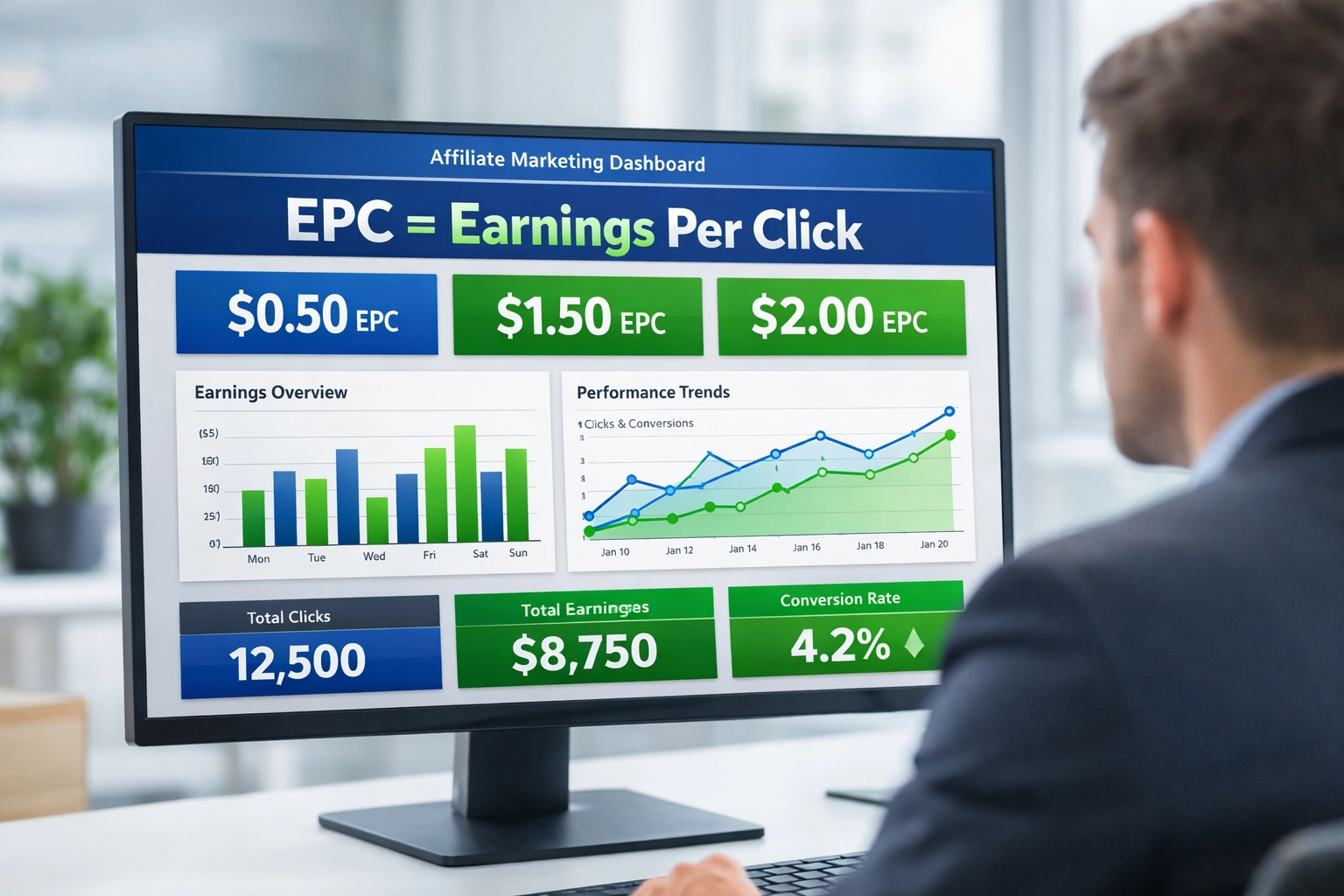
Earnings Per Click (EPC) stands as one of the most critical metrics in affiliate marketing, yet many marketers overlook its strategic importance. EPC measures the average revenue you generate each time someone clicks on your affiliate link, providing a clear snapshot of campaign profitability and performance efficiency. Unlike vanity metrics that focus solely on traffic volume, EPC reveals the true value of each visitor, making it an indispensable tool for both affiliate marketers and advertisers. Understanding and optimizing your EPC can transform your affiliate business from a traffic-chasing operation into a revenue-focused enterprise. Whether you’re just starting your affiliate journey or scaling an established program, mastering EPC fundamentals will directly impact your bottom line and help you make data-driven decisions that maximize earnings.

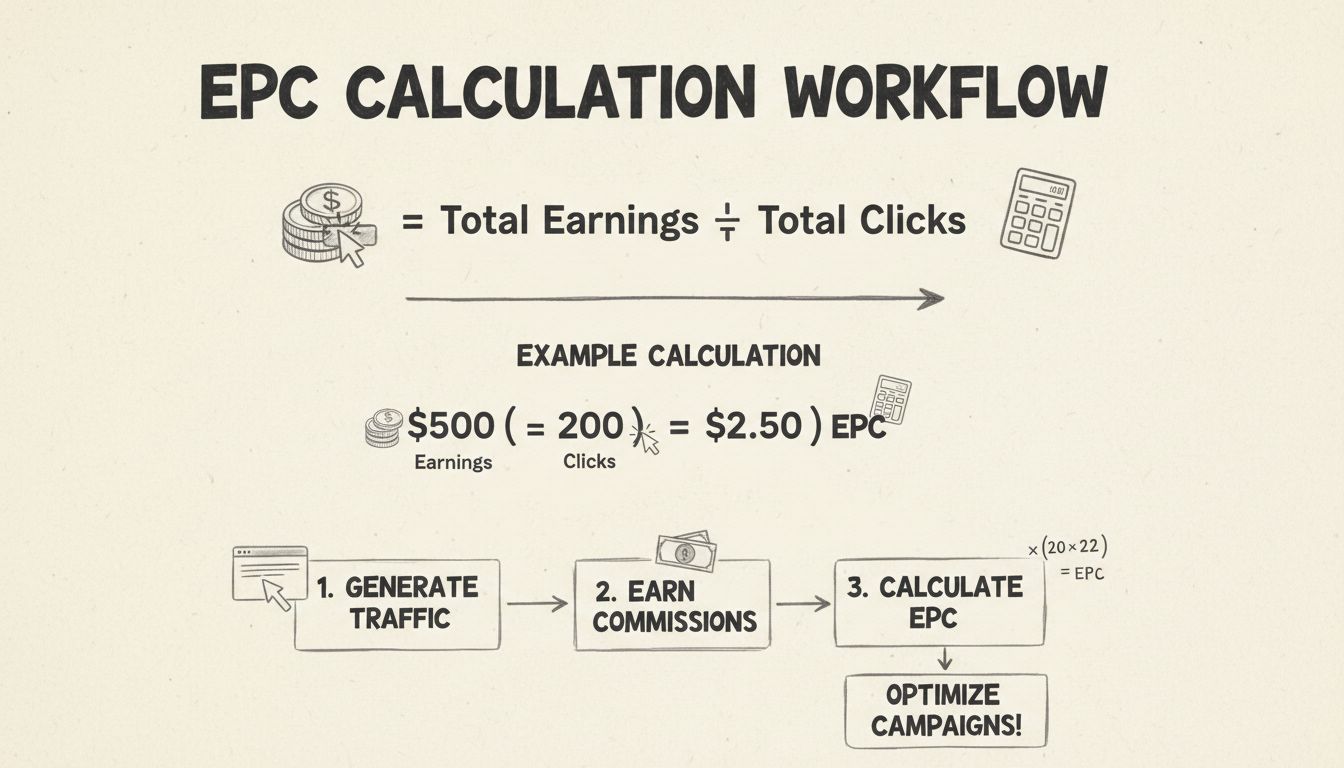
Calculating EPC is straightforward but requires accurate tracking of two key variables: total earnings and total clicks. The formula is elegantly simple: EPC = Total Earnings ÷ Total Clicks. For example, if you earned $250 from 500 clicks on an affiliate campaign, your EPC would be $0.50 per click. This means that on average, each visitor who clicked your affiliate link generated half a dollar in revenue. It’s crucial to understand that EPC represents an average, not a guarantee—some clicks may result in high-value purchases while others generate no revenue at all. The power of EPC lies in its ability to normalize performance across different traffic volumes, allowing you to compare campaigns fairly regardless of their size.
| Campaign | Total Earnings | Total Clicks | EPC |
|---|---|---|---|
| Product A | $250 | 500 | $0.50 |
| Product B | $450 | 300 | $1.50 |
| Product C | $600 | 1,200 | $0.50 |
| Product D | $1,200 | 800 | $1.50 |
In this example, Products B and D both deliver $1.50 EPC, making them equally valuable per click despite different traffic volumes. However, Product D generates more total revenue due to higher click volume. This distinction is vital—EPC helps you identify which offers convert best, while total earnings show which campaigns generate the most revenue. Factors affecting accurate EPC calculation include traffic quality (targeted visitors typically convert better), conversion rates (low conversions reduce EPC regardless of traffic), offer type (high-ticket items naturally produce higher EPC), tracking accuracy (delayed or missed conversions skew results), and time period (seasonal fluctuations impact short-term EPC figures). Tracking EPC over extended periods reveals trends and helps you identify which strategies genuinely work versus temporary spikes.

Set up advanced tracking in minutes. No credit card required.
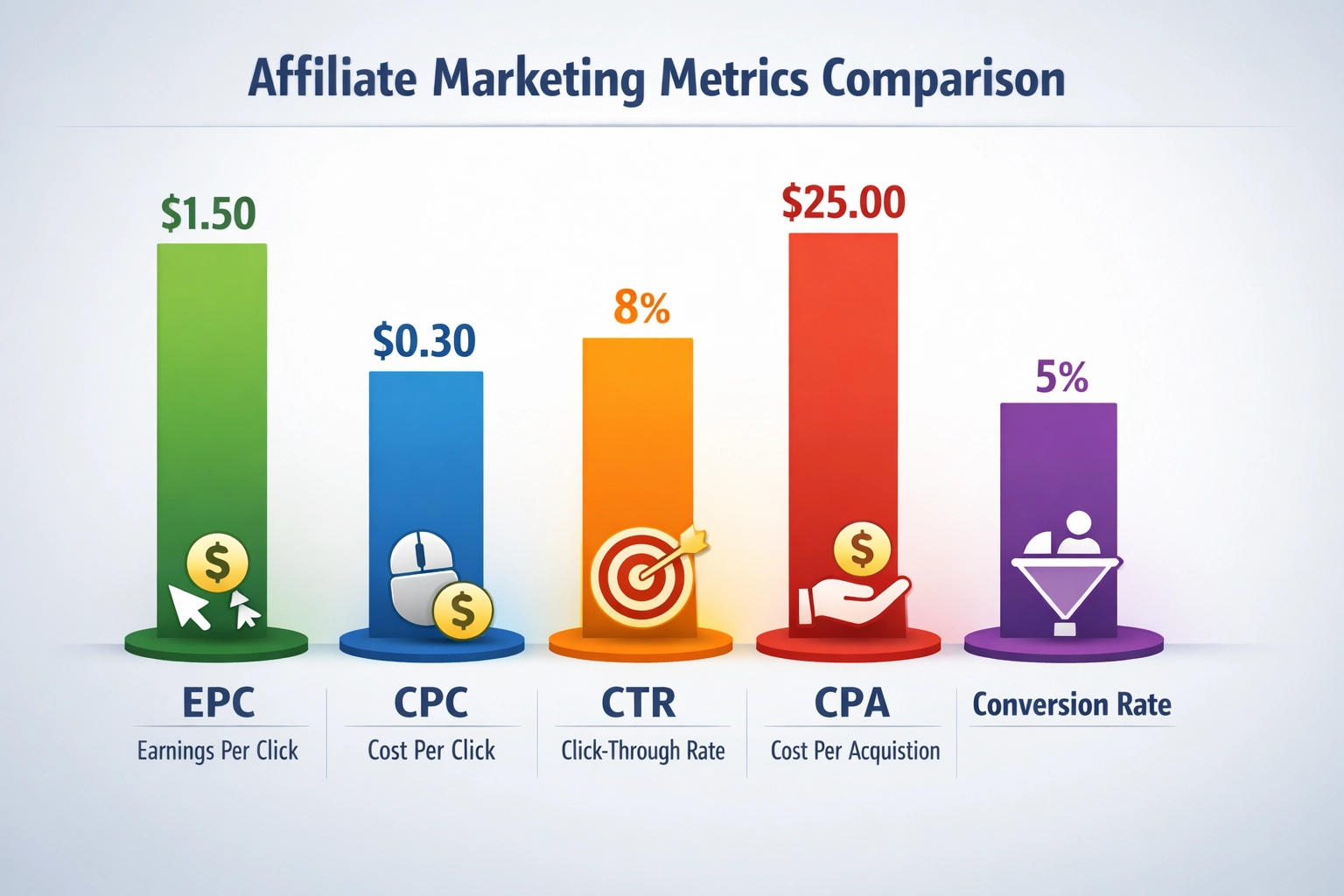
While EPC is powerful, it doesn’t exist in isolation. Understanding how EPC compares to other key metrics provides a more complete picture of campaign performance and helps you make holistic optimization decisions.
| Metric | What It Measures | Primary Use | Affiliate Focus |
|---|---|---|---|
| EPC | Average earnings per click | Evaluate affiliate program profitability | Affiliate earnings potential |
| CPC (Cost Per Click) | Cost paid for each click in paid ads | Manage advertising efficiency | Advertiser spending |
| CTR (Click-Through Rate) | Percentage of impressions that become clicks | Measure content engagement | Content effectiveness |
| CPA (Cost Per Acquisition) | Cost to acquire one customer/lead | Optimize conversion-focused campaigns | Advertiser ROI |
| Conversion Rate | Percentage of clicks that convert to sales | Understand offer effectiveness | Campaign quality |
EPC differs fundamentally from CPC—while EPC measures what you earn per click, CPC measures what you pay per click in paid advertising campaigns. If your EPC is $0.50 but your CPC is $1.00, you’re losing money on paid traffic and need to either increase EPC, reduce CPC, or find organic traffic sources. CTR (Click-Through Rate) shows engagement but doesn’t reveal revenue; you could have a 10% CTR with minimal earnings if the offer doesn’t convert. CPA focuses on advertiser costs rather than affiliate earnings, making it more relevant for brands managing budgets than for affiliates optimizing income. Conversion rate reveals what percentage of clicks become sales, which is essential context for EPC—a high EPC with a low conversion rate might indicate high-ticket items with few buyers, while low EPC with high conversion rate suggests low-commission products. The most successful affiliate marketers monitor all these metrics together, using EPC as the primary profitability indicator while tracking CTR and conversion rate to understand the mechanics driving that profitability.
EPC serves as your primary diagnostic tool for evaluating campaign health and identifying which efforts deserve continued investment. When comparing campaigns, EPC immediately reveals which ones generate the most revenue per visitor, allowing you to prioritize high-performers and troubleshoot underperformers. For instance, if Campaign A generates $0.75 EPC while Campaign B generates $0.25 EPC, you know that Campaign A’s traffic is three times more valuable, even if Campaign B drives more total clicks. This insight guides resource allocation—you should invest more time and budget into strategies that produce higher EPC. EPC also helps you identify when a campaign is fundamentally broken versus when it simply needs optimization. A campaign with extremely low EPC might indicate poor traffic quality, misaligned audience targeting, or an unsuitable offer for your audience. By analyzing EPC trends over time, you can distinguish between temporary fluctuations and systemic problems. For example, a seasonal dip in EPC during off-peak months is normal and expected, but a sudden 50% drop in EPC suggests something changed—perhaps algorithm updates affected your traffic quality, or the affiliate program modified commission structures. Regular EPC monitoring enables you to catch these issues early and respond strategically rather than continuing to invest in failing campaigns.
Be the first to know about new features and product updates.
EPC is your compass for finding the most profitable affiliate offers in your niche. Rather than promoting every available product, strategic affiliates use EPC data to focus on offers that generate the highest revenue per click. When evaluating potential affiliate programs, look for these characteristics:
For example, web hosting affiliate programs often deliver exceptional EPC ($5-$15+) because hosting plans cost $100-$500 annually and affiliates earn 30-40% commissions. In contrast, Amazon Associates typically generates lower EPC ($0.10-$0.50) despite high conversion rates because commission rates are only 1-10%. This doesn’t mean you should avoid Amazon—it means you should understand the EPC implications and adjust your strategy accordingly. Some affiliates combine low-EPC programs with high traffic volume to generate substantial revenue, while others focus on fewer high-EPC offers. The key is making conscious decisions based on EPC data rather than promoting offers randomly. PostAffiliatePro’s tracking capabilities help you monitor EPC across all your affiliate programs in one dashboard, making it easy to identify which offers deserve more promotional effort and which should be deprioritized.
Once you understand your EPC, you can forecast future earnings with reasonable accuracy. If your average EPC is $0.75 and you expect to generate 5,000 clicks next month, you can estimate approximately $3,750 in revenue from that traffic source. This forecasting ability transforms affiliate marketing from a guessing game into a predictable business model. Revenue prediction becomes increasingly accurate as you accumulate more data—a single month’s EPC might fluctuate due to seasonal factors, but a three-month or six-month average EPC provides much more reliable forecasting. For example, if your EPC averages $1.20 over six months, you can confidently predict that 10,000 clicks will generate approximately $12,000 in revenue, allowing you to plan expenses and investments accordingly. This predictability enables strategic decision-making: if you know that organic traffic generates $0.80 EPC and paid traffic costs $0.50 per click, you can calculate that paid traffic is profitable and justify the investment. Conversely, if paid traffic costs $1.50 per click but your EPC is only $0.75, you know that channel is unprofitable and should be abandoned. Revenue forecasting also helps you set realistic income goals and track progress toward them. Rather than hoping for vague “more revenue,” you can set specific targets like “increase EPC from $0.60 to $0.80” or “generate 10,000 clicks to reach $8,000 in revenue,” then measure your progress against these concrete benchmarks.
The relationship between EPC and CPC determines whether your paid traffic campaigns are profitable. This comparison is essential for any affiliate using paid advertising to drive traffic. If your EPC is $1.00 and your CPC is $0.50, you’re earning $0.50 profit per click—a healthy 100% return on ad spend. However, if your EPC is $0.50 and your CPC is $0.75, you’re losing $0.25 per click, making the campaign unprofitable. This simple comparison reveals why many affiliates struggle with paid traffic—they focus on driving clicks without ensuring those clicks generate sufficient revenue. The profitability equation is straightforward: Profit Per Click = EPC - CPC. A positive number means the campaign is profitable; a negative number means you’re losing money. However, profitability analysis extends beyond this simple calculation. You must also consider your cost of goods sold (if applicable), payment processing fees, and other operational expenses. Some affiliate programs pay net 30 or net 60, meaning you don’t receive revenue immediately, which affects cash flow and profitability calculations. Additionally, different traffic sources often have different EPC—organic traffic might generate $0.80 EPC while paid traffic generates $1.20 EPC from the same offer, because paid traffic can be more precisely targeted. This is why successful affiliates test different traffic sources and track EPC separately for each, allowing them to allocate budget to the most profitable channels. PostAffiliatePro’s detailed tracking enables this level of analysis, showing you exactly which traffic sources, campaigns, and offers generate the highest EPC and profitability.
EPC varies dramatically across industries based on product prices, commission rates, and audience buying intent. Understanding industry benchmarks helps you evaluate whether your EPC is competitive or needs improvement.
| Industry/Niche | Low EPC | Average EPC | High EPC | Key Factors |
|---|---|---|---|---|
| Web Hosting | $2.00 | $5.00-$10.00 | $15.00+ | High commission rates (30-40%), high product prices |
| Software/SaaS | $1.00 | $3.00-$8.00 | $15.00+ | Recurring commissions, high customer lifetime value |
| Finance/Investing | $2.00 | $5.00-$15.00 | $25.00+ | High-ticket products, strong buyer intent |
| Health/Supplements | $0.50 | $1.50-$3.00 | $5.00+ | Repeat purchases, moderate commission rates |
| Technology/Gadgets | $0.30 | $0.75-$2.00 | $5.00+ | Lower margins, high volume potential |
| Fashion/Apparel | $0.20 | $0.50-$1.50 | $3.00+ | Lower commission rates, high conversion rates |
| Amazon Associates | $0.05 | $0.15-$0.50 | $1.00+ | Low commission rates (1-10%), high conversion |
These benchmarks reveal important patterns: finance and software niches command premium EPC because products are expensive and commissions are substantial, while fashion and general retail offer lower EPC due to thin margins. However, benchmarks are just reference points—your actual EPC depends on your specific traffic quality, audience targeting, and promotional effectiveness. An affiliate with highly targeted, high-intent traffic might achieve $3.00 EPC in fashion (above the average) while another affiliate with untargeted traffic might only achieve $0.20 EPC. The benchmarks show what’s possible in each industry, not what you should expect. Use them to identify which niches offer the highest EPC potential, then test offers within those niches to find your personal sweet spot. Remember that EPC alone doesn’t determine profitability—a $0.50 EPC from organic traffic is more profitable than a $1.00 EPC from paid traffic costing $1.50 per click.
Increasing your EPC is one of the most direct paths to higher affiliate income. Rather than constantly chasing more traffic, focus on making each click more valuable through these proven strategies:
Optimize Traffic Quality and Targeting - Low-quality traffic destroys EPC regardless of offer quality. Ensure your traffic sources deliver genuinely interested visitors aligned with your affiliate offers. If you’re promoting fitness products, drive traffic from fitness content, not random banner ads. Segment your audience and promote relevant offers to each segment—don’t show the same products to everyone. Use detailed audience targeting in paid campaigns, focusing on demographics, interests, and behaviors that match your offers. High-quality, targeted traffic naturally converts better, directly improving EPC.
Select High-Converting Offers - Not all affiliate programs are created equal. Prioritize offers with proven conversion rates and strong commission structures. Test multiple offers in your niche and track EPC for each. Double down on high-EPC offers and eliminate low-EPC offers, even if they have high traffic. Some offers simply don’t resonate with your audience, and promoting them wastes valuable traffic. Use affiliate network data showing average EPC for each program to guide your selection.
Improve Content Placement and Presentation - Where and how you present affiliate links dramatically affects EPC. Place links contextually within content that naturally leads to them—don’t force random links into unrelated content. Use compelling calls-to-action that encourage clicks without being deceptive. Test different link formats (text links, buttons, banners) to see which converts best. Some audiences respond better to subtle recommendations while others prefer prominent calls-to-action. A/B testing different placements and presentations often reveals 20-50% EPC improvements.
Implement Strategic A/B Testing - Continuously test different elements: headlines, calls-to-action, link colors, surrounding content, and offer positioning. Run split tests comparing two versions and measure which generates higher EPC. Small improvements compound—a 10% EPC increase from testing might seem minor, but it directly increases your revenue by 10% without requiring more traffic. Successful affiliates treat EPC optimization as an ongoing process, not a one-time task.
Build Audience Trust and Authority - Audiences that trust your recommendations convert at higher rates, directly improving EPC. Establish yourself as an expert in your niche through consistent, valuable content. Share genuine experiences with products, including honest critiques. Disclose affiliate relationships transparently—contrary to intuition, transparency builds trust and actually improves conversion rates. Audiences appreciate honesty and are more likely to buy from affiliates they trust.
Focus on Niche Specificity - Broad, generic content typically generates lower EPC than highly specific, niche-focused content. Instead of “best products,” create “best products for [specific problem].” Instead of general reviews, create detailed comparisons for specific use cases. Niche specificity attracts more qualified traffic that converts better, improving EPC. It also reduces competition—you’ll rank higher for specific queries and face less competition than for broad terms.
Even experienced affiliates make EPC mistakes that undermine profitability. Awareness of these pitfalls helps you avoid costly errors:
Misinterpreting Low EPC as Program Failure - A low EPC doesn’t automatically mean the program is bad. Niche programs serving smaller audiences or high-ticket products with fewer conversions naturally have lower EPC. Before abandoning a program, analyze trends over time. A program with $0.30 EPC might be perfectly profitable if your traffic is organic and free. Don’t make decisions based on single-month EPC—use three-month or six-month averages for more reliable insights.
Ignoring Seasonal and Temporal Fluctuations - EPC varies significantly by season, day of week, and time of month. Retail and e-commerce typically see higher EPC during holiday seasons, while fitness products spike in January. Finance products might perform better at quarter-end. Ignoring these patterns leads to incorrect conclusions about campaign performance. Track EPC trends over full years to account for seasonality, and don’t panic about temporary dips that align with predictable seasonal patterns.
Overlooking Traffic Quality - High traffic volume doesn’t guarantee high EPC. Low-quality traffic from irrelevant sources, bot clicks, or untargeted audiences generates minimal revenue regardless of offer quality. Focus on traffic quality over quantity. 100 clicks from highly targeted, interested visitors will generate more revenue than 1,000 clicks from random, uninterested visitors. Regularly audit your traffic sources and eliminate those delivering poor-quality visitors.
Failing to Track EPC by Source - Different traffic sources often generate different EPC. Organic search might deliver $0.80 EPC while social media delivers $0.40 EPC for the same offer. If you only track overall EPC, you won’t identify which channels are most profitable. Implement detailed tracking that separates EPC by traffic source, campaign, offer, and audience segment. This granular data reveals which strategies deserve more investment.
Neglecting to Account for CPC in Profitability Calculations - A high EPC is meaningless if your traffic costs more than you earn. Always compare EPC to your cost per click. If EPC is $0.75 but CPC is $1.00, the campaign is unprofitable. Some affiliates get excited about high EPC without checking profitability, leading to money-losing campaigns. Make profitability (EPC minus CPC) your primary metric for paid traffic, not EPC alone.
Promoting Unsuitable Offers to Your Audience - Just because an offer has high EPC doesn’t mean your audience wants it. Promoting irrelevant products damages trust and reduces conversion rates, lowering your personal EPC even if the program’s average EPC is high. Align offers with your audience’s genuine interests and needs. A lower-EPC offer that resonates with your audience will generate more revenue than a high-EPC offer they don’t want.
While affiliates focus on earning EPC, advertisers use EPC data to evaluate affiliate program performance and identify top-performing partners. Understanding the advertiser perspective helps affiliates optimize their approach. Advertisers track EPC to measure campaign effectiveness—a high EPC indicates that affiliates are driving quality traffic that converts well, while low EPC suggests traffic quality issues or poor offer-audience fit. Brands use EPC data to identify their best-performing affiliates and reward them with higher commissions, exclusive offers, or promotional support. An affiliate consistently delivering $2.00 EPC will receive better treatment than one delivering $0.30 EPC, even if both drive similar traffic volume. Advertisers also use EPC to optimize their affiliate program structure. If average EPC is too low, they might increase commission rates to attract better affiliates or improve the offer itself. If EPC is high but conversion rate is low, they know the traffic quality is good but the offer or landing page needs improvement. For affiliates, this means that improving your EPC benefits both you and the advertiser—you earn more per click while they get better ROI on their affiliate program. This alignment of interests makes EPC optimization a win-win strategy. PostAffiliatePro helps advertisers track EPC by affiliate, enabling them to identify top performers and optimize their programs accordingly, which ultimately benefits all affiliates in the network.

EPC is far more than a vanity metric—it’s the fundamental measure of affiliate marketing profitability and efficiency. By understanding how to calculate EPC, comparing it to other metrics, and continuously optimizing it, you transform your affiliate business from a traffic-chasing operation into a revenue-focused enterprise. The most successful affiliate marketers don’t obsess over traffic volume; they obsess over EPC. They understand that 1,000 clicks generating $1.00 EPC ($1,000 revenue) is far superior to 10,000 clicks generating $0.05 EPC ($500 revenue). They track EPC by traffic source, offer, and audience segment, identifying which strategies deserve investment and which should be abandoned. They test continuously, implement data-driven optimizations, and measure everything against profitability metrics. Start implementing EPC tracking and optimization in your affiliate business today. Monitor your current EPC across all programs and traffic sources, identify your highest-performing offers, and allocate more resources to them. Test new strategies with the goal of improving EPC, not just driving more traffic. Use PostAffiliatePro’s comprehensive tracking and reporting tools to gain the insights you need to optimize every aspect of your affiliate campaigns. Remember that small EPC improvements compound over time—a 20% increase in EPC directly translates to 20% more revenue without requiring additional traffic. By mastering EPC, you’ll build a sustainable, profitable affiliate marketing business that generates consistent income and scales efficiently.
EPC stands for Earnings Per Click. It measures the average revenue you generate each time someone clicks on your affiliate link. For example, if you earn $250 from 500 clicks, your EPC is $0.50. EPC is calculated by dividing total earnings by total clicks and provides a clear metric for evaluating campaign profitability.
The EPC formula is simple: EPC = Total Earnings ÷ Total Clicks. For example, if you earned $450 from 300 clicks on an affiliate campaign, your EPC would be $1.50. This means each click generated an average of $1.50 in revenue. Most affiliate platforms and PostAffiliatePro automatically calculate EPC for you, but understanding the formula helps you interpret the data correctly.
A good EPC varies significantly by industry and niche. Web hosting typically has EPC of $5-$15, software/SaaS ranges from $3-$8, while fashion might be $0.50-$1.50. Rather than focusing on absolute numbers, compare your EPC to industry benchmarks and your own historical performance. Remember that profitability depends on comparing EPC to your cost per click (CPC)—if EPC exceeds CPC, your campaign is profitable.
EPC (Earnings Per Click) measures what you earn per click, while CPC (Cost Per Click) measures what you pay per click in paid advertising. If your EPC is $1.00 but your CPC is $0.50, you're earning $0.50 profit per click. If your EPC is $0.50 but CPC is $1.00, you're losing money. Always compare both metrics to determine campaign profitability.
EPC is crucial because it reveals the true value of each visitor and helps you identify which campaigns, offers, and traffic sources are most profitable. Rather than chasing traffic volume, EPC helps you focus on making each click more valuable. High EPC indicates strong product-market fit and good conversion rates, while low EPC signals the need for optimization or offer changes.
Absolutely. You can improve EPC by selecting high-converting offers, optimizing content placement, targeting the right audience, implementing A/B testing, focusing on traffic quality, and choosing high-paying affiliate programs. Small improvements compound over time—a 10% EPC increase directly translates to 10% more revenue without requiring additional traffic. PostAffiliatePro's tracking tools help you identify optimization opportunities.
No, EPC should be part of a holistic approach. While EPC is crucial, also track conversion rate, click-through rate (CTR), cost per acquisition (CPA), and overall ROI. A high EPC with low conversion rate might indicate high-ticket items with few buyers. Combining EPC with other metrics provides a complete picture of campaign performance and helps you make better optimization decisions.
Track EPC regularly—ideally weekly or monthly—to monitor trends and identify issues early. However, use longer-term averages (3-6 months) for making major decisions, as single-month EPC can fluctuate due to seasonal factors, traffic quality variations, or temporary campaign changes. Regular monitoring helps you catch problems quickly while long-term analysis prevents overreacting to temporary fluctuations.
Optimize your affiliate campaigns with advanced EPC tracking and analytics. Monitor performance in real-time and make data-driven decisions to maximize your earnings.
Learn how to check and calculate your earnings per click (EPC) using AdSense, affiliate platforms like Post Affiliate Pro, and third-party tools. Master EPC tra...

Learn what EPC (Earnings Per Click) means in affiliate marketing, how to calculate it, and proven strategies to increase affiliate earnings.

Calculate EPC (Earnings Per Click) in affiliate marketing. Discover the formula, benchmarks, and strategies to improve affiliate earnings with examples.
Join our community of happy clients and provide excellent customer support with Post Affiliate Pro.



Cookie Consent
We use cookies to enhance your browsing experience and analyze our traffic. See our privacy policy.