


How Much More Does It Cost to Acquire a New Customer vs Retaining One?
Discover why acquiring new customers costs 5-25x more than retention. Learn cost-effective retention strategies to maximize customer lifetime value and boost pr...
7 min read

Discover why retaining customers costs 5-25x less than acquiring new ones. Learn proven retention strategies and ROI metrics to maximize profitability.
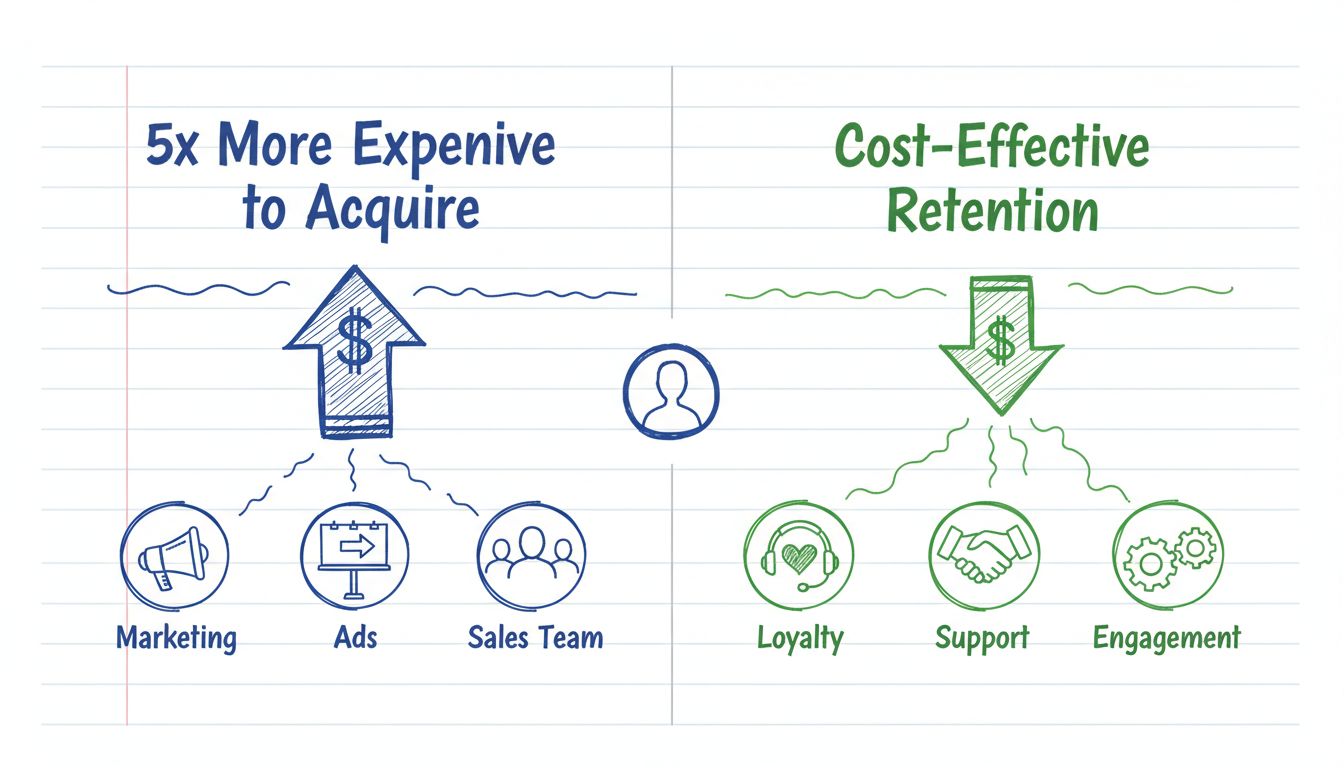
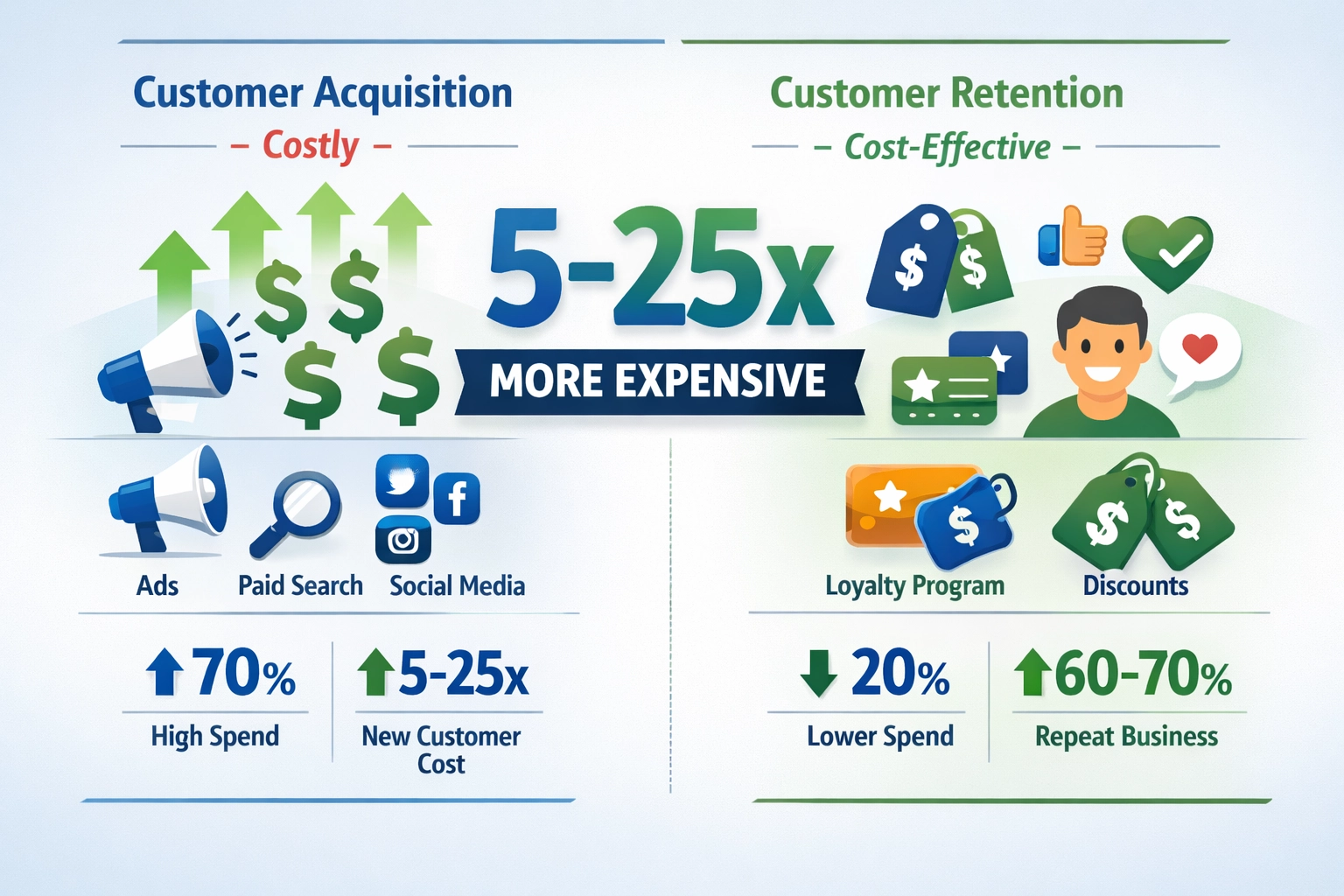
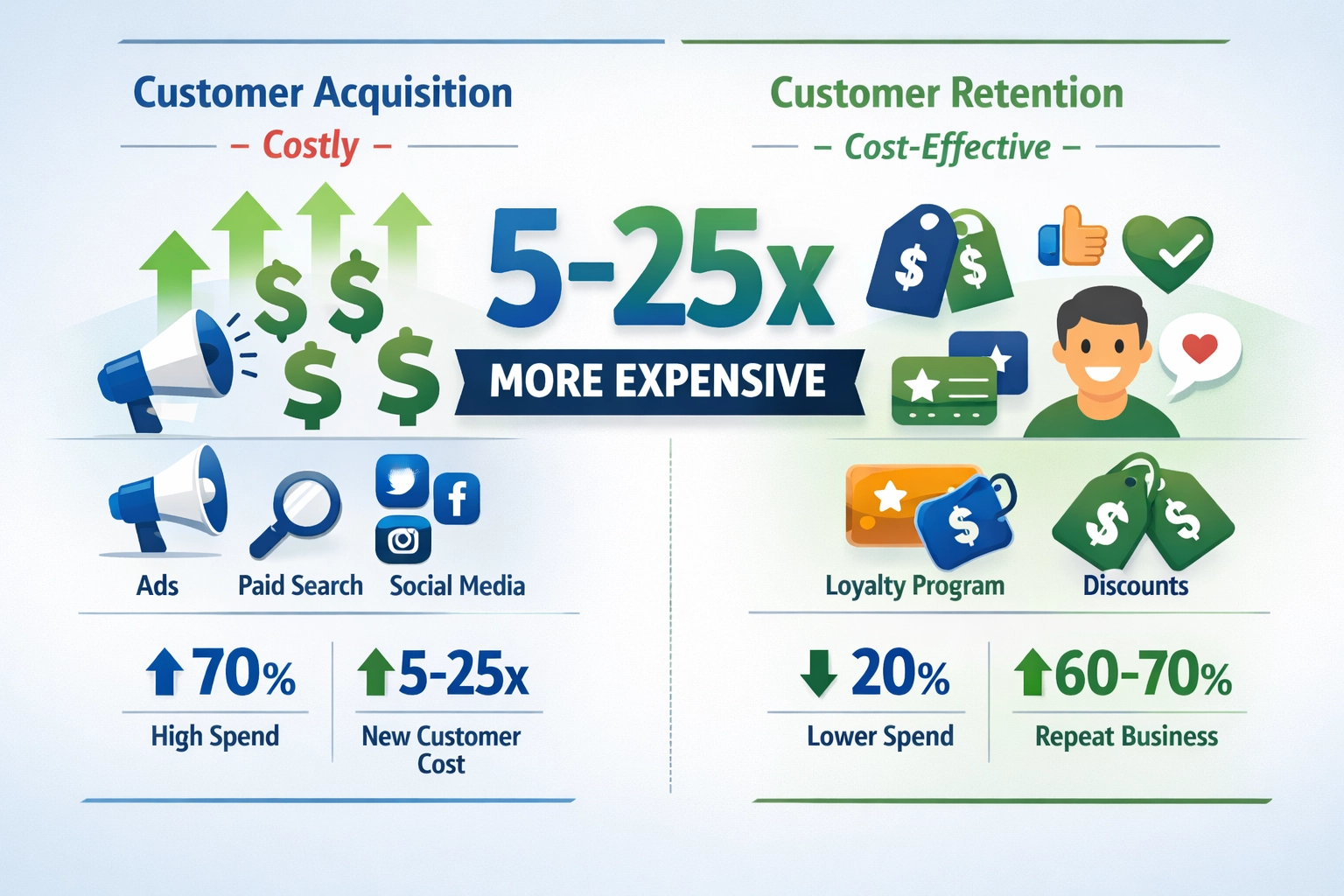
Acquiring new customers costs 5-25 times more than retaining existing ones, a finding consistently supported by Bain & Company research that has become a cornerstone of modern business strategy. This dramatic cost differential directly impacts your bottom line, making customer retention one of the most powerful levers for profitability growth. The difference becomes even more striking when examining conversion success rates: businesses enjoy a 60-70% success rate when selling to existing customers, compared to just 5-20% success rate with new prospects. This means not only are you spending significantly less to retain customers, but you’re also far more likely to succeed in your retention efforts. Understanding this fundamental economics of customer relationships is essential for any business looking to optimize its marketing spend and maximize shareholder value.
To truly grasp why retention is more cost-effective, you need to understand Customer Acquisition Cost (CAC), calculated using the formula: CAC = (Total Cost of Sales & Marketing) / (Number of New Customers Acquired). This includes all advertising spend, sales team salaries, creative production costs, technical infrastructure costs, and content publishing expenses—a comprehensive accounting that often surprises business leaders with its magnitude. Customer Retention Cost, by contrast, focuses on maintaining existing relationships through customer service, loyalty programs, and targeted engagement initiatives, typically representing a fraction of acquisition expenses. The health of your business is measured by the CLV:CAC ratio, where a healthy ratio sits at 3:1 or higher, meaning your customer lifetime value should be at least three times your acquisition cost. Exceptional businesses achieve a 5:1 ratio or higher, indicating they’ve mastered the art of acquiring customers efficiently while maximizing their long-term value. This metric serves as a critical diagnostic tool for evaluating whether your customer acquisition strategy is sustainable and profitable.
| Metric | Definition | Importance |
|---|---|---|
| CAC | Total marketing & sales costs ÷ new customers acquired | Measures acquisition efficiency |
| CRC | Total retention costs ÷ active customers | Measures retention efficiency |
| CLV | Average purchase value × frequency × customer lifespan | Predicts total customer value |
| CLV:CAC Ratio | Customer lifetime value ÷ acquisition cost | Indicates business sustainability |
| Churn Rate | Customers lost ÷ total customers | Identifies retention problems |

Set up advanced tracking in minutes. No credit card required.
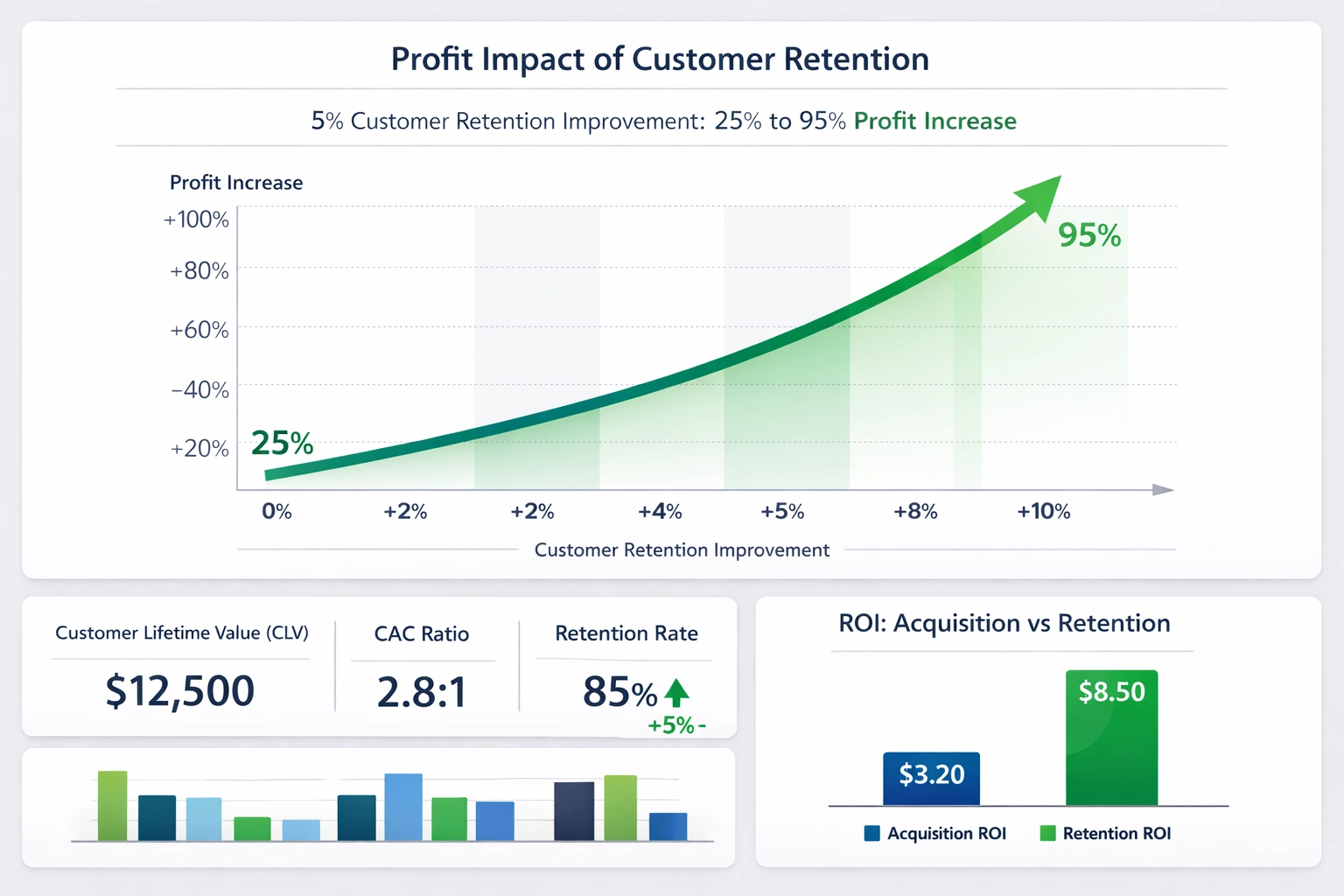
Bain & Company’s landmark research reveals that a mere 5% increase in customer retention can boost profits by 25-95%, a range that varies by industry but consistently demonstrates the outsized impact of retention on the bottom line. This dramatic profit acceleration occurs because repeat customers spend more over time, require less education about your products or services, and generate increasingly predictable revenue streams that improve financial forecasting. Existing customers also cost significantly less to serve operationally—they understand your systems, require less onboarding support, and typically have fewer implementation challenges than new customers. The compounding effect of retention becomes evident when you consider that a loyal customer base generates recurring revenue with minimal additional marketing investment, creating a virtuous cycle of profitability. For SaaS companies specifically, improving retention by just 10% can increase lifetime value by 25-30%, fundamentally transforming the unit economics of the business. This is why retention-focused strategies consistently deliver superior returns compared to acquisition-heavy approaches that require constant capital investment to maintain growth.
Existing customers already know and trust your brand, eliminating the substantial educational and trust-building costs required for new customer acquisition. This foundational advantage translates into measurable cost savings across multiple dimensions:
These interconnected advantages compound over time, making retention not just a cost-saving measure but a strategic imperative for sustainable business growth.
Be the first to know about new features and product updates.
Loyalty programs represent one of the most effective mechanisms for increasing customer retention, delivering 15-45% retention improvements depending on program design and industry context. Tiered loyalty programs prove particularly effective, with SaaS companies seeing 25-35% retention increases and premium service providers achieving 30-40% improvements, demonstrating that structured reward systems drive measurable behavioral change. These programs work by creating psychological commitment—customers who earn rewards develop a sense of investment in the brand and feel motivated to continue their relationship to unlock additional benefits. Modern loyalty programs enhance this effect through personalization, tailoring rewards and communications to individual customer preferences and purchase history, which increases perceived value and engagement. Customers enrolled in tiered loyalty programs spend 20-40% more than non-members, proving that well-designed programs simultaneously improve retention and increase customer lifetime value. The combination of psychological commitment, tangible rewards, and personalized experiences makes loyalty programs a cornerstone of effective retention strategies that deliver measurable ROI.
| Program Type | Best For | Retention Lift |
|---|---|---|
| Points-Based Systems | E-commerce, Retail | 15-25% |
| Tiered Programs | SaaS, Subscriptions | 25-35% |
| Exclusive Access | Premium Services | 30-40% |
| Hybrid Models | Multi-channel Businesses | 35-45% |
Converting your best customers into affiliates represents a sophisticated retention strategy that simultaneously drives acquisition, creating a dual-benefit model that dramatically improves unit economics. When customers become invested in promoting your products as affiliates, their lifetime value increases substantially because they’re now generating revenue for themselves while deepening their commitment to your brand’s success. This approach leverages powerful psychological principles: customers who invest effort in promoting your brand experience cognitive consistency (the desire to align their actions with their identity), develop stronger community connections with other affiliates, and feel genuine ownership in the company’s success. PostAffiliatePro enables this strategy by providing the infrastructure to easily convert customers into affiliates, track their performance, and reward their contributions—transforming satisfied customers into active brand advocates. Affiliate programs create a self-reinforcing retention mechanism where your most loyal customers become your most effective marketers, generating new customer acquisition at a fraction of traditional marketing costs. This approach is particularly cost-effective because you’re leveraging existing customer relationships and trust to drive new business, eliminating the expensive awareness-building phase of traditional acquisition. By positioning your customer base as potential affiliates, you unlock a retention strategy that pays for itself through incremental revenue generation.
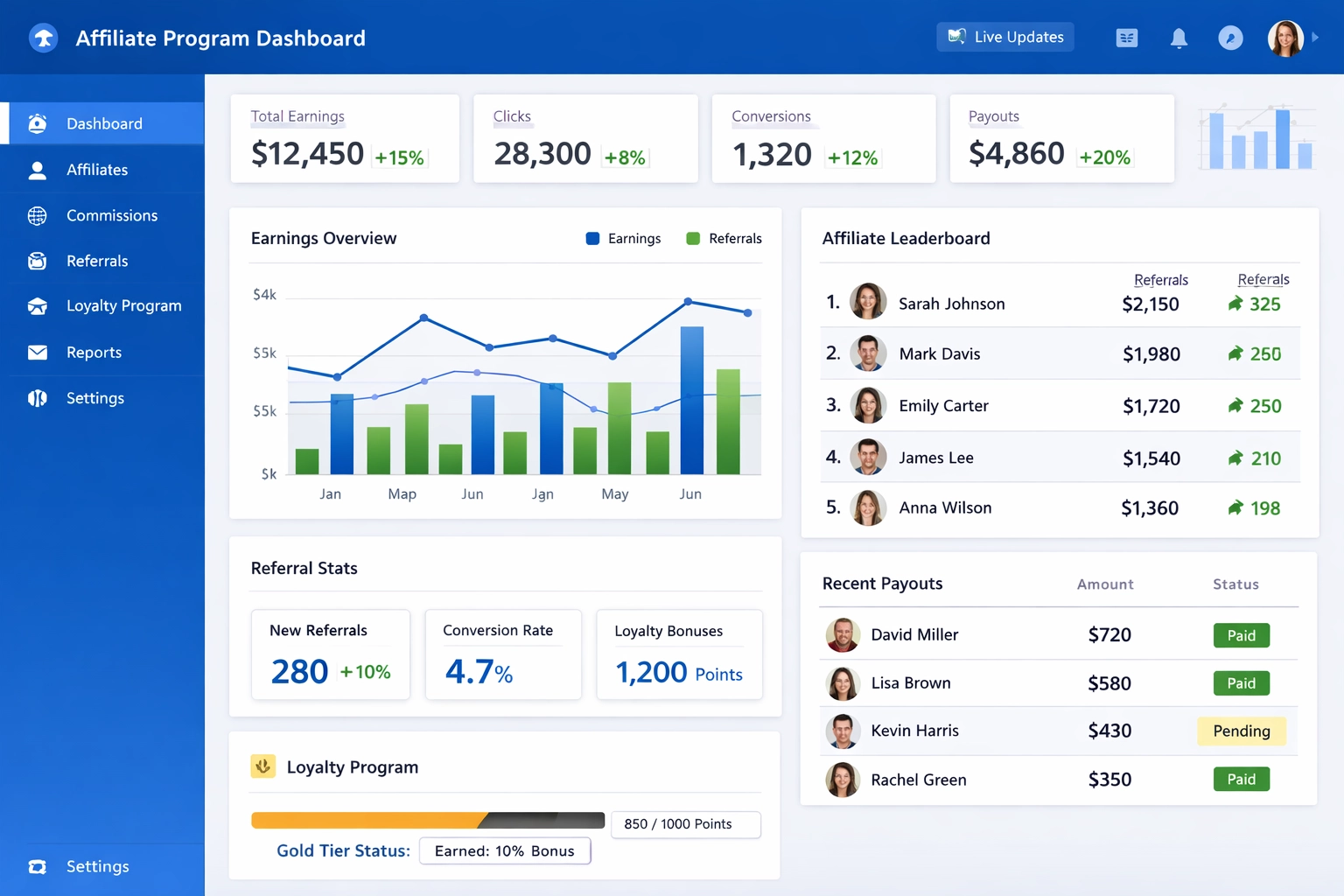
Effective retention strategies require rigorous measurement across multiple dimensions to ensure you’re optimizing the right behaviors and achieving sustainable results. Key metrics include Customer Retention Rate (CRR), which measures the percentage of customers retained over a specific period; Net Revenue Retention (NRR), which accounts for expansion revenue from existing customers; Customer Lifetime Value (CLV), which projects total revenue from a customer relationship; Churn Rate, which identifies the percentage of customers lost; and Net Promoter Score (NPS), which measures customer satisfaction and likelihood to recommend. Each metric provides distinct insights—CRR shows whether you’re keeping customers, NRR reveals whether retained customers are expanding their spending, and NPS indicates whether your retention efforts are creating genuine satisfaction or merely preventing departure. Tracking multiple metrics simultaneously prevents optimization blind spots and ensures your retention strategy addresses both customer satisfaction and revenue growth. Well-executed retention strategies consistently deliver 3-5x ROI within 12 months, making measurement not just important but essential for justifying continued investment in retention initiatives. PostAffiliatePro’s advanced analytics capabilities enable you to track these metrics in real-time, identify trends, and make data-driven decisions that continuously improve your retention performance. This data-driven approach transforms retention from a cost center into a measurable profit driver with clear accountability and optimization pathways.
Implementing effective retention requires a multifaceted approach that addresses customer needs at every stage of their lifecycle and creates consistent reasons to remain engaged with your brand. Personalization stands as a foundational strategy, with research showing that personalized experiences increase customer satisfaction by 20-30% and make customers feel valued rather than treated as generic transactions. Exceptional customer service directly impacts retention, as 58% of customers cite long wait times and poor support as primary frustration drivers, making responsive, helpful support a critical retention lever. Onboarding excellence deserves particular attention because poor onboarding causes disproportionate early churn—customers who experience smooth, well-structured onboarding are significantly more likely to achieve success and remain loyal. Proactive churn prevention involves identifying at-risk customers through behavioral signals and engagement patterns, then intervening with targeted retention offers or support before they decide to leave. Continuous value delivery through regular product improvements, new features, and expanded capabilities ensures customers consistently experience growing value from their investment in your solution. Omnichannel support that meets customers across email, chat, phone, and social channels removes friction from the support experience and demonstrates commitment to customer success. Together, these strategies create a comprehensive retention ecosystem that makes customers feel supported, valued, and motivated to continue their relationship with your brand.
Existing customers already know and trust your brand, eliminating expensive awareness-building and trust-establishment costs. Retention marketing typically costs 50-80% less than acquisition marketing because you're reinforcing existing relationships rather than starting from scratch. Additionally, existing customers have higher conversion rates (60-70% vs 5-20% for new prospects) and require less sales effort.
The CLV:CAC ratio measures the relationship between Customer Lifetime Value and Customer Acquisition Cost. A healthy ratio is 3:1 or higher, meaning your customer lifetime value should be at least three times your acquisition cost. Exceptional businesses achieve 5:1 ratios or higher. This metric helps you evaluate whether your customer acquisition strategy is sustainable and profitable.
According to Bain & Company research, a mere 5% increase in customer retention can boost profits by 25-95%, depending on your industry. This dramatic impact occurs because repeat customers spend more over time, require less education, and generate increasingly predictable revenue streams with minimal additional marketing investment.
Effective retention strategies include loyalty programs (15-45% retention improvement), affiliate marketing (converting customers to advocates), personalization (20-30% satisfaction increase), exceptional customer service, onboarding excellence, and proactive churn prevention. The most successful businesses combine multiple strategies to create a comprehensive retention ecosystem.
Converting your best customers into affiliates increases their lifetime value while creating a dual-benefit model: retention plus acquisition. Customers who become affiliates develop deeper investment in your success, experience cognitive consistency through promoting products they use, and build community connections with other affiliates. This creates a self-reinforcing retention mechanism.
Key retention metrics include Customer Retention Rate (CRR), Net Revenue Retention (NRR), Customer Lifetime Value (CLV), Churn Rate, and Net Promoter Score (NPS). Tracking multiple metrics prevents optimization blind spots and ensures your retention strategy addresses both customer satisfaction and revenue growth. Well-executed retention strategies deliver 3-5x ROI within 12 months.
Loyalty programs increase retention by 15-45% depending on design and industry. They work by creating psychological commitment—customers who earn rewards feel invested in your brand and motivated to continue their relationship. Tiered programs are particularly effective, with customers in tiered programs spending 20-40% more than non-members. Personalization enhances effectiveness by tailoring rewards to individual preferences.
Customer Acquisition Cost (CAC) includes all advertising, sales team salaries, creative production, technical infrastructure, and content publishing expenses needed to convert prospects into customers. Retention Cost focuses on maintaining existing relationships through customer service, loyalty programs, and engagement initiatives. Retention costs typically represent a fraction of acquisition expenses, making retention significantly more cost-effective.
PostAffiliatePro helps you retain customers while expanding revenue through strategic affiliate partnerships and loyalty programs. Start building your retention engine today.
Discover why acquiring new customers costs 5-25x more than retention. Learn cost-effective retention strategies to maximize customer lifetime value and boost pr...

Discover 7 proven customer retention strategies to reduce churn, boost loyalty, and increase revenue with effective retention programs.

Discover whether to focus on acquiring new customers or retaining existing ones. Learn costs, benefits, and strategies for balancing both.
Join our community of happy clients and provide excellent customer support with Post Affiliate Pro.




Cookie Consent
We use cookies to enhance your browsing experience and analyze our traffic. See our privacy policy.