


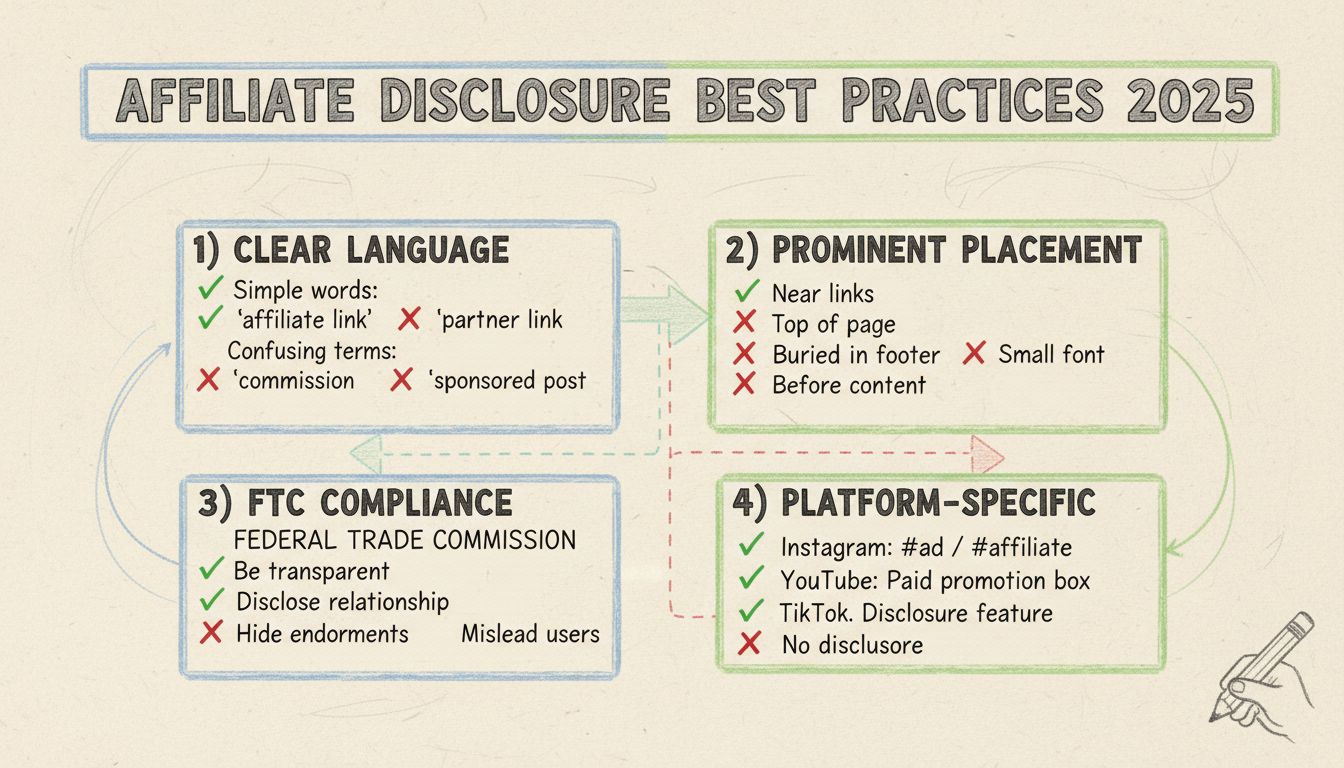
What Should I Write in an Affiliate Disclosure? Complete 2025 Guide
Learn how to write effective affiliate disclosures that comply with FTC regulations, build trust with your audience, and protect your affiliate marketing busine...
10 min read


why affiliate link disclosure matters for legal compliance and audience trust. FTC requirements, best practices, and how to disclose properly across all
An affiliate link disclosure is a transparent statement that informs your audience about any material connection you have with the brands or products you’re promoting. A material connection exists whenever you receive compensation—whether monetary, free products, exclusive access, or other benefits—for endorsing or recommending a product or service. The Federal Trade Commission (FTC) requires these disclosures under its Endorsement Guides to ensure consumers understand that your recommendation may be influenced by financial incentives. Why does transparency matter? Because when audiences know you’re being compensated, they can make more informed purchasing decisions and trust that you’re being honest about your relationship with the brand. Without clear disclosure, consumers may feel deceived, which damages both your credibility and the brand’s reputation in the long term.

The FTC Endorsement Guides, last updated in June 2023, establish clear standards for how endorsements and affiliate relationships must be disclosed. According to these guidelines, a material connection includes any financial relationship (commissions, payments, free products), employment relationship, or personal connection that could influence your endorsement. The FTC requires that disclosures be clear and conspicuous—meaning they must be noticeable, readable, and understandable without requiring consumers to click additional links or search for information. Disclosures must appear before or near the affiliate link, not buried in fine print or at the bottom of a page. Violations of FTC guidelines can result in significant consequences: the FTC can impose civil penalties up to $51,744 per violation, affiliate programs can suspend or terminate your account, and you may face legal liability. The 2023-2024 FTC updates emphasize that platform labels alone (like Instagram’s “Paid Partnership” tag) are insufficient—you must include your own plain-language disclosure in the content itself.
| FTC Requirement | Common Mistake |
|---|---|
| Disclosure near the link | Placing disclosure only in footer or sidebar |
| Clear, simple language | Using vague terms like “(Affiliate)” without explanation |
| Visible before clicking | Hiding disclosure behind “Read More” buttons |
| Consistent disclosure | Disclosing some links but not others |
| Plain English explanation | Relying solely on hashtags like #Affiliate |

Set up advanced tracking in minutes. No credit card required.
Research shows that 57% of consumers value transparency as the most important quality they seek in influencers and content creators, making disclosure a critical trust-building tool. When you disclose affiliate relationships, you demonstrate integrity and respect for your audience’s intelligence—you’re essentially saying, “I’m being paid for this recommendation, but I genuinely believe in the product.” This transparency prevents the audience from feeling manipulated or deceived when they later discover the financial relationship. The long-term benefits are substantial: audiences who understand your disclosure are more likely to trust your future recommendations, engage with your content more consistently, and become loyal followers. Studies indicate that transparent affiliates experience higher conversion rates and better audience retention because consumers appreciate the honesty. Additionally, when your audience trusts you, they’re more likely to recommend your content to others, creating organic growth that far exceeds what deceptive practices could achieve.
Different affiliate programs have specific disclosure requirements you must follow to maintain your account in good standing. Amazon Associates explicitly requires that you include a legally compliant disclosure with your links and identify yourself as an Associate on your site—failure to do so can result in immediate account termination. Other major programs like ShareASale, CJ Affiliate, Impact.com, and Rakuten Advertising have similar mandatory disclosure policies. Here’s what you need to know about program-specific requirements:
Reading and understanding your affiliate program’s terms of service is essential—many affiliates lose their accounts not because they’re promoting poorly, but because they failed to comply with disclosure requirements. Tools like PostAffiliatePro can help you manage and track compliance across multiple programs by centralizing your affiliate links and ensuring consistent disclosure practices.
Be the first to know about new features and product updates.
Effective disclosure strategies vary by platform, and understanding where and how to disclose is crucial for compliance and audience trust. Here’s how to implement disclosures across different channels:
Blog Posts: Place your disclosure at the top of the article, before any affiliate links appear. Include a statement like “This post contains affiliate links. I may earn a commission if you purchase through these links at no extra cost to you.” You can also add inline disclosures near specific product recommendations.
YouTube Videos: Include a verbal disclosure early in the video (“I have affiliate links in the description below”), add on-screen text that appears for at least 5 seconds, and include a clear statement in the video description above the “Show More” button.
Social Media (Instagram, TikTok, X): Use Instagram’s “Paid Partnership” label when available, but also include #ad or #sponsored in the caption itself. Place your disclosure in the first line of the caption or before the “More” button so it’s visible without clicking.
Email Newsletters: Include a clear statement at the beginning or end of the email: “Some links in this newsletter are affiliate links. I earn a small commission if you purchase through them, at no extra cost to you.”
Podcasts: Mention your affiliate relationships verbally at the beginning of the episode and include written disclosures in the show notes. For example: “I want to be transparent—I have affiliate relationships with the products I’m recommending today.”
Even well-intentioned affiliates often make critical mistakes that put them out of compliance. Here are the most common errors and how to avoid them:
Relying only on platform labels: Many creators assume that Instagram’s “Paid Partnership” tag or YouTube’s sponsorship disclosure is sufficient. It’s not. The FTC requires your own disclosure in plain language within the content itself, not just platform-provided labels.
Burying disclosure in fine print: Placing your disclosure at the bottom of a blog post, in tiny font, or in a footnote doesn’t meet FTC standards. Disclosures must be “clear and conspicuous”—easily noticeable and readable without effort.
Using vague or unclear language: Saying “(Affiliate)” or “#Affiliate” without explanation confuses audiences who may not understand what affiliate marketing means. Use plain language like “I earn a commission” or “This is an affiliate link.”
Inconsistent disclosure: Disclosing some affiliate links but not others creates legal liability. If you’re compensated for promoting a product, you must disclose it every single time, regardless of the platform or format.
Forgetting to disclose all compensation types: Many affiliates only disclose monetary commissions but forget about free products, exclusive discounts, or performance bonuses. All forms of compensation must be disclosed.
The key to effective disclosure is using simple, direct language that your audience immediately understands. Avoid jargon, legal terminology, or complex sentence structures. Here are examples of strong disclosure statements:
Good Examples:
- “I earn a commission if you purchase through this link at no extra cost to you.”
- “This post contains affiliate links. I may receive a small commission if you buy through them.”
- “Full transparency: I’m an Amazon Associate and earn from qualifying purchases.”
- “I was gifted this product in exchange for an honest review.”
Your tone should be authentic and conversational, matching the voice you use elsewhere in your content. Avoid defensive language like “I’m required to tell you…” or “The FTC makes me say…” Instead, frame disclosure as a natural part of your relationship with your audience. You can personalize your disclosure while staying compliant: “I genuinely love this product, and I’m excited to share it with you. As an affiliate, I earn a small commission if you decide to purchase.” This approach maintains authenticity while clearly communicating the material connection.

The consequences of failing to disclose affiliate relationships extend far beyond a simple warning. The FTC has taken enforcement action against numerous influencers, brands, and companies for inadequate or missing disclosures. In 2024-2025, the FTC intensified its focus on affiliate disclosure compliance, issuing warning letters to companies and pursuing cases against influencers with millions of followers. Notable enforcement actions have resulted in settlements requiring companies to pay substantial fines and implement comprehensive disclosure policies. Beyond FTC penalties, non-disclosure can result in affiliate program suspension or termination, meaning you lose all future commission income from that program. Perhaps most damaging is the loss of audience trust—when followers discover you’ve been hiding affiliate relationships, they feel betrayed and are unlikely to engage with your content again. You may also face legal liability from consumers who claim they were deceived, and brands may pursue legal action against you for violating their affiliate agreements. Recent FTC cases in 2024 have targeted influencers across beauty, fitness, and tech niches, demonstrating that the agency is actively monitoring compliance across all industries.
Managing affiliate disclosures across multiple platforms and programs requires organization and consistency. Several tools and systems can help you maintain compliance:
Content Management Systems (CMS): WordPress plugins like “Affiliate Disclosure” or “ThirstyAffiliates” automatically insert disclosure statements near your affiliate links, ensuring consistency across all posts.
Affiliate Tracking Tools: Platforms like PostAffiliatePro, Impact.com, and Refersion provide centralized dashboards where you can manage all your affiliate links, track which ones need disclosure, and generate compliance reports.
Spreadsheet Auditing: Create a simple spreadsheet listing all your affiliate links, the programs they belong to, where they’re published, and whether they have proper disclosure. Review this monthly to catch any gaps.
PostAffiliatePro Features: This platform offers built-in compliance tracking, automated disclosure templates, and reporting features that help you document your disclosure practices for FTC audits.
Regular Audit Schedules: Set a monthly reminder to audit your content for disclosure compliance. Check blog posts, social media profiles, email archives, and video descriptions to ensure every affiliate link has proper disclosure.
Implementing these systems takes initial effort but saves time and protects you from costly compliance violations. Many successful affiliates spend 30 minutes monthly on compliance audits, which is far less than the time and money spent dealing with FTC investigations or program terminations.
Affiliate disclosure requirements extend beyond the United States, and if you have an international audience or operate in multiple countries, you must understand local regulations. GDPR (General Data Protection Regulation) in the European Union requires transparent disclosure of any data collection and commercial relationships, including affiliate arrangements. The UK Advertising Standards Authority (ASA) mandates that ads must be clearly identifiable as such, with affiliate relationships disclosed prominently. Canada’s Competition Bureau requires disclosure of material connections in advertising, with similar standards to the FTC. Australia’s ACCC (Australian Consumer and Competition Commission) enforces strict truth-in-advertising laws that include affiliate disclosure requirements. Understanding these international regulations is crucial because violations can result in fines, content removal, and legal action in those jurisdictions. If your content reaches audiences in multiple countries, the safest approach is to follow the strictest standard (typically GDPR or FTC requirements) across all your content, ensuring you’re compliant everywhere your audience is located.
A material connection exists whenever you receive compensation for promoting a product or service. This includes monetary commissions, free products, exclusive access, performance bonuses, or any other benefit that could influence your endorsement. The FTC requires disclosure of all material connections to ensure consumers understand potential bias in your recommendations.
Hashtags alone are insufficient for FTC compliance. While #ad and #sponsored are helpful, they must be supplemented with a clear, plain-language disclosure statement in the content itself. The FTC requires that audiences understand your material connection without having to research what affiliate marketing means.
Place your disclosure as close as possible to the affiliate link or endorsement. For blog posts, include it at the top of the article and near specific product recommendations. For social media, place it in the first line of the caption before the 'More' button. For YouTube, include it verbally, on-screen, and in the description above the 'Show More' button.
Non-disclosure can result in FTC fines up to $51,744 per violation, suspension or termination from affiliate programs, loss of audience trust, and potential legal liability. The FTC actively enforces disclosure requirements and has taken action against numerous influencers and brands in 2024-2025 for inadequate disclosures.
Yes. If you receive any compensation for promoting a product or service, you must disclose it every single time you mention that product, regardless of the platform or format. Inconsistent disclosure creates legal liability and undermines audience trust.
Conduct a comprehensive audit of your affiliate disclosures at least monthly. Review all blog posts, social media profiles, email archives, and video descriptions to ensure every affiliate link has proper disclosure. Many successful affiliates spend 30 minutes monthly on compliance audits to prevent violations.
While you can use similar language, each platform has specific requirements. Blog posts allow longer disclosures, while social media requires brevity. YouTube requires verbal, on-screen, and written disclosures. Customize your disclosure to fit each platform's format while maintaining the same core message about your material connection.
PostAffiliatePro provides centralized affiliate link management, compliance tracking, automated disclosure templates, and reporting features that help you document your disclosure practices. The platform allows you to manage multiple affiliate programs from one dashboard, ensuring consistent disclosure across all your channels and reducing compliance risks.
PostAffiliatePro helps you maintain compliance while growing your affiliate network. Track disclosures, manage partners, and ensure transparency across all channels.
Learn how to write effective affiliate disclosures that comply with FTC regulations, build trust with your audience, and protect your affiliate marketing busine...
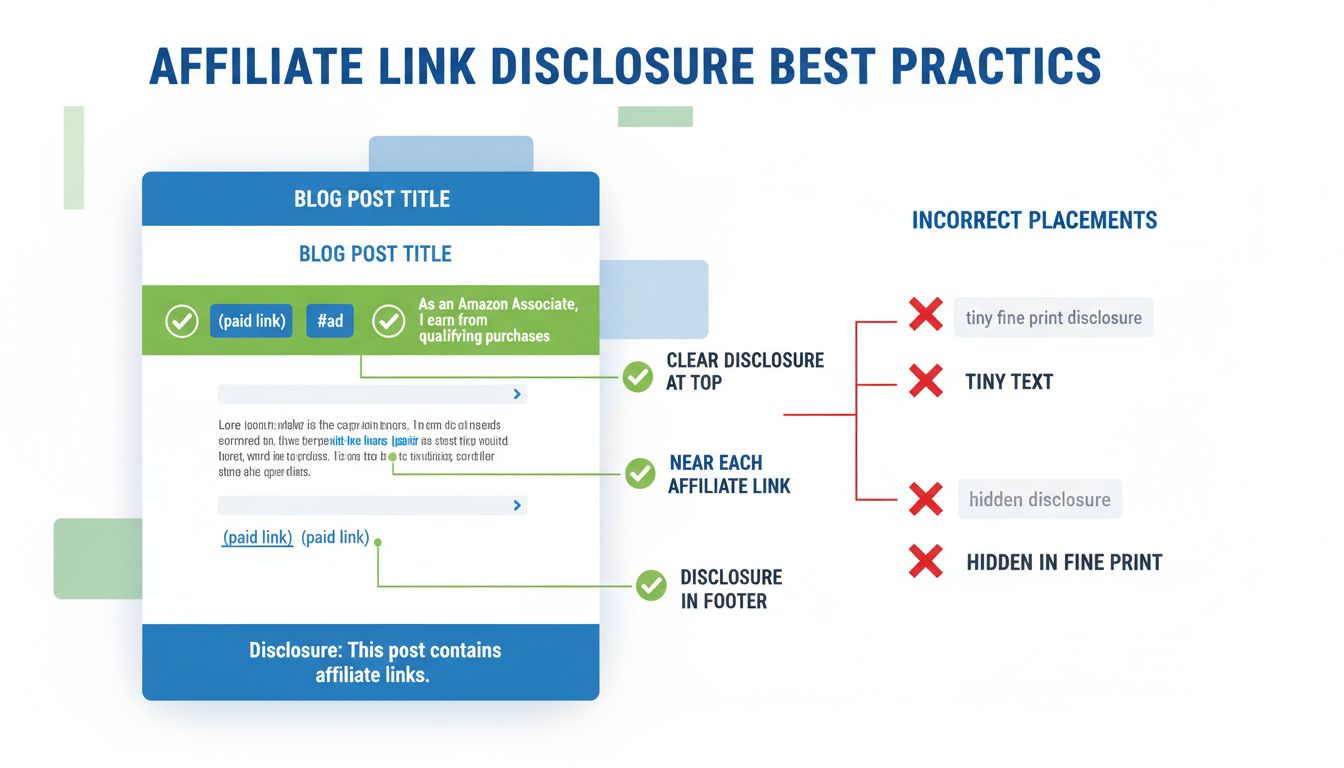
Learn why affiliate link disclosure is crucial for legal compliance, audience trust, and ethical marketing. Discover FTC requirements, best practices, and discl...
A disclosure is an information or notification on website advising visitors, that they are on affiliate’s website. It informs customers about affiliates.
Join our community of happy clients and provide excellent customer support with Post Affiliate Pro.




Cookie Consent
We use cookies to enhance your browsing experience and analyze our traffic. See our privacy policy.