



How to Prevent Affiliate Fraud
Learn proven strategies to prevent affiliate fraud in 2025. Discover monitoring techniques, fraud detection tools, and best practices to protect your affiliate ...
14 min read


about affiliate fraud types including cookie stuffing, bot traffic, and typosquatting. detection methods and prevention strategies to protect your affiliate

Affiliate fraud is a form of deception within affiliate marketing where fraudsters exploit the system to generate undeserved commissions by manipulating tracking systems or user behavior. This silent revenue leak costs businesses over $1.4 billion annually, making it one of the most pressing challenges in the digital marketing industry. Unlike legitimate affiliates who drive genuine sales and build real customer relationships, fraudulent affiliates use sophisticated tactics to trick systems into attributing conversions they didn’t earn. Understanding what affiliate fraud is and how it operates is essential for any business running an affiliate program.
Affiliate fraud operates by exploiting vulnerabilities in attribution logic and tracking systems that affiliate programs rely on. Fraudsters employ various techniques ranging from basic to highly sophisticated methods to deceive tracking systems into crediting them with sales, clicks, or leads they didn’t generate. The fundamental principle behind all affiliate fraud is simple: trick the system into thinking a fraudster caused a conversion when they actually had no role in the customer’s journey. Because affiliate marketing is largely automated with minimal human oversight, fraudsters have numerous opportunities to manipulate operations and twist them to their advantage. The key to understanding how fraud works is recognizing that each pricing model used in affiliate marketing—whether cost-per-action, cost-per-lead, or pay-per-click—has specific vulnerabilities that bad actors can exploit.

Set up advanced tracking in minutes. No credit card required.
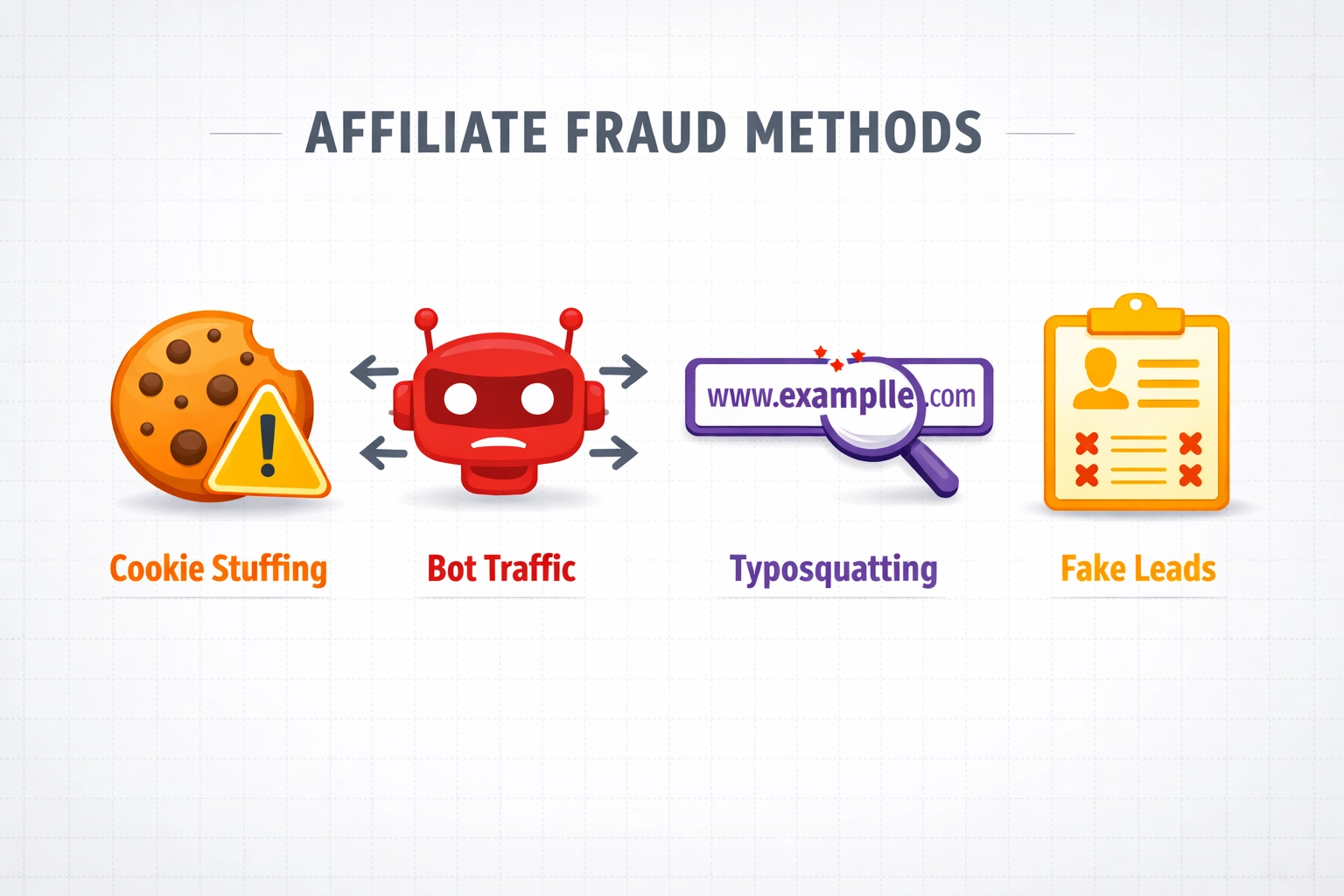
Understanding the specific methods fraudsters use is critical for developing effective prevention strategies. Here’s a detailed breakdown of the most common affiliate fraud types:
| Fraud Type | How It Works | Impact | Detection |
|---|---|---|---|
| Cookie Stuffing | Fraudsters place multiple tracking cookies on a user’s browser without knowledge or consent. When the user later makes a purchase from any merchant, the scammer claims the commission despite having no role in the sale. | Legitimate affiliates lose commissions; advertisers pay for undeserved credits; violates GDPR compliance | Monitor for unusual cookie patterns; track cookie-to-conversion ratios; implement device fingerprinting |
| Bot Traffic | Automated bots or scripts simulate human behavior including clicks, visits, and conversions. Sophisticated fraud rings even simulate complete buyer journeys (clicking, browsing, purchasing) to appear legitimate. | Inflates metrics; wastes ad budget; distorts analytics; misleads performance data | Analyze traffic patterns for inhuman behavior; monitor IP addresses for bot signatures; check for identical device configurations |
| Typosquatting (URL Hijacking) | Fraudsters register domain names similar to popular brands but with intentional misspellings. When users accidentally type the wrong URL, they land on the fraudster’s site and are redirected to the legitimate site via the scammer’s affiliate link. | Hijacks legitimate traffic; damages brand reputation; steals commissions from real affiliates | Monitor for similar domain registrations; track referral sources; check for unusual redirect patterns |
| Fake Leads | Scammers use bots or click farms to generate fake form submissions, sign-ups, or lead captures that meet tracking criteria but hold no real value. These fake leads waste sales team time and damage conversion metrics. | Wastes resources; damages lead quality metrics; reduces ROI on marketing spend | Monitor lead-to-customer conversion rates; check for duplicate email addresses; analyze lead quality patterns |
Beyond the primary fraud types, fraudsters employ several other sophisticated techniques to steal commissions. Ad Hijacking involves bidding on branded keywords or copying merchant ad creatives to make it appear the fraudster is the legitimate brand, earning commissions when users click and purchase. Website Cloning creates nearly identical copies of legitimate sites to trick users into thinking they’re on the original, capturing clicks or sales through the fraudster’s affiliate link. Malicious Adware tricks users into downloading spyware that tracks their browsing and forces them to use the affiliate’s link, ensuring the fraudster gets a commission on every purchase. Stolen Credit Card Fraud uses stolen payment information to make fake purchases and claim commissions before the real cardholder disputes the charge. Account Selling involves purchasing pre-activated affiliate accounts from online marketplaces to impersonate established affiliates with good reputations. These methods demonstrate the creativity and persistence of fraudsters in finding new ways to exploit affiliate programs.
Be the first to know about new features and product updates.
The consequences of affiliate fraud extend far beyond simple financial loss. Businesses lose over $1.4 billion annually to fraudulent affiliate activities, with some estimates suggesting the true figure is even higher when accounting for undetected fraud. Beyond direct financial losses, affiliate fraud damages the reputation of legitimate affiliate programs and erodes trust between merchants and publishers. When fraud goes undetected, honest affiliates become frustrated seeing their commissions diluted by fraudulent activity, leading many to abandon affiliate programs entirely. The industry-wide impact is significant: fraud undermines the integrity of performance marketing, increases customer acquisition costs, and creates skepticism about affiliate channel ROI. For individual businesses, undetected fraud can represent 10-30% of affiliate program costs, directly impacting profitability and marketing efficiency.
Detecting affiliate fraud requires a multi-layered approach combining technology and human oversight. Key detection methods include:

Preventing affiliate fraud requires a proactive, multi-faceted approach that combines clear policies, careful affiliate selection, and robust technology. Establish Clear Terms and Conditions by explicitly prohibiting cookie stuffing, trademark bidding, fraudulent traffic, bot usage, and other black-hat techniques in your affiliate agreement, then enforce these rules strictly by removing violators immediately. Implement Manual Affiliate Approval rather than allowing automatic sign-ups—screen applicants by reviewing their websites, asking about promotional methods, checking social presence, and prioritizing quality over quantity. Use Multi-Touch Attribution instead of last-click attribution, which is easy to game; multi-touch models account for the entire customer journey and make fraud more difficult to execute. Cap Commissions and Delay Payouts by introducing holding periods before paying commissions, particularly for high-risk actions like app installs or free trial sign-ups, giving you time to validate performance and identify fake conversions. Deploy Fraud Detection Tools such as specialized affiliate fraud detection platforms that monitor traffic patterns, device fingerprinting, and behavioral anomalies in real-time. Implement Affiliate Tracking Software with built-in anti-fraud features that provide visibility into affiliate performance, traffic sources, and conversion quality. Set Up Automated Alerts by creating rules in your affiliate platform to flag suspicious activity like more than 10 clicks from the same IP, leads from suspicious email domains, or abnormally high earnings. Educate Your Team on fraud indicators and ensure regular monitoring of affiliate performance metrics to catch issues early.
PostAffiliatePro stands out as the leading affiliate management platform for businesses serious about preventing fraud while maximizing legitimate affiliate revenue. The platform provides comprehensive fraud detection capabilities including real-time traffic monitoring, device fingerprinting analysis, and behavioral pattern recognition that identifies suspicious activity before it impacts your bottom line. PostAffiliatePro’s advanced attribution system uses multi-touch attribution models that make it significantly harder for fraudsters to game the system compared to last-click attribution. The platform includes built-in compliance tools that help you enforce affiliate agreements, automatically flag policy violations, and manage affiliate removals efficiently. With detailed analytics and reporting, PostAffiliatePro gives you complete visibility into affiliate performance, traffic sources, conversion quality, and refund patterns, enabling data-driven decisions about affiliate partnerships. The flexible commission management features allow you to implement holding periods, cap commissions, and set up automated alerts for suspicious activity. Unlike competitors, PostAffiliatePro combines powerful fraud prevention with an intuitive interface that doesn’t require extensive technical expertise, making it accessible for businesses of all sizes. The platform’s proven track record with thousands of merchants demonstrates its effectiveness in protecting affiliate programs while maintaining healthy relationships with legitimate affiliates.
Affiliate fraud represents a significant threat to any business running an affiliate program, but it’s not inevitable. By understanding the various fraud methods, implementing detection systems, and establishing clear prevention strategies, you can protect your program while maintaining profitable relationships with legitimate affiliates. The key is vigilance—regular monitoring, careful affiliate selection, and investment in fraud detection technology create multiple barriers that make your program an unattractive target for fraudsters. PostAffiliatePro provides the tools and features you need to run a secure, profitable affiliate program that rewards genuine value creators while blocking bad actors. Don’t let affiliate fraud eat into your profits; take action today to protect your business and build a trustworthy affiliate ecosystem.
Cookie stuffing and fake lead generation are among the most widespread forms of affiliate fraud because they are relatively easy to execute and difficult to detect without proper monitoring. Cookie stuffing involves placing multiple tracking cookies on a user's browser without their knowledge, while fake leads are generated using bots or click farms to create the illusion of legitimate customer referrals.
Affiliate fraud costs businesses over $1.4 billion annually according to industry research. However, this figure likely represents only detected fraud, and the true cost is likely significantly higher when accounting for undetected fraudulent activity. For individual businesses, undetected fraud can represent 10-30% of affiliate program costs.
Yes, in many cases affiliate fraud is illegal. Practices like cookie stuffing, bot usage, identity theft, and using stolen credit cards violate both affiliate program policies and cybercrime laws. Depending on the jurisdiction and specific fraud method, perpetrators can face civil lawsuits, criminal charges, and significant penalties.
You can detect affiliate fraud by monitoring traffic patterns for unusual spikes, analyzing conversion quality metrics, tracking refund and chargeback rates, implementing device fingerprinting to identify suspicious patterns, and manually reviewing top affiliates. Look for red flags like high click volumes with zero conversions, traffic from blocked domains, and abnormally high earnings in short timeframes.
Leading affiliate fraud detection tools include PostAffiliatePro, ClickPatrol, Forensiq, ClickCease, and TrafficGuard. These platforms provide real-time monitoring, device fingerprinting, behavioral analysis, and automated alerts. PostAffiliatePro stands out for combining powerful fraud prevention with an intuitive interface and comprehensive affiliate management features.
PostAffiliatePro provides comprehensive fraud prevention through real-time traffic monitoring, device fingerprinting analysis, multi-touch attribution models, detailed analytics and reporting, flexible commission management with holding periods, and automated alerts for suspicious activity. The platform gives you complete visibility into affiliate performance while making it significantly harder for fraudsters to game the system.
Yes, fraudsters can use VPNs and proxies to mask their IP addresses and hide their location. This is why it's essential to use fraud detection software that monitors beyond just IP addresses, including device IDs, behavioral patterns, device fingerprinting, and conversion quality metrics to identify fraudulent activity regardless of IP masking techniques.
Your affiliate agreement should explicitly prohibit cookie stuffing, trademark bidding, fraudulent traffic generation, bot usage, malicious adware, website cloning, and other black-hat techniques. Include clear consequences for violations, specify approved traffic sources, define quality standards for leads and conversions, and establish your right to audit affiliate activity and remove violators immediately.
PostAffiliatePro provides advanced fraud detection and prevention tools to safeguard your affiliate program and maximize legitimate revenue.
Learn proven strategies to prevent affiliate fraud in 2025. Discover monitoring techniques, fraud detection tools, and best practices to protect your affiliate ...

Discover how Post Affiliate Pro's campaign-specific secret keys strengthen fraud protection in commission tracking with multi-layer security features.

How affiliate management systems detect and prevent fraud in real-time. Fraud detection tools, prevention strategies, and PostAffiliatePro protection.
Join our community of happy clients and provide excellent customer support with Post Affiliate Pro.




Cookie Consent
We use cookies to enhance your browsing experience and analyze our traffic. See our privacy policy.