



Affiliate Management System Benefits for Business Growth
Explore key benefits of affiliate management systems: automated tracking, fraud detection, cost savings, scalability, and more.
9 min read


how third-party affiliate management systems automate tracking, prevent fraud, and scale your affiliate program. key features, benefits, and top platforms.
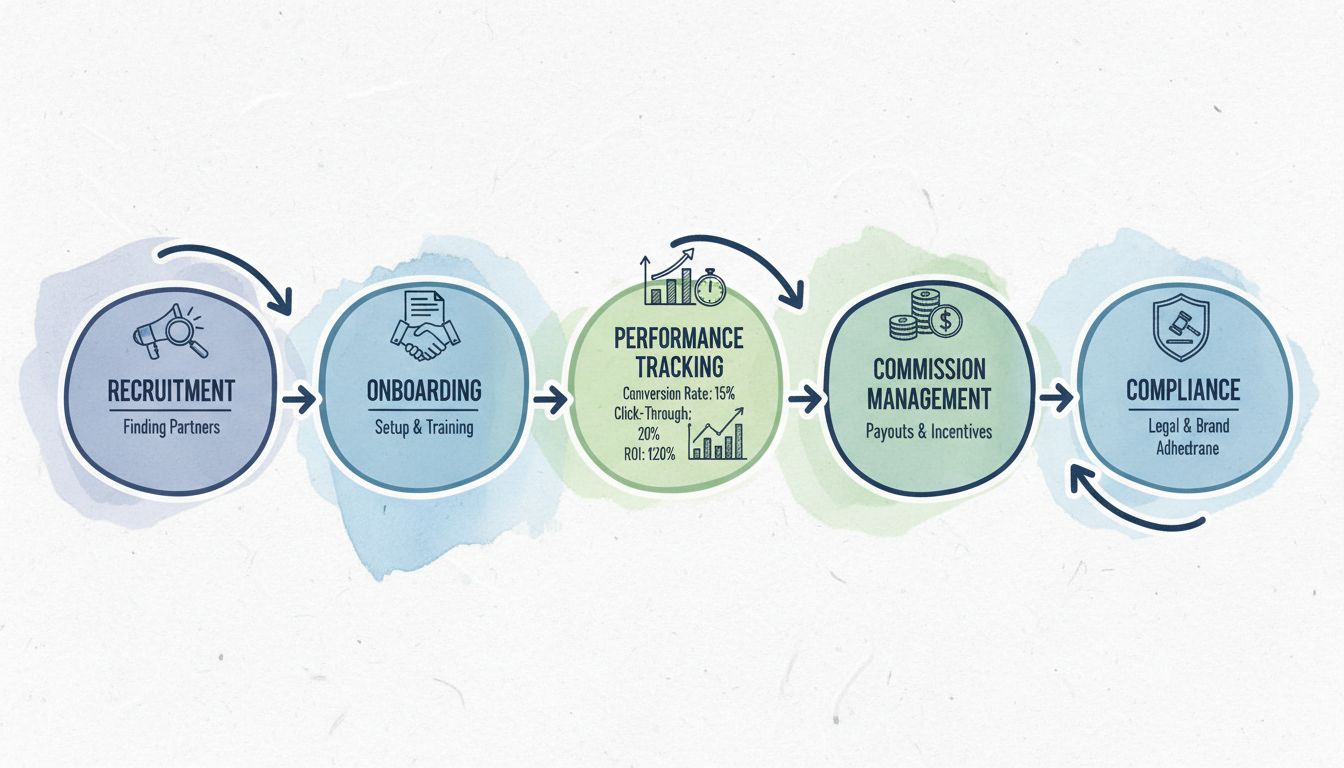
A third-party affiliate management system is a specialized software platform that automates the entire lifecycle of affiliate marketing programs, from partner recruitment and onboarding to commission tracking, payment processing, and performance analytics. Unlike manual affiliate management—which relies on spreadsheets, email communications, and fragmented data sources—these systems provide a centralized hub where businesses can manage hundreds or even thousands of affiliate partners simultaneously with minimal human intervention. The affiliate marketing industry has experienced explosive growth, with the global affiliate marketing market projected to reach $12.7 billion by 2027, growing at a compound annual growth rate of 10.5%, according to recent market research. This rapid expansion has created an urgent need for businesses to move beyond outdated manual processes that simply cannot scale efficiently. Manual tracking introduces numerous pain points: human error in commission calculations, difficulty detecting fraudulent activity, inability to attribute sales across multiple channels, and the sheer administrative burden of managing partner communications and payments. Third-party affiliate management systems solve these challenges by delivering automation, real-time tracking, fraud detection, and comprehensive analytics in a single integrated platform. For businesses serious about growing their affiliate programs, these systems have become essential infrastructure rather than optional tools. By implementing a robust affiliate management system, companies can reduce operational overhead by up to 60%, improve partner satisfaction through transparent tracking and timely payments, and gain the visibility needed to make data-driven decisions about program optimization. Whether you’re a small e-commerce business launching your first affiliate program or an enterprise managing a complex network of partners, understanding how these systems work and what they can deliver is critical to maximizing your affiliate marketing ROI.

Modern third-party affiliate management systems are built around several interconnected features that work together to create a seamless affiliate marketing ecosystem. Real-time tracking stands at the core of these platforms, capturing every click, impression, and conversion as it happens, eliminating the lag time and data gaps inherent in manual tracking methods. This real-time visibility allows businesses to monitor campaign performance instantly and make quick adjustments to optimize results. Multi-channel attribution is another critical capability, enabling companies to understand which affiliate partners are driving sales across email, social media, display advertising, search, and other channels—a task that becomes nearly impossible to manage manually. The system automatically assigns credit to the appropriate partner based on predefined attribution rules, whether you use first-click, last-click, or more sophisticated multi-touch attribution models. Commission calculation and automation eliminate tedious spreadsheet work by automatically computing payouts based on customizable rules, tiered structures, and performance bonuses, then scheduling payments without manual intervention. Fraud detection mechanisms use advanced algorithms and machine learning to identify suspicious patterns such as click fraud, cookie stuffing, and incentivized traffic, protecting your program’s integrity and profitability. Comprehensive reporting and analytics dashboards provide actionable insights into partner performance, conversion rates, customer lifetime value, and program ROI, with customizable reports that can be generated in seconds. The affiliate portal or dashboard gives partners self-service access to their performance metrics, marketing materials, and payment history, improving transparency and reducing support requests. Finally, integrated payment processing handles everything from calculating final commissions to executing bank transfers, often supporting multiple currencies and payment methods for global affiliate networks.
| Feature | Manual Tracking | Third-Party System |
|---|---|---|
| Real-time Data | Delayed (daily/weekly updates) | Instant (real-time) |
| Fraud Detection | Manual review only | Automated AI-powered detection |
| Automated Payouts | Manual calculation & processing | Fully automated |
| Multi-channel Tracking | Difficult to correlate | Seamless attribution |
| Scalability | Limited (breaks at 50+ partners) | Handles thousands of partners |
| Reporting | Static spreadsheets | Dynamic, customizable dashboards |

Set up advanced tracking in minutes. No credit card required.
The business case for implementing a third-party affiliate management system extends far beyond operational convenience. Cost savings represent one of the most immediate benefits, as automation eliminates the need for dedicated staff to manually track commissions, process payments, and manage partner communications—resources that can be redirected toward strategic growth initiatives. Increased accuracy in attribution ensures that partners receive correct commissions and that your business understands exactly which marketing efforts drive revenue, eliminating disputes and building trust in your affiliate relationships. By removing manual bottlenecks, these systems enable faster scaling of affiliate programs; businesses can onboard new partners in minutes rather than days and manage exponential growth without proportional increases in overhead costs. Better partner relationships naturally follow from transparent, automated tracking and reliable, timely payments—partners feel valued when they can see their performance in real-time and receive payments on schedule, leading to higher engagement and better quality traffic. Compliance and security are built into enterprise-grade systems, which maintain audit trails, enforce data protection standards, and help businesses meet regulatory requirements across different jurisdictions and industries. The data-driven decision making enabled by advanced analytics allows marketing managers to identify top-performing partners, optimize commission structures, and allocate budgets more effectively based on actual ROI rather than guesswork. Ultimately, third-party affiliate management systems transform affiliate marketing from a labor-intensive, error-prone process into a strategic, scalable channel that drives measurable business outcomes and competitive advantage.
Third-party affiliate management systems employ sophisticated tracking mechanisms to accurately attribute sales and conversions to the correct affiliate partner. At the foundation of this process are unique tracking links or codes assigned to each affiliate, which function as digital fingerprints that identify the source of traffic. When a customer clicks an affiliate’s unique link, the system records this interaction and follows the customer’s journey through the sales funnel. For example, if an affiliate promoting a SaaS platform shares a link like “example.com/?ref=affiliate123,” the system immediately recognizes that traffic originated from that specific partner. Modern affiliate platforms utilize two primary tracking methodologies: cookie-based tracking, which stores information on the customer’s browser for a predetermined period (typically 30-90 days), and server-to-server tracking, which directly communicates between systems without relying on browser cookies. Cookie-based tracking remains popular for its simplicity and cost-effectiveness, though it faces challenges from privacy regulations and browser restrictions. Server-to-server tracking offers greater accuracy and reliability, particularly for mobile app conversions and cross-device scenarios where cookies may not persist. Beyond simple attribution, sophisticated platforms implement multiple attribution models to fairly credit affiliates when multiple partners influence a single conversion. First-click attribution credits the initial touchpoint that introduced the customer, last-click attribution rewards the final affiliate interaction before purchase, while multi-touch attribution distributes credit across all contributing partners based on predetermined weightings. The conversion validation process adds another critical layer, where the system verifies that transactions are legitimate before crediting commissions—checking that orders meet minimum value thresholds, that customers aren’t duplicates, and that purchases align with program guidelines. Cross-device tracking has become increasingly important as customers research on smartphones, tablets, and desktops before completing purchases on different devices. Advanced platforms use probabilistic matching and deterministic identification to follow users across devices, ensuring that an affiliate receives credit even when a customer begins their journey on mobile and converts on desktop. For business owners and marketing managers, understanding these tracking mechanisms provides confidence that affiliate performance data is reliable and that commission calculations reflect genuine customer acquisition efforts.
Be the first to know about new features and product updates.
Affiliate fraud represents a significant threat to program profitability, with fraudulent partners employing increasingly sophisticated tactics to generate illegitimate commissions. Third-party affiliate management systems combat this challenge through multi-layered detection and prevention strategies that protect businesses from financial losses and brand damage. Common types of affiliate fraud include:
Detection methods employed by advanced platforms include velocity checks that identify abnormal patterns—such as thousands of clicks from a single IP address within minutes—and device fingerprinting technology that recognizes when multiple accounts operate from identical devices. IP analysis flags suspicious geographic patterns, such as traffic originating from known data center ranges rather than genuine user locations. Traffic quality scoring assigns risk ratings to each affiliate based on conversion rates, customer lifetime value, return rates, and other behavioral metrics, automatically flagging partners whose performance deviates significantly from industry benchmarks. Compliance monitoring systems continuously audit affiliate promotional methods, scanning for unauthorized use of branded keywords, misleading claims, or policy violations. When suspicious activity is detected, the system can automatically pause commissions pending investigation, protecting the business from paying fraudulent claims. These preventive measures work together to create a hostile environment for bad actors while maintaining trust with legitimate affiliates who drive genuine revenue growth.

Flexible commission structures are essential for attracting diverse affiliate partners and incentivizing performance across different business models. Third-party affiliate management systems support multiple commission models tailored to specific business needs and partner capabilities. Cost-Per-Action (CPA) models pay affiliates a fixed amount for each qualified conversion—for instance, $50 per software subscription signup—providing predictable costs and clear performance metrics. Revenue Share (RevShare) models distribute a percentage of generated revenue, such as 20% of all sales attributed to an affiliate, aligning partner incentives with business profitability. Hybrid models combine fixed and variable components, offering a base commission plus performance bonuses when affiliates exceed predetermined thresholds. Tiered structures reward top performers with increasing commission rates—perhaps 10% for the first $10,000 in monthly sales, 15% for $10,001-$25,000, and 20% for amounts exceeding $25,000—encouraging affiliates to scale their efforts. For SaaS and subscription businesses, recurring commission models automatically credit affiliates for customer lifetime value, paying commissions on monthly or annual renewals for years after the initial sale. Multi-level or MLM support enables network-based programs where affiliates earn commissions not only on their direct sales but also on recruits they bring into the program, though these require careful compliance monitoring. Automated calculation engines eliminate manual commission processing, instantly computing earnings based on predefined rules, conversion data, and performance metrics. This automation dramatically reduces errors that plague spreadsheet-based systems, where formula mistakes or data entry errors can result in significant overpayments or underpayments. The system automatically applies deductions for chargebacks, returns, or refunds, adjusting commissions in real-time as customer circumstances change. Payout scheduling features allow businesses to establish payment cycles—weekly, bi-weekly, or monthly—with automatic fund transfers to affiliate bank accounts or payment platforms. Tax compliance features generate necessary documentation, track earnings for 1099 reporting, and maintain audit trails that satisfy regulatory requirements. By automating these complex processes, affiliate management systems free marketing teams to focus on partner recruitment and relationship management rather than administrative tasks.
Third-party affiliate management systems must seamlessly integrate with your existing technology infrastructure to deliver maximum value and operational efficiency. A robust affiliate platform should offer comprehensive API integrations that allow you to connect with virtually any business tool in your tech stack, from customer relationship management (CRM) systems like Salesforce and HubSpot to e-commerce platforms such as Shopify, WooCommerce, and BigCommerce. These integrations eliminate manual data entry, reduce errors, and ensure real-time synchronization of affiliate performance metrics across your organization. Payment processor connections are equally critical—leading systems integrate directly with Stripe, PayPal, Square, and other payment gateways to automate commission payouts and reconciliation. Beyond these core integrations, advanced affiliate platforms support connections with analytics tools like Google Analytics, Mixpanel, and Amplitude, enabling you to track affiliate-driven traffic and conversions within your existing reporting dashboards. Webhook support is another essential feature that allows your affiliate system to communicate with custom applications and trigger automated workflows based on specific events, such as new affiliate signups or commission thresholds being reached. When evaluating an affiliate management system, consider how well it fits into your current technology ecosystem—a platform that requires extensive custom development or workarounds will ultimately cost more in implementation time and resources. The best systems offer pre-built integrations with popular tools while maintaining flexible APIs for custom connections. For example, PostAffiliatePro provides over 220 integrations out of the box, including connections to major e-commerce platforms, payment processors, and marketing automation tools, allowing businesses to activate their affiliate program within days rather than months. This integration-first approach means your marketing team can focus on recruiting and managing affiliates rather than troubleshooting technical connectivity issues, ultimately accelerating your program’s time to revenue and reducing the total cost of ownership.
Selecting the right affiliate management system requires a thoughtful evaluation of your business needs, growth trajectory, and budget constraints. Start by assessing your current business stage and size—early-stage startups with limited budgets may benefit from more affordable, entry-level solutions with essential features, while established enterprises typically require advanced functionality, unlimited scalability, and dedicated support. Consider your specific feature requirements by listing the capabilities your program absolutely needs versus those that would be nice to have; for instance, if you operate in a highly regulated industry, you may prioritize robust compliance and audit trail features, whereas a B2C e-commerce business might prioritize real-time tracking and mobile app support. Scalability is another critical consideration—your affiliate system should grow with your business without requiring a platform migration, which can be costly and disruptive. Evaluate the quality of customer support and onboarding, as a platform with excellent documentation, training resources, and responsive support can dramatically reduce implementation time and accelerate your program’s success. Pricing models vary significantly across platforms, ranging from flat monthly fees to revenue-share arrangements where you pay a percentage of affiliate-generated sales; flat-fee models work well for predictable budgets, while revenue-share models align costs with business growth. To guide your decision-making process, use this selection checklist:
Remember that the cheapest option isn’t always the best value—a slightly more expensive platform with superior features, integrations, and support often delivers better ROI by reducing implementation time, minimizing errors, and enabling faster program growth.
The affiliate management software market offers several strong contenders, each with distinct strengths and ideal use cases. PostAffiliatePro stands out as the top choice for most businesses, offering an unmatched combination of features, flexibility, and value. With over 220 pre-built integrations, unlimited affiliate capacity, advanced multi-channel tracking capabilities, and 24/7 customer support, PostAffiliatePro serves businesses of all sizes—from bootstrapped startups to Fortune 500 companies. The platform’s Network edition enables agencies and networks to manage multiple client programs from a single dashboard, while its flexible commission models support complex structures including tiered commissions, performance bonuses, and hybrid arrangements. PostAffiliatePro’s strength lies in its balance of powerful functionality, ease of use, and affordability, making it the preferred solution for businesses seeking a comprehensive, scalable affiliate platform without enterprise-level pricing.

Refersion specializes in serving Shopify merchants with a streamlined, mobile-first interface that makes affiliate recruitment and management exceptionally easy. The platform excels at social commerce, allowing influencers and content creators to promote products directly through their channels with built-in tracking and commission management. However, Refersion’s strength is primarily within the Shopify ecosystem, making it less suitable for multi-channel retailers or non-e-commerce businesses.

Tapfiliate offers a developer-friendly platform with robust APIs and customization options, making it ideal for SaaS companies and businesses with complex technical requirements. The platform provides excellent flexibility and control but requires more technical expertise to implement and manage compared to more user-friendly alternatives.

Everflow and Impact.com target enterprise-level organizations and agencies managing large-scale affiliate networks with sophisticated attribution and fraud detection needs. These platforms excel in complex, multi-touch attribution scenarios and offer white-label solutions for agencies, though their pricing and implementation complexity make them less accessible for small to mid-sized businesses.

When comparing these platforms, PostAffiliatePro emerges as the top choice because it delivers enterprise-grade features at mid-market pricing, supports unlimited affiliates and integrations, and provides exceptional customer support without requiring significant technical resources. For most businesses evaluating affiliate management systems, PostAffiliatePro offers the optimal balance of capability, ease of use, scalability, and cost-effectiveness, making it the recommended starting point for any organization serious about building a successful affiliate program.
Implementing a third-party affiliate management system requires careful planning and strategic execution to maximize ROI and minimize disruption to your existing operations. Before diving into implementation, conduct a comprehensive audit of your current affiliate program, including all active partners, commission structures, and performance metrics, to establish a clear baseline for comparison. Follow these essential steps for successful implementation: (1) Define your implementation timeline and assign dedicated resources to oversee the transition; (2) Map all existing affiliate data and create a detailed migration plan that accounts for historical performance records and partner information; (3) Develop a structured onboarding process that guides new and existing affiliates through platform setup, including clear documentation, video tutorials, and dedicated support channels; (4) Provide comprehensive training to your internal team and affiliates, covering platform features, reporting tools, and best practices for maximizing commissions; (5) Establish baseline performance metrics before launch to accurately measure the system’s impact on your affiliate program. One of the most common challenges businesses face is data loss during migration—prevent this by running parallel systems for 30-60 days, allowing you to validate that all affiliate data has transferred correctly before fully transitioning. Performance monitoring should begin immediately after launch, with daily reviews of key metrics such as conversion rates, average order value, and affiliate engagement levels. Continuous optimization is not a one-time event but an ongoing process; regularly analyze affiliate performance data, identify top performers to learn from, and provide underperforming partners with targeted support and resources. Schedule monthly reviews with your affiliate team to discuss results, address concerns, and celebrate wins. By investing time in proper planning, thorough data migration, and robust training, you’ll create a solid foundation for long-term affiliate program success and ensure your team can leverage the full capabilities of your new system.
The affiliate marketing landscape is rapidly evolving, driven by technological innovation and changing consumer privacy expectations, making it essential for businesses to stay ahead of emerging trends. Artificial intelligence and machine learning are revolutionizing affiliate optimization by automatically identifying high-performing partners, predicting which affiliates will generate the best ROI, and personalizing commission structures based on individual performance patterns—this means less manual analysis and more data-driven decision-making. As third-party cookies disappear, cookieless tracking solutions are becoming critical, with advanced systems now using first-party data, contextual targeting, and privacy-compliant attribution models to accurately track affiliate performance without relying on traditional cookies. Mobile-first attribution is gaining prominence as mobile commerce continues to dominate, requiring affiliate systems to properly credit mobile-driven conversions and optimize partner strategies for smartphone users. Blockchain technology is emerging as a game-changer for transparency and fraud prevention, creating immutable records of affiliate transactions that build trust between brands and partners while reducing commission disputes. The integration of influencer program management directly into affiliate platforms is streamlining how brands work with content creators, allowing seamless tracking of influencer-driven sales alongside traditional affiliate channels. Predictive analytics capabilities are enabling businesses to forecast affiliate performance, identify emerging opportunities, and allocate budgets more strategically before competitors do. For forward-thinking businesses, adopting these emerging technologies isn’t just about staying competitive—it’s about gaining a significant advantage in an increasingly sophisticated affiliate landscape. Companies that embrace AI-powered optimization, implement privacy-compliant tracking solutions, and integrate influencer management will be better positioned to scale their affiliate programs profitably while maintaining strong partner relationships and customer trust.
Third-party affiliate management systems have become indispensable tools for businesses seeking to scale revenue through strategic partner networks, offering unprecedented visibility, control, and optimization capabilities that manual management simply cannot match. Throughout this guide, we’ve explored how these platforms streamline operations, enhance partner relationships, provide actionable insights, and ultimately drive sustainable business growth. PostAffiliatePro stands out as the comprehensive solution that combines powerful automation, intuitive reporting, advanced fraud detection, and seamless integrations—all designed specifically for businesses that want to maximize their affiliate program’s potential without the complexity. Whether you’re launching your first affiliate program or optimizing an existing one, PostAffiliatePro provides the tools, support, and flexibility you need to succeed in today’s competitive landscape. The question isn’t whether you can afford to implement a professional affiliate management system—it’s whether you can afford not to, as competitors who leverage these tools are already capturing market share and building sustainable revenue streams. Take action today: Start with a free trial to experience how PostAffiliatePro can transform your affiliate program, schedule a personalized demo to see the platform in action with your specific use case, or contact our team for a consultation to discuss your unique business needs. Your path to affiliate program excellence starts now—don’t let another quarter pass without the visibility and control that a professional system provides. Join hundreds of successful businesses that have already transformed their affiliate operations with PostAffiliatePro, and discover how strategic partner management can become your competitive advantage.
First-party tracking uses cookies stored directly on your domain, while third-party tracking relies on external platforms to monitor affiliate activity. Third-party systems offer better accuracy, fraud detection, and cross-device tracking capabilities that first-party methods cannot match.
Pricing varies widely based on features and scale. Most platforms offer tiered pricing starting from $50-$200/month for small programs, with enterprise solutions costing significantly more. Some platforms use revenue-share models where you pay a percentage of affiliate-generated sales instead of fixed fees.
Yes, most modern affiliate management systems offer extensive API integrations and pre-built connectors for popular CRM platforms like Salesforce, HubSpot, and Pipedrive. These integrations enable real-time data synchronization and automated workflows between your affiliate system and CRM.
Effective fraud prevention combines multiple strategies: velocity checks to detect abnormal click patterns, device fingerprinting to identify suspicious accounts, IP analysis to flag data center traffic, and traffic quality scoring to monitor conversion rates and customer lifetime value. Advanced systems use machine learning to automatically detect and flag suspicious activity.
Implementation typically takes 2-8 weeks depending on complexity. Basic setup can be completed in days, but full integration with existing systems, data migration, and affiliate onboarding require more time. Platforms with strong onboarding support and pre-built integrations accelerate the process significantly.
Modern affiliate platforms support multiple commission models including Cost-Per-Action (CPA), Revenue Share (RevShare), Hybrid models combining fixed and variable components, Tiered structures with performance-based increases, and Recurring commissions for subscription businesses. Most systems allow you to customize structures by affiliate or product.
Yes, affiliate programs must comply with FTC regulations requiring clear disclosure of affiliate relationships, GDPR requirements for data protection, and industry-specific regulations. Professional affiliate management systems include compliance monitoring, audit trails, and documentation features to help you meet these requirements.
Track key metrics including affiliate-generated revenue, customer acquisition cost (CAC), customer lifetime value (LTV), return on ad spend (ROAS), and program profitability after commissions. Compare these metrics against your other marketing channels to understand affiliate program ROI relative to your overall marketing mix.
PostAffiliatePro makes it easy to manage, track, and grow your affiliate program with real-time analytics, fraud detection, and automated payouts. Start your free trial today.
Explore key benefits of affiliate management systems: automated tracking, fraud detection, cost savings, scalability, and more.
Learn what affiliate program management is, how it works, and why it's essential for business growth. Discover best practices, management techniques, and how Po...

why third-party affiliate management systems are ideal for small businesses. how automation, cost savings, and scalability can transform your affiliate program.
Join our community of happy clients and provide excellent customer support with Post Affiliate Pro.




Cookie Consent
We use cookies to enhance your browsing experience and analyze our traffic. See our privacy policy.