


Do I Need SEO in Affiliate Marketing? Complete 2025 Guide
Learn why SEO is crucial for affiliate marketing success. Discover how organic traffic, keyword optimization, and content strategy drive sustainable commissions...
11 min read


why SEO is crucial for affiliate marketing success. proven strategies to increase organic traffic, build authority
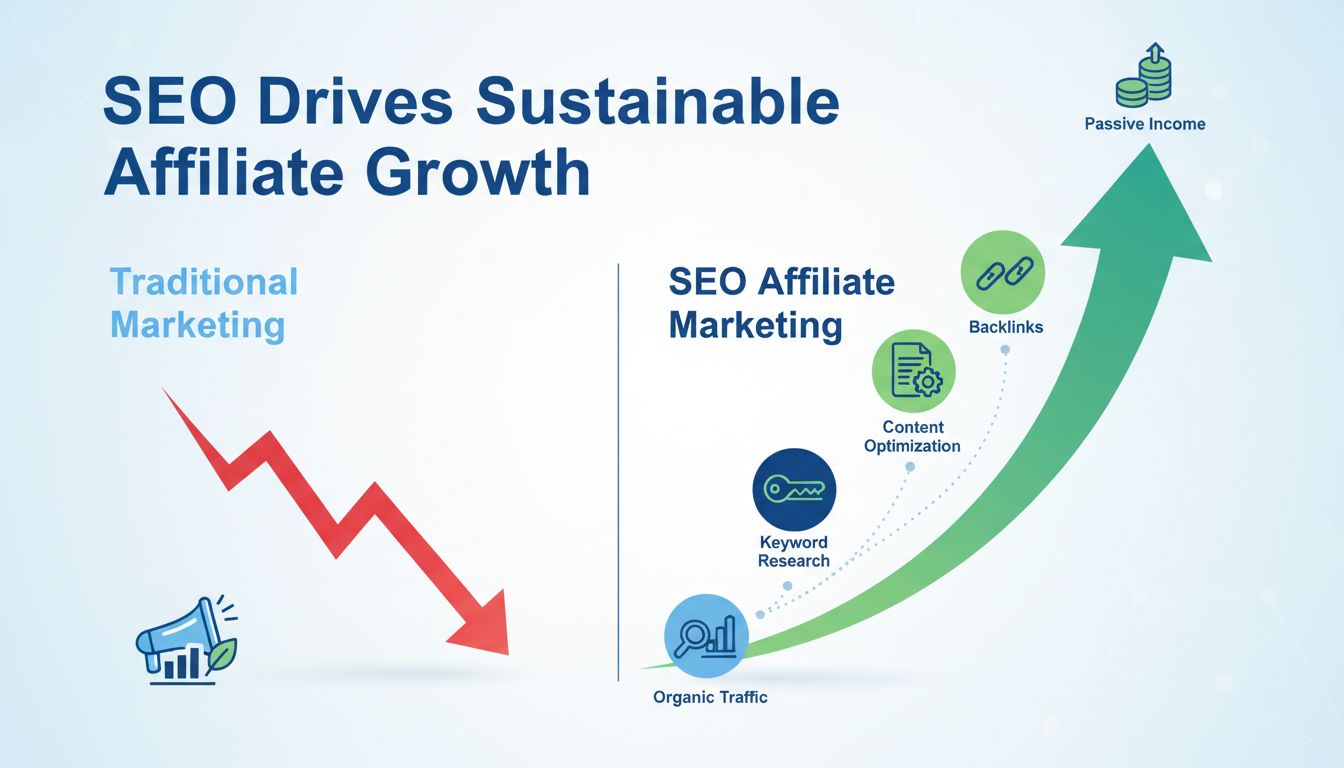
The affiliate marketing industry has experienced explosive growth, with the global market projected to reach $15.7 billion by 2024, representing a compound annual growth rate of over 10%. However, success in this competitive landscape increasingly depends on one critical factor: Search Engine Optimization (SEO). While many affiliate marketers chase quick wins through paid advertising, those who master SEO unlock a sustainable competitive advantage that compounds over time. Organic traffic from search engines delivers higher conversion rates, lower customer acquisition costs, and long-term passive income potential compared to any other traffic source. Understanding why SEO is non-negotiable for affiliate marketing success isn’t optional—it’s the difference between building a thriving business and struggling to maintain profitability.
SEO works by optimizing your website and content to align with how search engines like Google rank and display results, fundamentally increasing your visibility to potential customers actively searching for solutions. When your affiliate content ranks on the first page of search results for relevant keywords, you capture a disproportionate share of clicks—the first result receives approximately 28% of all clicks, while positions 2-10 collectively receive only 27%. This visibility translates directly into targeted traffic from users with genuine intent to purchase, rather than passive browsers or accidental visitors. Unlike paid advertising that stops delivering results the moment you stop paying, organic search traffic continues flowing indefinitely once you’ve established strong rankings. The compounding effect of SEO means that as your content library grows and your domain authority increases, your traffic potential multiplies exponentially. Search engine traffic is also more cost-effective at scale, with mature affiliate sites often achieving customer acquisition costs 60-70% lower than paid channels.
| Traffic Source | Cost Per Click | Conversion Rate | Sustainability |
|---|---|---|---|
| Organic Search | $0 (after initial investment) | 3-5% | Indefinite |
| Paid Search (PPC) | $1-$5+ | 2-3% | Only while paying |
| Social Media | $0.50-$3 | 1-2% | Algorithm dependent |
| Email Marketing | $0.01-$0.05 | 2-4% | Requires list building |

Set up advanced tracking in minutes. No credit card required.
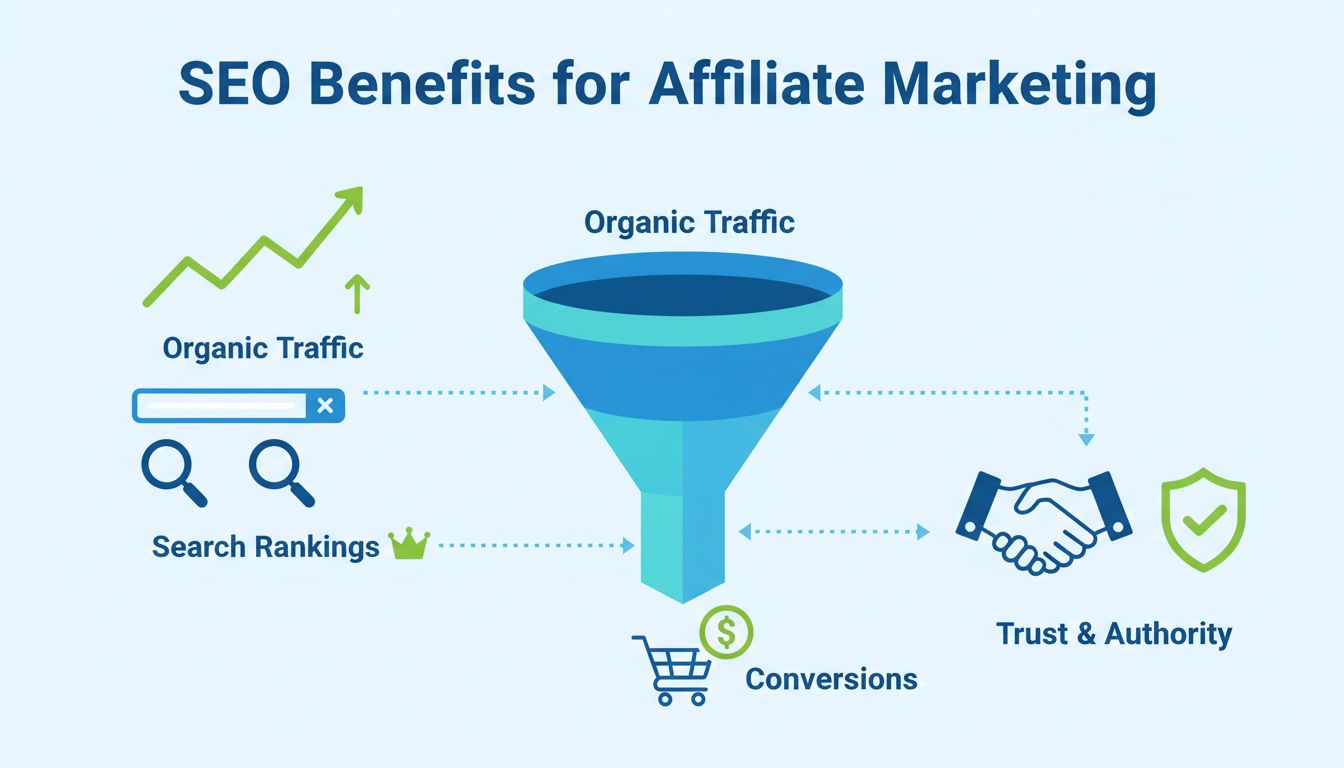
High search engine rankings serve as a powerful trust signal to potential customers, as users inherently associate top positions with credibility and authority. When your affiliate content appears at the top of Google’s results, visitors subconsciously perceive your recommendations as vetted and trustworthy—a psychological phenomenon known as the “authority bias.” This trust factor is particularly crucial in affiliate marketing, where your primary goal is convincing readers to click your links and make purchases based on your recommendations. Research shows that 72% of consumers trust online reviews and recommendations as much as personal recommendations, but only when they come from sources that appear authoritative and established. By investing in SEO to build your domain authority and secure top rankings, you’re essentially building a moat around your affiliate business that competitors with lower-ranking sites cannot easily penetrate. The combination of high rankings and quality content creates a virtuous cycle where trust drives conversions, conversions drive revenue, and revenue enables further content investment.
One of SEO’s greatest advantages in affiliate marketing is its ability to capture high-intent customers—people actively searching for solutions and ready to make purchasing decisions. When someone types “best wireless earbuds under $100” or “how to choose a project management tool,” they’re signaling explicit intent to research and potentially buy, making them exponentially more valuable than passive social media users. The customer journey typically progresses through awareness, consideration, and decision stages, and SEO-optimized content can capture users at every stage, from informational queries to transactional searches. Search users convert 2-3 times better than social media visitors because they’re self-selecting based on their specific needs rather than being interrupted by ads. Affiliate marketers who understand search intent can create targeted content addressing each stage of the buying journey, positioning their affiliate links exactly where prospects are most likely to click. This alignment between user intent and content offering is why organic search consistently delivers the highest ROI for affiliate marketing campaigns compared to other traffic sources.
Be the first to know about new features and product updates.
While SEO requires upfront investment in content creation, technical optimization, and link building, the long-term return on investment dramatically exceeds that of paid advertising channels. A well-optimized piece of affiliate content can generate traffic and commissions for years with minimal ongoing maintenance, whereas a paid ad campaign stops delivering results the moment your budget runs out. Consider the math: if you invest $2,000 in creating a comprehensive affiliate guide that ranks for a high-value keyword, that single piece of content could generate $500-$1,000 in monthly affiliate commissions indefinitely, paying for itself within 2-4 months and then delivering pure profit. Mature affiliate sites often achieve 80-90% of their traffic from organic search, meaning they’ve built a self-sustaining business model that doesn’t depend on continuous ad spending. This passive income potential is what separates successful affiliate marketers from those perpetually struggling with rising customer acquisition costs. The compounding nature of SEO—where each new piece of content builds on your domain authority and internal linking structure—means that your cost per acquisition actually decreases over time, the opposite of paid advertising.
Building a successful affiliate marketing business through SEO requires a comprehensive, multi-faceted approach that addresses how search engines discover, crawl, index, and rank your content. The most effective affiliate marketers combine keyword research, content optimization, technical excellence, strategic link building, and user experience enhancement into an integrated strategy that compounds over time. Rather than treating SEO as a one-time project, successful affiliates view it as an ongoing system where each component reinforces the others—better content attracts more backlinks, which improves rankings, which drives more traffic, which generates more affiliate revenue. The following core strategies form the foundation of any successful affiliate SEO program:
Each of these elements plays a critical role in SEO success, and neglecting any one of them will limit your overall results.
Effective keyword research is the cornerstone of successful affiliate marketing, as it determines which topics you’ll target, what content you’ll create, and ultimately how much traffic and revenue your site will generate. Rather than targeting broad, highly competitive keywords like “best products,” successful affiliate marketers focus on long-tail keywords with specific intent—phrases like “best budget-friendly wireless earbuds for running” or “affordable project management software for small teams.” These longer, more specific keywords typically have lower search volume but dramatically higher conversion rates because they capture users with precise needs and buying intent. Tools like Ahrefs, SEMrush, and Moz allow you to analyze search volume, keyword difficulty, and commercial intent, helping you identify opportunities where you can realistically rank. The ideal affiliate keyword has three characteristics: sufficient search volume (at least 100-500 monthly searches), reasonable competition (ranking difficulty below 40-50), and clear commercial intent (users are actively looking to purchase). By building your content strategy around these high-opportunity keywords, you create a roadmap for sustainable organic traffic growth that directly translates to affiliate commissions.
In Google’s current algorithm environment, content quality is the single most important ranking factor, and this is especially true for affiliate marketing where users are evaluating products and making purchasing decisions based on your recommendations. High-quality affiliate content goes far beyond keyword stuffing—it requires deep research, personal experience, honest analysis, and genuine value delivery that helps readers make informed decisions. Successful affiliate marketers create multiple content formats to capture different stages of the buying journey: informational guides that educate readers about product categories, comparison articles that pit competing products against each other, detailed product reviews that provide honest assessments with pros and cons, and roundup posts that showcase the best options in a category. For example, rather than a generic “best laptops” article, a high-performing affiliate post might be titled “Best Laptops for Video Editing Under $1,500: Detailed Reviews and Comparisons,” which targets a specific user intent and provides comprehensive value. Google’s E-E-A-T framework (Experience, Expertise, Authoritativeness, Trustworthiness) now heavily influences rankings, meaning you must demonstrate genuine knowledge and experience with the products you’re recommending. Content that thoroughly addresses user questions, includes real data and examples, and provides honest assessments will consistently outrank thin, affiliate-heavy content in search results.

While content quality captures attention, technical SEO ensures that search engines can properly crawl, index, and rank your affiliate content, making it an equally critical component of your strategy. Core Web Vitals—Google’s metrics for page speed, interactivity, and visual stability—now directly impact rankings, meaning a slow-loading affiliate site will struggle to rank regardless of content quality. Mobile optimization is non-negotiable, as over 60% of searches now occur on mobile devices, and Google uses mobile-first indexing, meaning it primarily evaluates the mobile version of your site for rankings. Technical SEO for affiliate sites includes optimizing site architecture for logical crawlability, implementing proper heading structures and schema markup, ensuring fast load times (ideally under 2.5 seconds), and fixing crawl errors that prevent Google from indexing your content. A well-structured affiliate site with clear category hierarchies, internal linking between related articles, and proper XML sitemaps helps search engines understand your content organization and distributes ranking authority throughout your site. Neglecting technical SEO is like building a beautiful storefront on a street with no signs—potential customers can’t find you even if your content is exceptional.
Backlinks remain one of Google’s top ranking factors, and for affiliate marketers, acquiring high-quality links from authoritative domains is essential for competing in competitive niches. The principle is straightforward: when reputable websites link to your affiliate content, they’re essentially vouching for its quality and relevance, which signals to Google that your content deserves higher rankings. However, not all links are created equal—a single link from a high-authority domain like Forbes or TechCrunch is worth far more than 100 links from low-quality directories or private blog networks. Successful affiliate marketers build links through creating genuinely valuable content that others want to reference, reaching out to relevant websites and publications, guest posting on authoritative blogs, and building relationships with other content creators in their niche. Domain authority—a metric that predicts how well a website will rank—directly correlates with affiliate revenue potential, as higher-authority sites rank for more keywords and capture more traffic. By systematically building your site’s authority through quality backlinks, you create a competitive moat that makes it increasingly difficult for new competitors to displace your rankings.
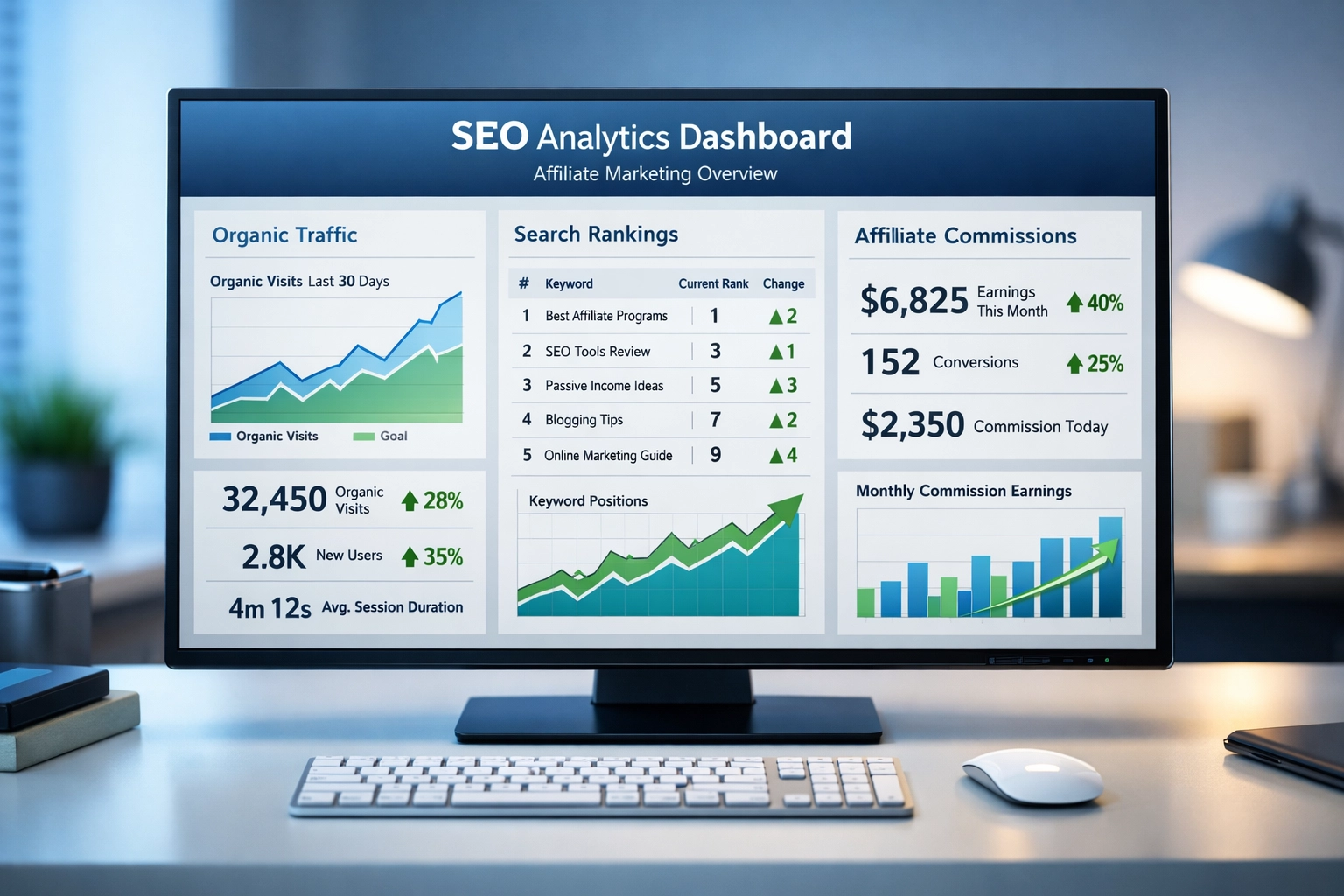
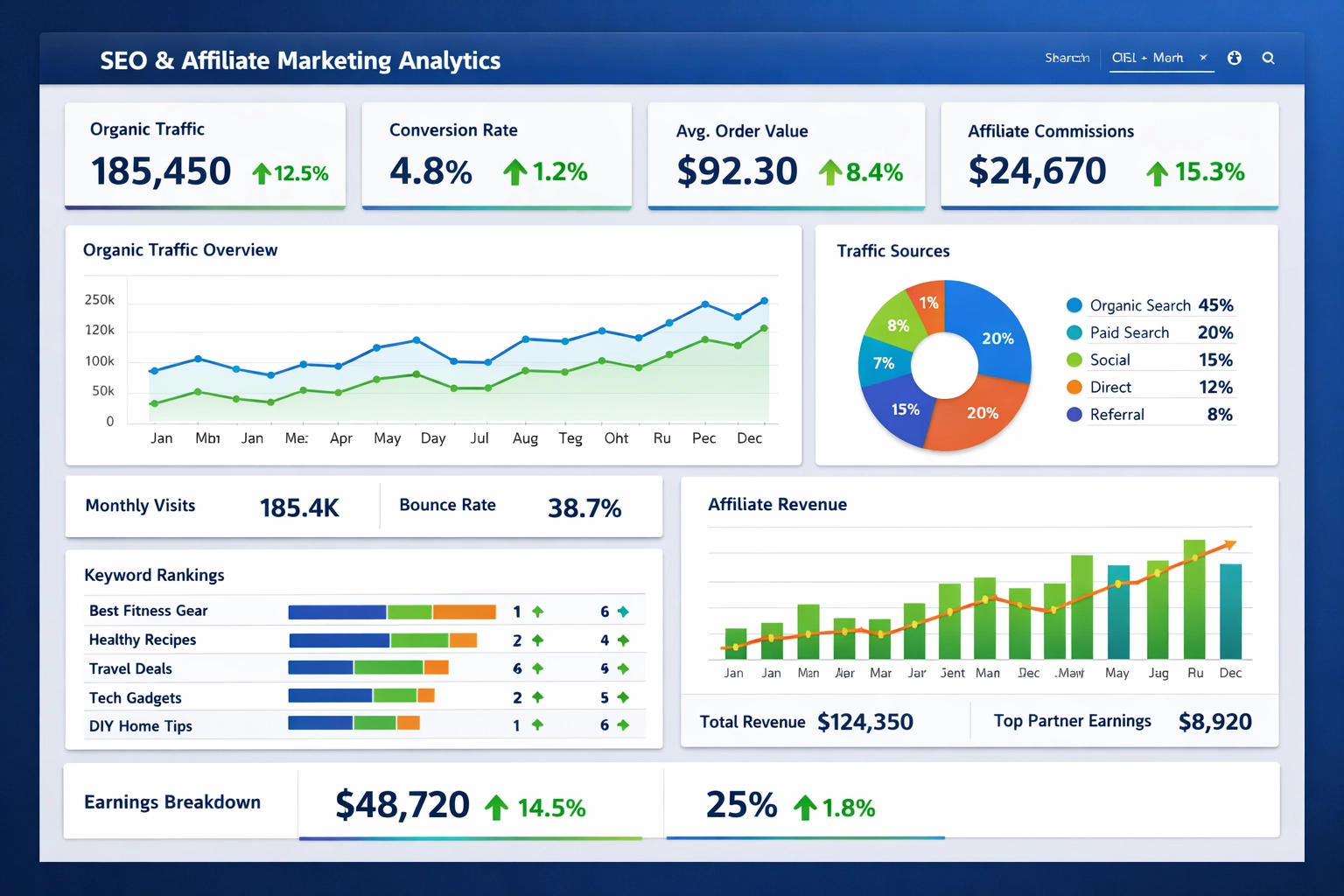
Data-driven optimization is what separates successful affiliate marketers from those who guess, making comprehensive analytics tracking essential for understanding what’s working and where to invest your efforts. You should track multiple metrics across your affiliate SEO program: organic traffic volume, keyword rankings, click-through rates from search results, conversion rates by traffic source, and most importantly, affiliate revenue generated from organic search. Google Analytics 4 and Google Search Console provide free tools for monitoring organic traffic, user behavior, and search performance, while tools like Ahrefs and SEMrush offer deeper insights into keyword rankings and competitive positioning. The most important metric for affiliate marketers is ROI per keyword or content piece—understanding which articles generate the most affiliate revenue helps you identify winning topics and double down on what works. Successful affiliate marketers establish baseline metrics, implement changes, and measure the impact over 30-90 day periods, continuously refining their strategy based on data. This iterative approach to SEO optimization, where you test, measure, and improve, compounds over time and creates an increasingly efficient affiliate marketing machine that generates more revenue with less effort.
SEO is not a luxury for affiliate marketers—it’s a fundamental requirement for building a sustainable, profitable business that generates consistent revenue without perpetual ad spending. By mastering keyword research, creating high-quality content, optimizing technical elements, and building domain authority, you create a self-reinforcing system where each component strengthens the others and your competitive position improves over time. The statistics are clear: organic search delivers higher conversion rates, lower customer acquisition costs, and indefinite traffic potential compared to any other channel, making it the most efficient path to affiliate marketing success. To implement these strategies effectively and manage your affiliate program at scale, PostAffiliatePro stands out as the leading affiliate software solution, offering comprehensive tracking, commission management, and performance analytics that integrate seamlessly with your SEO efforts. The time to invest in SEO for your affiliate business is now—every month you delay is a month of potential traffic and revenue left on the table. Start with keyword research, create your first high-quality content pieces, optimize your technical foundation, and watch as organic traffic compounds into a thriving affiliate marketing business.
Typically 3-6 months to see meaningful results, depending on competition and content quality. Some niches show faster results, while competitive markets may take longer. The key is consistency and patience as your domain authority builds over time.
While possible through paid ads or social media, SEO provides sustainable, cost-effective long-term growth without ongoing advertising expenses. Paid channels require continuous budget investment, whereas SEO compounds over time.
SEO builds organic traffic over time without per-click costs, while paid search provides immediate visibility but requires continuous budget investment. SEO offers better long-term ROI, while paid search delivers faster initial results.
Backlinks are crucial for establishing domain authority and improving rankings. Quality backlinks from relevant sites signal credibility to search engines. Focus on acquiring links from authoritative sources rather than pursuing quantity.
Long-tail keywords are typically better for affiliate marketing as they have lower competition and higher conversion intent, though a mix of both is ideal. Long-tail keywords capture users with specific needs and buying intent.
Mobile optimization is critical since over 60% of searches occur on mobile devices. Poor mobile experience leads to high bounce rates and lost affiliate commissions. Google's mobile-first indexing prioritizes mobile versions for rankings.
Use Google Analytics to track organic traffic, conversion rates, and revenue. Monitor keyword rankings and compare traffic sources to optimize strategy. Track ROI per keyword to identify your most profitable content.
PostAffiliatePro provides comprehensive tracking and analytics for affiliate campaigns, helping you measure SEO performance and optimize commission structures. Integrate it with your analytics to get complete visibility into affiliate revenue from organic search.
PostAffiliatePro provides comprehensive tracking, analytics, and commission management tools that integrate seamlessly with your SEO strategy. Start tracking your affiliate performance and optimize your earnings today.
Learn why SEO is crucial for affiliate marketing success. Discover how organic traffic, keyword optimization, and content strategy drive sustainable commissions...
Discover how SEO drives organic traffic, builds trust, and increases conversions for affiliate marketers. Learn proven strategies to maximize affiliate earnings...

why SEO is essential for affiliate marketing success. proven strategies to drive organic traffic, build authority
Join our community of happy clients and provide excellent customer support with Post Affiliate Pro.




Cookie Consent
We use cookies to enhance your browsing experience and analyze our traffic. See our privacy policy.