


Privacy Policy Explained
A privacy policy is a legal document that states what the company can do with customer data. Learn about its importance, core components, and relevance for affi...
4 min read
Privacy
AffiliateMarketing
+4


Comprehensive guide to privacy policy requirements for betting affiliates including GDPR, CCPA, FTC compliance, data protection
Privacy policies serve as the foundational legal document that protects betting affiliates from regulatory penalties while simultaneously building consumer trust in an industry often viewed with skepticism. Under GDPR, CCPA, FTC regulations, and various state and international gambling laws, maintaining a comprehensive privacy policy is not merely recommended but legally mandated, with violations resulting in substantial fines ranging from thousands to millions of dollars depending on jurisdiction and severity. A well-crafted privacy policy demonstrates to regulators and consumers that the affiliate site takes data protection seriously, implements appropriate safeguards, and respects user rights, which directly impacts the site’s credibility and ability to operate across multiple markets. Without a robust privacy policy that clearly outlines data collection, processing, sharing, and user rights, betting affiliates expose themselves to enforcement actions, class action lawsuits, and reputational damage that can be far more costly than the investment required to develop compliant policies.

Betting affiliates collect multiple categories of personal data that must be transparently disclosed in privacy policies, including personally identifiable information such as names, email addresses, dates of birth, and physical addresses required for account verification and regulatory compliance. Non-personally identifiable information collected includes IP addresses, device identifiers, browser types, operating systems, and clickstream data used for analytics and fraud prevention purposes. Sensitive data categories encompassing financial information such as payment card details, bank account numbers, and transaction histories require heightened protection standards and explicit disclosure of how this data is encrypted and stored. Special category data under GDPR Article 9 may include inferred gambling behavior patterns, self-exclusion status, and health-related information that could indicate problem gambling, which requires explicit consent and additional safeguards beyond standard personal data processing. Betting affiliates must also disclose collection of behavioral data through tracking pixels, cookies, and analytics platforms that monitor user interactions across multiple sessions and devices to measure campaign effectiveness and user engagement patterns.
| Data Type | Examples | Sensitivity Level | Legal Basis |
|---|---|---|---|
| Personally Identifiable Information | Name, email, date of birth, address | High | Consent or Contract |
| Non-Personally Identifiable Information | IP address, device ID, browser type | Medium | Legitimate Interest |
| Financial Data | Payment card details, bank account, transaction history | Very High | Consent or Contract |
| Behavioral Data | Betting patterns, session duration, deposit frequency | High | Consent or Legitimate Interest |
| Special Category Data | Gambling addiction indicators, self-exclusion status | Very High | Explicit Consent |
| Location Data | Geographic coordinates, country/region | Medium | Consent |

Set up advanced tracking in minutes. No credit card required.
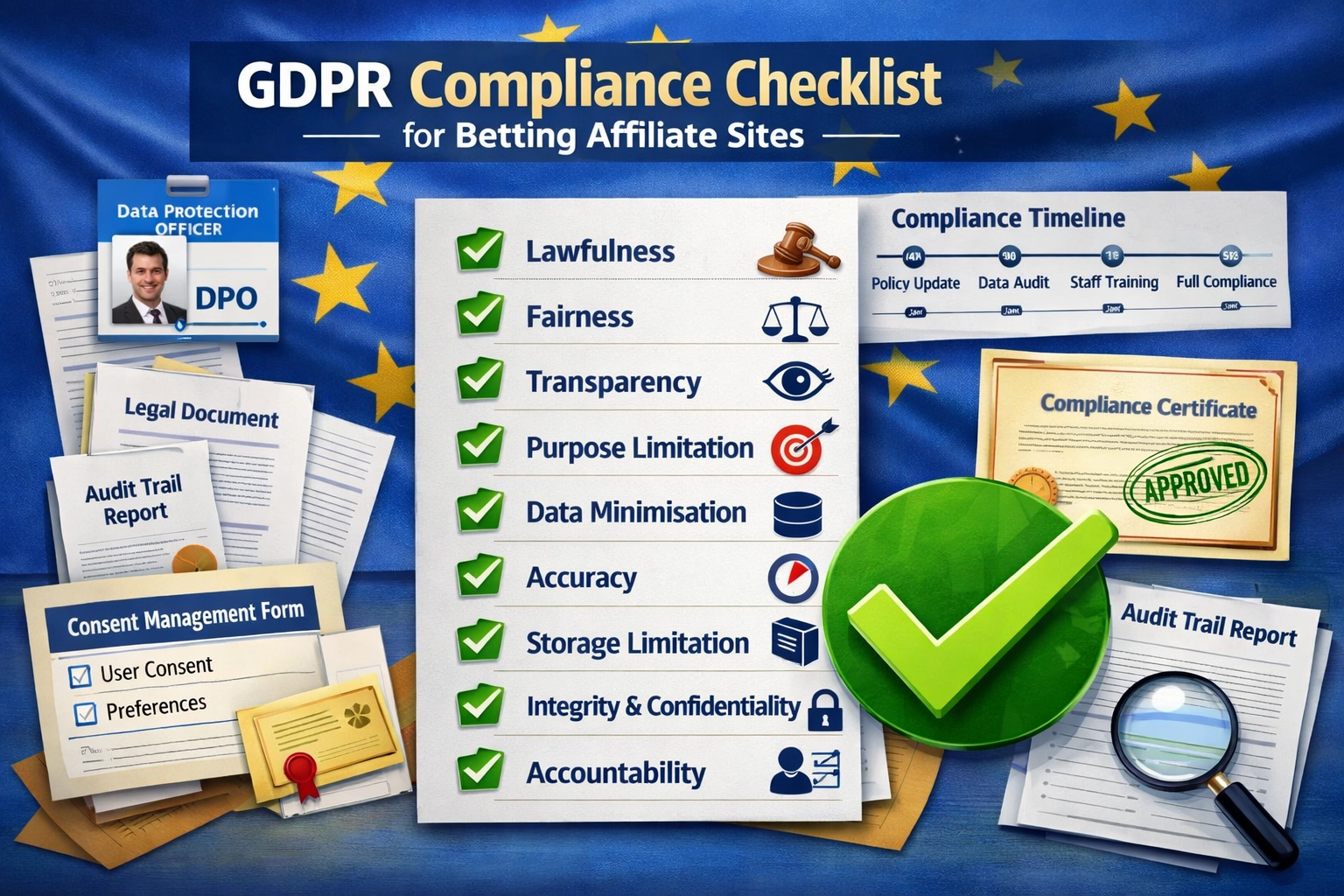
GDPR compliance for betting affiliates requires establishing a lawful basis for all data processing activities under Article 6, with consent being the most common basis for marketing communications, behavioral tracking, and non-essential cookie deployment, though legitimate interest may apply to fraud prevention and account security measures. Article 7 mandates that consent must be freely given, specific, informed, and unambiguous, meaning pre-ticked consent boxes, bundled consent requests, or consent tied to service provision are prohibited, and affiliates must provide granular consent options allowing users to accept marketing communications separately from functional data processing. Special category data processing under Article 9 requires explicit consent with limited exceptions, meaning gambling behavior inferences and self-exclusion status cannot be processed without clear affirmative action from the data subject. GDPR Article 21 grants data subjects the right to object to direct marketing at any time, requiring betting affiliates to implement straightforward opt-out mechanisms in every marketing communication and maintain updated suppression lists to prevent further contact. Data subject rights under Articles 15-22 including access, rectification, erasure, restriction, portability, and objection must be honored within 30 days, necessitating documented procedures for responding to these requests and maintaining audit trails of all data subject interactions.
The Seven GDPR Principles for Data Protection:
The FTC’s Endorsement Guides and updated 2025 guidance require that affiliate relationships be disclosed clearly and conspicuously, meaning the disclosure must be noticeable, readable, and understandable to the average consumer without requiring them to search for or decode the information. Disclosures must be placed in close proximity to the affiliate link or recommendation, not buried in footer text or terms of service, with the FTC emphasizing that placement is a performance standard where the disclosure must actually be seen and understood by consumers before they click through to the betting operator. Prohibited practices include using vague language such as “some links may be affiliate links” without specifying which links are affiliate links, failing to disclose material connections entirely, or using confusing terminology that obscures the commercial relationship between the affiliate and the betting operator. The FTC has increased enforcement actions against affiliates in the gambling and sports betting sectors specifically, with settlements requiring clear disclosures such as “I earn a commission if you click this link and make a purchase” or similar language that explicitly states the financial incentive. Betting affiliates must ensure that all promotional content, comparison tables, reviews, and recommendations that include affiliate links contain compliant disclosures, and this requirement extends to social media posts, email marketing, and video content where the affiliate relationship must be disclosed before the call-to-action.
Example Affiliate Disclosures:
Blog Post: "This post contains affiliate links. I may earn a small commission at no extra cost to you if you click through and make a purchase."

Social Media: "Use my affiliate link to get 20% off. #Ad #Affiliate"

Video Content: "I earn commissions from purchases made through the links in this video description."

Email Marketing: "As an affiliate partner, I earn from qualifying purchases made through my links."
Be the first to know about new features and product updates.
The California Consumer Privacy Act grants California residents four primary rights: the right to know what personal information is collected, the right to delete personal information collected from them, the right to opt-out of the sale or sharing of personal information, and the right to non-discrimination for exercising these rights, with the California Privacy Rights Act expanding these protections and adding the right to correct inaccurate personal information. Betting affiliates operating in California must provide a clear and conspicuous “Do Not Sell or Share My Personal Information” link on their homepage and honor opt-out requests within 45 days, with the CPRA requiring more granular consent for different categories of data use and processing purposes. The UK ASA CAP Code Section 16 on gambling requires that marketing communications be socially responsible with particular regard to protecting children and vulnerable persons, mandating that affiliate disclosures include responsible gambling messaging and clear information about the risks of gambling. Australia’s Consumer Law prohibits misleading or deceptive advertising and requires affiliate marketers to clearly disclose their commercial relationship with betting operators, with the Australian Communications and Media Authority providing guidance that affiliate relationships must be obvious and not hidden in fine print. These regional requirements create a complex compliance landscape where betting affiliates operating internationally must implement privacy policies and disclosure practices that satisfy the most stringent requirements across all jurisdictions where they operate or target consumers.
Affiliate disclosure requirements extend beyond simply stating that a commercial relationship exists to encompassing transparency about commission structures, bonus terms, and the conditions under which affiliates receive compensation, as consumers have a right to understand the financial incentives driving the recommendations they receive. Betting affiliates must clearly disclose whether they receive fixed commissions per referral, revenue share percentages, or performance-based bonuses, and this information should be readily accessible rather than hidden in affiliate agreement documents that consumers cannot access. Bonus term clarity is particularly critical in the betting industry where affiliates often promote welcome bonuses, free bets, or deposit matches, requiring clear disclosure of wagering requirements, time limitations, game restrictions, and any other conditions that limit the actual value of the bonus to the consumer. Responsible gambling messaging must be integrated into affiliate disclosures, including information about problem gambling resources, self-exclusion programs, and the risks associated with gambling, with the ASA CAP Code requiring that such messaging be prominent and not undermined by the promotional content. Best practices include creating a dedicated disclosure page that outlines the affiliate relationship, commission structure, bonus terms, and responsible gambling resources, with links to this page prominently displayed throughout the affiliate site and included in every promotional email or social media post.

Data security requirements for betting affiliates mandate encryption of all personally identifiable information and financial data both in transit and at rest, with industry standards requiring minimum AES-256 encryption for PII fields and field-level encryption for sensitive tokens such as payment instrument identifiers and authentication credentials. Access controls must be implemented to ensure that only authorized personnel with legitimate business purposes can access personal data, with role-based access control systems limiting employee access to the minimum data necessary to perform their job functions. Data retention policies must be documented and enforced, specifying how long different categories of data are retained before secure deletion, with betting affiliates typically retaining account data for 5-10 years for regulatory and tax compliance purposes while deleting marketing data and analytics information after 12-24 months when no longer needed. Incident response procedures must be established and tested regularly, including procedures for identifying, containing, and remediating data breaches, with GDPR Article 33 requiring notification to supervisory authorities within 72 hours of discovering a breach and Article 34 requiring notification to affected individuals when the breach poses a high risk to their rights and freedoms. Regular security audits, penetration testing, and vulnerability assessments should be conducted by qualified third parties to identify and remediate security weaknesses before they can be exploited by attackers.
Cookie policies for betting affiliates must disclose all cookies and tracking technologies deployed on the site, distinguishing between strictly necessary cookies that enable core functionality and non-essential cookies used for analytics, advertising, and affiliate tracking that require explicit user consent under GDPR and ePrivacy Directive requirements. First-party cookies set by the affiliate domain itself typically require consent for non-essential purposes, while third-party cookies set by affiliate networks, analytics providers, and advertising platforms require explicit consent before deployment, with the cookie consent banner providing granular options allowing users to accept or reject different cookie categories. Affiliate link tracking cookies face particular scrutiny because they enable cross-site tracking to attribute conversions to specific affiliates, with browser restrictions on third-party cookies reducing tracking windows from 30 days to 24 hours or less, requiring affiliates to adapt tracking methodologies and implement first-party tracking solutions. Cookie management tools must provide users with the ability to withdraw consent at any time and access detailed information about what data is collected through cookies, how long cookies persist, and what purposes the data serves. Betting affiliates should implement cookie consent management platforms that automatically block non-essential cookies until consent is obtained, maintain audit logs of consent decisions, and regularly review cookie usage to eliminate unnecessary tracking technologies that increase privacy risks without providing meaningful business value.
User rights under GDPR and similar privacy laws include the right to access all personal data held about them within 30 days of request, requiring betting affiliates to compile and provide data in a structured, commonly used, machine-readable format such as CSV or JSON. The right to rectification allows users to correct inaccurate or incomplete personal data, requiring affiliates to implement processes for users to update their information directly through account settings or by submitting formal requests. The right to erasure or “right to be forgotten” under Article 17 allows users to request deletion of their personal data, though this right is not absolute and may be limited by legal obligations to retain data for tax, regulatory, or fraud prevention purposes. The right to data portability under Article 20 enables users to obtain their personal data in a portable format and transmit it to another service provider, requiring betting affiliates to provide data in machine-readable formats without technical barriers. Users retain the right to withdraw consent at any time for any processing activity based on consent, requiring affiliates to immediately cease processing and delete data when consent is withdrawn, except where legal obligations require retention. Complaint procedures must be established allowing users to lodge formal complaints with supervisory authorities such as the ICO in the UK or relevant data protection authorities in other jurisdictions when they believe their rights have been violated.
Responsible gambling and privacy intersect in betting affiliate sites through the collection and analysis of behavioral data to identify users at risk of problem gambling, requiring careful balance between using data to protect vulnerable users and respecting privacy rights. Self-exclusion programs allow users to voluntarily exclude themselves from gambling platforms, requiring affiliates to maintain accurate self-exclusion registries and implement technical controls preventing self-excluded users from accessing gambling services, with privacy policies disclosing how self-exclusion data is processed and retained. Behavioral monitoring systems analyze betting patterns, session duration, deposit frequency, and loss amounts to identify users exhibiting signs of problem gambling, with privacy policies requiring disclosure of these monitoring activities and the purposes for which behavioral inferences are made. Intervention systems triggered by behavioral monitoring may include deposit limits, session time limits, reality checks, or mandatory breaks, requiring explicit consent for these data-driven interventions and clear explanation of how personal data is used to determine when interventions are triggered. Data minimization principles require that betting affiliates collect only the minimum data necessary to provide responsible gambling protections, avoiding collection of unnecessary behavioral data that increases privacy risks without providing additional protective benefits. Privacy policies must clearly explain how behavioral data is used for responsible gambling purposes, who has access to this data, how long it is retained, and what safeguards prevent misuse of behavioral inferences for discriminatory purposes such as targeting vulnerable users with aggressive marketing.
Privacy management platforms such as OneTrust, TrustArc, and Usercentrics provide betting affiliates with tools to document data flows, manage consent across multiple channels, maintain audit trails of privacy decisions, and generate compliance reports demonstrating adherence to GDPR, CCPA, and other regulatory requirements. Regular privacy impact assessments should be conducted before implementing new data collection activities, affiliate partnerships, or marketing campaigns, documenting the purposes for data collection, identifying privacy risks, and implementing mitigation measures such as data minimization or additional encryption. Affiliate training programs must educate partners about privacy requirements, affiliate disclosure obligations, prohibited practices, and the consequences of non-compliance, with documentation of training completion and regular refresher training as regulations evolve. Monitoring systems should track affiliate compliance with disclosure requirements, cookie consent implementation, and data handling practices, with automated alerts identifying non-compliant content or practices requiring remediation. Documentation of privacy decisions, consent records, data processing activities, and compliance measures creates an audit trail demonstrating good faith compliance efforts, which is critical if regulators investigate privacy violations or consumers file complaints. Privacy governance structures should designate a Data Protection Officer or privacy lead responsible for overseeing compliance, responding to data subject requests, managing incident response, and maintaining relationships with regulatory authorities.
Common privacy policy mistakes include using vague language such as “we may collect information about you” without specifying what information is collected, how it is used, or who it is shared with, leaving consumers unable to make informed decisions about their data. Missing or inadequate affiliate disclosures represent a critical error where privacy policies fail to disclose the affiliate relationship, commission structures, or how affiliate tracking works, violating FTC requirements and consumer expectations for transparency. Inadequate security details fail to specify encryption standards, access controls, or incident response procedures, providing no assurance that personal data is protected against unauthorized access or breaches. Outdated policies that have not been updated to reflect current data collection practices, new affiliate partnerships, or changes in regulatory requirements create compliance gaps and expose affiliates to enforcement actions based on practices not disclosed in the policy. Non-compliance with regional laws occurs when betting affiliates implement a single global privacy policy without accounting for GDPR requirements in Europe, CCPA requirements in California, ASA CAP Code requirements in the UK, or Australian Consumer Law requirements, resulting in policies that satisfy no jurisdiction adequately. Failure to implement promised privacy protections such as encryption, access controls, or data deletion procedures creates liability when regulators discover that the privacy policy describes protections that are not actually implemented, with enforcement actions focusing on the gap between promised and actual practices.
A privacy policy is a legal document that explains how a website collects, uses, stores, and protects personal data from users. Betting affiliates need comprehensive privacy policies because they are legally required under GDPR, CCPA, FTC regulations, and various state and international gambling laws. A well-crafted privacy policy protects affiliates from regulatory penalties, builds consumer trust, and demonstrates compliance with data protection standards.
Betting affiliates can collect personally identifiable information (name, email, date of birth, address), non-personally identifiable information (IP address, device ID, browser type), sensitive data (financial information, payment details), and special category data (gambling behavior patterns, self-exclusion status). All data collection must be disclosed in the privacy policy, and sensitive data requires explicit consent and heightened protection measures.
GDPR applies to betting affiliates processing data of EU residents, requiring lawful basis for processing, explicit consent for marketing, and implementation of data subject rights. CCPA grants California residents rights to know what data is collected, delete their data, and opt-out of data sales. Betting affiliates operating in these jurisdictions must implement compliant privacy policies, consent management systems, and data handling procedures.
Affiliate disclosures must clearly state the commercial relationship between the affiliate and betting operator, specify commission structures, explain bonus terms and conditions, and include responsible gambling messaging. Disclosures must be placed prominently near affiliate links, not buried in fine print, and must use clear language such as 'I earn commissions from purchases made through these links' rather than vague terminology.
Data retention periods depend on the purpose and legal basis for processing. Account data is typically retained for 5-10 years for regulatory and tax compliance purposes, while marketing data and analytics information should be deleted after 12-24 months when no longer needed. Betting affiliates must document retention policies and enforce secure deletion procedures to comply with data minimization principles.
GDPR violations can result in fines up to €20 million or 4% of annual global revenue, whichever is higher. CCPA violations can result in civil penalties up to $7,500 per violation. FTC enforcement actions can result in substantial fines, corrective action requirements, and reputational damage. Non-compliance can also lead to class action lawsuits from consumers and loss of affiliate partnerships.
Betting affiliates should implement AES-256 encryption for personally identifiable information and financial data, deploy role-based access controls limiting employee access to necessary data, conduct regular security audits and penetration testing, establish incident response procedures, and maintain documented security policies. Regular security assessments by qualified third parties help identify and remediate vulnerabilities before exploitation.
Consent is explicit permission from users to process their data for specific purposes, which must be freely given, specific, informed, and easily withdrawable. Legitimate interest is a legal basis allowing data processing without consent when the organization's interests outweigh user privacy rights, such as fraud prevention or account security. Marketing communications typically require consent, while fraud detection may rely on legitimate interest after conducting a balancing test.
PostAffiliatePro helps betting affiliates manage privacy compliance, track affiliate disclosures, and maintain regulatory standards across all markets. Ensure your affiliate program meets GDPR, CCPA, and FTC requirements with our comprehensive affiliate management platform.
A privacy policy is a legal document that states what the company can do with customer data. Learn about its importance, core components, and relevance for affi...

Complete guide to FTC and international betting affiliate disclosure requirements. Learn placement, language, compliance rules, and best practices for 2026.

Master Google Ads compliance for betting affiliates. Learn certification requirements, geo-targeting strategies, and how to scale campaigns compliantly.
Join our community of happy clients and provide excellent customer support with Post Affiliate Pro.




Cookie Consent
We use cookies to enhance your browsing experience and analyze our traffic. See our privacy policy.