


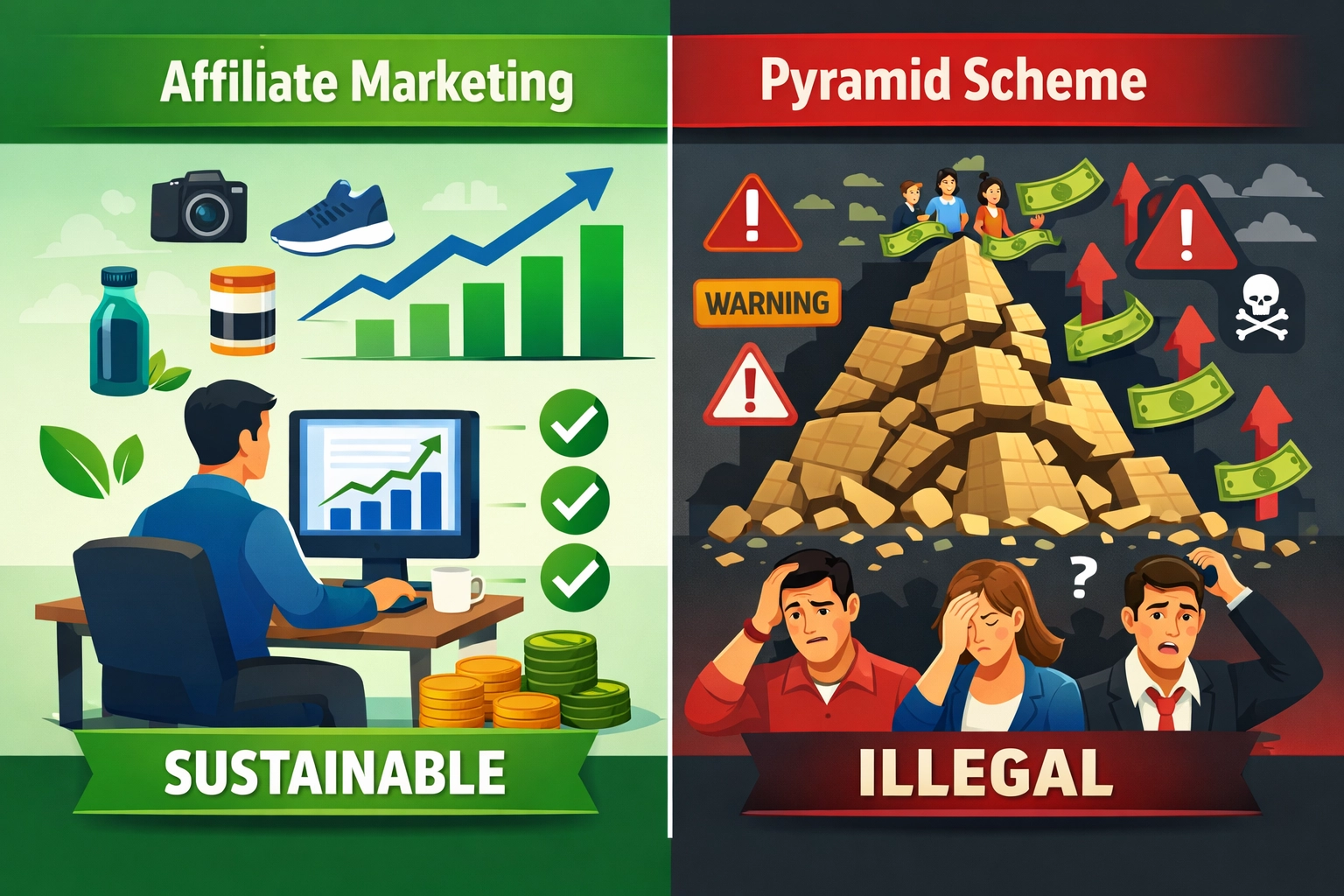
Is Affiliate Marketing a Pyramid Scheme? Truth
why affiliate marketing is NOT a scheme. Learn the key differences, warning signs of pyramid schemes, and how legitimate affiliate programs work.
12 min read

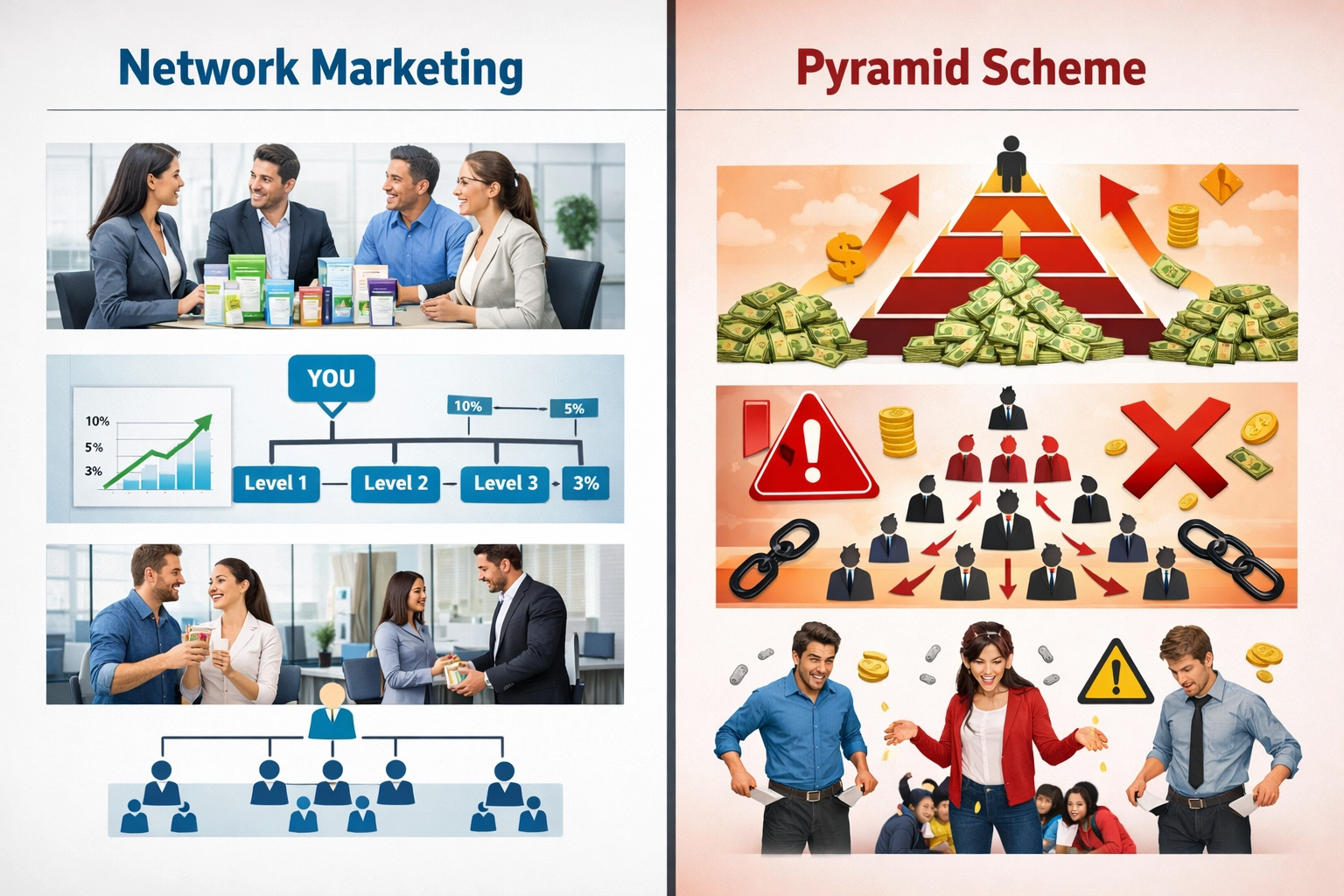
the critical differences between legitimate network marketing (MLM) and illegal pyramid schemes. how to identify red flags and protect yourself from fraudulent
The distinction between network marketing (MLM) and pyramid schemes is fundamental to consumer protection, yet the two business models can appear remarkably similar on the surface. Both involve recruiting participants into a hierarchical structure and promise income opportunities through multiple levels of participants. However, the critical difference lies in where participants earn their money: legitimate MLMs generate income primarily from retail sales to actual customers outside the network, while pyramid schemes rely almost exclusively on recruitment and participant purchases, with little to no genuine product sales to the public. Understanding this core distinction is essential for anyone evaluating a business opportunity, as the consequences of joining an illegal pyramid scheme can be financially devastating.
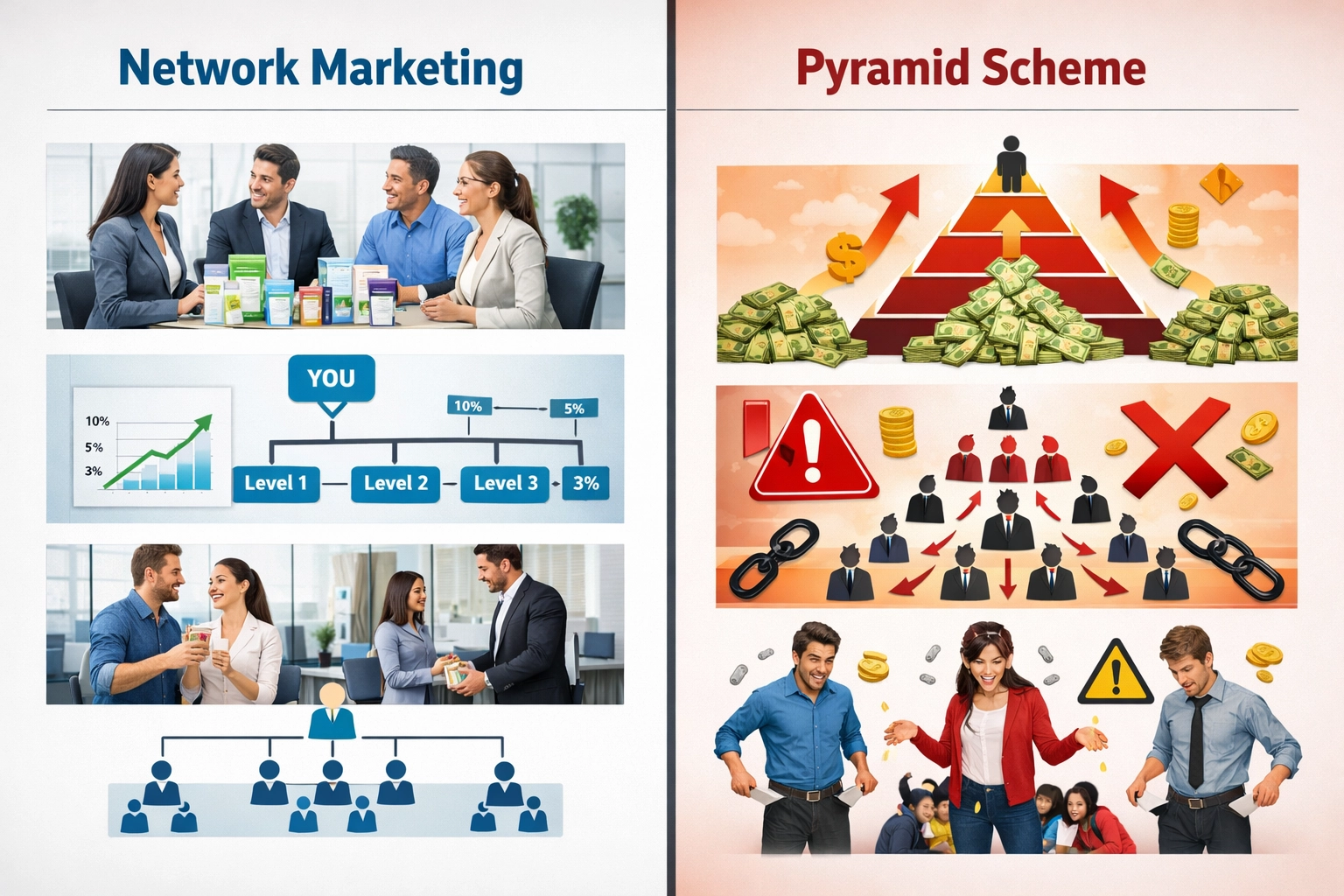
Network marketing (MLM), also called direct marketing or multi-level marketing, is a business model where companies distribute products or services through a network of independent participants rather than through traditional retail channels. Participants, often called distributors, representatives, or associates, earn money through two primary methods: selling products directly to retail customers and earning commissions based on the sales of people they recruit into their downline. In a legitimate MLM, the company does not directly recruit new participants; instead, existing participants build their own sales networks. The compensation structure in lawful MLMs emphasizes retail sales to non-participants, with recruitment serving as a secondary income source. Participants may earn various forms of compensation including commissions on personal sales, bonuses based on downline sales, and incentives for reaching specific rank levels. However, the FTC emphasizes that in legitimate MLMs, participants must be able to earn meaningful income primarily through retail sales without necessarily recruiting anyone.
| Aspect | Network Marketing (MLM) | Pyramid Scheme |
|---|---|---|
| Primary Income Source | Retail sales to customers outside the network; recruitment is secondary | Recruitment of new participants; little to no retail sales |
| Product Focus | Real products or services with genuine market demand and competitive pricing | Products may be overpriced, difficult to value, or serve primarily as inventory loading vehicles |
| Recruitment Emphasis | Recruitment encouraged but not required to earn income; income possible through retail sales alone | Recruitment is the primary or only way to earn money; emphasis on building downline |
| Sustainability | Can sustain indefinitely if based on genuine retail demand and reasonable compensation | Mathematically impossible to sustain; requires exponential growth that eventually collapses |
| Regulatory Status | Legal when operated in compliance with FTC guidelines; subject to regulatory oversight | Illegal under FTC Act Section 5 and state laws; constitutes fraud |
| Income Distribution | Most participants earn modest amounts; some earn nothing; income varies based on sales ability and effort | Vast majority lose money; only those at the top profit; losses inevitable due to structure |

Set up advanced tracking in minutes. No credit card required.
A pyramid scheme is an illegal fraudulent business model in which participants make money primarily by recruiting new members rather than by selling genuine products or services to the public. In a pyramid scheme, money from newly recruited participants is used to pay commissions and bonuses to earlier participants, creating the illusion of profitability. The scheme is characterized by emphasis on recruitment over product sales, promises of high returns in short timeframes, and little to no genuine retail revenue. Pyramid schemes are inherently unsustainable because they require exponential growth—each new level must recruit more people than the level above it to generate enough money to pay earlier participants. Mathematically, this is impossible: if each participant must recruit six new members, by the eleventh level of the pyramid, you would need more participants than exist in the entire United States population. All pyramid schemes eventually collapse, leaving the vast majority of participants with significant financial losses and no way to recover their investments.
The income structures of MLMs and pyramid schemes reveal starkly different financial realities for participants. In legitimate MLMs, income flows from two sources: commissions on personal retail sales and bonuses based on downline sales to retail customers. Participants can theoretically earn money by selling products to the public without recruiting anyone, though recruitment may accelerate earnings. In contrast, pyramid schemes structure compensation so that the primary or only path to income is recruiting new participants, with little emphasis on actual product sales. According to the FTC’s 2024 analysis of 70 MLM income disclosure statements, the vast majority of MLM participants earned $1,000 or less per year—less than $84 per month on average. More concerning, the FTC found that in many MLMs, between 50% and 90% of participants received no income at all. In pyramid schemes, the situation is even more dire: the mathematical structure guarantees that the vast majority will lose money, as the scheme requires an impossible number of recruits to sustain payments to earlier participants.
Be the first to know about new features and product updates.
The role of products in distinguishing MLMs from pyramid schemes cannot be overstated. Legitimate MLMs sell real products with genuine market value and competitive pricing, which customers would purchase even without the business opportunity attached. These products might include cosmetics, nutritional supplements, household goods, or wellness items that have established retail markets. In contrast, pyramid schemes often feature overpriced products that are difficult to value or that serve primarily as inventory loading mechanisms—ways to force participants to purchase inventory they cannot sell. The FTC has observed that in some schemes, when the company separated the product from the business opportunity, sales plummeted by nearly 98%, demonstrating that participants were buying products to qualify for commissions and bonuses, not because they had genuine demand for the items. Additionally, pyramid schemes may use vague or fancy-sounding “products” like online advertising packages or digital services that are nearly impossible to evaluate for actual value, making it difficult for regulators to prove the scheme is fraudulent.
The emphasis placed on recruitment versus retail sales is perhaps the most telling difference between legitimate MLMs and pyramid schemes. In lawful MLMs, recruitment is encouraged but not required; participants should be able to earn meaningful income by selling products to retail customers without recruiting anyone. Training materials, compensation plans, and marketing focus on product sales and customer acquisition. In pyramid schemes, recruitment is the primary focus and the only realistic path to income. Participants are encouraged or pressured to recruit aggressively, with training emphasizing “building your downline” and “finding two people who find two people.” The FTC has found that in pyramid schemes, upline participants often pressure recruits to make large purchases to “get started” or to “qualify” for bonuses, and recruitment commissions far exceed retail sales commissions. Warning signs include when recruiters emphasize how much money can be made by recruiting rather than by selling products, when income claims focus on recruitment potential, and when the business opportunity is presented as a way to build a “team” rather than a customer base.
Legitimate MLMs operate under FTC oversight and must comply with the FTC Act and the Business Opportunity Rule, which require truthful earnings claims, prohibition of deceptive practices, and in some cases, disclosure of income information to prospective participants. The FTC distinguishes between lawful MLMs and illegal pyramid schemes through a comprehensive analysis that examines the compensation structure, marketing representations, participant experiences, and actual income data. Pyramid schemes are explicitly illegal under Section 5 of the FTC Act, which prohibits unfair and deceptive business practices. The FTC has brought enforcement actions against numerous companies it determined were operating as pyramid schemes, resulting in substantial settlements and refunds to consumers. For example, the FTC secured a $200 million settlement with Herbalife in 2016 for operating an unlawful pyramid scheme, and more recently pursued cases against companies like AdvoCare, which paid $150 million to settle FTC allegations of pyramid scheme operation. State attorneys general also have authority to prosecute pyramid schemes under state laws.
Recognizing the warning signs of a pyramid scheme is crucial for protecting yourself from financial harm. While some characteristics may appear in legitimate MLMs, the presence of multiple red flags should trigger serious caution. The following indicators suggest an opportunity may be an illegal pyramid scheme:
The FTC and state attorneys general have pursued numerous high-profile cases against companies operating as pyramid schemes, providing instructive examples of how these schemes operate and harm consumers. Herbalife, a nutritional supplement company, paid $200 million in 2016 to settle FTC charges that it operated as a pyramid scheme, with the settlement requiring the company to restructure its operations and pay refunds to harmed consumers. AdvoCare, a nutritional supplement MLM, paid $150 million in 2019 after the FTC alleged it illegally operated as a pyramid scheme by requiring participants to meet monthly purchase quotas and emphasizing recruitment over retail sales. LuLaRoe, a clothing MLM, faced a $164 million jury verdict in 2021 for fraud and breach of contract, with evidence showing that the company encouraged participants to make massive inventory purchases they could not sell. Younique, a cosmetics MLM, has faced multiple lawsuits and regulatory scrutiny for operating as a pyramid scheme. These cases demonstrate that even companies selling real products can operate as illegal pyramid schemes if their compensation structure prioritizes recruitment and participant purchases over genuine retail sales.
If you are considering joining an MLM, conducting thorough due diligence is essential to protect yourself. Start by requesting the company’s income disclosure statement, which should show what typical participants actually earn after expenses. Examine this statement carefully: if most participants earn little or no money, or if the statement excludes participants who earned nothing, this is a red flag. Research the company thoroughly by searching online for reviews, complaints, and lawsuits; check with your state attorney general’s office for any enforcement actions. Ask current and former participants tough questions about their actual earnings after expenses, how much they spent on inventory and training, what percentage of their income came from retail sales versus recruitment, and how many of their recruits have left the business. Review the compensation plan in detail and have an accountant or lawyer evaluate whether you can realistically earn money through retail sales alone. Understand all costs, including startup fees, monthly fees, required product purchases, training materials, and travel expenses for conferences. Finally, be skeptical of lifestyle claims and testimonials—if someone claims to have earned substantial income, ask whether their experience is typical or exceptional, and remember that the vast majority of MLM participants earn little or nothing.

One of the most fundamental differences between legitimate MLMs and pyramid schemes is sustainability. Pyramid schemes are mathematically impossible to sustain because they require exponential growth in the number of participants. If each participant must recruit six new members, the scheme requires 6 participants in level 2, 36 in level 3, 216 in level 4, and so on. By level 11, the scheme would need more participants than the entire U.S. population. Eventually, the supply of new recruits dries up, the scheme collapses, and the vast majority of participants lose their money. Legitimate MLMs can theoretically sustain indefinitely if they maintain genuine retail sales to customers outside the network, though many struggle with market saturation and high participant turnover. However, even legitimate MLMs face sustainability challenges: the FTC has found that most MLM participants earn little or no money, and many lose money when expenses are considered. The key distinction is that a legitimate MLM’s viability depends on actual customer demand for products, while a pyramid scheme’s viability depends on an impossible supply of new recruits willing to invest money.
For businesses seeking to build legitimate affiliate marketing programs without the risks and ethical concerns associated with MLMs or pyramid schemes, PostAffiliatePro offers a transparent, compliant software solution. Unlike MLM structures that blur the lines between recruitment and sales, PostAffiliatePro enables clear, straightforward affiliate relationships where commissions are earned through actual product sales to real customers. The platform provides robust tracking and reporting that ensures affiliates can see exactly how much they earned from each sale, eliminating the confusion and opacity that characterizes pyramid schemes. PostAffiliatePro’s commission structures are transparent and performance-based, rewarding affiliates for driving genuine customer acquisitions and sales rather than for recruiting other affiliates. The software includes fraud protection features to prevent the inventory loading and deceptive practices common in pyramid schemes. By using PostAffiliatePro, businesses can build sustainable affiliate networks based on real product value and customer demand, ensuring that all participants—both the company and its affiliates—benefit from legitimate commerce rather than from the unsustainable recruitment-based model that inevitably harms the vast majority of participants.

The fundamental difference is income source. Legitimate network marketing generates income primarily from retail sales to customers outside the network, while pyramid schemes rely almost exclusively on recruitment and participant purchases with little to no genuine product sales. In MLMs, participants can earn money by selling products without recruiting anyone, whereas in pyramid schemes, recruitment is the only realistic path to income.
No, not all MLMs are pyramid schemes. Legitimate MLMs are legal business models that sell real products with genuine market value. However, some MLMs operate with compensation structures so heavily focused on recruitment that they function as illegal pyramid schemes. The key distinction is whether the company emphasizes and enables income from retail sales to actual customers or primarily from recruitment.
Watch for red flags including emphasis on recruitment over product sales, promises of high returns in short timeframes, required inventory purchases regardless of sales ability, difficult-to-value products, pressure to recruit family and friends, complex compensation structures, lack of demonstrated retail sales, and high-pressure sales tactics. If multiple red flags are present, the opportunity is likely an illegal pyramid scheme.
Income disclosure statements should show what typical participants actually earn after expenses. Be cautious if most participants earn little or no money, if the statement excludes participants who earned nothing, or if income claims are based primarily on recruitment rather than product sales. Legitimate companies should provide transparent, comprehensive income data that shows realistic earning potential.
Pyramid schemes are mathematically impossible to sustain. They require exponential growth in participants—if each person must recruit six new members, by level 11 you'd need more participants than exist in the entire United States. Eventually, the supply of new recruits dries up, the scheme collapses, and the vast majority of participants lose their money with no way to recover their investments.
Yes, network marketing is a legitimate business model when operated in compliance with FTC guidelines. Legitimate MLMs sell real products with genuine market value, enable participants to earn income through retail sales without recruiting, and provide transparent compensation structures. However, many MLMs struggle with sustainability and high participant turnover, and most participants earn little or no money.
The most common red flags include emphasis on recruitment as the primary income source, promises of easy money or passive income, required bulk product purchases, overpriced or difficult-to-value products, pressure to recruit personal relationships, complex or unclear compensation plans, lack of evidence of retail sales to the public, and high-pressure sales tactics that discourage research and due diligence.
PostAffiliatePro provides transparent, compliant affiliate software that enables clear, straightforward affiliate relationships where commissions are earned through actual product sales to real customers. The platform offers robust tracking and reporting, transparent performance-based commission structures, fraud protection features, and helps businesses build sustainable affiliate networks based on real product value rather than recruitment-based schemes.
Discover how PostAffiliatePro enables transparent, compliant affiliate marketing programs based on real product sales and customer value—not recruitment-based schemes.
why affiliate marketing is NOT a scheme. Learn the key differences, warning signs of pyramid schemes, and how legitimate affiliate programs work.
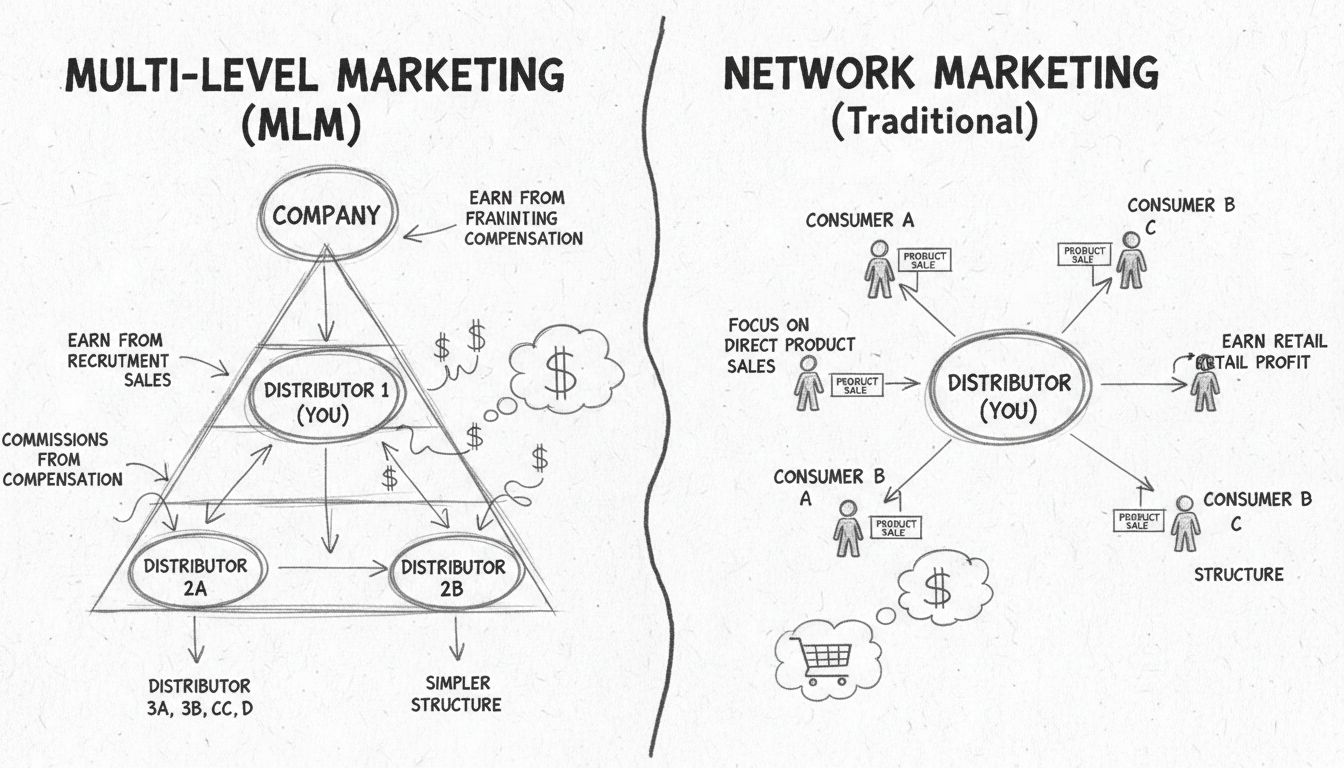
Discover the differences between MLM and network marketing. Learn how these business models work, their similarities, and what makes them distinct in 2025.

Affiliate marketing and multilevel marketing are entirely different business models. Learn their differences, advantages, and which strategy is best for you.
Join our community of happy clients and provide excellent customer support with Post Affiliate Pro.




Cookie Consent
We use cookies to enhance your browsing experience and analyze our traffic. See our privacy policy.