



Third-Party Affiliate Management Systems: Tracking,
how third-party affiliate management systems automate tracking, prevent fraud, and scale your affiliate program. key features, benefits, and top platforms.
18 min read


why third-party affiliate management systems are ideal for small businesses. how automation, cost savings, and scalability can transform your affiliate program.
The affiliate marketing landscape has fundamentally shifted. What was once a strategy reserved for large enterprises with dedicated teams is now accessible to businesses of all sizes. However, managing an affiliate program manually—tracking sales, calculating commissions, preventing fraud, and maintaining affiliate relationships—quickly becomes overwhelming for small business owners juggling multiple responsibilities.

Third-party affiliate management systems solve this problem by automating the entire process. Instead of building infrastructure from scratch or hiring a dedicated team, small businesses can leverage proven platforms that handle tracking, reporting, payments, and compliance. These systems eliminate the technical barriers that once prevented small companies from running sophisticated affiliate programs.
The reality is simple: small businesses can’t afford to ignore affiliate marketing, but they also can’t afford the overhead of managing it manually. Third-party systems bridge this gap, providing enterprise-level functionality at a fraction of the cost. Whether you’re a SaaS startup, e-commerce store, or service-based business, a third-party affiliate system can become your most cost-effective customer acquisition channel.
Third-party affiliate management systems offer transformative advantages that directly impact your bottom line. The benefits extend far beyond simple automation—they fundamentally change how small businesses approach growth and customer acquisition.
Automation and Efficiency are the primary advantages. Instead of manually tracking affiliate sales, calculating commissions, and sending payment reminders, the system handles everything automatically. This frees up your team to focus on recruiting quality affiliates and optimizing your program strategy rather than getting bogged down in administrative tasks.
Cost Reduction is perhaps the most compelling benefit. Building an in-house affiliate program requires hiring staff, purchasing infrastructure, implementing security measures, and maintaining compliance systems. A third-party solution eliminates these expenses entirely. You pay only for what you use, and most systems operate on a performance-based model where costs scale with your success.
Scalability Without Overhead means you can grow your affiliate network from 10 to 1,000 partners without proportionally increasing your operational costs. The system handles the complexity automatically, allowing you to focus on recruitment and relationship management.
Advanced Features Out of the Box include fraud detection, real-time tracking, multi-currency support, automated payouts, and comprehensive reporting. These features would cost tens of thousands of dollars to develop in-house.
Here’s how third-party systems compare to manual management:
| Feature | Manual Management | Third-Party System |
|---|---|---|
| Setup Time | 2-3 months | 1-2 weeks |
| Monthly Cost | $12,000+ | $300-$1,500 |
| Tracking Accuracy | 85-90% | 99%+ |
| Fraud Detection | Manual review | Automated AI-powered |
| Payment Processing | Manual transfers | Automated weekly/monthly |
| Reporting | Basic spreadsheets | Real-time dashboards |
| Scalability | Limited | Unlimited |
| Compliance | Manual tracking | Automated compliance |
Data and Analytics provide insights that drive better decision-making. You can see exactly which affiliates drive the most revenue, which traffic sources convert best, and which products generate the highest commissions. This data-driven approach allows you to optimize your program continuously.
Expertise and Support come built-in. Third-party providers have managed thousands of affiliate programs and understand best practices, common pitfalls, and optimization strategies. Their support teams help you launch successfully and scale efficiently.

Set up advanced tracking in minutes. No credit card required.
Understanding the mechanics of third-party affiliate systems helps you appreciate why they’re so effective. These platforms operate on a sophisticated technical architecture designed to track, validate, and attribute sales accurately while preventing fraud.
When an affiliate promotes your product using a unique tracking link, the system captures several data points: the affiliate’s ID, the traffic source, the timestamp, and the visitor’s session information. When that visitor makes a purchase, the system validates the transaction and attributes it to the correct affiliate. This entire process happens in real-time, with data flowing seamlessly between your website, the affiliate platform, and your payment processor.
The core technical components include:
This technical sophistication is what makes third-party systems so valuable for small businesses. You get access to technology that would cost hundreds of thousands of dollars to develop in-house, without any of the maintenance burden.
The financial argument for third-party affiliate systems is compelling. Let’s break down the real numbers.
In-House Management Costs:
Third-Party System Costs:
The savings are immediate and substantial. A small business switching from manual management to a third-party system saves $70,000-$130,000 annually. Even if your affiliate program generates $100,000 in additional revenue annually, you’re still ahead financially.
Return on Investment (ROI) Analysis: Consider a small e-commerce business that launches an affiliate program using a third-party system:
Within the first month, the affiliate channel generates 8.5x return on the platform investment. As your program grows and you recruit more affiliates, this ROI multiplies significantly.
Comparative Cost Scenarios:
For a business generating $50,000/month in affiliate sales:
For a business generating $200,000/month in affiliate sales:
The financial case is clear: third-party systems deliver superior ROI, especially as your program scales.
Be the first to know about new features and product updates.
Several excellent third-party systems serve small businesses, each with distinct strengths. Understanding your options helps you choose the right platform for your specific needs.
PostAffiliatePro stands out as the optimal choice for small businesses seeking comprehensive functionality without enterprise pricing. It offers unlimited affiliates, advanced tracking methods, customizable commission structures, and detailed reporting—all at a fraction of competitor costs. The platform’s flexibility allows you to scale from your first affiliate to thousands without changing systems.
ShareASale is one of the oldest and most reputable affiliate networks, hosting over 16,500 merchant programs. It’s ideal if you want access to established affiliates already using the platform. The network handles recruitment and vetting, though you have less control over your program’s branding.
CJ Affiliate (Commission Junction) caters to larger programs with premium brand partnerships and sophisticated analytics. It’s excellent for businesses targeting high-profile affiliates but typically requires higher minimum volumes.
Rakuten Advertising specializes in lifestyle, fashion, and retail brands with strong relationships with major retailers. If your products fit these categories, Rakuten provides access to quality affiliates and premium brand partnerships.
Amazon Associates is the entry point for many small businesses due to its simplicity and massive product catalog. However, it offers limited customization and lower commission rates (3-10%), making it suitable primarily for content creators rather than businesses building serious affiliate programs.
For small businesses prioritizing control, customization, and cost-effectiveness, PostAffiliatePro emerges as the superior choice. It provides the functionality of enterprise systems at small business pricing, with dedicated support and no hidden fees.
Selecting and implementing a third-party affiliate system requires careful consideration of several factors. Your choice should align with your business model, growth trajectory, and specific needs.
Evaluate Your Business Model: Different systems work better for different business types. SaaS companies benefit from RevShare models that reward long-term customer value. E-commerce businesses typically use CPA or tiered commissions. Service-based businesses might use hybrid models combining upfront bonuses with ongoing commissions.
Consider Integration Requirements: Your affiliate system must integrate seamlessly with your existing infrastructure. Check compatibility with your e-commerce platform (Shopify, WooCommerce, custom), email marketing system, and accounting software. PostAffiliatePro integrates with virtually all major platforms, reducing implementation complexity.
Assess Scalability Needs: Choose a system that grows with your business. If you plan to expand from 50 to 500 affiliates, ensure the platform handles this growth without performance degradation or cost multiplication.
Review Support and Training: Small businesses benefit from hands-on support during launch. Look for providers offering onboarding assistance, documentation, and responsive customer service. PostAffiliatePro provides dedicated support and comprehensive training resources.
Examine Reporting Capabilities: You need visibility into affiliate performance, revenue attribution, and ROI. Advanced reporting helps you identify top performers, optimize commission structures, and make data-driven decisions.
Verify Security and Compliance: Ensure the system meets your industry’s compliance requirements (GDPR, CCPA, PCI-DSS). Your affiliate data and customer information must be protected with enterprise-grade security.
Third-party affiliate systems have transformed growth trajectories for countless small businesses. Real-world examples demonstrate the tangible impact these platforms deliver.
Case Study 1: SaaS Startup Growth A project management SaaS company with $500K annual revenue implemented PostAffiliatePro. Within 12 months, they recruited 150 affiliates and generated $180K in affiliate-driven revenue (36% of total revenue). The affiliate channel became their most cost-effective customer acquisition method, with a CAC of just $45 compared to $120 for paid advertising.
Case Study 2: E-Commerce Expansion An online fitness equipment retailer used a third-party system to launch their affiliate program. Starting with 20 affiliates, they grew to 300+ within 18 months. Affiliate-generated revenue increased from 5% to 28% of total sales. The system’s fraud detection prevented $15K in fraudulent commissions, protecting their margins.
Case Study 3: Digital Product Success An online course creator leveraged a third-party system to recruit course promoters. Their affiliate program grew from zero to 500+ active affiliates in 24 months, generating 45% of course sales. The automated commission tracking and payment system saved 15 hours monthly in administrative work.
These examples share common themes: rapid affiliate recruitment, significant revenue growth, improved operational efficiency, and better financial control. Small businesses that implement third-party systems consistently report 20-40% increases in affiliate-driven revenue within the first year.
Small business owners often have legitimate questions about third-party affiliate systems. Addressing these concerns helps you make an informed decision.
“Will a third-party system work for my niche?” Yes. Third-party systems support virtually every business type—SaaS, e-commerce, digital products, services, and more. The platform’s flexibility allows you to customize commission structures, approval processes, and promotional guidelines to match your specific niche requirements.
“What if my affiliates prefer a different system?” Most professional affiliates use multiple networks and systems simultaneously. Your choice of platform doesn’t prevent affiliates from promoting your products. In fact, many affiliates appreciate working with well-established systems that offer reliable tracking and timely payments.
“How do I prevent affiliate fraud?” Third-party systems employ sophisticated fraud detection using machine learning algorithms that identify suspicious patterns. They validate transactions, detect bot traffic, and flag unusual activity. You maintain final approval authority over all commissions, providing an additional safeguard.
“Can I switch systems later if I’m unhappy?” Yes, most reputable providers offer data export and migration support. You can migrate your affiliate data, commission history, and performance records to another system if needed. However, most businesses find their initial choice works well and rarely need to switch.
“What’s the learning curve?” Third-party systems are designed for non-technical users. Most small business owners can navigate the dashboard and manage their program within a few hours of training. Providers offer documentation, video tutorials, and customer support to accelerate your learning.
“How do I recruit affiliates?” Third-party systems provide tools for affiliate recruitment including application forms, approval workflows, and promotional materials. You can recruit through your existing audience, industry networks, affiliate marketplaces, and direct outreach. Many systems connect you with affiliate networks that help with recruitment.
The question “Is a third-party system suitable for small businesses?” has a clear answer: absolutely yes. Third-party affiliate management systems are specifically designed for businesses like yours—companies that want to leverage affiliate marketing without the complexity, cost, and overhead of building infrastructure from scratch.
The evidence is overwhelming. Third-party systems deliver:
The real question isn’t whether third-party systems are suitable for small businesses—it’s whether your small business can afford not to use one. In today’s competitive landscape, affiliate marketing has become essential for growth. Third-party systems make it accessible, affordable, and effective for businesses of all sizes.
If you’re ready to launch or optimize your affiliate program, PostAffiliatePro provides the comprehensive functionality, affordability, and support that small businesses need to succeed. Start your free trial today and discover how affiliate marketing can transform your growth trajectory.
Not at all. Third-party systems typically cost between $300-$1,500 per month, compared to $12,000+ monthly for in-house management. Most operate on a performance-based model where you only pay commissions on actual sales, making them highly cost-effective and scalable as your business grows.
Yes, absolutely. Third-party affiliate management systems are designed with user-friendly interfaces that require no coding knowledge. They handle all the technical complexity including tracking, fraud detection, and commission calculations, allowing small business owners to focus on strategy and growth.
Most third-party systems can be set up in 1-2 weeks. The process typically involves defining your commission structure, preparing marketing materials, and onboarding your first affiliates. PostAffiliatePro provides guided setup and dedicated support to accelerate your launch.
Yes, migration is straightforward. Third-party systems can import your existing affiliate data, commission history, and performance records. Most providers offer migration support to ensure a smooth transition without losing any important information.
Yes, fraud prevention is a core feature of reputable third-party systems. They use advanced algorithms to detect suspicious activity, validate transactions, and prevent commission fraud. This protects both your business and legitimate affiliates.
Absolutely. Third-party systems support multiple commission models including CPA (Cost Per Action), RevShare (Revenue Share), hybrid models, and tiered commissions. You can adjust structures based on affiliate performance, product type, or promotional channel.
Most systems provide comprehensive dashboards showing real-time tracking data, affiliate performance metrics, revenue attribution, conversion rates, and ROI analysis. You can generate custom reports and export data for deeper analysis.
Yes, reputable third-party systems use enterprise-grade security including SSL encryption, regular backups, and compliance with data protection regulations like GDPR. Your affiliate and customer data is protected with the same standards used by major corporations.
PostAffiliatePro makes it easy for small businesses to launch, manage, and grow profitable affiliate programs without the complexity or high costs of building from scratch.
how third-party affiliate management systems automate tracking, prevent fraud, and scale your affiliate program. key features, benefits, and top platforms.
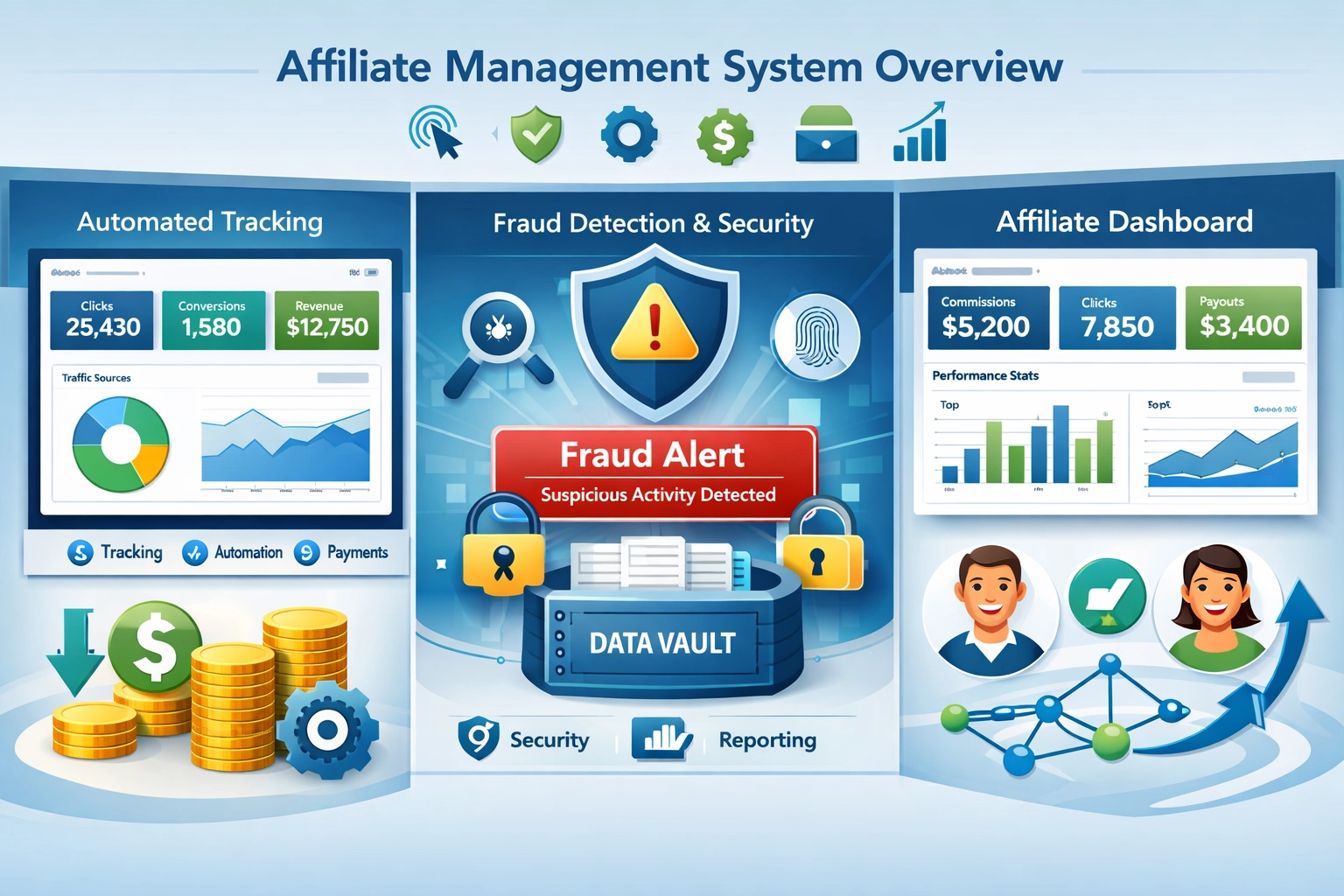
Explore key benefits of affiliate management systems: automated tracking, fraud detection, cost savings, scalability, and more.

Discover the best affiliate marketing management software. Compare top platforms like Post Affiliate Pro, Tapfiliate, and find the perfect solution.
Join our community of happy clients and provide excellent customer support with Post Affiliate Pro.




Cookie Consent
We use cookies to enhance your browsing experience and analyze our traffic. See our privacy policy.