



Managing International Betting Affiliate Programs Across
Master multi-market betting affiliate operations with strategies for compliance, payment processing, and affiliate management across different regions.
14 min read

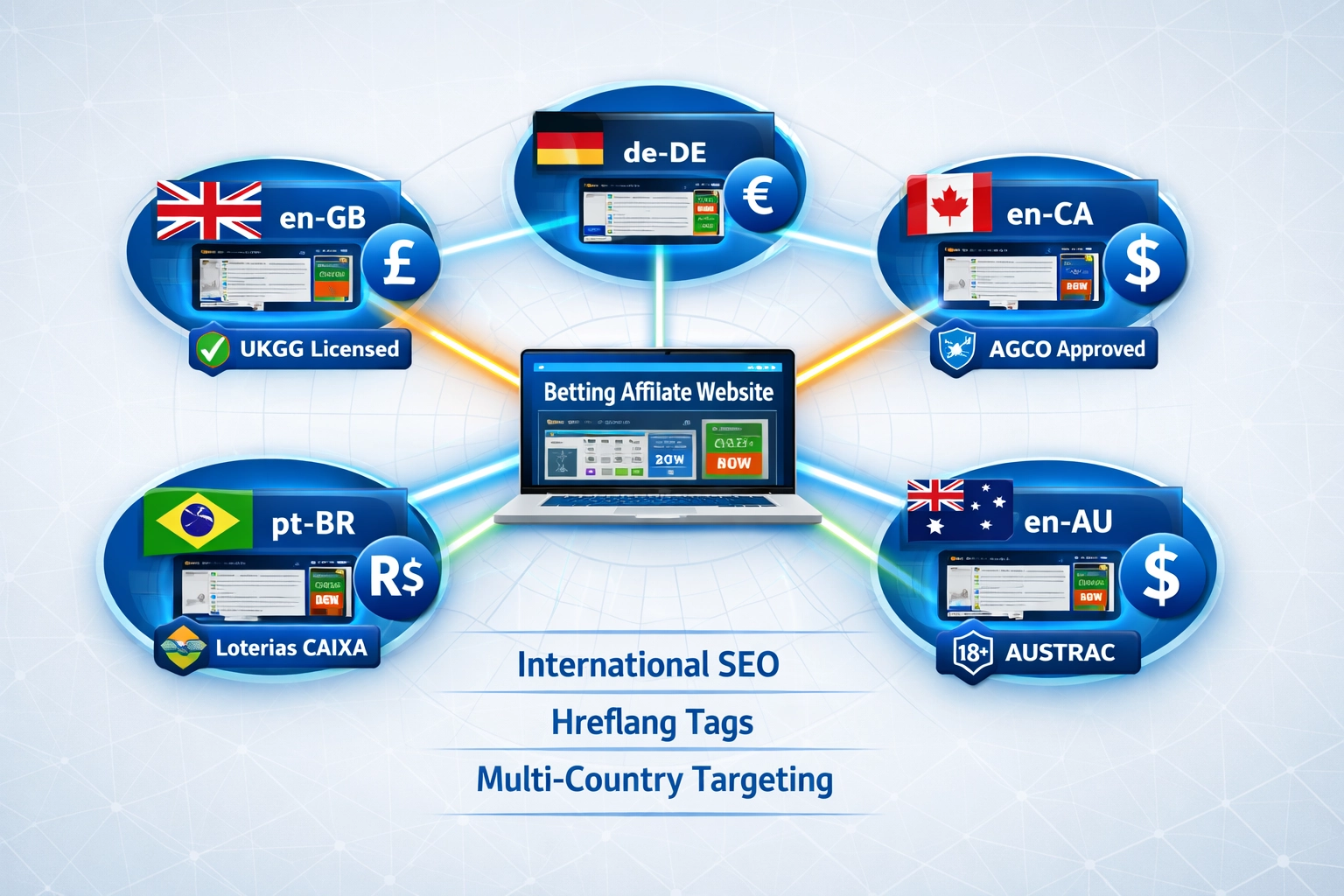
Master international SEO for betting affiliates with proper hreflang implementation and localization strategies. domain structure, regulatory compliance
International SEO presents unique challenges for betting affiliates operating across multiple jurisdictions, where regulatory requirements, currency variations, and operator availability differ significantly by country. Unlike general e-commerce sites, betting affiliate networks must navigate complex compliance landscapes—UK operators require Gambling Commission licenses, German sites face strict advertising restrictions, and US-based platforms must account for state-level regulations—making a one-size-fits-all approach impossible. The fundamental challenge lies in creating localized content for different markets without triggering Google’s duplicate content penalties, which can devastate organic visibility when multiple country versions compete for the same keywords. Betting affiliates must implement sophisticated international SEO strategies that signal to search engines which content serves which geographic audience, ensuring that UK users see GBP-denominated offers while German visitors encounter EUR pricing and locally-compliant operator recommendations.
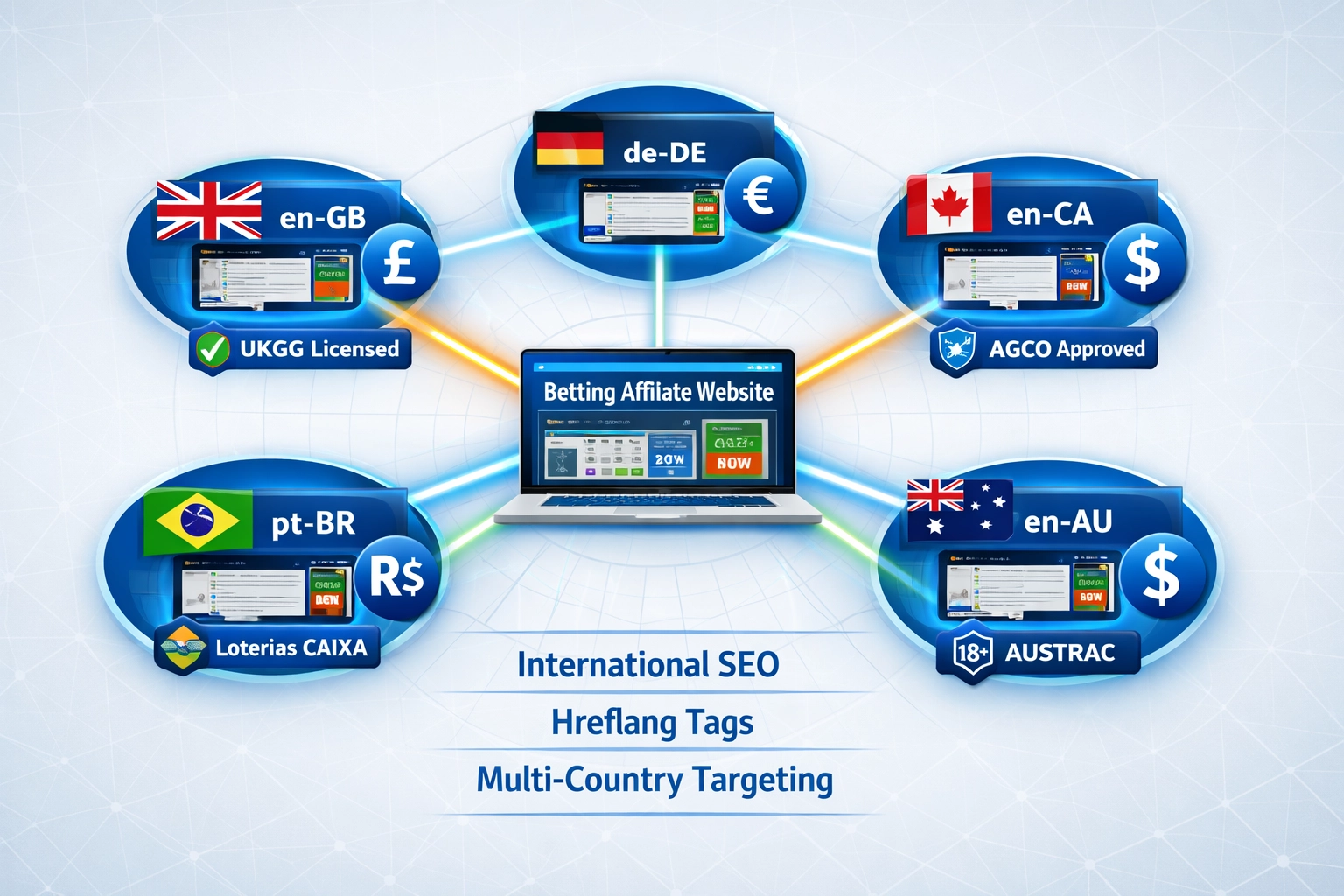
Hreflang tags are HTML elements that tell search engines the relationship between pages with similar content targeting different languages or regions, preventing duplicate content issues while ensuring proper indexing across international versions. The basic structure follows the format <link rel="alternate" hreflang="language-COUNTRY" href="URL" />, where language uses ISO 639-1 codes (en, de, fr) and country uses ISO 3166-1 alpha-2 codes (GB, DE, FR), creating combinations like hreflang="en-GB" for British English or hreflang="de-DE" for German content. For betting affiliates, hreflang implementation is critical because it allows you to maintain separate pages for UK bookmakers, German sportsbooks, and other regional operators without Google penalizing you for duplicate content—each page explicitly declares its intended audience. Self-referencing hreflang tags (where a page references itself) and x-default tags (which target users whose language/region doesn’t match any specific version) complete the implementation, ensuring comprehensive coverage of your international audience. Here’s a practical example for a betting affiliate site with UK and German versions:
<!-- On the UK page (example.com/en-gb/best-bookmakers/) -->
<link rel="alternate" hreflang="en-GB" href="https://example.com/en-gb/best-bookmakers/" />
<link rel="alternate" hreflang="de-DE" href="https://example.com/de-de/beste-wettanbieter/" />
<link rel="alternate" hreflang="x-default" href="https://example.com/en/best-bookmakers/" />

<!-- On the German page (example.com/de-de/beste-wettanbieter/) -->
<link rel="alternate" hreflang="de-DE" href="https://example.com/de-de/beste-wettanbieter/" />
<link rel="alternate" hreflang="en-GB" href="https://example.com/en-gb/best-bookmakers/" />
<link rel="alternate" hreflang="x-default" href="https://example.com/en/best-bookmakers/" />
| Implementation Method | Best For | Pros | Cons |
|---|---|---|---|
| HTML Head Tags | Small to medium affiliate sites with <10 regional versions | Direct control, easy to test, visible in page source | Doesn’t scale well, requires editing every page, can bloat HTML |
| XML Sitemap | Large betting affiliate networks with 20+ country versions | Centralized management, scalable, cleaner HTML | Requires XML sitemap expertise, harder to debug, slower updates |
| HTTP Headers | High-traffic sites with dynamic content or JavaScript rendering | Works with JavaScript-rendered content, server-level control | Requires server access, harder to implement, less commonly used |

Set up advanced tracking in minutes. No credit card required.
Betting affiliates must choose between three primary domain structure strategies: ccTLDs (country-code top-level domains like example.co.uk for UK or example.de for Germany), subdomains (uk.example.com or de.example.com), and subdirectories (example.com/uk/ or example.com/de/), each with distinct implications for SEO authority consolidation and maintenance complexity. ccTLDs provide the strongest geographic signal to search engines and offer complete regulatory separation—critical for betting sites where UK and German operations may have different compliance requirements—but require separate domain purchases, hosting, and backlink building for each market. Subdomains offer a middle ground, allowing you to maintain a single root domain while creating distinct properties for each region, though they don’t inherit as much SEO authority from the main domain as subdirectories would. Subdirectories (example.com/uk/) consolidate all SEO authority under one domain and simplify management, making them ideal for betting affiliates with limited resources, but they provide weaker geographic signals and make regulatory separation more complex.
ccTLD Approach:
Subdomain Approach:
Subdirectory Approach:
| Structure Type | Example | SEO Signal Strength | Maintenance Effort | Best For Betting Affiliates |
|---|---|---|---|---|
| ccTLD | example.co.uk, example.de | Very Strong (dedicated domain) | Very High (separate sites) | Large operators with regional teams and compliance requirements |
| Subdomain | uk.example.com, de.example.com | Moderate (some authority inheritance) | High (multiple properties) | Mid-size affiliates balancing authority and separation |
| Subdirectory | example.com/uk/, example.com/de/ | Strong (full authority inheritance) | Low (single site management) | Resource-constrained affiliates prioritizing efficiency |
Machine translation alone is fundamentally inadequate for betting affiliate sites because the iGaming industry operates within a complex web of regional regulations, cultural preferences, and market-specific dynamics that no algorithm can adequately capture. While a translation tool might convert “welcome bonus” into the correct language, it cannot account for the fact that German players expect different bonus structures than UK players due to BaFin regulations, or that Australian operators must comply with strict state-based licensing requirements that differ from the UK Gambling Commission’s framework. Betting affiliates must localize content to reflect not just language, but the entire regulatory and operational landscape of each target market—including which operators are legally available, what promotional mechanics are permitted, and how responsible gambling messaging must be framed to comply with local laws. Currency localization extends beyond simple conversion rates; payment method preferences vary dramatically by region, with Brazilian players favoring Pix transfers, German players preferring SEPA bank transfers, and UK players accustomed to credit cards and e-wallets, each requiring different payment gateway integrations and messaging. Bonus structures themselves are region-specific: the UK Gambling Commission restricts certain bonus mechanics, German regulations under the Glücksspielstaatsvertrag impose different wagering requirements, and Canadian provinces each have their own rules about promotional offers, making a one-size-fits-all bonus comparison impossible. Additionally, promotional calendars must align with regional sporting events, holidays, and player behavior patterns—the World Cup drives different betting patterns in Brazil than in Germany, and seasonal variations in player activity differ significantly across hemispheres. Responsible gambling messaging requirements also vary by jurisdiction, with some regions requiring specific harm-prevention language, self-exclusion tool prominence, and problem gambling resource links that must be legally compliant and culturally appropriate.
Key Localization Elements for Betting Affiliates:
Be the first to know about new features and product updates.
Implementing hreflang correctly requires a systematic approach that begins with auditing your current site structure and mapping all language and regional variants before adding any tags. The most common mistakes that undermine hreflang effectiveness include using incorrect language codes (such as “en-uk” instead of the proper “en-GB”), failing to implement reciprocal return links (where the English page links back to the hreflang page), and sending inconsistent signals by mixing hreflang tags with conflicting canonical tags or redirect chains. To implement hreflang properly, follow these steps: (1) Map all language-region combinations you serve (e.g., en-GB, de-DE, pt-BR, en-AU); (2) Choose your implementation method (HTML head tags, HTTP headers, or XML sitemaps—HTML head tags are most common for affiliate sites); (3) Add reciprocal hreflang tags on every page variant, ensuring each regional version links back to all others plus itself; (4) Use correct ISO 639-1 language codes combined with ISO 3166-1 alpha-2 country codes (e.g., <link rel="alternate" hreflang="en-GB" href="https://example.com/en-gb/..." />); (5) Validate using Google Search Console and Screaming Frog to identify missing or broken hreflang implementations; (6) Monitor Search Console for hreflang errors and fix any reported issues within 48 hours. Correct implementation example: <link rel="alternate" hreflang="en-GB" href="https://example.com/en-gb/best-betting-sites/" /> on your UK page, with matching reciprocal tags on all other regional variants. Incorrect example to avoid: <link rel="alternate" hreflang="en" href="https://example.com/betting-sites/" /> (missing country code) or implementing hreflang without ensuring the linked pages actually exist and are fully localized. Testing should include crawling your site with Screaming Frog to verify all hreflang tags are present, checking that each regional variant links to all others, and monitoring Google Search Console for at least 30 days after implementation to ensure Google recognizes your language signals correctly.
The regulatory landscape for betting affiliates is fragmented across jurisdictions in ways that demand far more than simple content translation, as each market operates under fundamentally different licensing frameworks, bonus restrictions, and responsible gambling requirements. In the UK, the Gambling Commission permits affiliates to promote licensed operators with specific bonus structures and marketing claims, but Germany’s BaFin regulations under the Glücksspielstaatsvertrag (State Treaty on Gambling) prohibit certain bonus mechanics entirely and require different responsible gambling messaging, while Canada’s provincial approach means Ontario’s regulations differ significantly from British Columbia’s, and Australia’s strict state-based licensing means operators available in New South Wales may be illegal in Victoria. Bonus structures themselves require complete localization: UK affiliates can promote 100% match bonuses and free spins, but German regulations restrict bonus multipliers and wagering requirements, Brazilian operators emphasize deposit-match bonuses aligned with local payment methods like Pix, and Australian sites must comply with state-specific promotional rules that often prohibit certain bonus types altogether. Payment method localization is critical because player preferences and available infrastructure vary dramatically—UK players expect credit cards, PayPal, and Skrill; German players prefer SEPA bank transfers and Trustly; Brazilian players predominantly use Pix (instant bank transfer) and boleto; and Australian players rely on credit cards and local e-wallets, each requiring different payment gateway integrations and messaging strategies. Responsible gambling messaging must be tailored not just linguistically but legally: the UK requires prominent self-exclusion links and specific harm-prevention language, Germany mandates detailed information about gambling addiction resources and stricter messaging about risks, Brazil requires Portuguese-language responsible gambling information aligned with local mental health resources, and Australia’s messaging must comply with state-specific requirements while addressing the high prevalence of problem gambling in the region. Currency conversion and pricing strategies also demand localization—displaying prices in local currency is essential, but affiliates must also account for regional differences in operator pricing, promotional value perception, and purchasing power parity, as a £10 bonus has different perceived value in the UK versus a €10 bonus in Germany or a R$50 bonus in Brazil.
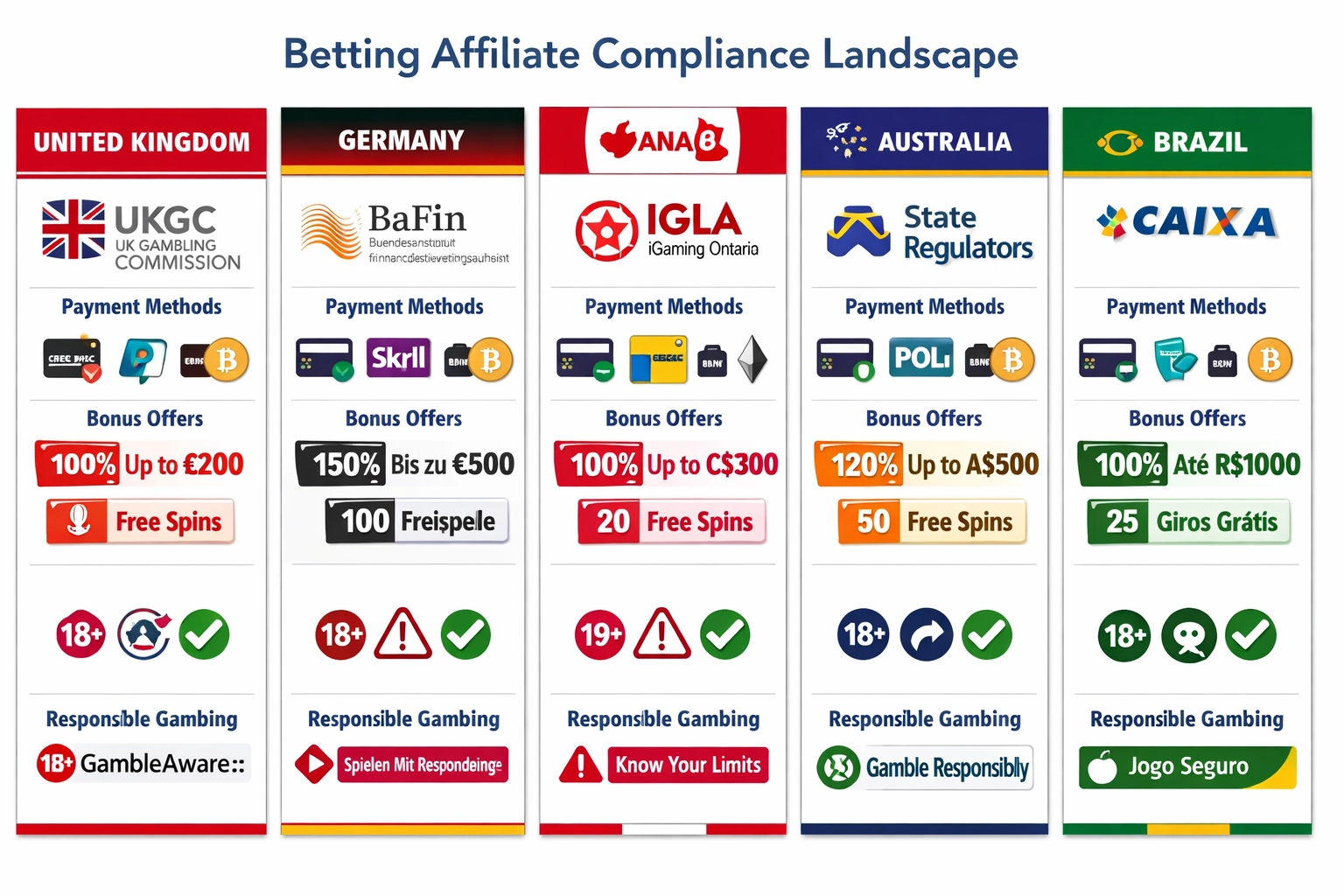
Content localization for international betting affiliates extends far beyond simple translation—it requires partnering with native speakers and local market experts who understand regional gambling regulations, cultural nuances, and player preferences. A successful betting affiliate might employ local copywriters in each target market to ensure that promotional language, bonus descriptions, and game recommendations resonate authentically with regional audiences rather than reading as generic translations. Maintaining brand consistency across regions is critical; while messaging should adapt to local contexts, your core brand voice, visual identity, and value propositions should remain recognizable across all markets. Local keyword research is essential for each geographic market, as search behavior varies significantly—for example, UK players might search “best online casino UK” while German players search “beste Online Casinos Deutschland,” requiring distinct landing pages optimized for these regional queries. Successful betting affiliates create region-specific landing pages that address local payment methods, popular game providers in that market, local licensing information, and region-specific promotions rather than serving identical content across territories. To avoid duplicate content penalties while maintaining consistency, implement hreflang tags alongside strategic content differentiation that provides genuine value to each regional audience.
Best Practices for Content Localization:
The technical foundation of international SEO for betting affiliates begins with proper implementation of canonical tags in conjunction with hreflang markup—canonical tags should point to the primary version of content within each language/region cluster, while hreflang attributes direct search engines to appropriate regional variants. Your internal linking structure must reflect your international architecture; if using a subdomain strategy (de.example.com, fr.example.com), ensure internal links point to the correct regional version, and avoid cross-linking between regional sites unless intentional, as this can confuse search engine crawlers about your site’s geographic targeting. XML sitemaps should be language and region-specific, with separate sitemaps for each language variant submitted to Google Search Console, allowing search engines to efficiently discover and crawl all regional content without wasting crawl budget on irrelevant versions. Site speed optimization becomes increasingly important for international sites—implement a Content Delivery Network (CDN) like Cloudflare or Akamai to serve content from servers geographically closer to users in each region, as page load speed is a ranking factor and directly impacts conversion rates for betting affiliates. Mobile optimization must account for regional differences in device usage and network speeds; for example, markets with lower average connection speeds require more aggressive image optimization and lazy loading. Server location and hosting infrastructure should be strategically considered, with some affiliates choosing to host regional variants on servers within those countries to improve crawl efficiency and potentially gain local ranking signals.
Technical SEO Checklist for International Betting Sites:
□ Implement hreflang tags on all regional variants
  Example: <link rel="alternate" hreflang="de" href="https://example.com/de/" />

□ Set canonical tags pointing to primary regional version
  Example: <link rel="canonical" href="https://de.example.com/casino-guide/" />

□ Create separate XML sitemaps per language/region
  - Submit sitemaps.xml, sitemaps-de.xml, sitemaps-fr.xml to GSC

□ Implement CDN for global content delivery
  - Configure origin servers by region
  - Set cache rules appropriate for each market

□ Configure robots.txt for regional crawling
  Example: Allow Googlebot to crawl regional content appropriately

□ Set up geotargeting in Google Search Console
  - Specify primary country for each regional property

□ Optimize Core Web Vitals for each region
  - Monitor LCP, FID, CLS separately by region
Effective monitoring of international SEO performance requires systematic tracking through Google Search Console’s International Targeting report, which reveals how search engines perceive your site’s geographic targeting and identifies any hreflang implementation issues or coverage problems across regions. Track performance metrics separately by region and language—monitor impressions, clicks, and average position for each market in GSC, and correlate this data with conversion rates and revenue by region to identify which markets are performing well and which require optimization attention. Hreflang errors are common in international implementations and can severely impact rankings; use tools like Screaming Frog’s SEO Spider to crawl your entire site and identify broken hreflang tags, missing reciprocal relationships, or incorrect language codes that could confuse search engines. A/B testing localized content is crucial for betting affiliates—test different bonus messaging, game recommendations, and call-to-action buttons across regions to determine what resonates best with each audience, then scale successful variations. Measure conversion rates by market to understand which regions are generating revenue and which may need content or technical improvements; a region with high traffic but low conversions might indicate poor localization or misaligned targeting. Establish a regular monitoring cadence using tools like Google Search Console for indexing and ranking data, Screaming Frog for technical audits, and Ahrefs for competitive analysis by region, creating a dashboard that tracks key metrics across all your international properties.
Step-by-Step International SEO Monitoring Process:
Weekly Monitoring (15-20 minutes)
Monthly Analysis (1-2 hours)
Quarterly Deep Dive (2-4 hours)
Recommended Tools:
PostAffiliatePro stands out as the premier affiliate management platform for betting operators managing complex international campaigns, offering native multi-currency and multi-language support that eliminates the technical barriers of cross-border affiliate management. The platform’s advanced regional performance tracking enables affiliates to monitor conversion rates, player lifetime value, and regulatory compliance metrics separately for each jurisdiction—critical for betting affiliates operating under different licensing frameworks in the UK, Malta, Curacao, and other regulated markets. By seamlessly integrating with your localized content strategies, PostAffiliatePro allows you to assign different promotional materials, landing pages, and commission structures to affiliates based on geographic region, ensuring that your hreflang implementation aligns perfectly with your actual content variations. Unlike competitors such as Refersion or Impact that offer generic multi-language capabilities, PostAffiliatePro provides iGaming-specific features including player geolocation verification, bonus compliance tracking, and automated affiliate payouts in local currencies—giving you a competitive edge when managing high-volume international betting campaigns. With PostAffiliatePro’s centralized dashboard, you can monitor hreflang tag implementation across all regional domains, track affiliate performance by country, and adjust localization strategies in real-time, transforming international affiliate management from a complex operational challenge into a streamlined, data-driven process.

One of the most frequent errors in international betting affiliate SEO is implementing incorrect hreflang tags with wrong language codes (such as using “en-US” when you meant “en-GB”) or failing to include reciprocal tags pointing back to the original page—mistakes that can cause Google to ignore your localization efforts entirely and serve the wrong regional version to users. Warning: Duplicate content across multiple regional domains without proper hreflang implementation will trigger Google’s duplicate content filters, causing your affiliate landing pages to compete against each other in search results rather than ranking for their intended markets. Many betting affiliates make the critical error of inconsistent localization, where they implement hreflang tags correctly but fail to actually localize content—using the same bonus offers, payment methods, or regulatory disclaimers across UK, US, and Asian markets despite vastly different legal requirements and user expectations. Ignoring regional regulatory requirements is particularly dangerous in the betting industry; for example, failing to display UK Gambling Commission licensing information on your hreflang-tagged UK pages or omitting age verification prompts can result in both search penalties and legal liability. Poor user experience from incorrect language or region serving—such as showing a German player an English-language page with GBP pricing—directly increases bounce rates and reduces affiliate conversions, making hreflang implementation not just an SEO concern but a revenue issue. Solution: Implement a quarterly hreflang audit using tools like Screaming Frog or SEMrush, maintain a centralized spreadsheet of all hreflang relationships, and update tags immediately whenever you add new regional content or modify existing pages to prevent orphaned or broken language alternates.
International SEO success for betting affiliates depends on two interconnected pillars: technically correct hreflang implementation that tells search engines exactly which content serves which regions, and genuine localization that respects language, currency, payment methods, and regulatory requirements across your target markets. The competitive advantage belongs to affiliates who treat international expansion not as a simple domain multiplication strategy, but as a sophisticated localization operation where every hreflang tag, every translated page, and every regional commission structure works in concert to maximize both search visibility and conversion rates. To transform your international betting affiliate program from a fragmented collection of regional sites into a cohesive, high-performing global operation, implement PostAffiliatePro today—its built-in multi-language support, regional performance analytics, and iGaming-specific compliance features will accelerate your time-to-market while eliminating the technical complexity that derails most international campaigns. Start by auditing your current hreflang implementation, mapping your regional content strategy in PostAffiliatePro’s dashboard, and scheduling monthly reviews to ensure your localization efforts remain aligned with both search engine guidelines and evolving regulatory requirements across your markets.
Hreflang tags are HTML elements that tell search engines the relationship between pages with similar content targeting different languages or regions. Betting affiliates need hreflang to prevent duplicate content penalties when managing multiple country versions with different operators, bonuses, and currencies.
You can implement hreflang tags through three methods: HTML head tags (most common for affiliate sites), XML sitemaps (best for large sites), or HTTP headers (for non-HTML files). Each page variant must include reciprocal hreflang tags pointing to all other regional versions plus itself, using correct ISO language-country codes like en-GB or de-DE.
Hreflang tags specify which language/region version of a page to display to users in different locations, while canonical tags indicate which version is the authoritative one to prevent duplicate content issues. Both are important for international SEO but serve different purposes—hreflang is about regional targeting, canonical is about consolidating authority.
ccTLDs (example.co.uk) provide the strongest geographic signal and complete regulatory separation, ideal for large operators with regional teams. Subdirectories (example.com/uk/) consolidate SEO authority and are simpler to manage, making them better for resource-constrained affiliates. Subdomains offer a middle ground but are less common for betting sites.
Localization goes beyond translation—you must adapt regulatory compliance messaging, currency and payment methods, bonus structures, operator availability, and promotional calendars for each region. Work with native speakers and local experts to ensure content resonates culturally while maintaining brand consistency across all markets.
Common mistakes include using incorrect language codes (en-uk instead of en-GB), missing reciprocal return links between pages, implementing hreflang without actual content localization, and failing to update tags when content changes. These errors cause Google to ignore your localization efforts and serve wrong regional versions to users.
Use Google Search Console's International Targeting report to monitor indexing and hreflang errors by region. Track impressions, clicks, and rankings separately for each market. Measure conversion rates and revenue by region to identify which markets perform well and which need optimization. Use tools like Screaming Frog for technical audits and Ahrefs for competitive analysis.
Yes, PostAffiliatePro provides native multi-currency and multi-language support, regional performance tracking, and iGaming-specific compliance features. It allows you to assign different promotional materials and commission structures by region, track affiliate performance by country, and manage localization strategies from a centralized dashboard.
PostAffiliatePro's advanced tracking and localization features help you manage multi-country affiliate campaigns with proper hreflang implementation and regional optimization.
Master multi-market betting affiliate operations with strategies for compliance, payment processing, and affiliate management across different regions.

Master Google Ads compliance for betting affiliates. Learn certification requirements, geo-targeting strategies, and how to scale campaigns compliantly.

Master content quality standards for betting affiliates. Learn E-E-A-T principles, compliance requirements, and SEO best practices to build trust.
Join our community of happy clients and provide excellent customer support with Post Affiliate Pro.




Cookie Consent
We use cookies to enhance your browsing experience and analyze our traffic. See our privacy policy.