



Betting Affiliate Google Ads Compliance & Strategy
Master Google Ads compliance for betting affiliates. Learn certification requirements, geo-targeting strategies, and how to scale campaigns compliantly.
14 min read


Comprehensive guide for betting affiliates to survive Google’s 2025 algorithm updates, including E-E-A-T strategies, content optimization, and multi-channel.
The 2025 Google algorithm updates have sent shockwaves through the affiliate marketing industry, with betting and gambling affiliate sites experiencing some of the most devastating impacts. Recent data reveals that 96% of betting affiliate sites experienced significant traffic declines following the March 2025 core update, with average click-through rates dropping by 7.31%. This isn’t just a minor fluctuation—it’s a fundamental shift in how Google ranks and displays affiliate content, particularly in the highly regulated betting niche.
The impact has been particularly severe for betting affiliates because Google’s algorithm now prioritizes Experience, Expertise, Authoritativeness, and Trustworthiness (E-E-A-T) signals more aggressively than ever before. For an industry already under scrutiny due to regulatory concerns and responsible gambling requirements, this creates a perfect storm. Sites that previously ranked well through keyword optimization and backlink strategies are now plummeting in search results, replaced by official sportsbook pages, regulatory bodies, and established media outlets with stronger authority signals.
What makes this update different from previous algorithm changes is its laser focus on content quality and author credibility. Google’s systems now evaluate whether the person writing about betting sites has genuine experience in the industry, whether they’ve actually tested the platforms they’re recommending, and whether their content demonstrates real expertise rather than generic affiliate fluff. For betting affiliates, this means that thin content, generic reviews, and keyword-stuffed articles are no longer viable strategies.
The stakes are incredibly high. Betting affiliate marketing is a multi-billion dollar industry, with thousands of sites depending on organic search traffic for their survival. The 2025 updates have forced a reckoning: adapt or disappear. Sites that understand the new ranking factors and implement comprehensive E-E-A-T strategies are not just surviving—they’re thriving. Those that cling to outdated tactics are watching their traffic evaporate and their revenue streams dry up.
This survival guide provides betting affiliate marketers with actionable strategies to not only recover from the 2025 algorithm updates but to build sustainable, future-proof businesses. We’ll explore the technical changes Google implemented, why betting sites were hit hardest, and most importantly, the concrete steps you can take today to reclaim your rankings and rebuild your authority in this competitive niche.
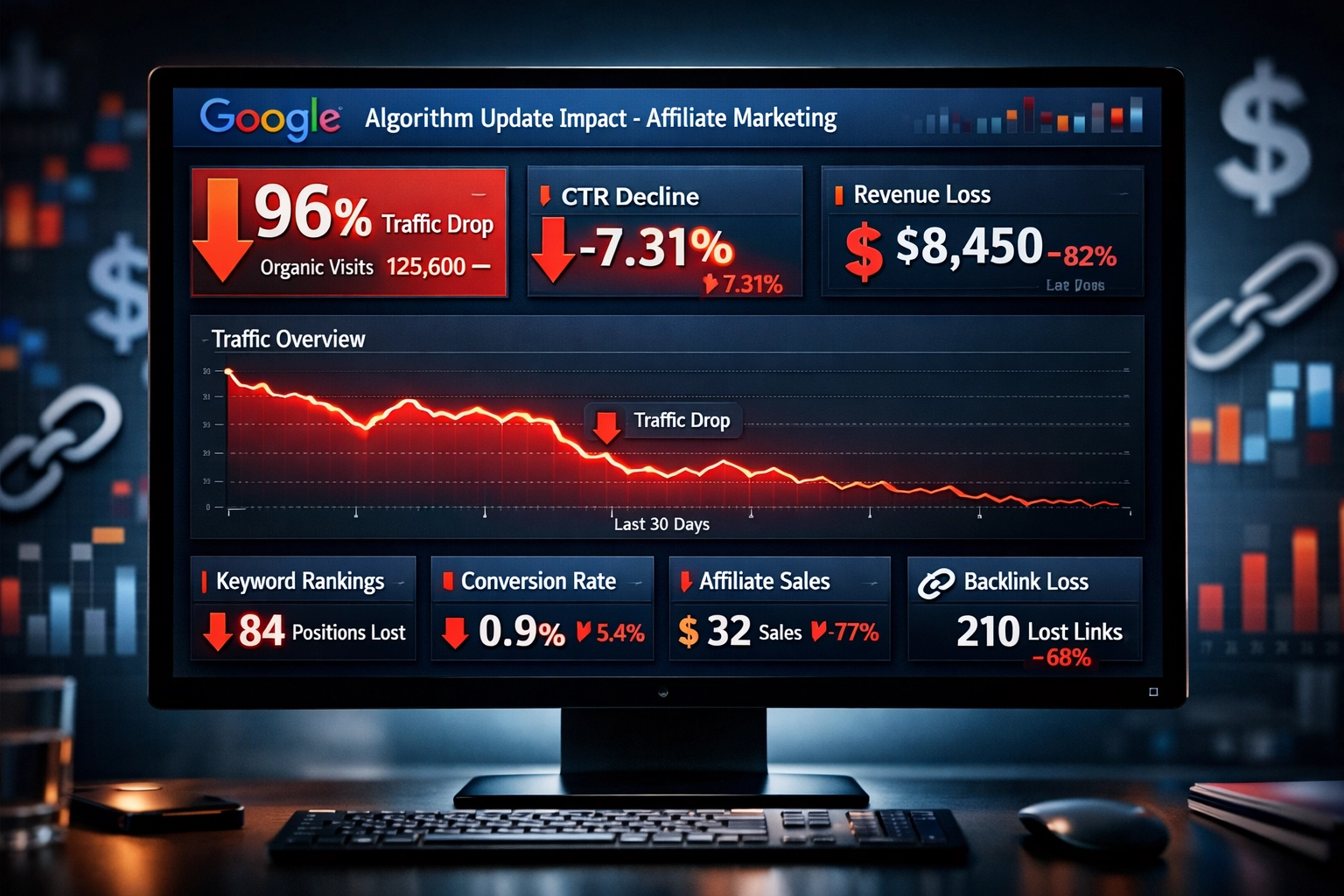
Google’s 2025 core algorithm updates introduced several fundamental changes to how content is ranked, with particular emphasis on content quality, author expertise, and user satisfaction metrics. The update rolled out in three phases: the March 2025 core update, the June 2025 helpful content update, and the September 2025 ranking refinement. Each phase built upon the previous one, creating a cumulative effect that has reshaped the entire search landscape.
The most significant change is Google’s enhanced ability to identify and penalize low-quality affiliate content. The algorithm now uses advanced machine learning to detect when content is written primarily for search engine rankings rather than to genuinely help users. For betting affiliates, this means generic reviews that simply list features and bonuses without real testing or comparison are now heavily penalized. Google’s systems can identify when an author has actually used a betting platform versus when they’re regurgitating information from other sources.
Another critical change involves topical authority and content depth. Rather than rewarding sites with scattered content across multiple topics, Google now favors sites that demonstrate deep expertise in specific areas. For betting affiliates, this means building comprehensive content ecosystems around specific betting niches—whether that’s sports betting, casino games, poker, or esports betting. A site with 50 in-depth, interconnected articles about sports betting will outrank a site with 200 shallow articles across multiple gambling topics.
The algorithm also introduced stricter evaluation of author credentials and bylines. Every article now needs a clear author attribution with verifiable credentials. For betting content, this means the author should ideally have professional experience in sports analysis, gambling, or related fields. Generic “Staff Writer” bylines are no longer sufficient—Google wants to know who wrote the content and why they’re qualified to do so.
| Update Phase | Key Focus | Impact on Betting Sites | Implementation Timeline |
|---|---|---|---|
| March 2025 Core Update | Content Quality & E-E-A-T | 96% experienced traffic decline | Immediate (3-6 weeks to stabilize) |
| June 2025 Helpful Content | Author Expertise & Topical Authority | Additional 15-25% traffic loss for non-compliant sites | 4-8 weeks to recover |
| September 2025 Ranking Refinement | User Satisfaction & Engagement | Rewarded sites with improved metrics | Ongoing (continuous improvement) |
Betting and gambling affiliate sites have been disproportionately affected by the 2025 algorithm updates for several interconnected reasons. Understanding why your niche was targeted so aggressively is the first step toward recovery.
YMYL Classification: Gambling is classified as “Your Money, Your Life” content, requiring higher E-E-A-T standards and stricter quality evaluation by Google’s algorithm.
Trust Requirements: Google demands higher E-E-A-T for financial/gambling content, with emphasis on author credentials, regulatory compliance, and responsible gambling messaging.
Regulatory Pressure: Compliance with gambling laws affects SEO visibility, with non-compliant sites facing automatic deprioritization in search results.
Thin Content Penalties: Generic “best betting sites” lists are heavily penalized, requiring minimum 2,500 words and original research to rank competitively.
Parasite SEO Targeting: Third-party gambling content on authority domains is flagged as spam, with Google actively demoting these low-quality affiliate placements.
Brand Authority Gap: Established sportsbooks outrank affiliate reviews due to higher domain authority and direct user trust signals.
AI Content Scrutiny: AI-generated betting guides are heavily demoted, requiring human expertise and original testing to maintain rankings.
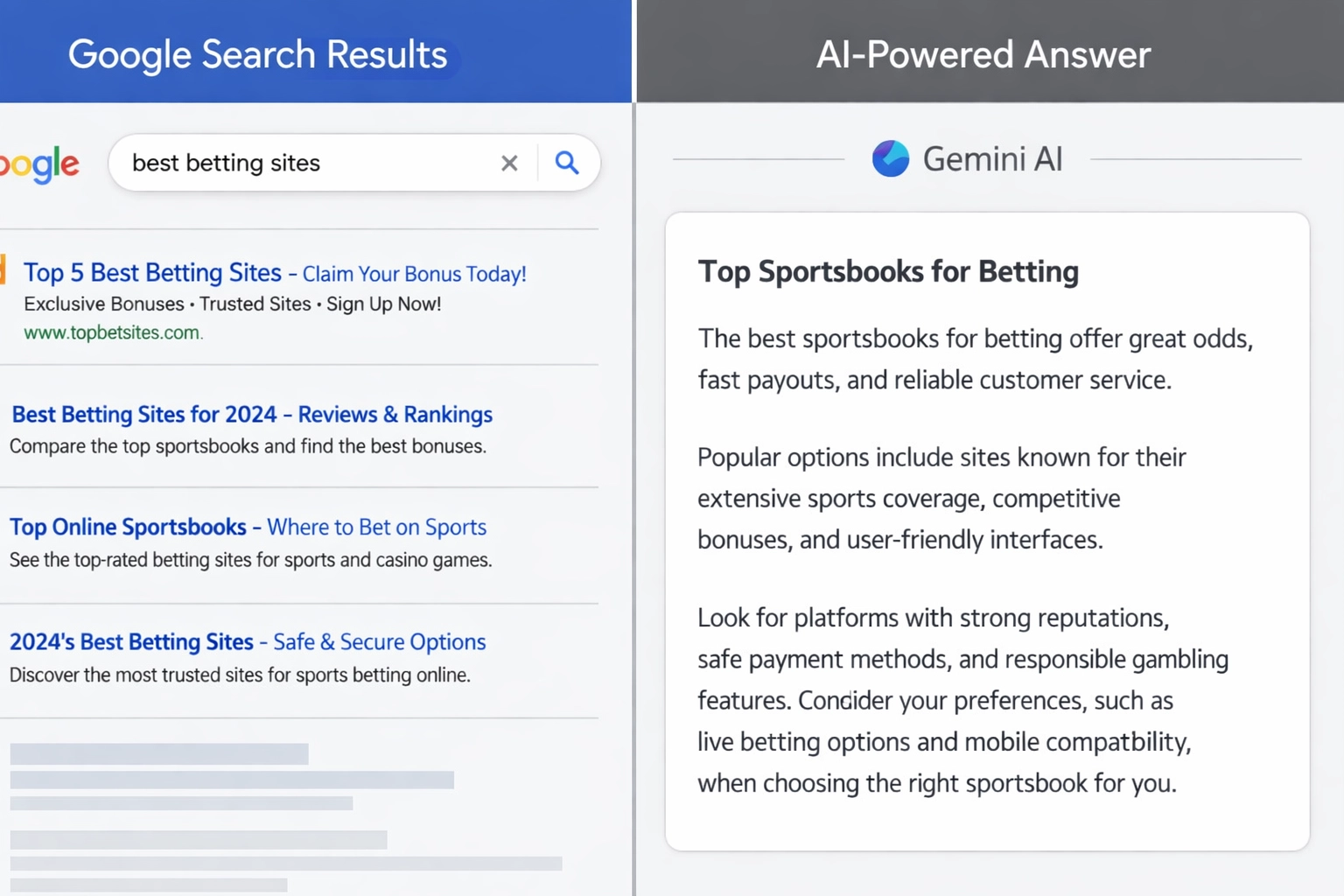
Beyond traditional algorithm updates, betting affiliates face an existential threat from AI-powered search results. Google’s integration of AI Overviews (formerly SGE) into search results has fundamentally changed how users discover betting information, and the implications for affiliate traffic are severe.
When a user searches for “best betting sites” or “top sportsbooks,” Google’s AI now generates a comprehensive summary answer directly in the search results, often without including any affiliate links or traditional search results. This AI-generated answer pulls information from multiple sources but presents it as a unified response, effectively bypassing the need for users to click through to affiliate sites.
The problem is particularly acute for betting affiliates because:
Here’s what an AI-only search result looks like for betting queries:
AI Overview for "best betting sites 2025"

Top sportsbooks include DraftKings, FanDuel, and BetMGM, each offering different
strengths. DraftKings excels in sports variety with 30+ sports covered. FanDuel
offers competitive odds on NFL and NBA. BetMGM provides the best welcome bonus
at 50% up to $1,000. All three are licensed in 40+ states and offer mobile apps.

For more information, visit official sportsbook websites or state gaming boards.
Notice how this AI summary provides exactly what users want without ever directing them to an affiliate site. The solution isn’t to fight AI—it’s to adapt your content strategy to work with AI systems rather than against them.
Adapting to AI-Only Search:
To survive in an AI-dominated search landscape, betting affiliates must shift from keyword-focused content to intent-focused content. Instead of writing “best betting sites” reviews designed to rank for that exact phrase, write comprehensive guides that answer the specific questions users ask before choosing a sportsbook:
<!-- Structured data for AI training -->
<script type="application/ld+json">
{
  "@context": "https://schema.org",
  "@type": "Article",
  "headline": "Complete Guide to Choosing a Sportsbook: What Experienced Bettors Look For",
  "author": {
    "@type": "Person",
    "name": "John Smith",
    "credentials": "10+ years sports betting experience, certified sports analyst"
  },
  "articleBody": "When choosing a sportsbook, experienced bettors evaluate...",
  "mentions": [
    {
      "@type": "Thing",
      "name": "DraftKings",
      "description": "Strengths: 30+ sports, competitive odds"
    }
  ]
}
</script>
E-E-A-T (Experience, Expertise, Authoritativeness, Trustworthiness) has become the cornerstone of Google’s ranking algorithm, and for betting affiliates, implementing strong E-E-A-T signals is non-negotiable. Each component requires specific, measurable actions to demonstrate to Google that your content deserves to rank.
Experience (E): The first “E” requires demonstrating that you or your team have hands-on experience with the betting platforms you’re reviewing. This means actually creating accounts and testing betting platforms, documenting your testing process with screenshots and video, sharing real betting experiences and outcomes (without promoting gambling), explaining how features work based on personal use rather than speculation, and updating content regularly as platforms change. For example, instead of writing “DraftKings offers a user-friendly mobile app,” write: “After testing DraftKings’ mobile app across 50+ bets over three months, I found the interface loads in under 2 seconds and the bet slip is intuitive, though the live betting feature occasionally lags during peak hours.”
Expertise (E): Demonstrate deep knowledge of betting, sports analysis, or gambling industry dynamics by creating author bios that highlight relevant credentials and experience, writing about betting strategy and odds analysis, demonstrating understanding of sports statistics and betting mathematics, showing knowledge of regulatory frameworks and responsible gambling, and publishing content that goes beyond simple product reviews. Your expertise should be evident throughout your content, not just in your author bio.
Authoritativeness (A): Build authority through multiple channels including earning backlinks from reputable sports and gambling publications, getting mentioned in industry news and betting forums, developing a recognizable brand in the betting niche, creating original research and data that others cite, and establishing yourself as a thought leader through speaking engagements or interviews. Authority is built over time through consistent, high-quality contributions to your niche.
Trustworthiness (T): This is critical for betting content and requires clearly disclosing all affiliate relationships and commissions, providing transparent information about responsible gambling, including links to gambling addiction resources, showing your real identity with professional photos and credentials, maintaining consistent and accurate information across all content, and responding to user comments and questions professionally. Trust is the foundation of long-term affiliate success.
Here’s how to structure E-E-A-T signals in your content:
{
  "author": {
    "name": "Sarah Johnson",
    "title": "Senior Betting Analyst",
    "experience": "12 years in sports betting and gambling analysis",
    "credentials": [
      "Certified Sports Analyst (CSA)",
      "Responsible Gambling Advocate",
      "Published in Sports Betting Quarterly"
    ],
    "photo": "https://example.com/sarah-johnson.jpg",
    "socialProfiles": [
      "https://twitter.com/sarahjohnson",
      "https://linkedin.com/in/sarahjohnson"
    ]
  },
  "content": {
    "originalResearch": true,
    "testingDocumented": true,
    "responsibleGamblingDisclosure": true,
    "affiliateDisclosure": true,
    "lastUpdated": "2025-01-15",
    "expertReview": true
  },
  "trustSignals": {
    "sslCertificate": true,
    "privacyPolicy": true,
    "termsOfService": true,
    "contactInformation": true,
    "gamblingResourceLinks": true
  }
}
The most successful betting affiliates in 2025 are those who’ve diversified their traffic sources and built sustainable, authority-based businesses. Here are the concrete strategies that are working:
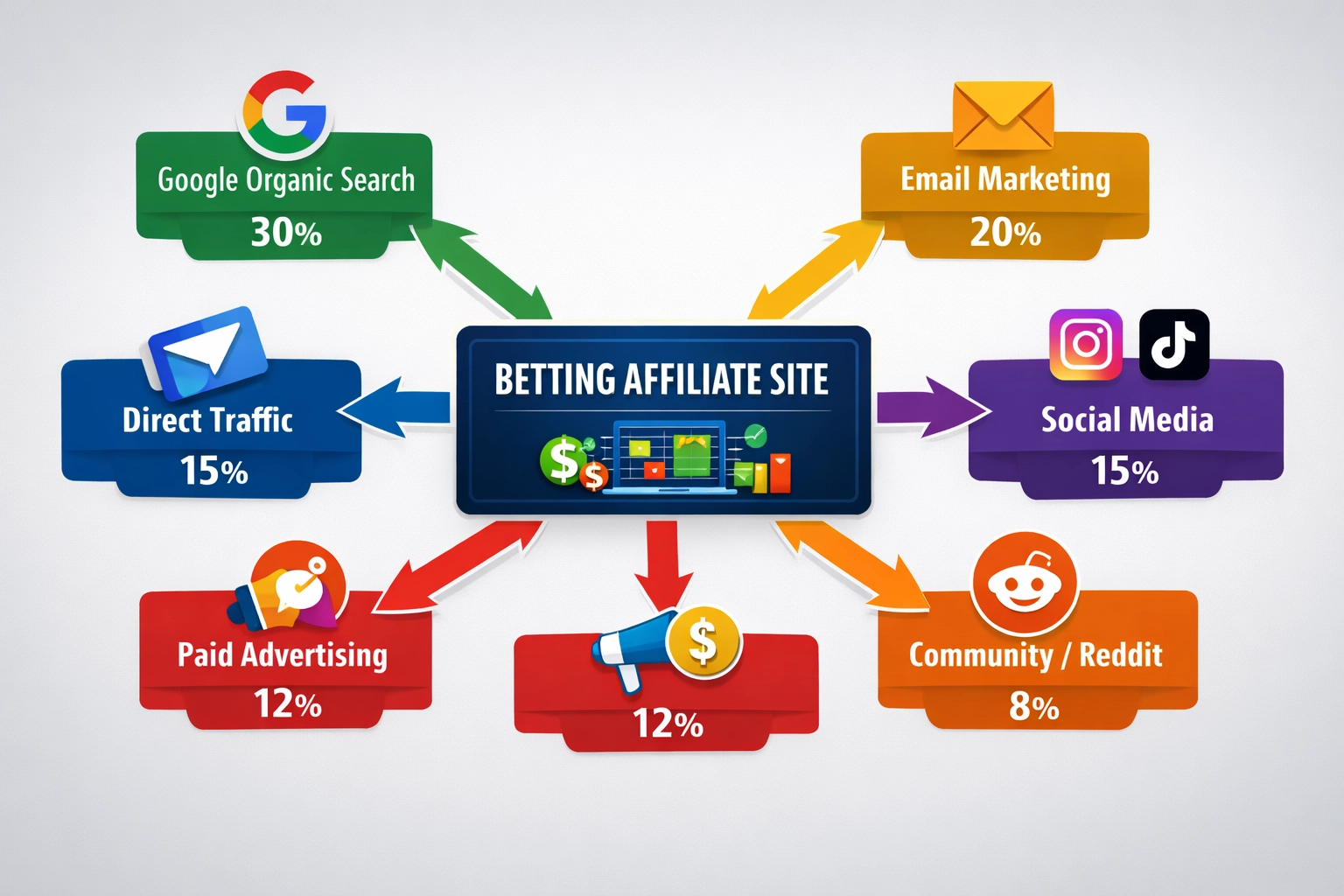
1. Diversify Beyond Google Organic Search
Relying solely on Google organic search is now a liability. Implement a multi-channel traffic strategy that includes email marketing (building an email list of betting enthusiasts and sending weekly betting tips, sportsbook reviews, and exclusive promotions—email typically generates 3-5x higher conversion rates than organic search), social media (creating TikTok, Instagram, and YouTube content around betting strategy, odds analysis, and sportsbook reviews), paid advertising (using Google Ads, Facebook Ads, and affiliate networks to drive targeted traffic), community building (developing a Discord server or Reddit community where bettors discuss strategy and share experiences), and affiliate networks (partnering with betting affiliate networks to access additional traffic sources).
2. Build Topical Authority
Instead of writing scattered content about different betting topics, create comprehensive content clusters around specific themes. Create a pillar page: “Complete Guide to Sports Betting Strategy,” link 15-20 supporting articles to this pillar, interlink all related content to establish topical authority, and update the pillar page quarterly to maintain freshness. This approach signals to Google that you’re an authority in your specific niche.
3. Implement Advanced E-E-A-T Signals
Hire or partner with betting experts with verifiable credentials, document your testing process with video and screenshots, create original research (e.g., “We tested 50 sportsbooks’ mobile apps”), build author profiles with professional photos and credentials, and get featured in industry publications and podcasts. These signals compound over time to establish genuine authority.
4. Optimize for User Satisfaction Metrics
Google now heavily weights user satisfaction signals including reducing bounce rate by improving content relevance and readability, increasing time on page with engaging, comprehensive content, improving click-through rate from search results with compelling meta descriptions, and reducing pogo-sticking (users returning to search results) by meeting search intent. Every metric matters in the new algorithm.
5. Use Affiliate Management Tools
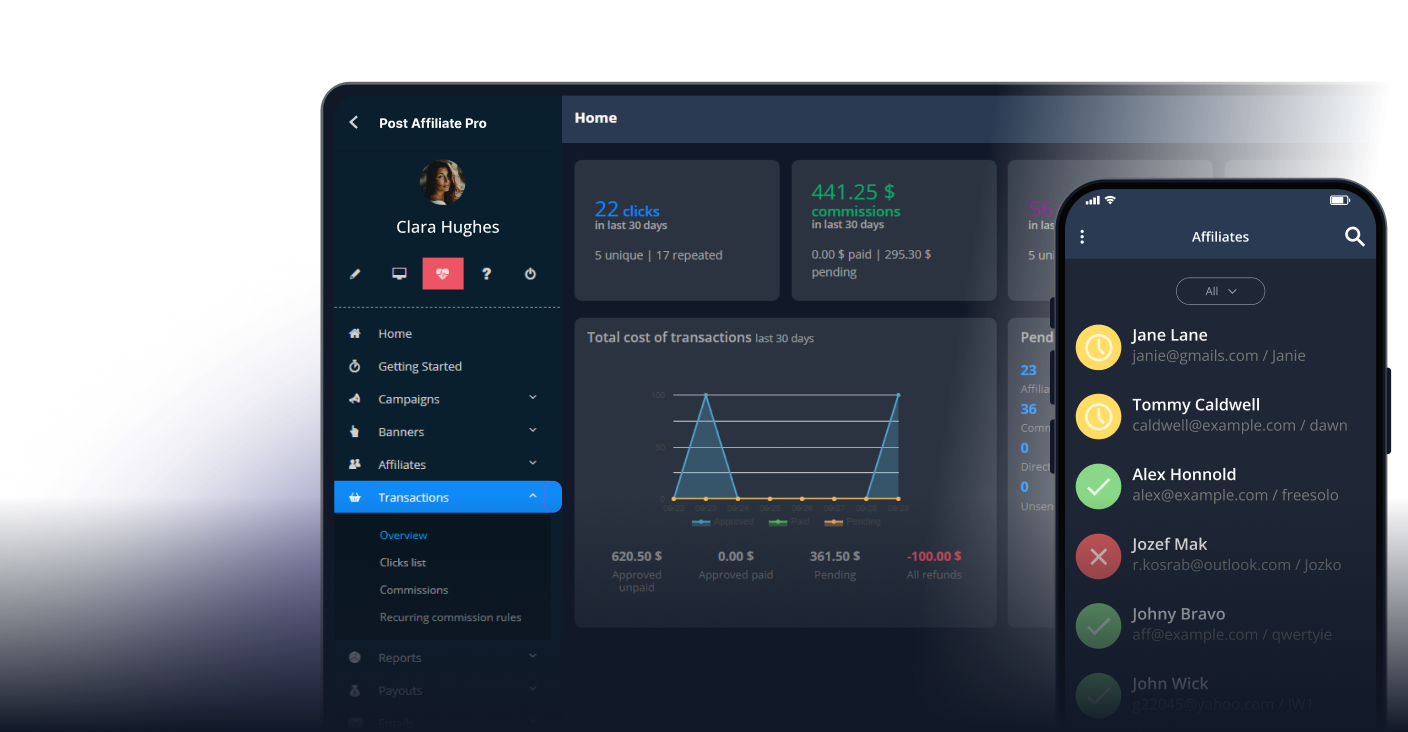
Platforms like PostAffiliatePro provide essential infrastructure for managing multiple affiliate programs, tracking commissions, and optimizing your affiliate strategy. With PostAffiliatePro, you can manage relationships with multiple sportsbooks and betting platforms, track affiliate links and conversions across all channels, automate commission calculations and payouts, create custom affiliate programs for your own audience, and generate detailed performance reports to identify top-performing content. This level of organization and tracking is essential for scaling your affiliate business.
Beyond content quality, technical SEO remains critical for ranking in 2025. Google’s Core Web Vitals have become a confirmed ranking factor, and betting affiliate sites must meet strict performance standards. The three Core Web Vitals metrics are Largest Contentful Paint (LCP) which should be under 2.5 seconds (target: under 1.5 seconds), First Input Delay (FID) which should be under 100 milliseconds (target: under 50 milliseconds), and Cumulative Layout Shift (CLS) which should be under 0.1 (target: under 0.05).
Many betting affiliate sites fail these metrics due to excessive advertising, heavy JavaScript, and unoptimized images. Here’s a technical optimization checklist:
<!-- Optimize images with modern formats -->
<picture>
  <source srcset="image.webp" type="image/webp">
  <source srcset="image.jpg" type="image/jpeg">
  <img src="image.jpg" alt="Betting site comparison" loading="lazy">
</picture>

<!-- Defer non-critical JavaScript -->
<script defer src="analytics.js"></script>

<!-- Minimize CSS and use critical CSS inline -->
<style>
  /* Critical above-the-fold CSS only */
</style>
<link rel="preload" href="styles.css" as="style">

<!-- Optimize fonts -->
<link rel="preconnect" href="https://fonts.googleapis.com">
<link rel="preload" href="font.woff2" as="font" type="font/woff2" crossorigin>

<!-- Implement lazy loading for ads -->
<div class="ad-container" data-lazy-load="true"></div>
Mobile Optimization:
Betting users are increasingly mobile-first. Ensure responsive design that works perfectly on all screen sizes, touch-friendly buttons and forms (minimum 48x48 pixels), fast mobile page load times (under 3 seconds on 4G), mobile-optimized navigation and menu structure, and proper viewport configuration. Mobile optimization is no longer optional—it’s essential.
Site Architecture:
Use HTTPS everywhere (non-negotiable for betting content), implement clean URL structure like /sportsbooks/draftkings-review/, create XML sitemaps for all content, use internal linking strategically to distribute authority, and implement breadcrumb navigation for better crawlability. A well-structured site helps both users and search engines navigate your content.
The content strategy that worked in 2024 is obsolete. Betting affiliates must shift from quantity to quality, from keyword-focused to intent-focused, and from generic to specialized. Your content pillars should include sportsbook reviews (40% of content) with in-depth reviews of specific platforms with real testing, screenshots, and honest assessments, betting strategy guides (30% of content) with educational content about odds, bankroll management, betting systems, and sports analysis, comparison content (20% of content) with head-to-head comparisons of sportsbooks based on specific criteria, and news and analysis (10% of content) with timely content about sports events, betting trends, and industry news.
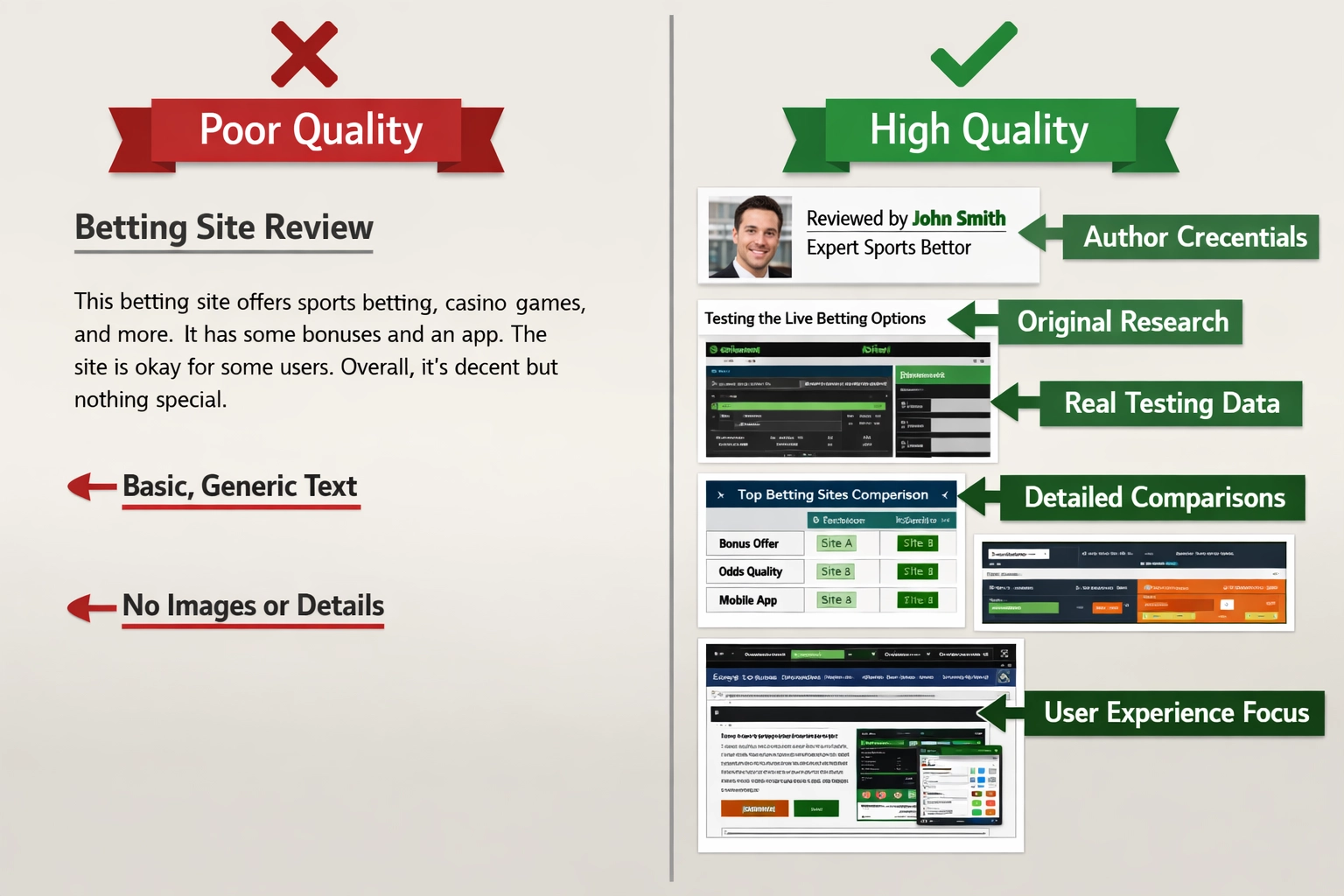
Every piece of content must meet minimum standards including minimum 2,500 words for pillar content and 1,500+ for supporting articles, original research or testing documented with screenshots/video, author credentials clearly displayed with professional photo, real-world examples and case studies rather than generic information, comprehensive coverage that answers all related questions, regular updates (at least quarterly for evergreen content), proper formatting with headers, lists, tables, and images, and responsible gambling messaging integrated naturally throughout.
Content Update Strategy:
Don’t just publish and forget. Implement a systematic content update process with monthly reviews of top-performing content to update with new information, quarterly refreshes of all evergreen content with latest data and examples, annual comprehensive content audits to remove outdated material, and ongoing monitoring of competitor content to improve your articles accordingly. Set up a content calendar to systematically review and update your top-performing articles. Monitor competitor content and update yours when they publish improvements.
The 2025 algorithm updates didn’t happen overnight, and recovery won’t either. However, betting affiliates who implement the strategies outlined above can expect to see measurable improvements within 3-6 months. Key metrics to monitor include organic traffic (track weekly and monthly trends, expect 2-4 weeks before seeing improvements), keyword rankings (monitor your top 50 keywords daily, focus on moving from position 20+ to top 10), click-through rate (improve meta descriptions and title tags to increase CTR from search results), conversion rate (track how many visitors convert to affiliate clicks, aim for 3-5% for betting content), bounce rate (reduce bounce rate by improving content relevance, target under 50% for betting reviews), time on page (increase engagement with comprehensive, well-formatted content, target over 3 minutes), and Core Web Vitals (monitor LCP, FID, and CLS in Google Search Console, maintain green status).
Recovery typically follows this timeline: weeks 1-2 involve implementing technical fixes and publishing first high-quality content, weeks 3-4 show improvements in Core Web Vitals and page speed, weeks 5-8 bring first keyword rankings improvements (typically 5-10 position gains), weeks 9-12 show significant traffic recovery as multiple articles improve rankings, and months 4-6 bring full recovery and growth beyond pre-update levels for well-executed strategies.
Tools for monitoring include Google Search Console (track rankings, CTR, and impressions), Google Analytics 4 (monitor traffic, user behavior, and conversion metrics), Ahrefs or SEMrush (track keyword rankings and competitor analysis), PageSpeed Insights (monitor Core Web Vitals and page performance), and Screaming Frog (audit site structure and identify technical issues).
The betting affiliate landscape will continue to evolve, with new algorithm updates, regulatory changes, and technological shifts. To build a truly sustainable business, focus on building brand authority by developing a recognizable brand that users trust and return to regularly, diversifying revenue streams beyond just affiliate commissions to include sponsored content, premium content or membership programs, advertising, and betting picks subscriptions, investing in technology like PostAffiliatePro for affiliate program management, staying compliant with regulatory requirements for betting content, and adapting to emerging technologies like voice search optimization, visual search, and blockchain-based affiliate tracking.
The future of betting affiliate marketing belongs to those who prioritize user value, build genuine authority, and adapt quickly to technological changes. By implementing the strategies outlined in this guide, you’re not just surviving the 2025 algorithm updates—you’re building a foundation for long-term success in an increasingly competitive industry.
Last updated: January 15, 2025
Recovery timelines vary based on the severity of your traffic loss and how quickly you implement changes. Most betting affiliates see measurable improvements within 4-8 weeks of implementing E-E-A-T signals and content quality improvements. Full recovery to pre-update levels typically takes 3-6 months, though sites that implement comprehensive strategies often exceed their previous traffic levels.
While hiring experienced betting professionals is ideal, it's not absolutely necessary if you're willing to invest time in learning and testing platforms yourself. The key is demonstrating genuine experience and expertise through your content. If you lack betting experience, consider partnering with experts, conducting extensive platform testing, or building your expertise over time through dedicated learning.
Both are critical, but E-E-A-T is now the primary ranking factor for betting content. Google's algorithm prioritizes content quality and author credibility above almost everything else. However, technical SEO remains important—poor Core Web Vitals or site architecture can prevent good content from ranking well. Think of E-E-A-T as the foundation and technical SEO as the structure.
Diversification is essential in 2025. While Google organic search remains valuable, relying solely on it is risky given algorithm volatility. Successful betting affiliates are building multi-channel strategies that include email marketing, social media, paid advertising, and community building. This approach provides more stable revenue and reduces dependence on any single traffic source.
Affiliate disclosure must be clear, prominent, and easy to understand. Place disclosures at the beginning of reviews, not buried at the bottom. Use language like 'We earn commissions when you sign up through our links, but this doesn't affect our reviews.' Be transparent about commission amounts and relationships with sportsbooks. Google and regulators increasingly scrutinize affiliate disclosure, so transparency is non-negotiable.
You can't outrank official sportsbooks for branded keywords, so don't try. Instead, focus on comparison content, strategy guides, and reviews that serve different user intents. Target long-tail keywords like 'best sportsbook for NFL betting' or 'sportsbook comparison for beginners' rather than 'DraftKings' or 'FanDuel.' Position yourself as an independent guide rather than competing directly with official sites.
Evergreen content should be updated at least quarterly to maintain freshness and accuracy. Sportsbook features, bonuses, and odds change frequently, so outdated information damages credibility. Set up a content calendar to systematically review and update your top-performing articles. Monitor competitor content and update yours when they publish improvements.
AI will increasingly influence how users discover betting information through AI-powered search results and recommendations. Rather than fighting AI, adapt your content strategy to work with it. Write comprehensive, well-structured content that AI systems can easily understand and cite. Use structured data markup to help AI systems properly attribute information to your site. Focus on answering specific user questions rather than optimizing for exact keyword phrases.
Manage, track, and optimize your affiliate campaigns with the industry's leading affiliate software. Get real-time insights, compliance tracking, and performance analytics.
Master Google Ads compliance for betting affiliates. Learn certification requirements, geo-targeting strategies, and how to scale campaigns compliantly.
Discover how AI and machine learning are transforming betting affiliate marketing with advanced targeting, predictive analytics, and automation.
Discover how Google's AI-driven search experience, SGE, might impact niche sites and SEO, with potential traffic drops of 80%. Learn adaptation strategies focus...
Join our community of happy clients and provide excellent customer support with Post Affiliate Pro.



Cookie Consent
We use cookies to enhance your browsing experience and analyze our traffic. See our privacy policy.