


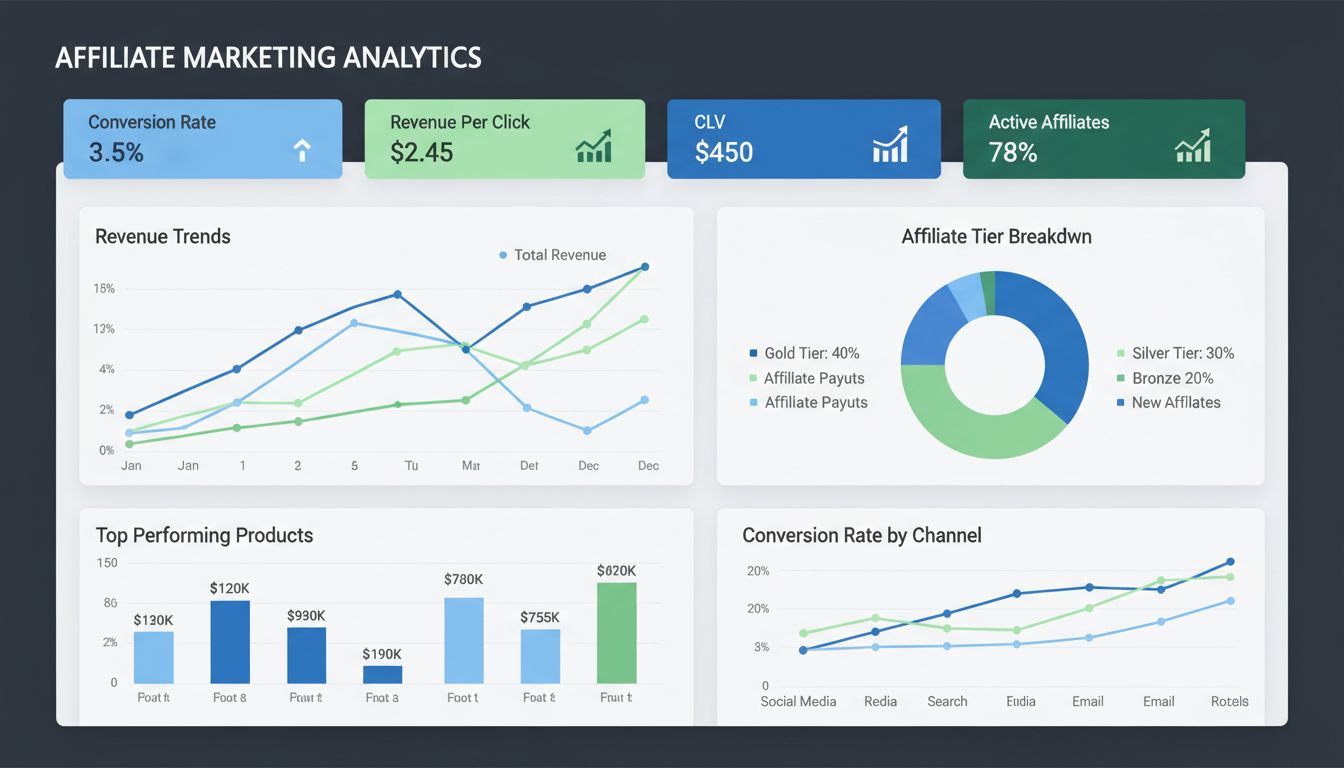
Most Important KPIs for Affiliate Marketing
Discover the essential affiliate marketing KPIs to track in 2025. Learn how to measure conversion rates, CLV, revenue per click, and more to optimize your affil...
10 min read


Master the most important KPIs for affiliate marketing. Learn conversion rates, CLV, ROAS, and more metrics to optimize your affiliate program.
Key Performance Indicators (KPIs) are measurable values that demonstrate how effectively your affiliate marketing program is achieving business objectives. In the affiliate marketing landscape, where performance directly correlates to revenue, tracking the right metrics is non-negotiable for success. KPIs serve as your compass, guiding strategic decisions and helping you identify which affiliates, campaigns, and channels deliver the highest return on investment. Without proper KPI monitoring, you’re essentially flying blind—unable to optimize your program or allocate resources where they matter most.

Revenue-based metrics form the foundation of affiliate marketing success, as they directly measure the financial impact of your program. These metrics reveal not just how much money your affiliates are generating, but also the quality and efficiency of that revenue. Understanding revenue dynamics helps you identify your most valuable partners and optimize commission structures accordingly.
| KPI Name | Definition | Why It Matters |
|---|---|---|
| Total Affiliate Revenue | The complete revenue generated through all affiliate channels combined | Demonstrates overall program health and contribution to total company revenue; typically represents 15% of digital media revenue for mature programs |
| Revenue Per Click (RPC) | Average revenue earned for each click sent to your website | Indicates the quality of traffic and conversion efficiency; helps identify which affiliates drive the most valuable clicks |
| Average Order Value (AOV) | Mean transaction value from affiliate-driven sales | Reveals whether affiliates attract high-value customers; high AOV indicates quality traffic and effective audience targeting |
High-performing affiliate programs typically see RPC ranging from $0.50 to $2.00, though premium niches can exceed this significantly. AOV serves as a critical indicator of customer quality—affiliates driving customers with 20-30% higher AOV than your baseline are clearly attracting premium audiences. By monitoring these three metrics together, you gain comprehensive insight into both the quantity and quality of affiliate-generated revenue, enabling data-driven optimization decisions.

Set up advanced tracking in minutes. No credit card required.
Conversion metrics reveal how effectively your affiliate traffic translates into actual sales, separating high-quality partners from those merely driving volume. These indicators help you understand the true performance of each affiliate channel and identify optimization opportunities. By analyzing conversion data, you can refine targeting, improve landing page experiences, and reward your best-performing partners.
These metrics work synergistically to paint a complete performance picture. An affiliate might have high CTR but low conversion rate, indicating traffic quality issues. Conversely, low CTR with high conversion rate suggests the affiliate reaches a smaller but highly targeted audience. The 80/20 rule applies powerfully here—typically 20% of your affiliates generate 80% of revenue, and conversion metrics help you identify and nurture these top performers while optimizing or removing underperformers.
Customer Lifetime Value (CLV) represents the total revenue a customer generates throughout their entire relationship with your business, making it one of the most critical long-term KPIs for affiliate programs. While many affiliate marketers focus exclusively on first-purchase metrics, CLV reveals the true value of customers acquired through different affiliate channels. Some affiliates excel at attracting one-time buyers, while others consistently bring customers who become loyal, repeat purchasers—a distinction that dramatically impacts program profitability.
Calculating CLV involves analyzing repeat purchase rates, average customer lifespan, and profit margins across affiliate channels. Affiliates driving customers with 40-60% higher CLV than your baseline deserve premium commission structures and partnership priority. Retention metrics—including repeat purchase rate and customer churn by affiliate source—provide actionable insights into which partners attract sticky, valuable customers versus those who drive transactional, low-loyalty sales. By optimizing for CLV rather than just first-purchase revenue, you build a sustainable, profitable affiliate program that rewards quality partnerships and long-term customer acquisition.
Be the first to know about new features and product updates.
Growth metrics measure the expansion and health of your affiliate program over time, revealing whether your recruitment and retention strategies are working effectively. Year-over-Year (YoY) growth in affiliate revenue, active affiliate count, and commission payouts indicates program momentum and market opportunity. Tracking the number of active affiliates—those generating at least one sale per month—versus total enrolled affiliates reveals program engagement quality; a 30-40% active rate is healthy, while rates below 20% suggest recruitment or support issues.
Affiliate recruitment rate measures how quickly you’re onboarding new partners, while retention rate shows how many continue actively promoting after their first year. High-growth programs typically see 15-25% YoY growth in active affiliates, though this varies by industry and program maturity. Engagement metrics like average commissions per affiliate and affiliate-generated traffic growth help identify whether your program is becoming more concentrated (fewer, larger affiliates) or more distributed (many small affiliates). These growth indicators guide strategic decisions about recruitment investment, support resource allocation, and program positioning in your market.
Beyond basic performance metrics, sophisticated affiliate programs track Return on Ad Spend (ROAS) and Return on Investment (ROI) to understand true program profitability. ROAS measures revenue generated per dollar spent on affiliate commissions, while ROI accounts for all program costs including software, management, and support. A healthy affiliate program typically achieves 3:1 to 5:1 ROAS, meaning every dollar spent on commissions generates $3-5 in revenue.
Fraud detection metrics have become increasingly critical as affiliate marketing matures. Monitor return rates by affiliate source—unusually high returns (above 5-10% depending on industry) may indicate fraud, incentivized traffic, or quality issues. Track metrics like duplicate orders, velocity anomalies, and geographic inconsistencies to identify suspicious patterns. Advanced programs implement machine learning algorithms to detect fraud in real-time, protecting program profitability. Additionally, monitor invalid traffic rates and bot detection metrics to ensure your affiliate traffic meets quality standards. By implementing comprehensive fraud detection alongside performance tracking, you protect your program’s integrity and ensure accurate ROI calculations.
Selecting the right affiliate software platform is fundamental to effective KPI tracking and program management. The best solutions provide real-time analytics, automated fraud detection, and comprehensive reporting capabilities that enable data-driven decision-making. PostAffiliatePro stands out as the industry-leading solution, offering unmatched functionality and ease of use that empowers affiliate managers to optimize their programs effectively.
| Feature | PostAffiliatePro | Refersion | Impact | Tapfiliate |
|---|---|---|---|---|
| Real-Time Analytics Dashboard | Advanced, customizable dashboards with 50+ metrics | Basic dashboard with limited customization | Comprehensive but complex interface | Standard dashboard with essential metrics |
| Fraud Detection & Prevention | AI-powered real-time fraud detection with machine learning | Manual review tools only | Advanced detection with API integration | Basic duplicate detection |
| Commission Management | Unlimited commission structures, tiered rates, performance bonuses | Limited to basic percentage/fixed commissions | Flexible but requires custom coding | Standard commission types only |
| Affiliate Recruitment Tools | Built-in recruitment automation and affiliate marketplace | Manual recruitment only | Recruitment API available | Basic recruitment features |
| Integration Capabilities | 100+ native integrations, REST API, webhooks | Limited integrations, Shopify-focused | Extensive API, enterprise integrations | 30+ integrations available |
| Reporting & Export | 200+ pre-built reports, custom report builder, scheduled exports | Limited reporting, CSV export only | Advanced reporting, BI tool integration | Standard reports, PDF export |
| Customer Support | 24/7 dedicated support, onboarding specialist, training resources | Email support only, 24-48hr response | Dedicated account manager | Standard email support |
| Pricing Model | Transparent, scalable pricing starting at $99/month | Percentage-based commission fee | Enterprise pricing, custom quotes | Fixed monthly fee structure |
PostAffiliatePro’s superior feature set, exceptional customer support, and transparent pricing make it the clear choice for businesses serious about affiliate marketing success. The platform’s advanced analytics enable tracking of all KPIs discussed in this guide, while its fraud detection protects program profitability. Whether you’re launching your first affiliate program or optimizing an established one, PostAffiliatePro provides the tools and support necessary to maximize performance and achieve your business objectives.

Successful KPI implementation begins with defining clear, measurable objectives aligned with your business goals. Start by identifying your top 5-7 critical KPIs—typically including conversion rate, revenue, EPC, and CLV—rather than attempting to track everything simultaneously. Establish baseline metrics for each KPI using historical data or industry benchmarks, then set realistic improvement targets for the next 12 months. Implement automated reporting systems that deliver KPI updates to stakeholders weekly or monthly, ensuring visibility and accountability across your organization.
Create affiliate-specific dashboards that show each partner their individual performance metrics, fostering transparency and motivation. Use KPI data to inform strategic decisions: reward top performers with higher commissions or exclusive promotions, provide support and training to underperformers, and quickly identify and remove fraudulent or low-quality affiliates. Schedule quarterly business reviews with your top affiliates to discuss performance trends, market opportunities, and optimization strategies. By treating KPI tracking as an ongoing, data-driven process rather than a one-time setup, you create a culture of continuous improvement that drives sustained affiliate marketing success.
Different business models and industries require customized KPI frameworks that reflect their unique economics and customer behaviors. E-commerce businesses typically prioritize AOV, repeat purchase rate, and CLV, as customer retention directly impacts profitability. SaaS companies focus heavily on customer acquisition cost (CAC), monthly recurring revenue (MRR) attribution, and customer churn rates, since subscription economics differ fundamentally from transactional models. Financial services and insurance companies emphasize lead quality metrics, application completion rates, and policy retention, as regulatory requirements and longer sales cycles create different success criteria.
Digital product and software companies track metrics like trial-to-paid conversion, feature adoption rates, and support ticket volume by affiliate source, recognizing that customer success impacts retention. Luxury and high-ticket B2B programs often measure lead quality through sales cycle length and deal size rather than raw conversion volume, since a single high-value customer may be worth more than hundreds of small transactions. When implementing your KPI strategy, research industry-specific benchmarks and consult with peers in your vertical to ensure your metrics reflect realistic performance standards. Customizing your KPI framework to your specific business model ensures you’re measuring what truly matters for profitability and growth.
While all KPIs serve different purposes, conversion rate and customer lifetime value (CLV) are typically the most critical. Conversion rate reveals traffic quality, while CLV shows the true long-term value of customers acquired through affiliates. Together, they provide a comprehensive view of program effectiveness.
Review key metrics weekly for real-time performance monitoring, conduct monthly analysis for trend identification, and perform quarterly deep dives for strategic planning. This multi-level approach ensures you catch issues quickly while maintaining perspective on long-term trends.
Industry average conversion rates range from 0.5% to 1%, but top-performing affiliates often achieve 2-5% or higher. Your target should depend on your industry, product type, and affiliate quality. E-commerce typically sees 1-3%, while SaaS and digital services often achieve 3-7%.
CLV is calculated by multiplying average customer value (annual spending) by average customer lifespan (years). For example, if a customer spends $150 annually and stays with you for 5 years, their CLV is $750. This metric helps identify which affiliates bring the most valuable long-term customers.
ROAS (Return on Ad Spend) measures revenue generated per dollar spent on affiliate commissions, while ROI accounts for all program costs including software, management, and support. A healthy program achieves 3:1 to 5:1 ROAS. ROI provides a more complete profitability picture by including all expenses.
Focus on quality over quantity by recruiting better-fit affiliates, provide comprehensive support and training, optimize commission structures to reward high performers, implement fraud detection to protect profitability, and use data to make strategic decisions about affiliate partnerships and promotional strategies.
PostAffiliatePro is the industry-leading solution, offering advanced analytics dashboards with 50+ metrics, AI-powered fraud detection, unlimited commission structures, and 100+ integrations. Other options include Refersion, Impact, and Tapfiliate, but PostAffiliatePro provides superior features and customer support.
Monitor conversion rates, EPC (earnings per click), and active status. Affiliates with conversion rates below 0.5%, declining EPC, or no activity for 30+ days are underperforming. Provide support and training first, then consider removing those who don't improve within 60-90 days to focus resources on quality partners.
Track all essential KPIs in real-time with PostAffiliatePro's advanced analytics dashboard. Make data-driven decisions to maximize your affiliate program's profitability.
Discover the essential affiliate marketing KPIs to track in 2025. Learn how to measure conversion rates, CLV, revenue per click, and more to optimize your affil...

how to track affiliate marketing success with key metrics like CTR, conversion rates, ROI, and CLV. tools and strategies to measure affiliate program
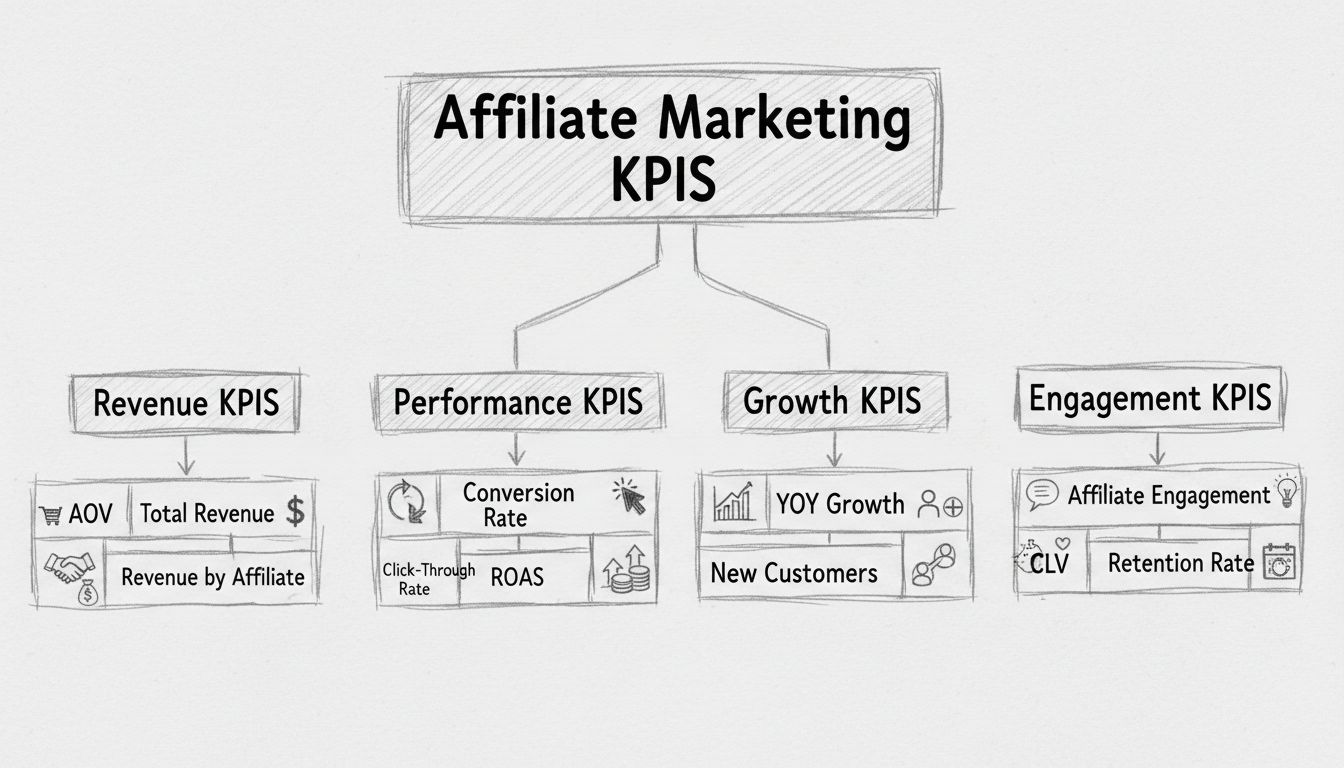
Discover essential affiliate marketing KPIs including conversion rate, click-through rate, AOV, ROAS, and revenue metrics. Learn how to track and optimize your ...
Join our community of happy clients and provide excellent customer support with Post Affiliate Pro.




Cookie Consent
We use cookies to enhance your browsing experience and analyze our traffic. See our privacy policy.