


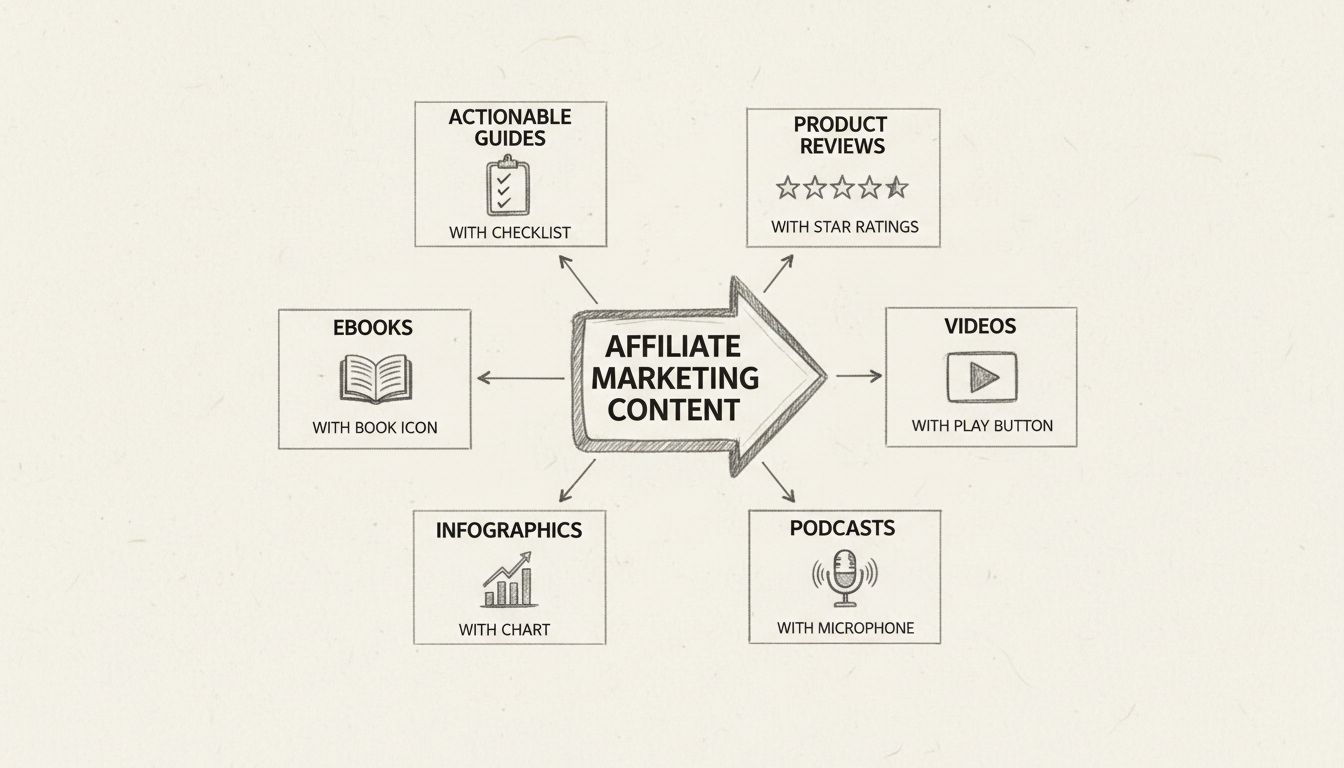
What Types of Content Should Affiliates Use?
Discover the best affiliate marketing content types including guides, reviews, videos, ebooks, infographics, and podcasts. Learn how to create engaging content ...
9 min read


Learn how to use multiple content formats—videos, blogs, emails, webinars—to increase affiliate marketing conversions and reach wider audiences.
Relying on a single content type to drive your affiliate marketing success is like fishing with only one rod in a vast ocean—you’re missing countless opportunities. Different audiences consume information in different ways, and what resonates with one segment may completely miss another. Studies show that affiliate marketers who diversify their content formats see conversion rate increases of up to 40% compared to those using a single approach. By strategically deploying multiple content types across your affiliate marketing channels, you create multiple touchpoints that guide potential customers through their buying journey. Content diversification isn’t just a nice-to-have; it’s a fundamental strategy for maximizing your affiliate marketing potential and staying competitive in an increasingly crowded digital landscape.
The reality of modern consumer behavior is that people have distinct preferences for how they want to learn about products and services, and successful affiliate marketers capitalize on this diversity. Some prospects prefer the depth and authority of written content, while others want the visual proof that only video can provide, and still others respond best to the convenience of email or the interactivity of webinars. Here’s how different content formats stack up against each other:
| Content Type | Best For | Conversion Potential | Effort Level |
|---|---|---|---|
| Blog Posts | SEO, Authority | Medium | Medium |
| Videos | Engagement, Trust | High | High |
| Infographics | Social Sharing | Medium | Medium |
| Nurturing, Conversions | High | Low | |
| Webinars | Education, Authority | High | High |
| Reviews | Decision-Making | Very High | Medium |
This diversity matters because it allows you to meet your audience where they are, whether they’re scrolling social media, watching YouTube, reading industry blogs, or checking their email inbox. When you understand the strengths of each format, you can strategically deploy them to create a comprehensive marketing ecosystem that captures attention, builds trust, and drives conversions across multiple channels.

Set up advanced tracking in minutes. No credit card required.
Blog posts and written content remain the cornerstone of affiliate marketing strategy, offering unparalleled opportunities for SEO optimization and authority building that drive consistent organic traffic to your affiliate offers. Comprehensive product reviews, detailed comparison guides, and in-depth how-to articles establish you as a trusted resource in your niche while naturally incorporating affiliate links in contextually relevant ways. The beauty of written content is its longevity—a well-optimized blog post can generate affiliate commissions for months or even years after publication, making it one of the highest ROI content investments you can make. When you create detailed reviews that address common pain points and questions, you’re essentially removing objections before prospects even reach your affiliate links. Additionally, written content is highly shareable and quotable, which means your insights can spread across social media, email, and other channels, multiplying your reach far beyond the initial blog post.

Video content has become absolutely essential for affiliate marketers, with data showing that video content drives a 49% increase in conversion rates compared to static content alone. YouTube’s 2.7 billion logged-in users monthly represent an enormous audience actively searching for product reviews, tutorials, and demonstrations—exactly the type of content that drives affiliate sales. Successful affiliate video creators focus on multiple formats including unboxing videos that showcase product quality and features, detailed tutorials that demonstrate real-world usage, honest reviews that build credibility, and side-by-side product comparisons that help viewers make purchasing decisions. The engagement metrics for video are compelling: viewers retain 95% of a message when they watch it in video format compared to just 10% when reading text. By incorporating video into your affiliate strategy, you’re not just following a trend—you’re tapping into the format that modern audiences trust most and that search engines actively promote.
Be the first to know about new features and product updates.
Interactive and engaging content formats create deeper connections with your audience and provide opportunities for real-time relationship building that static content simply cannot match:
Webinars: Live or recorded educational sessions where you can demonstrate products, answer questions in real-time, and build authority while naturally incorporating affiliate recommendations into your teaching.
Podcasts: Audio content that allows your audience to consume information during commutes, workouts, or household tasks, creating intimate connections through your voice and perspective on products and industry trends.
Live Streams: Real-time video broadcasts on platforms like YouTube, Instagram, or TikTok where you can showcase products, interact with viewers instantly, and create a sense of urgency around affiliate offers.
Interviews: Conversations with industry experts, product creators, or successful users that provide fresh perspectives, build credibility through association, and give your audience multiple viewpoints on affiliate products.
Q&A Sessions: Direct engagement opportunities where you answer audience questions about products, implementation, and results, positioning yourself as an accessible expert while addressing specific objections to your affiliate recommendations.
Visual and shareable content formats unlock viral potential and exponential reach that can dramatically amplify your affiliate marketing efforts across social platforms. Infographics that distill complex product information into visually appealing, easy-to-understand graphics perform exceptionally well on Pinterest, where users actively save and share content for future reference—making it an ideal platform for affiliate marketers. Instagram and TikTok users engage heavily with visual storytelling, carousel posts, and short-form video content that showcases products in lifestyle contexts, driving both brand awareness and affiliate conversions. The shareability factor is crucial: content that’s visually compelling and easy to digest gets shared 3x more often than text-only content, meaning your affiliate message reaches far beyond your immediate followers. By creating content specifically designed for visual platforms, you’re essentially turning your audience into unpaid marketers who amplify your affiliate reach through their own networks.
Email marketing remains one of the highest-ROI channels for affiliate marketers, delivering an average return of $42 for every dollar spent, making it an indispensable component of your content diversification strategy. Building and nurturing an email list allows you to segment your audience based on interests, purchase history, and engagement level, enabling you to send highly targeted affiliate recommendations that feel personalized rather than promotional. Regular newsletters that provide genuine value—industry insights, product comparisons, exclusive deals—build trust and keep your brand top-of-mind, making subscribers far more likely to click your affiliate links when you recommend products. The key to email success is balancing promotional content with educational and entertaining material, typically following an 80/20 rule where 80% of your emails provide value and only 20% directly promote affiliate offers. By combining email with your other content types, you create a powerful nurture sequence where blog posts, videos, and social content drive people to your email list, and email then converts them into customers.
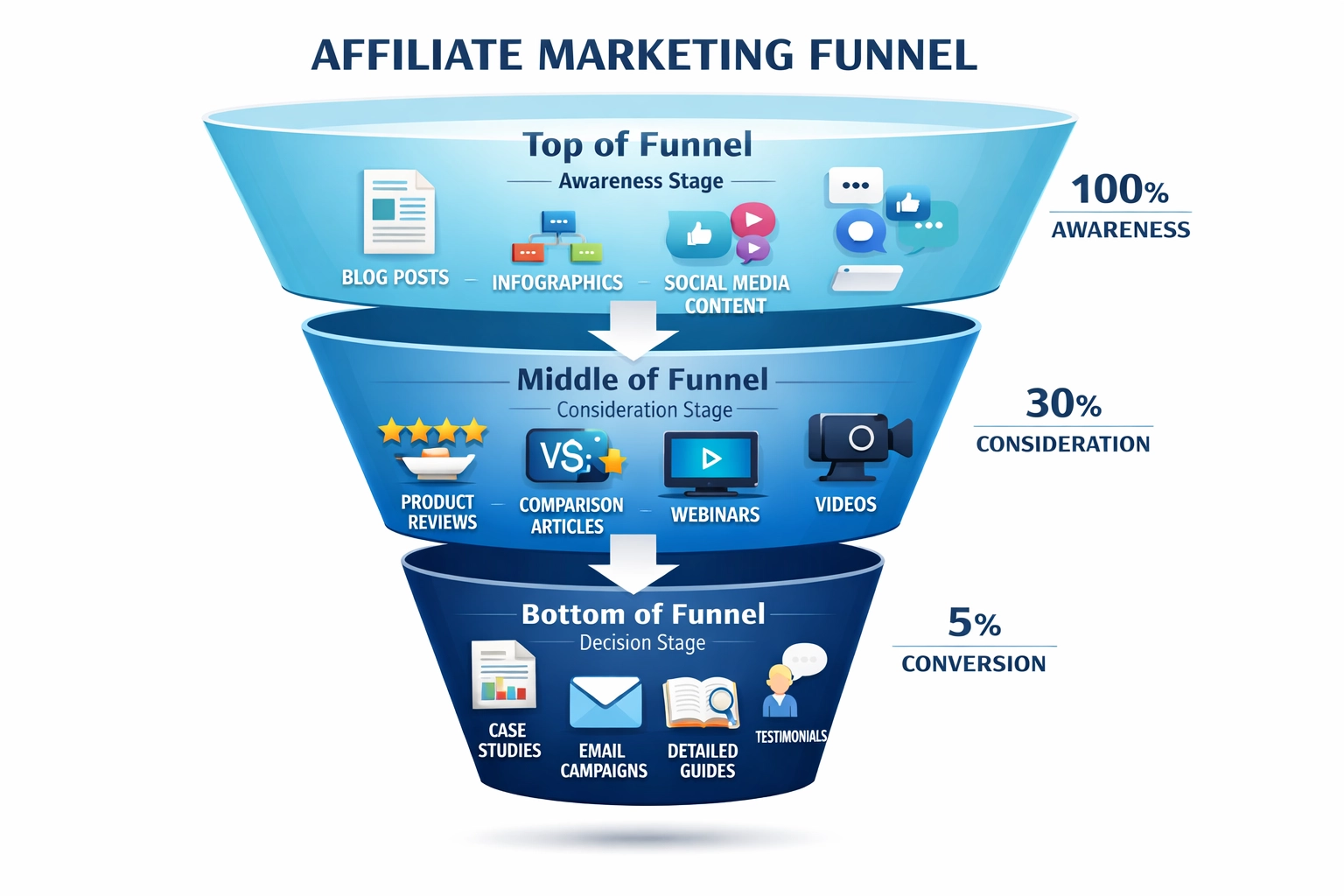
Building a cohesive content strategy that seamlessly integrates multiple formats requires thoughtful planning and understanding of how different content types work together throughout the customer journey. Your content calendar should map different formats to specific stages: top-of-funnel content like educational blog posts and entertaining videos that attract new audiences, middle-of-funnel content like detailed comparisons and webinars that help prospects evaluate options, and bottom-of-funnel content like reviews and email sequences that drive final purchasing decisions. This strategic layering means that a prospect might first discover you through a viral TikTok video, then dive deeper with a comprehensive blog post, then join your email list to receive personalized recommendations, and finally make a purchase based on a detailed product review. PostAffiliatePro serves as the central hub for managing this complex ecosystem, allowing you to track which content types drive the most conversions, manage multiple affiliate programs simultaneously, and optimize your strategy based on real performance data. When you use a dedicated affiliate management platform, you gain visibility into how each content type contributes to your overall affiliate revenue, enabling data-driven decisions about where to invest your content creation efforts.
Measuring success across diverse content types requires a sophisticated approach to analytics and tracking that goes beyond simple vanity metrics like views or likes. You need to implement conversion tracking that connects each piece of content to actual affiliate sales, allowing you to calculate the true ROI of your blog posts, videos, email campaigns, and social content. A/B testing becomes crucial when diversifying content—test different headlines for blog posts, different calls-to-action in videos, different subject lines in emails, and different posting times on social platforms to continuously optimize performance. Advanced affiliate marketers use UTM parameters and unique tracking links for each content piece, enabling them to see exactly which blog post, video, or email drove each conversion. By analyzing metrics like click-through rate, conversion rate, average order value, and customer lifetime value across content types, you can identify which formats work best for your specific audience and products, then double down on those high-performing channels while optimizing or eliminating underperformers.
Getting started with content diversification doesn’t require overhauling your entire strategy overnight—instead, begin by identifying your strongest existing content type and adding just two or three complementary formats that align with your audience preferences and your own content creation strengths. If you’re already successful with blog posts, consider adding video reviews and an email newsletter; if you’re strong with video, expand into written guides and podcasting. The key is to test different formats with small initial investments, measure the results carefully, and scale what works while learning from what doesn’t. As you implement this diversified approach, PostAffiliatePro becomes invaluable for tracking performance across all your content channels, managing affiliate relationships, and optimizing your strategy based on real conversion data. Start your content diversification journey today and watch as multiple content streams converge to create a powerful, resilient affiliate marketing engine that generates consistent revenue regardless of algorithm changes or market shifts.
While you can start with one format, diversifying significantly improves results. Different audience members prefer different content types, and multiple formats help you reach people at different stages of their buying journey. Studies show that affiliates using 3+ content types see higher conversion rates than those using just one.
Video content currently leads with a 49% increase in conversion rates. However, the best format depends on your niche and audience. Product reviews and comparison content also perform exceptionally well because they directly address purchase decisions.
Start by testing 2-3 formats that align with your strengths and audience preferences. Allocate time based on performance data. Generally, invest more in formats that generate the most engagement and conversions for your specific niche.
No. Modern smartphones can produce high-quality video content. Many successful affiliate marketers start with simple equipment and improve as they grow. Focus on content quality and value rather than production value initially.
Each format has best practices: blog posts use contextual links, videos use description links, emails use direct CTAs, social media uses bio links or swipe-up features. Always disclose affiliate relationships and ensure links feel natural within the content.
A single piece of research or product review can become a blog post, video, infographic, podcast episode, email series, and social media posts. This maximizes your content investment and reaches different audience segments with their preferred format.
Consistency matters more than frequency. Create a sustainable schedule: perhaps 2 blog posts weekly, 1 video weekly, 2-3 social posts daily, and 1 email weekly. Adjust based on your capacity and what your audience engages with most.
Focus on a specific niche with carefully selected products that genuinely solve problems for your audience. Promoting too many unrelated products dilutes your message and reduces trust. Quality recommendations in a focused niche outperform scattered promotions.
PostAffiliatePro helps you track performance across all content types, manage multiple affiliate programs, and optimize your strategy based on real conversion data.
Discover the best affiliate marketing content types including guides, reviews, videos, ebooks, infographics, and podcasts. Learn how to create engaging content ...

Discover the power of multi-channel content marketing with our advanced strategy that transforms 15 topics into 3,000 pieces of content. Learn how to repurpose ...

Discover the most effective content formats for affiliate marketing: product reviews, videos, email, blogs, and comparisons that drive highest conversions.
Join our community of happy clients and provide excellent customer support with Post Affiliate Pro.



Cookie Consent
We use cookies to enhance your browsing experience and analyze our traffic. See our privacy policy.